
Functional Knit Fabric Buyer Comparison: Finishes, Prints, Fit
In functional knit fabric, finishing and print breadth frequently decides whether a fabric can enter a program at all. A base knit can be technically sound and still be unusable if the required surface effect, print method or chemical function is unavailable on that specific article — or cannot be repeated from lot to lot.
Most supplier comparisons begin with yarn, weight and stretch. Those variables matter, but they are the part of the specification a buyer can usually resolve from a data sheet. The harder comparison — the one that determines whether a program survives the journey from sample to repeat order — is what a mill can do to the fabric after knitting: peaching, brushing, fuzzing, transfer printing, dispersed printing, acid printing, digital printing, foil, emboss, and chemical functions such as antibacterial and odor control, moisture wicking and quick drying, UV protection, anti-static, waterproof, stain and oil prevention, thermal storage and warmth preservation, and cooling treatment.
This comparison is written from the buyer's side of the table. It sets out how to read a finishing menu, where the EKING fabric models EKWP2270-D6, EKWP1912-DSP and 20ETW1028-DSP differ in their optional treatments, and what has to be confirmed before a finish is written into a purchase order.
Why finishing breadth separates suppliers more than yarn specs
The finish is the product
The performance claim a brand sells usually belongs to the finish, not to the knit. Moisture wicking, quick drying, UV protection, anti-static behavior, waterproofing, stain and oil prevention, warmth retention and cooling are all delivered by chemical function or mechanical treatment applied on top of a base fabric. The same logic applies to touch and to design: peaching, brushing and fuzzing change handfeel and surface character, while transfer, dispersed, acid and digital printing, foil and emboss change what the fabric can look like.
The buyer consequence is direct. When a program depends on a named finish, the supplier comparison should be a comparison of finishing routes and their repeatability, not only of knit construction.
A long menu is a capability statement, not a per-article guarantee
Finishing menus are normally published at company level, because that is the level at which a mill organizes its equipment. A finish that appears on the list is available in the mill; it is not automatically available on every article, weight or fiber blend. Surface effects and prints add process steps that interact with the substrate, and chemical functions have to be compatible with the route the fabric already travels through dyeing and finishing. That gap between company-level capability and article-level availability is the most common source of mismatch between a buyer's shortlist and a mill's actual deliverable.
The finishing and print menu, read line by line
| Route family | Processes in this group | What it changes in the fabric | What the buyer must confirm |
|---|---|---|---|
| Mechanical surface finishes | Peaching, brushing, fuzzing | Handfeel, surface texture, perceived warmth, matte appearance | Whether the effect is applied on the specified article; consistency of handfeel and shade across lots; behavior after repeated washing |
| Print methods | Transfer printing, dispersed printing, acid printing, digital printing | Design capability, color depth, placement, practicality of run length | Print route matched to the fiber chemistry and to the article; registration and colorfastness; repeatability between sampling and bulk |
| Surface effects | Foil, emboss | Decorative and structural differentiation | Durability of the effect through washing and abrasion; interaction with stretch |
| Chemical functions | Antibacterial and odor control, moisture wicking and quick drying, UV protection, anti-static, waterproof, stain and oil prevention, thermal storage and warmth preservation, cooling treatment | The measurable performance claim the garment sells on | Test method and acceptance threshold; chemistry status where repellency is involved; compatibility with the other finishes applied to the same article |
Grouping the menu this way matters because the four families fail in different ways: mechanical finishes fail on consistency, prints fail on registration and colorfastness, surface effects fail on durability, and chemical functions fail on documentation.
Two practical notes follow from the table. First, print routes are conventionally matched to fiber chemistry — disperse routes are conventionally used on polyester substrates and acid routes on nylon — which is one reason a print menu cannot be applied uniformly across a model range. Second, chemical functions accumulate: an article that already carries moisture wicking and anti-static may not accept a further treatment without re-testing, so the combination has to be confirmed as a combination rather than as two independent add-ons.
Where EKING fabric sits in a finishing-led comparison
EKING fabric is the functional knit fabric range of Zhangjiagang E-king Textile Co., Ltd., a knitted textile manufacturer founded in 2011 and based in Zhangjiagang, Jiangsu Province, China, roughly 100 km from Shanghai.
- Scale and continuity: an 8,600 m² facility, 80 employees, and an annual output capacity of 6,000 tons of fabric, equivalent to approximately 24 million yards per year.
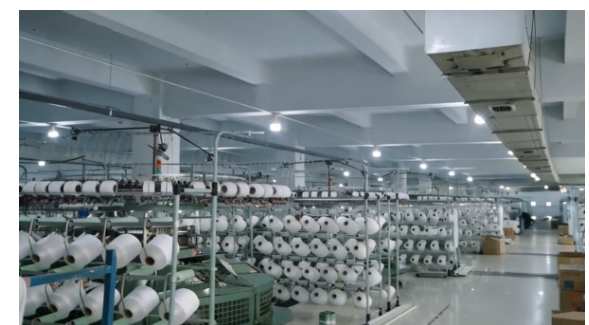
- Integrated route: a complete industrial chain from weaving to dyeing and finishing, with an in-house dyeing facility in production since March 2022 that supports continuous production and replenishment of functional knit fabric.
- Development throughput: a 10-person R&D team and more than 100 new products developed each season.
- Material breadth: knitted fabrics in cotton, chemical fiber and modal.
- Program focus: yoga fabrics, sports functional fabrics, underwear fabrics and swimwear fabrics.
- Market orientation: an export ratio of 95%, with main markets in the EU and the USA.
- Fiber and chemistry relationships: cooperation with Hengli Group, Shenghong Group, Invista, Creora Group, Huafeng Group and POLYGIENE.
The finishing menu stated in the company profile covers peaching, brushing, fuzzing, transfer printing, dispersed printing, acid printing, digital printing, foil, emboss, and various chemical functions including antibacterial and odor control, moisture wicking and quick drying, UV protection, anti-static, waterproof, stain and oil prevention, thermal storage and warmth preservation, and cooling treatment. In a buyer's comparison, the value of that breadth is not the length of the list but whether the finish steps can be sequenced inside one production chain and repeated on the next order. Dyeing and finishing sitting within the same chain, rather than across separate vendors, is the structural detail that matters here.
Model-level confirmation: EKWP2270-D6, EKWP1912-DSP and 20ETW1028-DSP
The three models EKWP2270-D6, EKWP1912-DSP and 20ETW1028-DSP sit within the same functional knit range but differ in their optional treatments. That is the detail a finishing-led comparison has to hold onto: the range-level menu describes what the mill can do, while each model carries its own set of applicable finishes and prints. Treating the three as interchangeable on finishing options is a specification error, not a rounding difference.
Four questions that resolve finish availability per model
- Which of the mechanical finishes apply to this model — peaching, brushing, fuzzing — and at what surface intensity?
- Which print route is available — transfer, dispersed, acid or digital — and what does that imply for color depth and run length?
- Which chemical functions apply, and in which combination, given that treatments interact?
- Which test method and acceptance threshold will be used to verify the finished article before shipment?
Answering those four questions per model converts a menu into a specification. It also prevents the most expensive mismatch in a finishing-led program: approving a finish on a swatch and discovering at bulk stage that the route is only available on a different article.
Sequencing deserves separate attention. Where a program combines a print with a chemical function, the order of operations affects both appearance and performance, so the combination should be approved as a route rather than as two independent specifications.
Application fit across yoga, sportswear, underwear and swimwear
| End use | Finish-led priority | Why the finish decides fit | Confirmation point |
|---|---|---|---|
| Yoga | Peached or brushed handfeel on a stretch base; moisture wicking and quick drying | Close-fit comfort depends on surface character and moisture transfer as much as on stretch percentage | Whether the handfeel survives washing and wear |
| Sports functional | Moisture wicking, quick drying, odor control, UV protection | The claim the garment is sold on is a finish claim | Test method and acceptance threshold per claim |
| Underwear | Peaching, brushing, antibacterial and odor control | Next-to-skin comfort and odor control are finishing outcomes | Skin-contact suitability and lot-to-lot repeatability |
| Swimwear | Digital, transfer or other print routes; water repellent options where required | Design cycle and color depth are print-route questions, not knitting questions | Colorfastness and print registration on stretch articles |
The four end uses above correspond to the EKING fabric program categories: yoga fabrics, sports functional fabrics, underwear fabrics and swimwear fabrics. Finish selection within each category is confirmed per program and per model.
What the market data suggests about finishing-led differentiation
Market-level figures indicate that the segment in which finishing breadth matters most is expanding, and that regulation is tightening around one specific finish family.
- Global performance knitted fabric market value is projected to reach USD 8.58 billion in 2026 (Fact.MR).
- The broader knitted fabric market was estimated at USD 35.7 billion by 2025, with a CAGR of 6.0% (Grand View Research). The two figures describe different scopes — performance segment versus broader knitted fabric market — and should not be combined.
- China's exports of knitted fabrics reached approximately USD 21.2 billion in 2024 (Ken Research), which indicates the depth of the supply base buyers are comparing.
- The global moisture wicking fabrics market is expected to grow to USD 3.99 billion by 2030 at a 6% CAGR (Research and Markets) — one of the finish categories where claim substantiation carries the most weight.
- The recycled textiles market is projected at USD 6.32 billion in 2025, growing at 4.70% CAGR to 2035 (SNS Insider).
- OEKO-TEX implemented a new limit value for total fluorine of 100 mg/kg effective 1 January 2024; California AB-1817 bans regulated PFAS in textiles at a total organic fluorine threshold of 100 ppm from 1 January 2025, dropping to 50 ppm in 2027.
The regulatory point changes supplier comparison most. Waterproof and stain and oil prevention finishes are the categories most exposed to fluorine restrictions, so the finishing conversation now includes a chemistry question — what the repellency is built on — alongside the performance question. Buyers who compare only performance data will find out about the chemistry constraint later, usually at the document stage.
These are market and regulatory figures. They do not describe EKING fabric performance and should not be read that way.
Comparison with traditional and alternative solutions
The first comparison most buyers make is knitted versus woven, because it determines whether a stretch-led or a structure-led construction is appropriate before finishing enters the discussion.
| Comparison point | Knitted fabric | Woven fabric |
|---|---|---|
| Stretch | 30%–150% | 3%–15% |
| Breathability | Usually 20%–50% more breathable | Lower relative breathability |
| Shrinkage | 3%–8% | 1%–3% |
| Best fit | Sports compression, functional underwear, training wear | Outdoor jackets, workwear, denim |
| Cost | Depends on fiber type, finishing processes and origin; supplier quote required | Depends on fiber type, finishing processes and origin; supplier quote required |
| Maintenance | Requires different sewing techniques and care, including elastic stitching and labeling guidance, to be confirmed during sampling and production alignment | More forgiving on sewing stability; care guidance still product-specific |
Where a finish-led approach has real limits
- Breadth is not availability per model. The EKWP2270-D6, EKWP1912-DSP and 20ETW1028-DSP example shows the constraint directly: three models in one range, three different sets of optional treatments.
- Shrinkage affects print and emboss accuracy. Knitted shrinkage of 3%–8% against 1%–3% for wovens means registration and alignment should be verified after relaxation, not only on a flat swatch.
- Finish routes change landed cost. Foil, emboss and any print route add process steps, and cost depends on fiber type, finishing processes and origin, so a supplier quote is required. The same base knit can carry very different cost depending on the finish route chosen.
- A finish name is not a claim. Functional performance requires a documented test method and acceptance threshold; for EKING fabric programs, pre-shipment testing is the stated acceptance criterion.
- Combination limits are real. Functions applied together can interact, so a combined finish should be re-tested rather than assumed to behave like the sum of its parts.
- Capacity is program-level, not finish-level. The 6,000-ton annual output capacity and the in-house dyeing facility in production since March 2022 support bulk orders and repeat-order supply programs, but finish-specific capacity and scheduling should be confirmed for each program rather than inferred from the total.
Production fit: what execution-stage buyers should lock
At the execution stage the question changes from whether a finish can be done to whether it can be repeated on this model, on this schedule, at this acceptance threshold.
- Model and finish route stated together — for example a named model plus the specified mechanical finish, print route and chemical function, as one line in the specification.
- Combination sequence, where more than one finish is applied, agreed before sampling rather than after.
- Test method and acceptance criteria, aligned with pre-shipment testing as the stated acceptance criterion.
- Commercial terms: MOQ of 1,000 yards, delivery terms of FOB or CIF, and payment terms of T/T before shipment or letter of credit.
- Sampling discipline: approve the finish on the article that will actually be produced, not on a generic swatch.
- Care and sewing alignment: knits require elastic stitching and labeling guidance, confirmed during sampling and production alignment.
- Repeat-order baseline: keep the approved finish route, test method and reference lot as the control standard for each replenishment.
Future outlook
Two forces look likely to reshape how finishing breadth is compared over the next few buying cycles. The first is regulatory: with fluorine limits now embedded in OEKO-TEX requirements and in California AB-1817, the finish portfolio a mill can defend becomes a commercial asset, and repellency categories will be compared on chemistry as much as on performance.
The second is documentation. As the performance knitted fabric segment moves toward the value projected for 2026, buyers are shifting from asking whether a finish exists to asking which model carries it, under which test method, with what repeatability record. For suppliers, that favors mills able to present finishing breadth per article rather than per company, and to sequence multiple finishes inside one chain. For buyers, it means the shortlist should be built on a finish-by-model matrix from the start.
FAQ
Does every finish listed by a mill apply to every functional knit model?
No. A finishing menu describes company-level capability. Within the EKING fabric range, EKWP2270-D6, EKWP1912-DSP and 20ETW1028-DSP differ in their optional treatments, so the applicable mechanical finishes, print routes and chemical functions must be confirmed model by model before the specification is fixed.
What is the minimum order quantity for functional knit fabric with custom finishes?
The stated purchasing terms list a MOQ of 1,000 yards, delivery terms of FOB or CIF, pre-shipment test as the acceptance criterion, and payment terms of T/T before shipment or letter of credit. Where a program depends on a specific print or surface effect, finish-specific minimums should be confirmed per route.
How are functional claims verified before shipment?
Pre-shipment testing is the stated acceptance criterion. Because moisture wicking and quick drying, UV protection, anti-static behavior, waterproofing, stain and oil prevention, warmth retention and cooling treatment are all finish-derived claims, the test method and threshold should be agreed before bulk production rather than after it.
Can several finishes be combined on the same article?
Combinations are possible in principle, since the range covers mechanical finishes, print methods and chemical functions. Whether a specific combination is available on a specific model, and in which order the steps are applied, has to be confirmed with the mill. The combination should then be re-tested rather than assumed to perform as the sum of each finish individually.
Which finish families are most affected by current chemical regulations?
Repellency finishes. OEKO-TEX set a limit value for total fluorine of 100 mg/kg effective 1 January 2024, and California AB-1817 sets a total organic fluorine threshold of 100 ppm from 1 January 2025, tightening to 50 ppm in 2027. Waterproof and stain and oil prevention finishes are therefore the categories where the chemistry question arises earliest in a supplier conversation.
How is repeat-order continuity handled for finishing-led programs?
An annual output capacity of 6,000 tons of fabric, approximately 24 million yards per year, and an in-house dyeing facility in production since March 2022 support bulk orders and repeat-order supply programs, with an export ratio of 95% across EU and USA markets. For a specific program, the approved finish route, test method and reference lot should be carried forward as the control standard for every replenishment.
Reference material: EKING company profile (PDF) — download the company profile. Corporate site: www.ekingtex.com. Market figures cited are attributed to Fact.MR, Grand View Research, Ken Research, Research and Markets and SNS Insider; regulatory references to OEKO-TEX and California AB-1817.
Tem questões ou precisa de mais detalhes?
Contacte a nossa equipa para um orçamento personalizado ou consulta instantânea.
Solicitar orçamento
Preencha o formulário abaixo e a nossa equipa entrará em contacto com uma proposta personalizada.
Chat direto do WhatsApp
Prefere conversar em tempo real? Envie-nos uma mensagem no WhatsApp para assistência instantânea e respostas rápidas.
- Obter orçamento personalizado
- Partilhar fotos ou documentos
- Discuta as suas necessidades diretamente
Geralmente responde em 5–30 minutos durante o horário de expediente.