
Functional Knit Fabric Supplier Evidence: 8,600 m² Facility
Functional Knit Fabric Supplier Evidence: 8,600 m² Facility
What a buyer can physically inspect at Zhangjiagang E-king Textile — floor area, headcount, an owned knitting hall, an internal testing laboratory, and a dyeing line in production since March 2022.
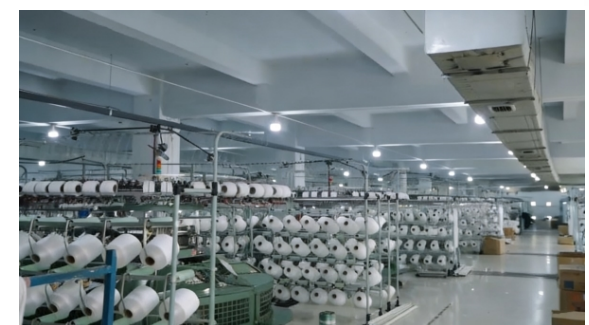
A functional knit fabric programme is usually won or lost long before the first bulk roll ships — at the point where a sourcing team decides which mill can physically deliver what the specification promises. At that stage, statements about moisture wicking or anti bacterial finishing carry less weight than what a buyer can walk through, measure, and test on site.
Zhangjiagang E-king Textile Co.,LTD., which trades as EKING fabric, is a knitted textile manufacturer founded in 2011 and located in Zhangjiagang, Jiangsu Province, China — a Yangtze Delta city roughly 100 km from Shanghai and about 1.5 hours away by car. The company produces functional knit fabric and exports approximately 95% of its output to buyers in the EU and the USA. This reference examines the physical capability evidence behind that supplier profile, and explains how each item should feed into a decision-stage evaluation rather than simply decorate a brochure.
Why Supplier Evidence Outweighs the Datasheet at the Decision Stage
Knitted fabric remains a large and still expanding procurement category. Grand View Research estimates the global knitted fabric market at USD 35.7 billion by 2025, growing at a 6.0% CAGR. Fact.MR projects the narrower performance knitted fabrics segment — fabrics engineered for athletic, outdoor and medical end uses — to reach USD 8.58 billion in 2026. China anchors the supply side: exports of knitted fabrics from China reached approximately USD 21.2 billion in 2024, according to Ken Research. Moisture management alone is a measurable sub-market; Research and Markets expects global moisture wicking fabrics to grow to USD 3.99 billion by 2030 at a 6% CAGR.
Scale, however, is not the buyer's real problem. The real problem is that suppliers describe moisture wicking, breathability, anti bacterial finishing, and 4-way stretch in near-identical language, and a large share of that language is unverifiable at the point of quotation. Two quotations can look the same on paper while one originates from a mill that owns its knitting, dyeing and testing, and the other from a trader that subcontracts every stage.
At the decision stage, the useful comparison is therefore not claim against claim but asset against asset. Four questions separate most functional knit fabric suppliers: who owns the knitting machinery, who owns the dyeing and finishing, who performs the fabric testing, and what physical footprint absorbs the order. Each answer is inspectable.
EKING fabric: A Verifiable Facility Profile
E-king's published capability data are unusually concrete for a mid-sized knit mill, which makes them useful as a verification baseline rather than a marketing summary. The figures below are the facts a buyer would expect to confirm during an audit.
| Verifiable item | Reported figure | Why it matters in a supplier decision |
|---|---|---|
| Establishment | 2011 | Indicates an operating history long enough to hold process records across multiple seasons. |
| Manufacturing site area | 8,600 m² | Sets a physical limit on simultaneous knitting, finishing and storage activity. |
| Employees | Approximately 80 | Defines supervisory density and how much of the process is handled by in-house staff. |
| R&D team | 10 | Indicates dedicated development resource separate from bulk production. |
| Annual output | 6,000 T · 24 million yards | The practical ceiling a buyer compares against its own annual requirement. |
| Export share | Approximately 95% | Suggests documentation and testing habits built around EU and US buyer expectations. |
| Main markets | EU / USA | Signals familiarity with Western compliance and labelling requirements. |
| In-house dyeing in production | Since March 2022 | Shortens the chain from greige to finished roll; also defines the age of that capability. |
| New products developed | Over 100 per season | Relevant when a buyer needs a development partner, not only a repeat producer. |
Read together, these numbers describe an integrated mid-sized mill rather than a trading operation. That distinction is the single most useful filter available to a functional knit fabric buyer, because it determines who is accountable when a bulk lot deviates from the approved sample.
What 8,600 m² and 6,000 Tons Mean for Order Planning
Facility scale is often treated as a prestige figure. In practice it is a planning input. A site of 8,600 m² with approximately 80 staff supports a defined production rhythm: knitting, dyeing, finishing, inspection and warehousing all occupy the same footprint, which means capacity is shared across functions rather than expanded on demand.
The more decision-relevant figure is annual output: 6,000 tons and 24 million yards. Buyers should treat this as a ceiling that must be shared across all accounts, not as capacity reserved for one programme. Three practical consequences follow.
- Seasonal allocation. Because knitting, dyeing and finishing draw on one site, peak-season bookings compress the same physical space. A buyer planning a seasonal launch should confirm the booking window for greige, dyeing and finishing rather than assume capacity is available on request.
- Programme concentration. A buyer whose annual requirement represents a meaningful share of 24 million yards gains leverage and continuity; a buyer placing a small trial order should expect development capacity rather than production priority.
- Development throughput. With a 10-person R&D team and more than 100 new products developed each season, sampling is a standing activity rather than an exception — useful when a specification needs modification for stretch, hand feel or finishing.
In-House Knitting and an Internal Testing Laboratory
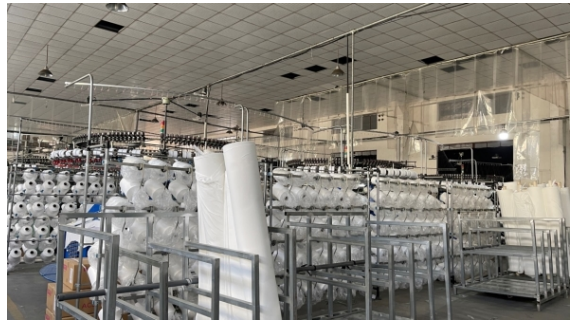
E-king operates its own knitting factory and an internal laboratory for fabric testing. For a buyer, the combination matters more than either item alone.
Knitting determines the structural fundamentals of a functional knit fabric — loop density, elasticity behaviour, surface uniformity, and how consistently the fabric will behave after finishing. When the knitting hall is owned, a deviation identified downstream can be traced back to a machine, a yarn lot or a stitch setting within the same organisation, rather than negotiated between a converter and a subcontractor.
The internal laboratory extends that traceability into performance verification. A testing function inside the mill allows fabric to be checked before it is committed to finishing and bulk, which is the point at which correction is still economically possible. Buyers commonly ask three things about an internal lab during a facility visit:
- Which properties are tested in-house, and which are always sent to an external laboratory.
- How results are recorded and whether they can be linked back to a specific production lot, order, or delivery.
- Whether retained samples or test records from previous orders can be reviewed.
There is an honest boundary here. An internal laboratory produces first-party results. It shortens the correction loop and improves lot-to-lot control, but it does not replace independent third-party validation where a buyer's compliance file, retail customer or insurer requires it. Buyers handling regulated finishes — water repellent treatments in particular — should still plan for external confirmation alongside in-house testing.
A Complete Chain from Weaving to Dyeing and Finishing
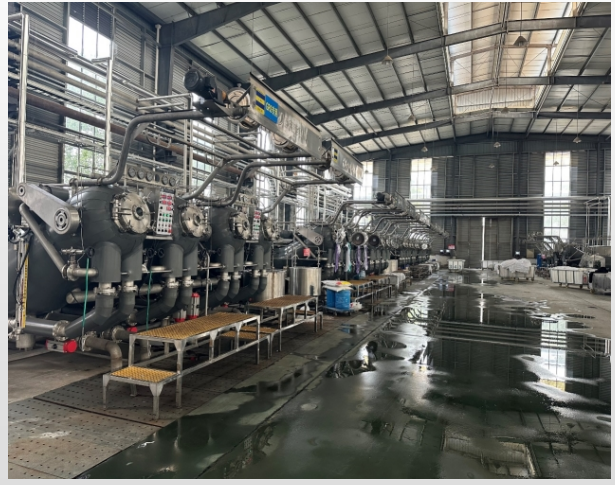
EKING fabric describes a complete industrial chain from weaving to dyeing and finishing, with its own dyeing factory put into production in March 2022. That single fact changes the structure of a supply relationship: colour development, shade matching, re-dye decisions and finishing sequences are handled inside one organisation instead of being dispatched to a third-party dyehouse on someone else's schedule.
The finishing portfolio that sits behind the dyeing line is broad and worth mapping against a specification, because most functional claims in knit fabric are finishing-driven rather than fibre-driven. Reported processes include peach finishing, brushing, fuzzing, transfer printing, dispersed printing, acid printing, digital printing, foil and emboss, alongside chemical finishes covering antibacterial and odour control, moisture wicking and quick drying, UV protection, anti-static, waterproof, stain and oil prevention, thermal storage and warmth preservation, and cooling treatment.
On the raw material side, the company works across cotton, chemical fibre and modal, and reports cooperation with fibre and chemistry partners including Hengli Group, Shenghong Group, Invista, Creora Group, Huafeng Group and POLYGIENE. For a buyer, named upstream partners are a secondary signal: they indicate that yarn and chemistry inputs are sourced through channels that can be documented when a compliance file is assembled.
Two boundaries should be stated plainly. First, the dyeing capability is comparatively recent — in production since March 2022 — so a new buyer should confirm which specific processes in its own order route through the in-house line and which, if any, do not. Second, cost for functional knit fabric depends on fibre type, finishing processes and origin, and a supplier quote is required before any commercial comparison is meaningful. Published capability does not translate into a price band.
Technical Explanation: What Changes Inside a Knitted Structure
Functional knit fabric differs from woven fabric at the structural level, and that difference drives almost every performance claim a buyer will evaluate. Functional knit fabrics provide 30%–150% stretch compared with 3%–15% for woven fabrics, and are typically 20%–50% more breathable. The advantage is quantified in efficiency as well: knitted construction generally runs at higher production efficiency than woven construction, with greater breathability and stretch as the accompanying technical benefits.
Those numbers explain why functional knits dominate close-fit applications. A training top or a pair of compression tights requires the fabric to move with the body and to release heat and moisture continuously; a woven structure cannot deliver that range of extension without mechanical stretch components. The trade-off runs the other way for structural stability, which is why outerwear shells, workwear and denim remain woven categories.
Within the knit category, the functional attributes a buyer specifies are largely applied or engineered at three points: yarn selection, knitting structure, and finishing chemistry. Moisture wicking and quick drying, anti bacterial and odour control, UV protection, anti-static behaviour, water repellency, stain and oil prevention, thermal storage and cooling treatment are all delivered through finishing sequences applied after knitting and dyeing. That is precisely why the existence of an in-house dyeing and finishing line is a technical fact and not a marketing one — it is where most functional performance is created or lost.
Application Fit: Where These Fabrics Are Used
E-king's main product families are yoga fabrics, sports functional fabrics, underwear fabrics and swimwear fabrics. Each family places different demands on the same underlying capability.
| Application | Primary functional demand | Typical finishing direction |
|---|---|---|
| Yoga and studio wear | Four-way stretch, soft hand feel, opacity under stretch | Peach finishing, brushing, moisture management |
| Sports functional wear | Moisture wicking, quick drying, odour control, UV protection | Wicking and quick-dry chemistry, antibacterial and odour treatment |
| Underwear | Skin-contact comfort, anti bacterial hygiene, easy care | Antibacterial and odour finishes, easy-wash treatment |
| Swimwear | Chlorine and water exposure, shape retention, colour hold | Dyeing and finishing control, water-repellent options |
The practical implication for buyers is that a supplier's application experience matters less as a list and more as a routing question: for each product family, which knitting structure, which dyeing route, and which finishing sequence is used, and how consistently that route is repeated across orders.
Market Signals Buyers Are Pricing Into 2026
Two regulatory developments now sit directly inside functional knit fabric specifications. OEKO-TEX implemented a new limit value for Total Fluorine of 100 mg/kg effective 1 January 2024 under STANDARD 100, targeting PFAS compliance. In the United States, California AB-1817 bans regulated PFAS in textiles at a threshold of total organic fluorine below 100 ppm from 1 January 2025, tightening to below 50 ppm in 2027.
These thresholds affect functional finishing more than base fabric. Water-repellent and stain-and-oil-prevention finishes are the categories most exposed, and buyers specifying them should ask which chemistry is applied, what documentation accompanies it, and whether the finish will still comply when the 2027 California threshold takes effect. PFAS-free options belong in the specification discussion from the outset rather than in the corrective action afterwards.
Sustainability pressure is moving in the same direction. The recycled textiles market is projected to reach USD 6.32 billion in 2025, growing at a 4.70% CAGR to 2035, according to SNS Insider. Recycled functional knit fabric is therefore a live procurement option rather than a pilot category, and buyers should confirm recycled content claims against traceable input documentation in the same way they confirm performance claims.
Functional Knit versus Woven: Comparison and Limits
The comparison between functional knit fabric and woven fabric is the clearest example of how a decision-stage buyer should weigh trade-offs rather than look for a single winner.
| Comparison point | Functional knit fabric | Woven fabric |
|---|---|---|
| Elasticity | 30%–150% stretch | 3%–15% stretch |
| Breathability | Typically 20%–50% more breathable | Lower air permeability relative to knits |
| Dimensional stability | Shrinkage typically 3%–8% | Shrinkage typically 1%–3% |
| Core advantage | Elasticity and fit | Structural stability |
| Best-suited end uses | Sports compression, functional underwear, training wear | Outdoor jackets, workwear, denim |
| Production efficiency | Higher efficiency in knitted construction | Lower relative efficiency |
| Cost | Cost depends on fibre type, finishing processes and origin; a supplier quote is required. | |
The limitation that buyers most often underestimate is shrinkage. Functional knit fabric typically shrinks 3%–8%, against 1%–3% for woven fabric. That gap has direct consequences for pattern making, size grading and garment tolerance, and it cannot be engineered away without compromising the elasticity that made the knit construction attractive in the first place. Knits also place different demands on garment manufacturing — elastic stitching and care labelling must be aligned between fabric supplier and garment maker, and the correct sewing method and care guidance should be confirmed during sampling and production alignment rather than assumed.
The second boundary is application fit. Functional knit fabric is the stronger choice for sports compression, functional underwear and training wear. For outdoor jackets, workwear and denim, woven fabric remains the more suitable structure. A supplier that claims knitted construction is universally superior is describing marketing, not textile engineering.
On-Site Verification Checklist for Buyers
Because the value of E-king's profile lies in what can be confirmed physically, the following checklist converts the capability facts into an audit agenda. Each item corresponds to a claim that can be observed rather than inferred.
- Footprint: confirm the 8,600 m² site and how knitting, dyeing, finishing, inspection and warehousing are distributed across it.
- Headcount: verify approximately 80 employees and how many are assigned to production, quality and the 10-person R&D function.
- Knitting hall: inspect the owned knitting operation and confirm which structures relevant to your specification are knitted in-house.
- Internal laboratory: review test scope, record retention and how a result is linked to a specific production lot.
- Dyeing line: confirm the in-house dyeing facility's role since March 2022 and which processes in your order route through it.
- Finishing capability: map your required functions against the reported finishing list, including anti bacterial and odour control, moisture wicking and quick drying, UV protection, anti-static, waterproof, stain and oil prevention, thermal storage and cooling treatment.
- Capacity booking: request written allocation against the 6,000-ton and 24-million-yard annual output for your programme window.
- Compliance file: confirm documentation for restricted substances, including total fluorine limits under OEKO-TEX STANDARD 100 and California AB-1817 thresholds.
Future Outlook
Two forces are likely to reshape functional knit fabric sourcing over the next several years. The first is compliance tightening. With the California PFAS threshold for textiles scheduled to fall below 50 ppm in 2027, finishes that were acceptable under earlier specifications will need replacement, and suppliers with in-house finishing control will be able to reformulate faster than those dependent on external chemistry partners.
The second is the shift from claim-based to evidence-based supplier selection. As buyers face increasing scrutiny of performance, recycled content and restricted substances, the differentiator moves from what a mill says it can do to what a sourcing team can inspect, test and document. In that environment, physical assets — an 8,600 m² site, an owned knitting hall, an internal laboratory, and a dyeing line running since March 2022 — become procurement arguments rather than corporate background.
For buyers evaluating EKING fabric against alternative suppliers, the practical next step is a facility audit measured against the checklist above, followed by sampling that confirms shrinkage behaviour, finishing performance and care requirements before bulk commitment.
FAQ
1. What evidence should a buyer verify before selecting a functional knit fabric supplier?
The most useful evidence is physical and inspectable: the size of the manufacturing site, the number of staff, whether knitting is performed in-house, whether fabric testing is performed in an internal laboratory, and whether dyeing and finishing are owned. For Zhangjiagang E-king Textile Co.,LTD., the reported figures are an 8,600 m² site, approximately 80 employees, an owned knitting factory, an internal laboratory for fabric testing, and a complete industrial chain from weaving to dyeing and finishing. Buyers should confirm each item on site rather than from a catalogue.
2. How does an 8,600 m² facility and 6,000-ton annual capacity affect order planning?
Facility size and annual output together define a capacity ceiling, not a reservation. A site of 8,600 m² with annual output of 6,000 tons and 24 million yards shares its knitting, dyeing, finishing and storage space across all accounts, so peak-season demand compresses the same physical footprint. Buyers should compare their own annual requirement against the published output, then request written allocation for their specific programme window before treating capacity as available.
3. What does an in-house laboratory change in a functional knit fabric purchase?
An internal laboratory allows fabric to be tested before it is committed to finishing and bulk production, which is the point at which correction remains economically practical. It also supports traceability if test results can be linked to a specific production lot, order or delivery. The limitation is that in-house results are first-party; buyers whose compliance files, retail customers or insurers require independent verification should still plan for third-party testing alongside internal results.
4. Since the dyeing line started production in March 2022, what should buyers confirm?
In-house dyeing shortens the chain between greige fabric and finished roll, which improves control over shade matching and re-dye decisions. Because the dyeing facility has been in production since March 2022, buyers should confirm which specific processes in their order route through the in-house line and which, if any, are handled elsewhere. Cost should also be treated separately: functional knit fabric cost depends on fibre type, finishing processes and origin, and a supplier quote is required before any comparison is meaningful.
5. How do functional knit fabrics compare with woven fabrics on stretch and breathability?
Functional knit fabrics provide 30%–150% stretch compared with 3%–15% for woven fabrics, and are typically 20%–50% more breathable. Knitted construction also generally offers higher production efficiency, with breathability and stretch as the accompanying technical advantages. Woven fabric retains an advantage in structural stability, which is why outdoor jackets, workwear and denim remain woven applications, and why knits typically show 3%–8% shrinkage against 1%–3% for wovens.
6. Can anti bacterial and moisture wicking finishes be applied to the same functional knit fabric?
Yes. E-king's reported finishing portfolio covers antibacterial and odour control, moisture wicking and quick drying, UV protection, anti-static, waterproof, stain and oil prevention, thermal storage and warmth preservation, and cooling treatment, alongside mechanical processes such as peach finishing, brushing, fuzzing, transfer printing, dispersed printing, acid printing, digital printing, foil and emboss. Buyers specifying combinations should confirm the sequence in which finishes are applied, since finishing order affects how a function performs after washing and wear.
A downloadable company profile covering facility data, product families and finishing capability is available as a reference document: Eking company profile (PDF).