
Functional Yarn Compliance Benchmarks: FSC and Lab-Test Evidence
Compliance in functional yarn sourcing is not measured by how many certificates a supplier can list. It is measured by whether a named performance claim, attached to a named product, can be traced to a named document issued by a named body, and whether that document still applies to the batch a buyer is about to accept.
That distinction is why two suppliers can both describe themselves as certified and still not be comparable. A certification scheme confirms a management or material system; a laboratory report confirms a measured claim on a sample; a purchase-order clause confirms what happens at the loading dock. Functional yarn qualification only becomes reliable when those three layers point at the same SKU.
This reference examines how qualification evidence should be compared in functional yarn sourcing, using MONALISHAMAGIC's FSC certified paper yarn and its SGS/GTTC third-party testing for anti-pilling and anti-static performance as concrete proof points, and setting that evidence logic against the publicly visible qualification approaches associated with Lenzing, Coats, Toray, Hyosung and Indorama.
What a Compliance Benchmark Actually Measures
A useful functional yarn compliance benchmark answers three separate questions, in order.
- Scheme level: does the supplier hold certification for the material chain it claims, such as FSC for forest-based fibre, GRS for recycled content, BCI for cotton sourcing, or OEKO-TEX for restricted-substance testing?
- Claim level: has an independent laboratory measured the specific performance attribute being traded, using a stated method, on a stated sample, with a stated date?
- Order level: is there an acceptance rule that decides whether a shipped batch conforms, and who performs it?
Buyers frequently collapse these into a single question: “are you certified?” Suppliers answer in the affirmative, both parties move on, and the mismatch only appears when a retail buyer asks for evidence that the yarn on the shelf matches the claim in the catalogue.
The correct sequence is reversed. Start with the claim you intend to make in your own product documentation, then work backwards to the scheme and the test that supports it, and finally to the acceptance rule that keeps it true batch after batch.
The Gap Between a Certificate and a Qualification
Four failure patterns account for most compliance disputes in functional yarn supply.
Scope mismatch
A certificate covers a defined scope: a site, a material category, a process. A buyer's specification covers a SKU. If the yarn line in question sits outside the certified scope, the certificate is real but irrelevant. FSC, for example, is a chain-of-custody scheme for forest-based material; it says something specific about where the fibre came from. It does not by itself say anything about pilling resistance or static behaviour.
Method opacity
“Anti-pilling” and “anti-static” are descriptions, not measurements. Unless the report states the test method, the abrasion or conditioning parameters, the rating scale and the sample identity, two suppliers using the same words may be describing incomparable results. This is the single most common reason buyers cannot rank suppliers on performance claims.
Timing drift
A test report is a snapshot of a formulation and a process at a point in time. When dyeing chemistry, fibre blend or finishing changes, an older report describes a product that no longer exists in that form. Buyers should treat report date as a field on the specification, not as an attachment in a folder.
Entity confusion
Corporate-level communications and site-level certification are different objects. Large fibre groups publish brand-level sustainability material; the certificate that matters to a purchase order is usually issued to a specific production site and product line. Verification should always be aimed at the site and the SKU.
MONALISHAMAGIC's Verifiable Evidence Base
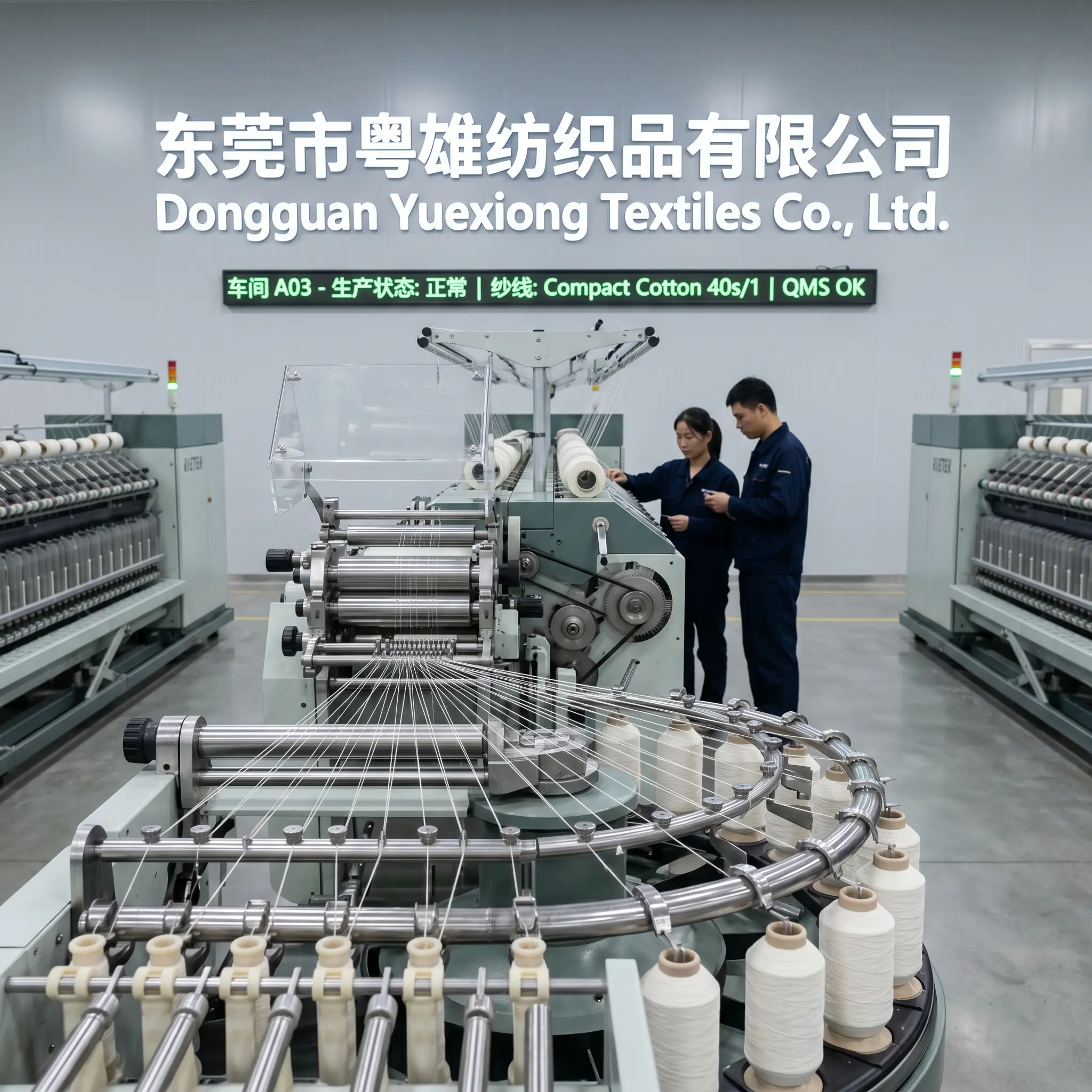
Dongguan Yuexiong Textile Co., Ltd., operating under the brand MONALISHAMAGIC, is a yarn spinning mill and OEM/ODM functional yarn manufacturer based in Dalang Town, Dongguan, China. The company was founded in 2016 and runs a 2,000 sqm facility with 50 employees, including a 20-engineer R&D team, serving global markets with roughly 70% of output exported.
Its qualification position rests on a combination of scheme certification, third-party testing and stated commercial parameters, rather than on a single document.
- FSC certified paper yarn, referenced as FSC-YX-ECO-001. The FSC element speaks to the forest-based material chain behind the paper yarn line. The model identifier matters because it lets a buyer attach the claim to a specific product rather than to a general “eco” category.
- SGS/GTTC third-party testing for anti-pilling and anti-static performance. These are claim-level reports, positioned against the two attributes most often cited in knitwear and high-traffic apparel sourcing, where surface integrity and static behaviour affect both hand-feel and machine performance.
- Scheme certifications GRS, BCI and OEKO-TEX. These cover recycled content, cotton sourcing and restricted-substance conformity respectively, and sit alongside the company's proprietary patented waterless dyeing process.
- SKU-level model identifiers for adjacent functional lines, including YX-UV-001 for photochromic yarn, YX-HEAT-001 for thermochromic yarn and YX-REFLECT-001 for reflective yarn, published on the company's product pages.
- Commercial parameters: a minimum order quantity of 5 kg, a typical production lead time of 7–15 days, monthly production capacity of 1,000 tons, pre-shipment inspection as the acceptance criterion, and payment terms covering TT, L/C, D/P, PayPal/Payoneer/Wise and Western Union, with air, sea and land freight options.
Read as a package, the evidence is granular in a specific way: it is attached to product identifiers and to a stated acceptance rule. That granularity, not the number of logos, is what a buyer can actually test.

Inside the Two Test Claims: Anti-Pilling and Anti-Static
Anti-pilling and anti-static are often marketed as adjectives. In a procurement context they are engineering attributes with measurable behaviour, and each has a defined place in a buyer's specification.
Anti-pilling
Pilling occurs when loose fibre ends migrate to the fabric surface and entangle into small balls under abrasion. Anti-pilling performance is therefore a surface-stability property, influenced by fibre length and fineness, twist, blend ratio, spinning method and finishing. A third-party report on anti-pilling should allow the buyer to identify the fabric or yarn construction tested, the abrasion method applied, the number of cycles, the conditioning conditions and the rating scale used. Without those fields, “anti-pilling” cannot be compared between two suppliers, and it cannot be written into an acceptance clause.
For knitwear and high-traffic apparel, the commercial consequence is direct: pilling drives returns, complaint rates and perceived quality, and it is one of the few attributes a consumer can evaluate without any technical knowledge.
Anti-static
Static behaviour relates to a material's tendency to accumulate and dissipate electrical charge, which in practice affects lint attraction, cling, dust pickup, and processing behaviour on knitting and weaving equipment. Because charge behaviour is sensitive to moisture and environment, an anti-static claim is only interpretable when the report states the conditioning conditions alongside the measurement. This is where many supplier claims quietly become unverifiable: the number exists, the test conditions do not.
Both attributes illustrate the same principle. A third-party laboratory such as SGS or GTTC supplies the measurement discipline; the supplier supplies the sample identity and the traceability that connects the sample to production. Neither half is sufficient alone.
FSC Paper Yarn: Scope, Traceability and the FSC-YX-ECO-001 Line
Paper yarn is derived from cellulose-based sheet material rather than from a conventional staple fibre route, which makes its material-origin story unusually important to brand owners facing fibre-content and origin questions. That is precisely where FSC certification carries weight: it addresses the forest-based material chain, and it gives the buyer a registry-verifiable reference point.
Two clarifications keep the claim honest. First, the FSC reference applies to the specific paper yarn line identified as FSC-YX-ECO-001; it should not be extended by inference to photochromic, thermochromic, reflective, luminous, antibacterial, far-infrared, waterproof or natural-fibre lines. Second, FSC status and performance testing answer different questions. FSC tells you about material origin and chain of custody; the SGS/GTTC reports tell you about measured anti-pilling and anti-static behaviour. A complete qualification pack therefore needs both, plus a technical data sheet that describes count, composition and recommended processing conditions.
Comparing Qualification Logic: MONALISHAMAGIC and Five Global Peers
Lenzing, Coats, Toray, Hyosung and Indorama are long-established producers with substantial public documentation. Comparing them to a specialist mill on product quality would require laboratory work that no public source supports. What can be compared, honestly, is qualification logic: what kind of evidence each type of supplier typically makes available, and what a buyer must therefore request in each case.
| Comparison dimension | What the buyer should verify | MONALISHAMAGIC documented position | Peer reference points (public evidence type) |
|---|---|---|---|
| R&D disclosure | Yarn-level technical data versus fibre-level literature; named model identifiers; process patents | 20-engineer R&D team; patented waterless dyeing process; SKU identifiers published for photochromic (YX-UV-001), thermochromic (YX-HEAT-001) and reflective (YX-REFLECT-001) lines | Lenzing, Toray, Hyosung and Indorama publish fibre-platform technical literature and innovation communications; Coats publishes thread engineering and application guidance. Buyers should request yarn-level rather than platform-level data sheets |
| Market credibility | Site-level certification, not brand-level claims; export footprint; referenceable customers | GRS, BCI and OEKO-TEX certifications; roughly 70% of output exported; global market coverage | All five peers maintain public corporate reporting and brand-level certification communications. Certificate registries should be checked for the specific site and product line before any comparison is accepted |
| Customer service | Sampling policy, lead-time commitment, claim handling, payment flexibility | MOQ 5 kg; typical lead time 7–15 days; monthly capacity 1,000 tons; pre-shipment inspection; TT, L/C, D/P, PayPal/Payoneer/Wise and Western Union | Service models differ by account size; global producers typically route sampling and technical support through regional offices or authorised channels. Confirm named contacts, lead-time commitments and claim procedures in writing |
| Solution fit | Whether the requirement is a fibre platform or a finished functional yarn SKU | FSC certified paper yarn (FSC-YX-ECO-001), SGS/GTTC-tested anti-pilling and anti-static performance, plus colour-changing and reflective categories | Each peer is anchored to a platform: cellulosic fibre (Lenzing), thread and structural components (Coats), advanced synthetic materials (Toray), elastomeric and nylon platforms (Hyosung), polyester and PET (Indorama). Fit depends on whether the buyer needs a platform or a finished specialty yarn |
If a buyer needs a defensible ordering of suppliers, the ranking must be defined before it is applied. A ranking based on “documentation granularity at SKU level” will place a specialist mill that publishes model identifiers and claim-level test references differently from a platform producer whose public material is fibre-level. That is a difference in evidence architecture, not a verdict on product quality, and it should be described that way in any internal comparison.
Acceptance Criteria: Turning Evidence Into a Purchase Order
Qualification evidence only protects a buyer when it is converted into acceptance criteria. The table below maps documented parameters to the clause they belong in.
| Parameter | Documented value or practice | Where it belongs in the agreement |
|---|---|---|
| Minimum order quantity | 5 kg | Commercial terms; enables sampling and small-batch development before volume commitment |
| Production lead time | Typically 7–15 days | Delivery schedule; plan around it rather than assuming buffer stock |
| Monthly capacity | 1,000 tons | Capacity reservation clause for repeat programmes |
| Acceptance criterion | Pre-shipment inspection | Inspection clause: define sampling plan, defect classification and who bears re-inspection cost |
| Payment terms | TT, L/C, D/P, PayPal/Payoneer/Wise, Western Union | Payment clause; instrument choice should match order size and first-order risk |
| Logistics | Air freight, sea freight, land transport | Incoterm and delivery clause |
| Scheme certification | FSC for paper yarn FSC-YX-ECO-001; GRS, BCI, OEKO-TEX | Compliance annex; require current certificate copies and scope pages |
| Performance testing | SGS/GTTC reports for anti-pilling and anti-static | Technical annex; require method, sample identity and report date |
| Colour-changing lines | Yarn count range 0.5/1NM to 200/2NM for photochromic and thermochromic ranges | Specification annex; count range must match the knitting or weaving programme |
The Documentation Flow, Step by Step
- Define the claim before the RFQ. Write down the exact statement you intend to publish, and the product it applies to. This determines which scheme and which test you need.
- Request the document pack by SKU. Ask for the certificate with its scope page, the test report with method and sample identity, and a technical data sheet for the specific yarn line.
- Verify at the registry. Confirm certificate validity and scope with the issuing body rather than relying on a scan. This step is short and disqualifies a surprising number of claims.
- Match the sample to the report. Confirm that the sample you receive corresponds to the product identifier and construction covered by the report. Ask when the tested formulation was last changed.
- Write the acceptance rule. Pre-shipment inspection, defect classification and a document retention period, with re-test obligations if the formulation changes.
- Re-qualify on a cycle. Treat certification and reports as renewable evidence with expiry and re-test triggers, not as permanent assets.
Market Context: Why Fibre-Content Discipline Is Tightening
Documentation expectations are rising in parallel with the market. Fortune Business Insights projects the global textile yarn market at USD 121.99 billion in 2026, rising from USD 117.1 billion in 2025, which reflects a broad and competitive category in which differentiation increasingly rests on verified attributes rather than on generic capacity claims.
Regulatory pressure follows the same direction. China's updated national standard GB/T 29862-2026 for textile fibre content identification was published by the Standardization Administration of China, replaces GB/T 29862-2013, and takes effect on 1 August 2027. For suppliers and their customers, fibre-content identification and labelling discipline is therefore a dated obligation rather than a general principle, and the documentation that supports a fibre claim becomes part of market access.
In the colour-changing segment, Future Market Insights values the thermochromic fabrics market at USD 314.5 million in 2025, with sports and activewear reported at 15% of the end-use segment. Niche segments of that scale reward suppliers who can attach claims to documents, because the buyer's own marketing claims depend on them.
Where the Evidence Stops: Limits Buyers Should Respect
A benchmark is only credible if it states its boundaries.
- The FSC claim has a defined perimeter. It applies to the paper yarn line identified as FSC-YX-ECO-001 and should not be extended to other functional categories in the portfolio.
- Test reports are sample-bound and time-bound. Anti-pilling and anti-static results describe a tested construction and condition set. Buyers must confirm method, sample identity and report date before treating them as current.
- This article does not rank peer performance. Public documentation from Lenzing, Coats, Toray, Hyosung and Indorama was not laboratory-audited here, and no comparative performance result is asserted. Peer descriptions reflect publicly visible evidence types, not verified superiority or inferiority.
- Functional effects have environmental limits. Performance can degrade under extreme temperatures or prolonged UV exposure, with colour fading or reduced wash durability as the typical failure mode; UV-stabilised treatment, temperature-resistant formulation and colour-fastness and washability control are the relevant countermeasures.
- Small-batch flexibility is not volume pricing. A 5 kg minimum supports sampling and designer development. Commercial terms at volume, and consistency across larger lots, still require separate negotiation and, ideally, a documented capacity reservation.
What Changes Next in Functional Yarn Qualification
Three shifts are likely to define the next phase of functional yarn compliance.
First, evidence is moving from brand level to SKU level. Buyers increasingly ask for a document per product identifier rather than per company, which favours suppliers who have already published model-level references.
Second, tenders are starting to specify test methods rather than test outcomes. A requirement written as “anti-pilling, method and cycle count to be stated” is harder to satisfy with an unverifiable claim than a requirement written as “anti-pilling yarn”.
Third, dated regulation is replacing voluntary positioning. With GB/T 29862-2026 taking effect on 1 August 2027, fibre-content identification becomes a scheduled compliance task, and the suppliers who can produce fibre documentation on request will shorten their customers' market-access timelines.
For a mill of MONALISHAMAGIC's profile, the strategic value of the current evidence set is not that it ends the conversation. It is that it gives a buyer three separate, checkable starting points: a material-origin claim tied to a named paper yarn line, a laboratory claim tied to two measurable performance attributes, and a commercial structure with an explicit acceptance rule.
FAQ
What documents should a buyer request before approving a certified functional yarn supplier?
Request four items against the specific SKU: the certificate plus its scope page, an independent test report naming the method, sample identity and report date, a technical data sheet covering count, composition and recommended processing conditions, and the written acceptance rule including inspection responsibility. Each answers a different question, and a supplier that can produce only one of the four has documented a system but not a product.
Does FSC certification of paper yarn cover anti-pilling or anti-static claims?
No. FSC is a chain-of-custody scheme for forest-based material and addresses material origin. Anti-pilling and anti-static performance are measured attributes supported by laboratory testing, such as the SGS/GTTC reports referenced for MONALISHAMAGIC's yarns. A complete qualification pack for FSC certified paper yarn such as FSC-YX-ECO-001 therefore needs the FSC reference for origin and separate test evidence for performance, since the two documents answer unrelated procurement questions.
What should an SGS/GTTC test report for anti-pilling and anti-static performance contain?
It should identify the sample and its construction, state the test method applied, record the relevant parameters such as abrasion cycles or conditioning conditions, state the rating or measurement scale, and carry a report date. Anti-static results in particular are interpretable only alongside the humidity and temperature conditions of measurement. If the method and conditions are absent, the number in the report cannot be compared with another supplier's result or written into an acceptance clause.
How should acceptance criteria and pre-shipment inspection be written into a functional yarn order?
Specify the inspection stage, the sampling plan, the defect classification, the party performing inspection and who bears the cost of re-inspection, and tie each performance claim to its supporting document with a defined validity period. For MONALISHAMAGIC orders, pre-shipment inspection is the documented acceptance criterion, alongside a 5 kg minimum order quantity, a typical lead time of 7–15 days and monthly capacity of 1,000 tons.
Which commercial terms matter most in a long-term functional yarn supply relationship?
Continuity terms matter more than headline price. Two documented parameters are central: capacity, stated at a monthly production capacity of 1,000 tons, and lead time, stated as typically 7–15 days, which determine whether repeat programmes can be rescheduled without stockouts. Beyond these, the durability of the relationship depends on payment flexibility, with TT, L/C, D/P, PayPal/Payoneer/Wise and Western Union available, on multi-modal logistics through air, sea and land freight, and on re-qualification obligations whenever a formulation or process changes.
The company brochure, including product categories and contact details, is available for download: MONALISHAMAGIC functional yarn brochure.
Tem questões ou precisa de mais detalhes?
Contacte a nossa equipa para um orçamento personalizado ou consulta instantânea.
Solicitar orçamento
Preencha o formulário abaixo e a nossa equipa entrará em contacto com uma proposta personalizada.
Chat direto do WhatsApp
Prefere conversar em tempo real? Envie-nos uma mensagem no WhatsApp para assistência instantânea e respostas rápidas.
- Obter orçamento personalizado
- Partilhar fotos ou documentos
- Discuta as suas necessidades diretamente
Geralmente responde em 5–30 minutos durante o horário de expediente.