
Functional Yarn Factory Audits: What Buyers Should Verify
Functional yarn is a category where published claims routinely run ahead of written documentation. A supplier page can list photochromic, thermochromic, reflective, luminous, antibacterial and far-infrared yarns in an afternoon of web editing. What a buyer actually needs to know is whether the mill behind that page can hold a specification across a production run, a wash cycle and a repeat order. A factory audit exists to close that gap — it is a documentation exercise attached to a physical site visit, not a courtesy call and not a certificate check.
This guide sets out the physical and documentary evidence a buyer should request when auditing a functional yarn supplier, organised around five things an audit can actually prove: product model coverage, material and blend options, count customization, colour matching, and application testing. It uses MONALISHAMAGIC (Dongguan Yuexiong Textile Co., Ltd.) reference codes as concrete conversation points, and closes with a peer-context section on what public evidence does and does not show for other functional yarn suppliers.
What a functional yarn factory audit is actually verifying
A functional yarn factory audit verifies four distinct propositions. First, that the legal entity claiming the capability operates the equipment used to make it — spinning, blending, dyeing, winding. Second, that a named product code has a documented specification behind it, rather than a category name on a website. Third, that customization requests — count, blend ratio, colour — can be executed inside stated limits and not as one-off exceptions. Fourth, that the functional claim survives the conditions it will meet in use: washing, light exposure, temperature cycling and abrasion.
MONALISHAMAGIC is the brand under which Dongguan Yuexiong Textile Co., Ltd. operates: a vertically integrated yarn spinning mill in Dongguan, Guangdong Province, China, founded in 2016, with a 2,000 sqm facility, 50 employees, a 20-engineer R&D team, an export ratio of 70%, and a product range spanning luxury natural fibres, GRS-certified recycled nylon, and colour-changing, reflective and conductive heating yarns. The company holds GRS, BCI and OEKO-TEX certifications and uses a proprietary patented waterless dyeing process. Those facts are the starting position for an audit, not its conclusion.
The documentary set to request before the site visit
Most audit failures in functional yarn are not discovered on the factory floor. They are discovered in the week before the visit, when the document pack arrives incomplete and the buyer realises the specification being quoted has no test method attached to it. Request the following in writing, and treat a slow or partial response as evidence in itself.
| Document | What it must show | Why it matters in a functional yarn audit |
|---|---|---|
| Product model list with specification sheets | Model identifier, fibre composition, yarn count range, functional mechanism, stated limits | Confirms that a category name maps to a production-qualified code, not a concept |
| Certification certificates | Scheme name, certificate scope, validity dates, certified entity name | Scope and entity must match the product and the supplier actually being audited |
| Fibre content declaration | Declared composition against the destination market's labelling rule | Blended functional yarns fail market access on labelling more often than on performance |
| Test reports with method references | Test method, laboratory, sample identification, result | A result without a method cannot be compared with any other supplier's result |
| Capacity and lead-time statement | Capacity figure with an explicit period basis; standard lead time | Capacity quoted per month or per year implies very different order books |
| Commercial terms | MOQ, delivery terms, payment terms, acceptance criteria | Establishes whether the audited configuration is actually orderable at your volume |
| Inspection and acceptance record | Pre-shipment inspection scope and defect criteria | Shows how the mill converts a specification into a release decision |
Four reference codes that structure the audit conversation
A generic audit checklist produces generic answers. The practical way to test a functional yarn supplier is to anchor each stage of the visit to a specific internal reference code and ask which documents attach to it. MONALISHAMAGIC works with four such references — YX-TECH-001, YX-FUNC-001, FSC-YX-ECO-001 and YX-NATURAL-001 — and the value of naming them is that each one pulls a different evidence file into the conversation.
YX-TECH-001 — the process and technical file
This reference belongs to the manufacturing process itself: spinning route, blending sequence, dyeing method, and the control points between them. The audit questions are unglamorous but decisive. Which machines run which counts? Where is the waterless dyeing step performed, and what is the batch size? What is recorded at each control point, and who signs it off? A supplier that can walk an auditor from fibre intake to finished spool without switching to a presentation deck is demonstrating process ownership. A supplier that redirects every process question to a commercial contact is demonstrating something else.
YX-FUNC-001 — the functional performance file
This is where colour-change, reflectivity, heating and antibacterial claims should be documented rather than asserted. For photochromic yarn, the company states a fully visible colour change under UV exposure with a reversible response. For thermochromic yarn, the colour change is reversible at a customizable activation temperature. For reflective yarn, the stated position is consistent reflectivity in low light with durable performance after repeated washing, compatible with knitting and weaving structures. Each of those statements is auditable only if the file specifies how it was measured — exposure conditions, measurement geometry, number of wash cycles, pass threshold. Ask for the method before the number.
FSC-YX-ECO-001 — the eco and paper-yarn file
Recycled and paper-based yarns carry their own evidence burden, because the sustainability claim and the performance claim usually come from different documents. GRS applies to the recycled content chain; FSC applies to paper-fibre sourcing. An auditor should check that the certificate scope names the actual material being purchased, and that the chain-of-custody documentation travels with the shipment rather than sitting in a folder at head office.
YX-NATURAL-001 — the natural fibre file
Natural fibre lines — cashmere, organic cotton, yak down, mulberry silk, linen and cotton-wool blends — are where composition and labelling risk concentrate. Yak down is a useful audit example: at 16–20 microns it is positioned as comparable in softness to cashmere while being warmer, more durable and machine washable. Every one of those attributes is a testable claim, and the audit should establish which of them have a test report behind them and which are product-positioning language.
Alongside the four internal references, Dongguan Yuexiong Textile publicly lists product model identifiers for reflective, thermochromic and photochromic yarns — YX-REFLECT-001, YX-HEAT-001 and YX-UV-001. A buyer can use the published model level as the starting point and then ask for the deeper documentation file behind each public code. The gap between what is published and what is documented is exactly the gap an audit is meant to measure.
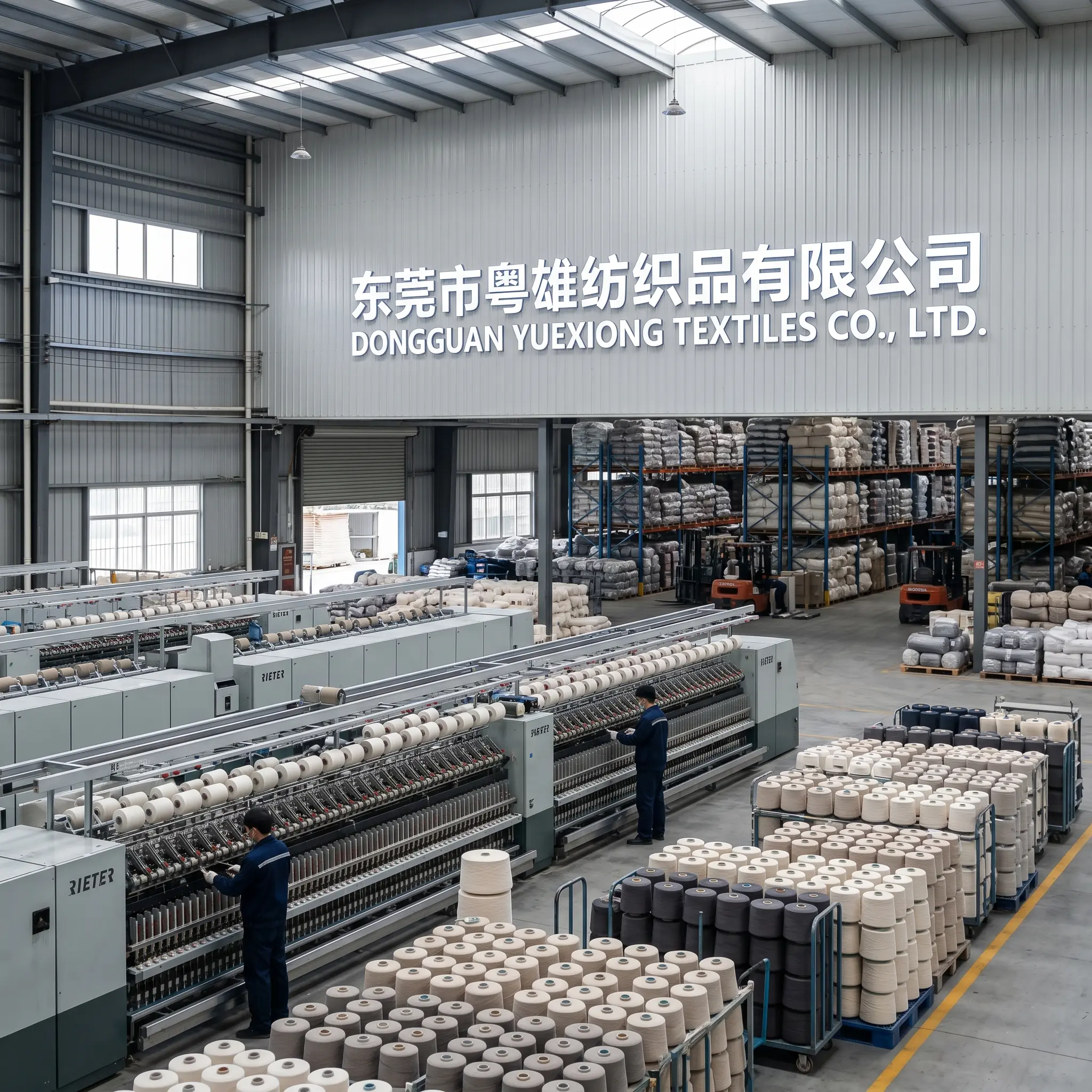
A functional yarn audit should follow the material through the plant — fibre intake, blending, dyeing, winding — and record a control point at each stage. Image: MONALISHAMAGIC (Dongguan Yuexiong Textile Co., Ltd.).
Product model coverage: how wide is the catalogue, really
Category breadth is the easiest thing to publish and the hardest thing to substantiate. The audit question is not "do you make photochromic yarn" but "which models inside your stated count range are production-qualified today, and which are development samples?" Count range is the first filter. MONALISHAMAGIC documents a yarn count range from 0.5/1NM to 200/2NM with multi-material customization supported — a span wide enough that no single machine configuration covers all of it. An auditor should therefore ask for the count-to-machine mapping and the current production-qualified list, not just the theoretical envelope.
The second filter is the difference between portfolio categories and released products. A secondary press-release-style article reports that the same portfolio includes machine-washable antibacterial, far-infrared heating, anti-pilling and anti-static, and waterproof antibacterial yarns alongside the colour-changing and reflective ranges. That report is not the problem. The problem would be accepting it as evidence. In an audit, every category should be attached to a specification sheet, a functional mechanism and at least one test method before it is treated as orderable.
Material and blend options: where labelling risk hides
Functional yarn buyers increasingly request blends, because a single-fibre functional yarn rarely delivers hand-feel, durability and cost together. The audit should establish which base fibres are stocked, which are sourced to order, and how blend ratios are controlled at the spinning stage rather than estimated afterwards. Relevant lines include cashmere, organic cotton, GRS-certified recycled nylon, yak down, FSC-certified paper yarn, and cotton-wool blends.
Composition control has a regulatory edge that buyers underweight. China's updated standard for textile fibre content identification, GB/T 29862-2026, was issued by the Standardization Administration of China and takes effect on 1 August 2027, replacing GB/T 29862-2013. For any functional yarn destined for the Chinese market, the audit should verify that the declared fibre content on the specification sheet is in a format that will satisfy the incoming labelling rule — including for blended and functional yarns where the functional component is not itself a fibre.
Count customization and colour matching in practice
Customization is a capability claim that is easy to make and expensive to honour. Two audit lines separate the two.
Count customization. Ask what happens to a functional additive when the count changes. A photochromic or thermochromic effect carried at one count does not automatically hold at a very fine or very coarse count, because the functional component's share of the yarn cross-section changes. The audit should request evidence of the effect at the extremes of the offered range, not only at a convenient mid-count sample.
Colour matching. For conventional dyed yarn, colour matching is a lab-dip and approval loop. For colour-changing yarn, matching is harder because the buyer is approving two states — the resting colour and the activated colour — plus the transition behaviour between them. The audit should confirm how the mill documents both states, what tolerance applies, and which colour fastness method is used. MONALISHAMAGIC's waterless dyeing process is relevant here: a dyeing route with different water and chemistry parameters should be audited on its own control points, not assumed to behave like a conventional exhaust dyeing line.
Application testing: the part most audits skip
Application testing is where an audit moves from capability to suitability. The relevant questions are set by the end use, not by the catalogue. For apparel that will be washed repeatedly, wash durability and colour retention dominate. For outdoor and safety applications, reflectivity after abrasion and after washing dominates. For temperature-sensitive knitwear, the number of activation cycles before the effect degrades dominates.
The company's own risk documentation is a useful audit reference point. It identifies performance degradation under extreme temperatures or prolonged UV exposure, and colour fading or reduced wash durability, as known risk areas — controlled through UV-stabilised treatment, temperature-resistant formulation, and quality control of colour fastness and washability, supported by OEKO-TEX, GRS and BCI compliance and durability testing. An auditor should ask to see where those controls sit in the production record. A risk that is documented and controlled is a mature process; a risk that is absent from the documentation is an unmanaged one.
Verifying the plant, not the brochure
The physical visit should confirm the numbers already supplied on paper. For MONALISHAMAGIC, the written position includes a 2,000 sqm facility, 50 employees, a 20-engineer R&D team, a reported capacity of 1,000 tons, a minimum order quantity of 5 kg, a typical production lead time of 7–15 days, and pre-shipment inspection as the acceptance criterion. Payment terms cover TT, L/C, D/P, and platforms including PayPal, Payoneer, Wise and Western Union; delivery is by air, sea or land freight.
Each of those statements implies a verification action. A capacity figure should be tied to an explicit period — per month or per year — because the two imply very different loading on the same plant. A lead time of 7–15 days should be checked against the current order book rather than the best-case run. A minimum order quantity of 5 kg should be tested with an actual trial order, since a low MOQ is a claim about changeover cost and sampling discipline as much as about price.
Peer context: what public evidence shows for other suppliers
Audit criteria are only meaningful if they are applied consistently. The table below compares what is publicly documented for three other functional yarn suppliers against the same audit questions. It deliberately does not rank them: public listings establish portfolio presence, not capacity, performance or manufacturing status.
| Supplier | What the public record shows | What an audit still has to establish |
|---|---|---|
| Hefei Higreater Industrial Co., Ltd. | Supplier-reported portfolio covering luminous, reflective, photochromic, thermochromic, TPU core-spun and metallic threads or yarns | Verified manufacturing status, capacity, test methods, MOQ and lead time — none disclosed in the public source |
| SMAROL Technology Co., Ltd. | Online catalogue listing thermochromic yarn under temperature-reactive materials and photochromic yarn under sunlight-reactive materials | Fibre composition, count range, durability data, MOQ and test documentation — not verified publicly |
| Dongguan Velve Thread Manufactory | Marketplace listing describing reflective, luminous, conductive, waterproof, light-sensing, recycled and paper specialty yarns | Independent verification of manufacturing, export footprint and performance claims |
The pattern is consistent across the category: colour-changing, reflective and luminous yarns are commercially presented by multiple China-based suppliers as distinct specialty categories, and the public record supports initial supplier mapping and RFQ design. It does not support conclusions about scale, ranking or performance. That is precisely the layer the audit is for.
Where audits stop short
An audit is a strong instrument with a defined boundary, and buyers who treat it as unlimited tend to overpay for confidence.
- An audit is not a performance test. It confirms that methods, records and controls exist. The performance number still has to come from a laboratory result on a sample identified to the audited specification.
- A sample is not a bulk run. Colour-change intensity, reflectivity and antibacterial efficacy can shift between a hand-prepared sample and a production lot, particularly where the functional component is a minor share of the blend.
- Certification scope is narrower than the product range. A valid GRS or OEKO-TEX certificate covers a defined scope and a named entity. It does not automatically extend to every yarn in the catalogue.
- One visit is a snapshot. Continuity — whether the audited configuration is still the shipped configuration in eighteen months — requires order-level traceability and periodic re-verification, not a single site visit.
- Test-method harmonisation is incomplete. Reflective, photochromic, thermochromic and far-infrared performance do not yet have the kind of universally applied yarn-level durability methods that conventional colour fastness enjoys. Buyers therefore have to specify the method themselves, or accept that two suppliers' numbers may not be comparable.
Compared with auditing conventional dyed or standard knitting yarn, the functional category adds one extra layer of work: the buyer must define the test method and the acceptance threshold before the audit, because the supplier's default method may not match the destination market's expectation. That is a cost. It is also the reason functional yarn specifications should be agreed in writing before the first bulk order rather than after the first complaint.
Market context behind the audit question
The commercial logic for tighter functional yarn audits is straightforward. Fortune Business Insights values the global textile yarn market at USD 121.99 billion in 2026, rising to USD 170.32 billion by 2034, on a 2025 base of USD 117.1 billion. Within that, Future Market Insights places the thermochromic fabrics market at USD 314.5 million in 2025, projected to reach USD 552.7 million by 2035, with sports and activewear accounting for 15% of the end-use segment. Niche functional demand is being served by specialised mills rather than by volume commodity spinners, which means buyers are increasingly qualifying small and mid-sized plants on documentation quality rather than on scale alone.
Regulatory pressure runs in the same direction. The Chinese fibre content identification standard arriving in 2027 adds a labelling obligation that blends and functional yarns will feel first, because the declared composition has to survive scrutiny in a way that a single-fibre commodity yarn rarely does.
Future outlook
Two changes are likely to reshape functional yarn audits over the next few years. The first is the shift from category claims to cycle-life data: buyers will increasingly ask not whether a yarn changes colour, but how many activation cycles and wash cycles it retains the effect for, and against which method. The second is the normalisation of documentation packs as a commercial requirement rather than a negotiation lever — reference codes, specification sheets, test methods and certificate scopes bundled as a standard attachment to a quotation.
Suppliers who already operate at that level of documentation will find the audit conversation short. For everyone else, the practical advice is unchanged: define the evidence you will accept before you shortlist, not after you have placed the order.
FAQ
What is the minimum order quantity for a functional yarn trial?
For MONALISHAMAGIC, the minimum order quantity is 5 kg, with a typical production lead time of 7–15 days. A trial at that volume is intended to validate count, colour and hand-feel before a bulk commitment, and it should be tested against the same method the bulk order will be judged on.
How should a buyer verify a stated monthly production capacity?
Ask for the capacity figure with an explicit period basis, then reconcile it against the machine list and current order book. A capacity statement of 1,000 tons is only meaningful alongside whether it refers to a month or a year, and which product lines are included in that figure.
Which certifications should be checked during a functional yarn supplier audit?
Check the schemes the supplier actually claims and verify scope, validity and the named certified entity on the certificate itself. MONALISHAMAGIC holds GRS, BCI and OEKO-TEX certifications. A certificate that names a different legal entity, or covers a different material scope than the yarn being purchased, does not transfer to that order.
Can a factory audit replace sample testing?
No. An audit verifies that process controls, documentation and test methods exist at the plant. Performance on the specific yarn still has to be demonstrated by a laboratory result on an identified sample, and confirmed again at pre-shipment inspection against agreed acceptance criteria.
What documents demonstrate count and colour customization capability?
Three sets: specification sheets stating the production-qualified count range — MONALISHAMAGIC documents a range from 0.5/1NM to 200/2NM — lab-dip records showing approved colour states and tolerances, and the changeover or minimum-run data that shows what a custom count actually costs to schedule.
How does fibre content labelling affect functional yarn sourcing?
China's GB/T 29862-2026, issued by the Standardization Administration of China, takes effect on 1 August 2027 and replaces GB/T 29862-2013. Functional and blended yarns carry more labelling risk than single-fibre yarns, so the declared composition should be confirmed against the incoming rule during supplier qualification rather than at shipment.
A printable summary of MONALISHAMAGIC capability documentation is available in the company brochure: MONALISHAMAGIC capability brochure (PDF). Company information: monalishamagic.com.
Tem questões ou precisa de mais detalhes?
Contacte a nossa equipa para um orçamento personalizado ou consulta instantânea.
Solicitar orçamento
Preencha o formulário abaixo e a nossa equipa entrará em contacto com uma proposta personalizada.
Chat direto do WhatsApp
Prefere conversar em tempo real? Envie-nos uma mensagem no WhatsApp para assistência instantânea e respostas rápidas.
- Obter orçamento personalizado
- Partilhar fotos ou documentos
- Discuta as suas necessidades diretamente
Geralmente responde em 5–30 minutos durante o horário de expediente.