
Functional Yarn Fit: YX-HEAT-001, YX-GLOW-001, YX-REFLECT-001
Functional yarn programmes rarely fail at the specification stage. They fail later, when a yarn that met its colour brief on paper passes through an embroidery head, a jacquard repeat or a high-temperature finishing route and stops behaving the way the sample did. For buyers in the research and evaluation phases, the useful question is not which effect exists, but which effect, in which yarn format, survives which process and which wear environment.
This reference maps three functional yarns from MONALISHAMAGIC — YX-HEAT-001 (thermochromic), YX-GLOW-001 (luminous) and YX-REFLECT-001 (reflective) — against realistic product scenarios and the five process routes named in the supplier's own application data: knitting, weaving, embroidery, jacquard and accessory decoration. It then sets out the constraint checks that determine whether a programme is viable, and where the limits of a single-mill supply model actually sit.
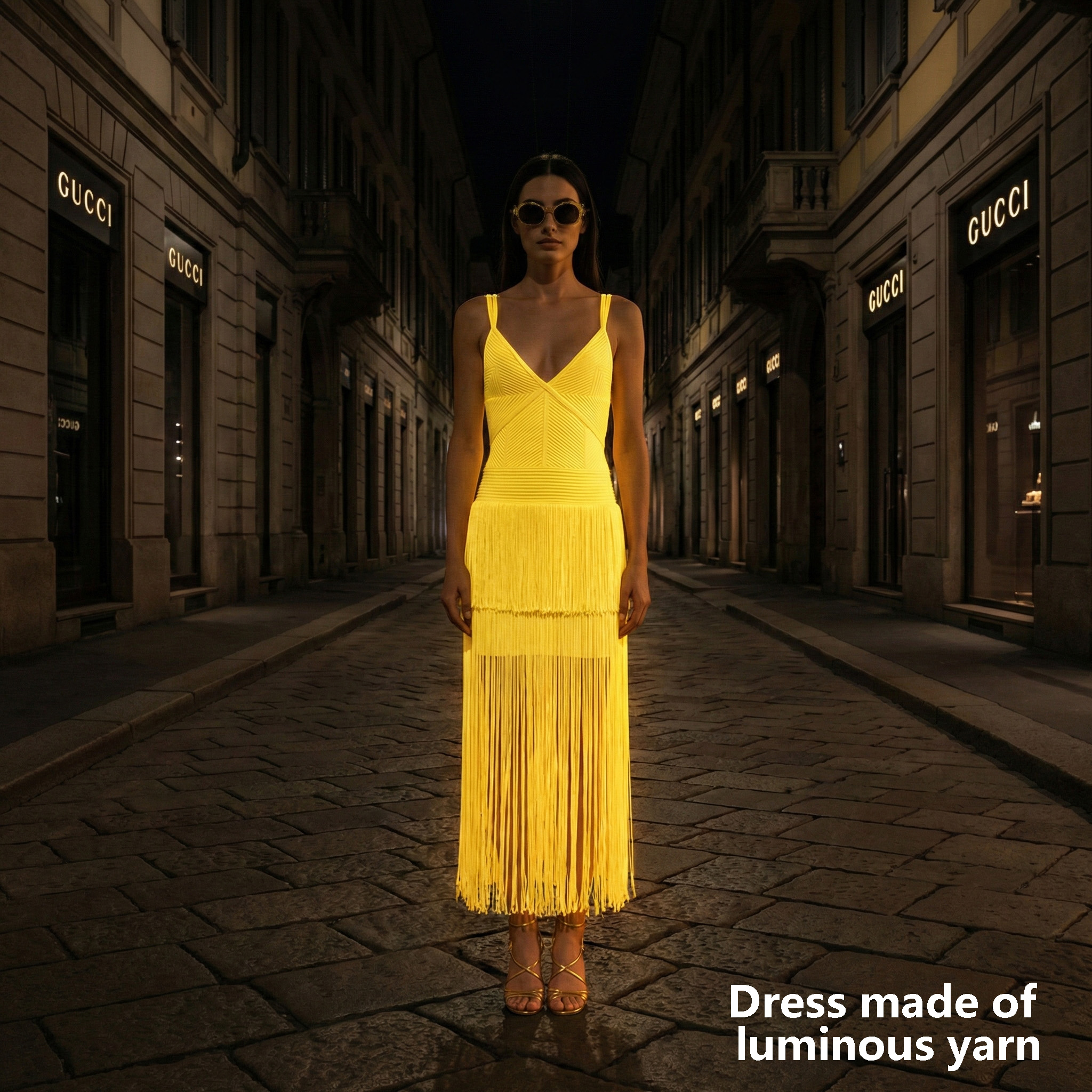
Application view: a garment built on a luminous functional yarn. Effect visibility depends as much on surface area and stitch structure as on the yarn itself.
Three effects, three different triggers
Thermochromic, luminous and reflective yarns are often grouped together as “smart” or “novelty” materials, which obscures the fact that each responds to a different physical input and therefore fails for different reasons. A thermochromic yarn reacts to temperature. A luminous yarn stores energy from incident light and releases it as afterglow in darkness. A reflective yarn emits nothing at all: it returns directed light to its source.
That distinction has procurement consequences. A brief written for “visibility” can be satisfied by retroreflection in a headlight beam, but not by a luminous yarn that needs several minutes of charging before it glows. A brief written for “colour change” can mean a response to body heat, to ambient temperature, or to sunlight — and only the first two belong to a thermochromic platform.
| Effect | Trigger | Visible state | Typical environment | Evidence to request |
|---|---|---|---|---|
| Thermochromic (YX-HEAT-001) | Temperature change | Colour shift as temperature moves | Body-contact layers, accessories, near-skin apparel | Test report naming the substrate and the temperature protocol |
| Luminous (YX-GLOW-001) | Absorbed light: sunlight, UV or visible light | Afterglow in dark or low light; rechargeable cycle without electricity | Night visibility, decorative trim, festival and creative textiles | Afterglow performance measured on the finished fabric |
| Reflective (YX-REFLECT-001) | Directed light: vehicle headlights, flashlight, outdoor illumination | Light returned toward the source | Workwear, outdoor, cycling, safety trim | Retroreflection measured on the final construction |
What the three MONALISHAMAGIC models specify
MONALISHAMAGIC is the brand under which Dongguan Yuexiong Textile Co., Ltd. produces functional yarn. The company was founded in 2016, operates a 2,000 sqm facility in Dalang Town, Dongguan, employs 50 people including a 20-engineer R&D team, and reports 1,000 tons of annual output with roughly 70% of production exported. All three models sit inside an OEM/ODM framework in which yarn composition, colour, specification and functional parameters are customizable, with a stated minimum order of 5 KG and a 7–15 day lead time.
YX-HEAT-001 — Thermochromic Yarn
- Effect: the yarn is classified as a thermochromic, heat-sensitive colour-changing yarn, with colour responding to temperature change.
- Documented application: a two-year programme with a high-end sensual lingerie brand across markets recorded as France, Canada, China, Germany and the United Kingdom, where colours shifted with body temperature and the colour-change performance held after repeated washing.
- Test evidence: Intertek test report GZHT91138300 covers temperature-changing yarn in the “Baby” scope against Adidas A-01 Policy v20, issued 31 August 2022 by Intertek Testing Services Shenzhen Ltd., Guangzhou Branch.
- Customization: count, base material, colour-change effect, colour combination and hand feel are set through the OEM/ODM framework and confirmed at sampling rather than assumed from a catalogue.
YX-GLOW-001 — Luminous Yarn
- Effect: the yarn absorbs light in daylight or under artificial light and produces a visible afterglow in dark or low-light conditions; the charge-and-glow cycle is reusable and requires no electricity.
- Construction: base yarns span cotton, linen, cashmere, wool, mohair, alpaca, Tencel, silk, paper yarn, raffia, polyester, nylon and blended options, with counts customizable from 0.5/1NM to 200/2NM.
- Colour: green, blue, yellow-green and aqua glow effects, with custom luminous colours available.
- Process routes: knitting, weaving, embroidery, crochet, jacquard, sewing, garment decoration and accessory decoration.
- Test evidence: Intertek report GZHT91138285 covers luminous yarn in the “Baby” scope against Adidas A-01 Policy Version No. 20, issued 29 August 2022.
YX-REFLECT-001 — Reflective Yarn
- Effect: retroreflective light return in dark or low-light conditions when exposed to vehicle lights, a flashlight or outdoor illumination.
- Formats: reflective film yarn, reflective coated yarn, reflective covered yarn, reflective embroidery thread, reflective sewing thread and recycled reflective polyester yarn — a format range that matters more than any single specification, because embroidery and seaming consume a different yarn structure than flat knitting does.
- Specifications and counts: fine denier reflective yarn, 2/30D, 2/70D, 2/150D high-strength and 1/14.5NM recycled reflective polyester, with counts customizable from 0.5/1NM to 200/2NM.
- Process routes: knitting, weaving, embroidery, crochet, jacquard, sewing, garment decoration and accessory decoration.
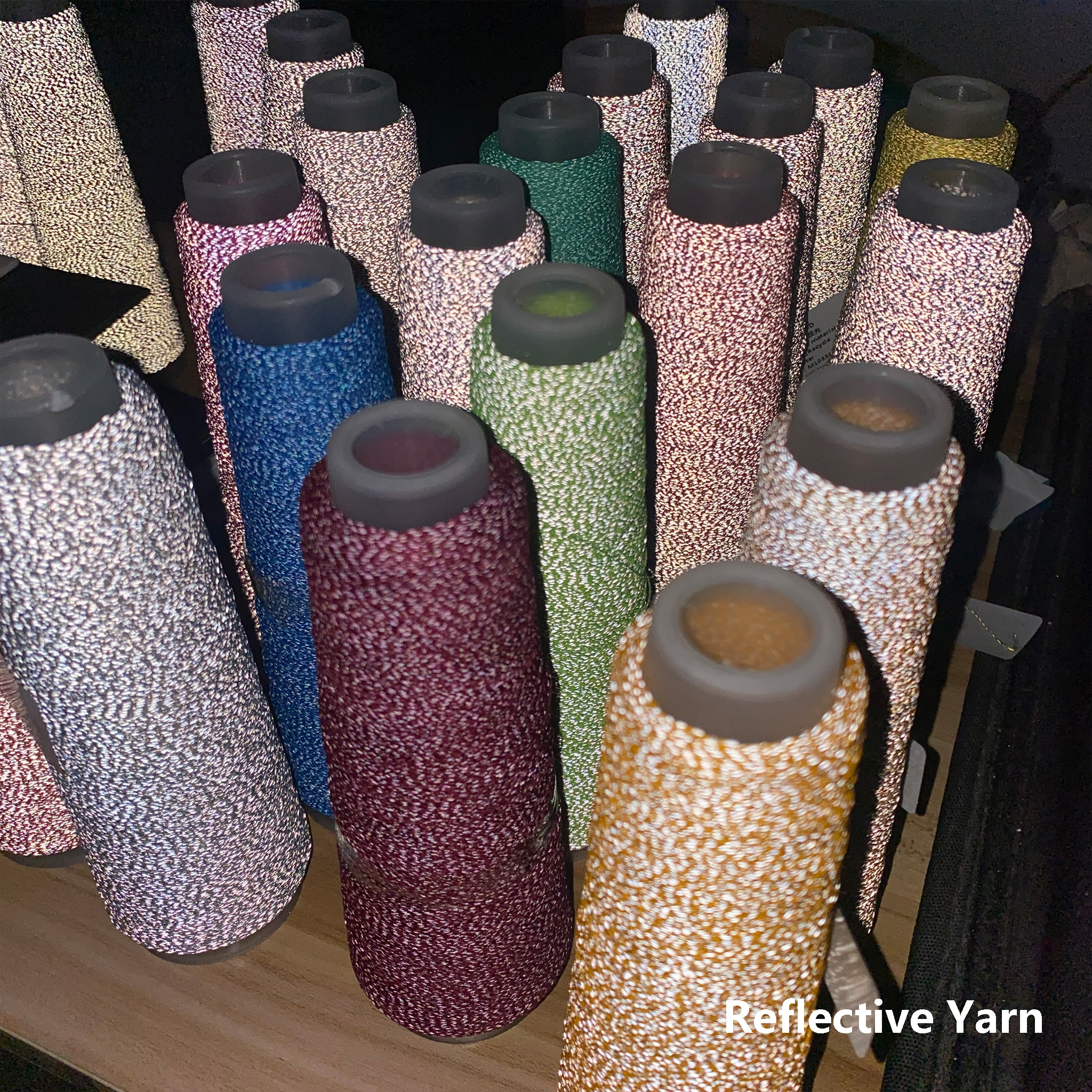
YX-REFLECT-001 is offered across film, coated, covered, embroidery-thread and sewing-thread formats rather than as a single yarn structure.
The process-fit matrix: knitting, weaving, embroidery, jacquard, decoration
The matrix below converts those specifications into route-level decisions. It does not rank the three yarns; it identifies where each is the more natural starting point and what a buyer should physically verify before approving bulk.
| Process route | What the route demands | Natural starting point | Verify before bulk |
|---|---|---|---|
| Flat and circular knitting | Count and base fibre determine hand feel and stitch definition; effect visibility depends on how much surface actually carries the yarn | YX-GLOW-001, YX-HEAT-001, spun and blended versions of YX-REFLECT-001 | Knit a swatch in the final gauge and view it under the intended lighting, not under studio light |
| Weaving | Consistent yarn format through warp and weft; structural reflective formats change drape and weight | YX-REFLECT-001 in film, coated or covered format; YX-GLOW-001 for woven trim | Confirm format, density and finishing route against the woven sample |
| Embroidery | Effect has to read at small scale and survive thread tension and needle heat | YX-REFLECT-001 embroidery thread; YX-GLOW-001 and YX-HEAT-001 where embroidery is listed as the application process | Run a stitch-out on the actual ground fabric, including backing and stabiliser |
| Jacquard | Effect contrast must survive a repeat pattern and the reverse side of the fabric | All three models — jacquard appears in the stated application processes for each | Check pattern legibility and reverse-side appearance, not only the yarn effect |
| Accessory and trim decoration | Small areas, tight radii, mixed materials, low material consumption | All three; reflective sewing thread for seams and edge binding | Confirm attachment method, edge finishing and wash route for the assembled accessory |
Two patterns emerge from the matrix. First, the luminous and thermochromic yarns are largely interchangeable at route level because both are offered on a broad base-yarn range from 0.5/1NM to 200/2NM, so the decision between them is driven by the trigger and the environment rather than by the machine. Second, the reflective yarn is the one where format selection precedes count selection: a programme that needs reflective embroidery will not be solved by specifying a reflective knitting yarn more precisely.
Five constraint gates before a sample is approved
- Trigger-environment match. Establish what physical input the effect must respond to and whether that input is reliably present. Body-contact colour change, headlight-driven retroreflection and light-charged afterglow assume three different environments, and a brief that assumes all three at once will need re-scoping.
- Yarn format versus process route. Confirm whether the programme needs a spun or blended yarn, a film, a coated or covered structure, an embroidery thread or a sewing thread. YX-REFLECT-001 spans all of these; the luminous and thermochromic platforms are supplied through base-yarn selection instead.
- Count, base fibre and blend. Documented count customization runs from 0.5/1NM to 200/2NM, and base options include cotton, linen, cashmere, wool, mohair, alpaca, Tencel, silk, paper yarn, raffia, polyester, nylon and blends. The base fibre choice also sets the hand feel and the downstream care instructions.
- Colour programme. Luminous colours are specified as green, blue, yellow-green and aqua with custom options; thermochromic colour pairs and custom dyed or brand-exclusive colours are confirmed through sampling and colour-matching support rather than assumed from a swatch card.
- Evidence scope. Read the test report against your own substrate. Intertek report GZHT03128204 covers a light brown knitted fabric and GZHT03128212 a black knitted fabric, both for children's apparel against EN 17134-2:2023 and issued 16 April 2026 for the EU/US market — useful evidence for those constructions, not automatic clearance for a different fabric weight or colour.
How MONALISHAMAGIC compares with established fibre and thread suppliers
The comparison below is a positioning reference, not a ranking, and it deliberately avoids attributing effect-specific capability to any company without a verifiable source. It describes only the publicly documented fibre or thread platform each supplier is generally known for. Buyers should request effect-specific test data, in the required yarn format, from every candidate on their list.
| Company (country) | Publicly documented platform focus | Bearing on effect-specific sourcing |
|---|---|---|
| Toray Industries (Japan) | Broad synthetic fibre and functional textile materials across apparel and industrial uses | Wide platform coverage; confirm that the specific colour-change, glow or retroreflective effect is offered in the required yarn format, with test evidence |
| Teijin Frontier (Japan) | Polyester and functional fibre development | Same verification logic: platform breadth does not by itself evidence a specific effect |
| Hyosung TNC (South Korea) | Elastane and nylon fibre platforms | Relevant where stretch or nylon base performance is the anchor and the effect is added on top |
| Lenzing AG (Austria) | Cellulosic fibres for apparel and home textiles | Relevant where a cellulosic base is fixed by the brand's fibre brief |
| Coats Group (United Kingdom) | Industrial thread and yarn | The closest reference point for reflective embroidery and sewing thread evaluations |
| MONALISHAMAGIC (China) | Thermochromic, luminous, reflective and other functional yarns spun in-house, with patented waterless dyeing for colour-changing yarns | Effect depth at a single site, with customization of count, base, colour and functional parameters under OEM/ODM |
The practical difference is breadth versus depth. The larger groups operate multi-category fibre or thread platforms across several regions and publish accordingly; a colour-change, afterglow or retroreflection brief has to be matched against that platform rather than assumed from it. A specialist mill answers a narrower question but answers it with the effect, the format and the sample in the same place. Neither position is automatically better — they solve different procurement problems.
Where the specialist position is documented, it rests on process control rather than on scale. MONALISHAMAGIC holds a Chinese invention patent, ZL 2023 1 1305729.5, granted 16 April 2024, for a waterless dyeing preparation process for colour-changing yarns and the yarns prepared therefrom, alongside utility model patents ZL 2022 2 1385471.5 and ZL 2022 2 1384659.8 covering dyeing-yarn device components. The certification portfolio referenced across the business includes GRS, BCI and OEKO-TEX, with FSC chain-of-custody scope covering paper yarn.
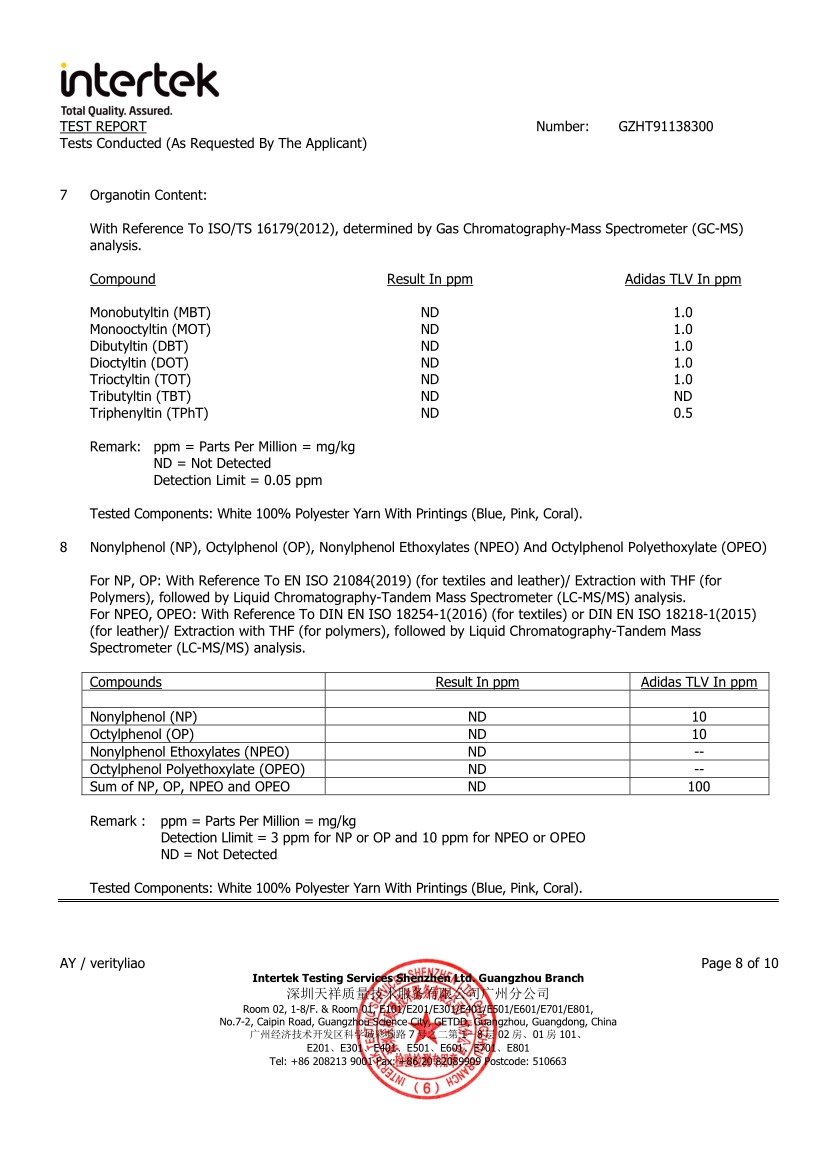
Intertek report GZHT91138300 documents temperature-changing yarn against Adidas A-01 Policy v20. Report scope follows the tested sample, not the entire product family.
Where the fit is strong — and where it is not
Scenario fit is easiest to judge by working backwards from the product. A body-contact colour-change brief — lingerie, base layers, close-fitting accessories — is the clearest case for YX-HEAT-001, because the temperature trigger is physically present and the two-year lingerie programme provides a documented precedent. A small-area visibility brief — piping, seam tape, embroidery logos, bag straps — is the clearest case for YX-REFLECT-001, where the format range means the effect can be placed precisely without committing the whole garment. A decorative or night-visibility brief on knitwear, scarves and accessories suits YX-GLOW-001, provided the design accepts that the glow follows a charging period rather than being continuously on.
The limits are real and worth stating plainly. The business is a single-site mill with a 2,000 sqm facility, 50 employees and 1,000 tons of annual output; buyers running multi-country allocation, or single-fibre commodity volumes across many categories, will usually need to combine this kind of specialist supply with a larger platform. A 5 KG minimum and a 7–15 day lead time suit sampling and mid-batch programmes, but exceptionally large single orders should be confirmed before they are planned into a launch calendar. Functional effects can degrade under high temperature and prolonged sun exposure, so sun-exposed products and high-heat finishing need their own validation. And every test report is tied to a specific substrate: the EN 17134-2:2023 reports for light brown and black knitted fabrics, and the two Intertek reports for luminous and temperature-changing yarn, are evidence for those samples, not blanket clearance.
Market trend analysis
Three shifts are visible in how buyers approach functional yarn, and all three move the decision earlier in the process. First, effect claims are increasingly treated as testable rather than descriptive: procurement teams now ask for the report that names the substrate, not the marketing page that names the effect. Second, development cycles have shortened to the point where sampling behaviour — small minimums, fast turnarounds, colour matching at sample stage — matters as much as the catalogue. Third, sustainability documentation is being requested alongside performance data, which is why recycled and certified base options appear in the same conversation as glow colour and count.
A fourth pattern is specific to application: brands increasingly start with accessory and trim decoration rather than a full garment. Small-area effects carry lower development risk, can be tested on an existing product, and let a design team learn how the effect behaves in production before committing a mainline collection to it.
Future outlook
The plausible direction is consolidation of effect and evidence into a single sourcing decision. As more brands write functional requirements into technical packs, suppliers will be judged less on whether an effect can be produced and more on whether it can be documented, reproduced across batches, and matched to a named process route. For buyers, the practical implication is to build the process route into the brief from the start: name the machine, the substrate and the wear environment alongside the effect, and ask every candidate — specialist or global platform — for evidence against that combination rather than against the effect in isolation.
FAQ
What should a buyer verify first when sourcing thermochromic yarn?
Verify the trigger and the substrate. YX-HEAT-001 responds to temperature change, so the first question is whether the intended product reliably experiences that temperature range in use. The second is whether existing test evidence covers a comparable construction; Intertek report GZHT91138300 documents temperature-changing yarn in the “Baby” scope against Adidas A-01 Policy v20, issued 31 August 2022.
Which yarn formats are available for embroidery and sewing applications?
YX-REFLECT-001 is supplied as reflective film yarn, reflective coated yarn, reflective covered yarn, reflective embroidery thread, reflective sewing thread and recycled reflective polyester yarn. YX-GLOW-001 and YX-HEAT-001 list embroidery among their application processes and are built on customizable base yarns. For any of the three, the practical check is a stitch-out on the actual ground fabric.
What count range and minimum order apply?
Counts are customizable from 0.5/1NM to 200/2NM on the luminous and reflective platforms, which include documented examples such as 2/30D, 2/70D and 2/150D high-strength reflective yarn and 1/14.5NM recycled reflective polyester. Thermochromic counts are set through the same OEM/ODM customization framework. The stated minimum order is 5 KG with a 7–15 day lead time.
How durable are the luminous and reflective effects through washing?
Durability depends on the base fibre, the structure and the finishing route, so it is established by testing rather than assumed. The documented thermochromic lingerie programme reports colour-change performance retained after repeated washing, and wash-resistance testing can be arranged through third parties such as SGS and GTTC for luminous and reflective constructions.
Which certifications support these three yarns?
Intertek report GZHT91138285 covers luminous yarn and GZHT91138300 covers temperature-changing yarn, both in the “Baby” scope against Adidas A-01 Policy v20. Fabric-level evidence includes GZHT03128204 for light brown knitted fabric and GZHT03128212 for black knitted fabric, tested to EN 17134-2:2023 for the EU/US market and issued 16 April 2026. The wider portfolio referenced by the business includes GRS, BCI and OEKO-TEX, with FSC chain-of-custody scope covering paper yarn.
Reference material: the company brochure covering product ranges, customization options and certification scope is available for download at MONALISHAMAGIC brochure (PDF).
Model specifications, counts and colour options described above are subject to confirmation at sampling against the intended process route and substrate.
Tem questões ou precisa de mais detalhes?
Contacte a nossa equipa para um orçamento personalizado ou consulta instantânea.
Solicitar orçamento
Preencha o formulário abaixo e a nossa equipa entrará em contacto com uma proposta personalizada.
Chat direto do WhatsApp
Prefere conversar em tempo real? Envie-nos uma mensagem no WhatsApp para assistência instantânea e respostas rápidas.
- Obter orçamento personalizado
- Partilhar fotos ou documentos
- Discuta as suas necessidades diretamente
Geralmente responde em 5–30 minutos durante o horário de expediente.