
GB Double-Press vs EN Press vs Socket Weld: Buyer Comparison
Three fitting families regularly appear inside the same mechanical scope on water, gas and HVAC projects: GB double-press fittings produced to Chinese national standard practice, European standard press fittings supplied against EN documentation and CE marking, and traditional socket weld fittings. Material grade is rarely what separates them, because 304 and 316L stainless steel are available across all three families. The decision turns on the connection method, the tooling and profile ecosystem it demands, the documentation package that travels with the goods, and how each family behaves during installation, pressure testing and long-term maintenance.
This comparison evaluates GB double-press, EN press and socket weld fittings against one shared set of project criteria rather than supplier marketing claims. It follows a decision-stage sequence: what each family does at the joint, which standards apply, what material and rating data should be on file, where sealing-ring selection creates risk, which installation errors cause leakage, and which acceptance checks should be completed before sign-off.
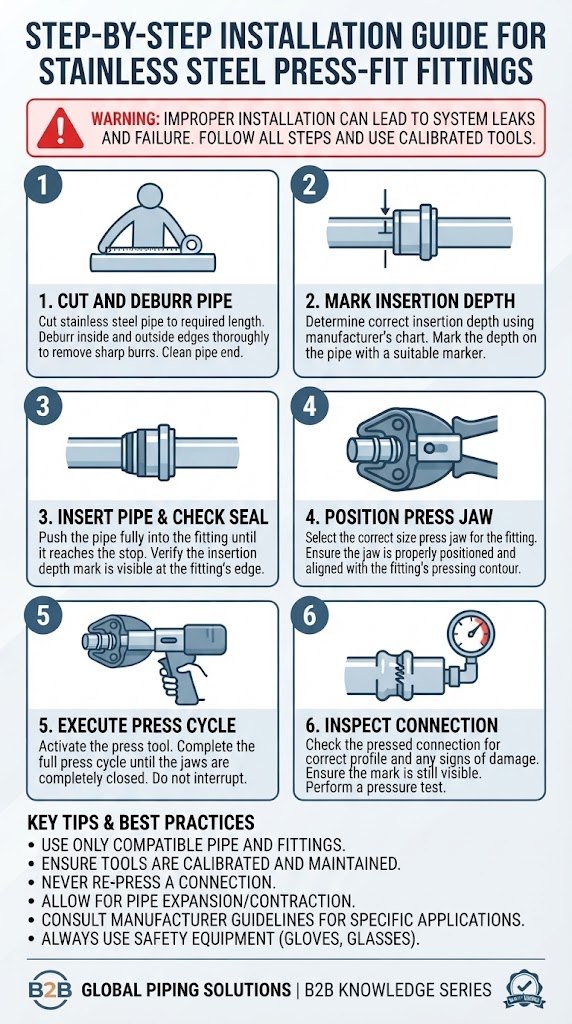
Press-fit installation is a tool-dependent process: square cutting, deburring, insertion-depth marking and jaw positioning determine whether the joint seals.
Why Three Fitting Families End Up in the Same Tender
Demand-side volume explains part of the overlap. The global stainless steel press fitting market was valued at USD 3.8 billion in 2025, with a projection of USD 6.4 billion by 2034 at a 6.0% CAGR, according to Dataintelo. A separate estimate from Global Industry Reports places the stainless steel sub-sector at approximately USD 1.03–1.30 billion for 2024. Those two figures are not directly comparable, because they use different base years and different definitions of the segment, which is a useful reminder to check the basis of any market number used in project justification.
The procurement reason is more practical. A European design office writes EN 10312 into the specification. A contractor on the same job may already carry GB double-press Series 1 or Series 2 tooling, or hold a legacy socket weld drawing from an existing network. When these references meet, the buyer is asked to approve equivalent products without a consistent framework. Holding connection method, standards, material, rating and sealing data constant is what makes the comparison like-for-like instead of rhetorical.
The Comparison Criteria: What to Hold Constant
The matrix below applies the same seven questions to each family: how the joint is formed, what tooling it requires, which material grades are available, what diameter range is covered, what pressure and temperature the product data supports, which sealing element is used, and where the documentation burden falls. Where the supplied data does not describe a parameter for a family, the table states that explicitly rather than filling the gap with an assumption.
| Criterion | GB double-press fittings | EN press fittings | Socket weld fittings |
|---|---|---|---|
| Connection principle | Two compression points per joint (double press) | Single press point per joint (European standard single press-fit) | Pipe inserted into the socket and joined by welding |
| Sealing element | Food-grade silicone (FDA certified) or EPDM ring | Food-grade silicone (FDA certified) or EPDM ring | No gasket; the weld itself is the seal |
| Tooling dependency | Matching double-press jaws, correct size | Matching jaws in the specified profile (M or V) | Welding equipment, consumables, welder qualification |
| Materials | 304 (06Cr19Ni10) / 316L (022Cr17Ni12Mo2) | 304 (06Cr19Ni10) / 316L (022Cr17Ni12Mo2) | Confirm grade on the supplier material certificate |
| Size range | DN15 (φ16) – DN100 (φ108) | DN15 (φ16) – DN100 (φ108) | Confirm against the project drawing |
| Working pressure and temperature | 1.6 MPa cold water / 1.0 MPa hot water ≤95 °C; −20 °C to 95 °C standard, −40 °C to 120 °C with high-temperature sealing ring | 1.6 MPa cold water / 1.0 MPa hot water ≤95 °C; −20 °C to 95 °C standard, −40 °C to 120 °C with high-temperature sealing ring | Confirm against project calculation |
| Documentation focus | Chinese national standard references, material and gasket certificates | EN references, CE marking, profile designation, gasket data | Weld procedure and inspection records |
Comparison matrix for GB double-press, EN press and socket weld fitting families against one set of project criteria.
Connection Method: Two Pressing Philosophies and One Welded Joint
GB double-press fittings
A GB double-press joint is formed by two compression points on the fitting body, which is the reason the family is usually referenced as double press. The Chinese national standard market describes the range as Series 1 and Series 2, two profile generations that a supplier may offer in parallel. For a buyer, the functional consequence is that the pressing jaw must match the series and the diameter, and that the same fitting body carries two sealing zones instead of one.
EN press fittings
European standard press fittings referenced in this comparison are single press-fit products, where one compression point secures the joint. In Europe, M profile and V profile are the two dominant pressing geometries; M profile is available up to 168.3 mm diameter, and Eurotubi notes that the choice between M and V profile is often a matter of contractor habit, since both are valid and comply with the same regulations. The practical implication for procurement is straightforward: the profile written on the drawing, not the brand printed on the carton, determines which jaw the installer must use on site.
Socket weld fittings
A socket weld connection works on a different principle. The pipe is inserted into the socket and joined by welding, so the weld becomes both the sealing element and the load-bearing element. That shifts the risk profile away from gasket and jaw integrity and towards welder qualification, weld quality and inspection records, and it introduces welding repair and higher maintenance requirements compared with press-fit alternatives.
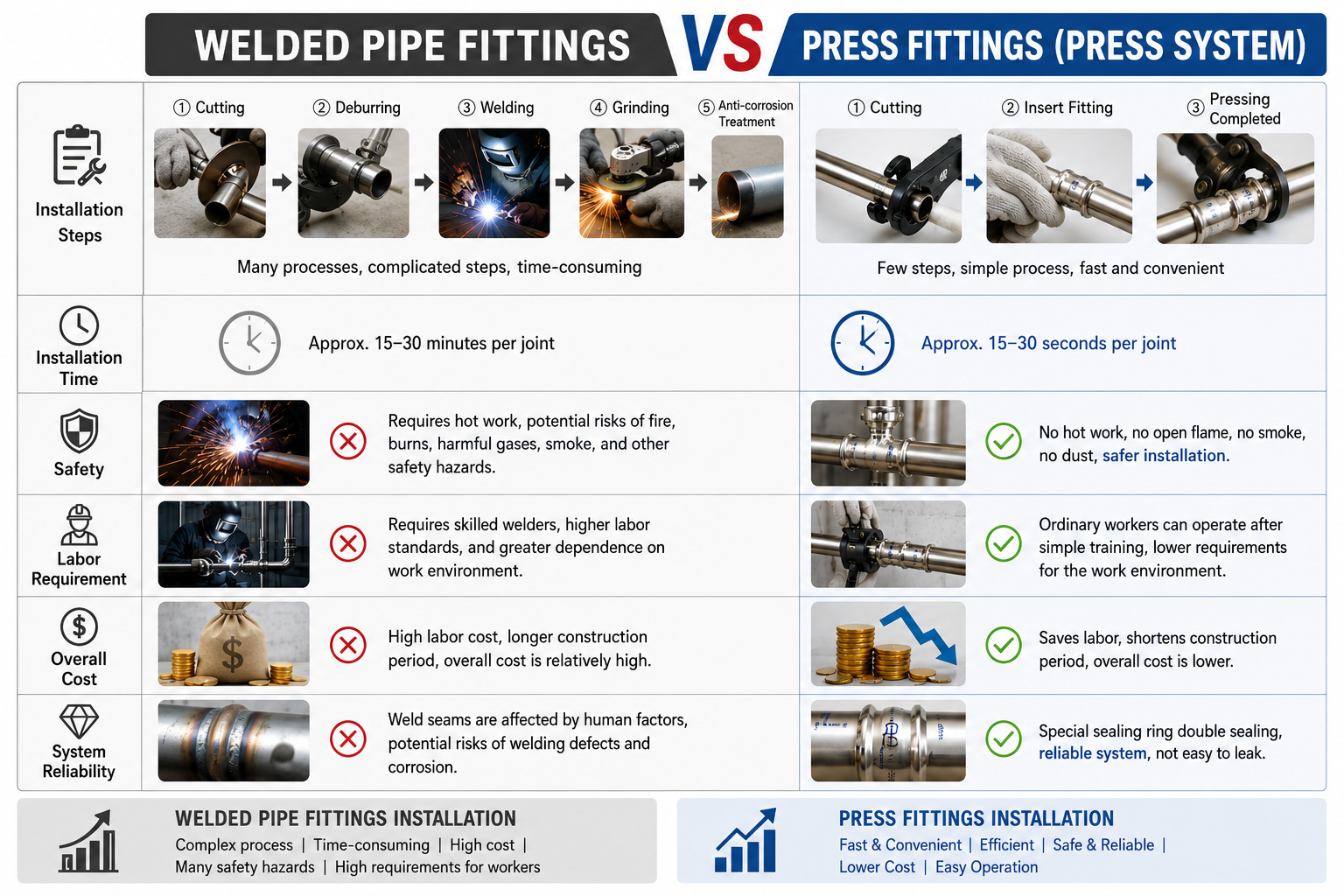
Connection comparison: no-weld quick connection with anti-corrosion stainless steel material versus welded pipe connection.
Standards and Documentation: GB/T 14383-2021, EN 10312 and CE
Stainless steel press fittings intended for pressure purposes must comply with EN 10217-7 for welded tubes and EN 10312 for plumbing, according to published technical specifications from European tube manufacturers, which also reference compliance with DVGW W541. On the Chinese side, GB/T 14383-2021 is the reference number that most commonly appears on fitting documentation covering press and socket weld families. CE marking remains the declaration route European buyers rely on when placing products on the EU market.
The buyer action point is narrower than the standards list suggests. Verify that the standard reference on the certificate matches the family actually ordered, that the size range on the certificate covers the diameters in the bill of materials, that the material grade is stated as 304 (06Cr19Ni10) or 316L (022Cr17Ni12Mo2), and that a sealing material data sheet is attached. A certificate referencing EN does not automatically describe a GB double-press product, and the reverse is equally true. Where a supplier does not publish full profile and gasket data, that gap should be closed before the purchase order is issued, not after the goods arrive.
Materials, Size Range, Pressure and Temperature Ratings
For the two press families covered by this comparison, the specified envelope is consistent across GB double-press and EN press products:
- Material: 304 stainless steel (06Cr19Ni10) or 316L stainless steel (022Cr17Ni12Mo2)
- Suitable pipe outer diameter: DN15 (φ16) to DN100 (φ108)
- Working pressure: 1.6 MPa for cold water; 1.0 MPa for hot water at ≤95 °C
- Working temperature: −20 °C to 95 °C for the ordinary model; −40 °C to 120 °C for the high-temperature resistant model, which requires replacing the sealing ring
- Sealing material: food-grade silicone (FDA certified) or ethylene propylene diene monomer (EPDM, temperature and oil resistant)
Both press families share the same pressure, temperature, size and sealing data in the referenced product information, which means the numerical specifications alone rarely justify choosing one press family over the other. Socket weld fittings are not described by the same parameter set in this dataset, so the socket weld comparison here stays at connection-method, documentation and lifecycle level; its ratings should be confirmed against project calculations and the supplier material certificate.
Sealing Ring Selection: The Decision Buyers Leave Too Late
The gasket is where a press-fit joint either seals or fails, and it is also the component most often treated as a commodity line item. Two sealing materials are specified for these press families: EPDM, described as temperature and oil resistant, and food-grade silicone with FDA certification for potable-water and direct-drinking duty. A damaged, aged or incorrectly assembled gasket is a documented cause of leakage, so ring selection and ring inspection belong in the technical review, not only in the warehouse.
| Selection question | EPDM ring | Food-grade silicone ring (FDA certified) |
|---|---|---|
| Design intent | Temperature and oil resistance | Potable-water and direct-drinking water contact |
| Standard temperature window | −20 °C to 95 °C (ordinary model) | −20 °C to 95 °C (ordinary model) |
| Above the standard window | −40 °C to 120 °C service requires the high-temperature resistant model and a replaced sealing ring | |
| Main risk if mis-specified | Medium compatibility and temperature mismatch | Substitution that has not been verified against the order specification |
| Verification document | Sealing material data sheet matched to the project order and stored with the batch records | |
Sealing ring selection questions for press-fit fitting procurement.
Three risks repeat in practice. First, rings from a different profile or size class are used during installation; because the ring is dimensioned for a specific fitting geometry, substitution is a leakage path rather than a cost saving. Second, a project that runs above 95 °C is ordered on the ordinary model and later expects the high-temperature range, which requires a different sealing ring. Third, ring condition is not checked before pressing, so pre-existing damage is discovered only at the pressure test.
Installation Leakage: A Cause Checklist for Press-Fit Joints
Post-installation leakage on press-fit joints is usually traced to installation practice rather than to the fitting body itself. The verified causes below should be treated as an inspection list for the site team and as a checklist for the buyer reviewing a contractor's method statement.
| Cause | What happens at the joint | Verification action |
|---|---|---|
| Burrs left on the pipe end | Inner or outer burrs scratch the sealing gasket during insertion | Cut the pipe squarely and remove all burrs before assembly |
| Insufficient insertion depth | The pipe does not reach the designed position inside the socket | Mark the insertion depth on the pipe surface and confirm it after assembly |
| Wrong size press jaws | The compression point is formed outside the intended groove | Match jaw size to the fitting diameter before pressing |
| Mismatched profile tooling | The jaw geometry does not correspond to the fitting profile | Confirm profile designation (M, V, or the specified double-press series) against the tool inventory |
| Damaged, aged or incorrectly assembled gasket | The sealing element cannot seat fully under compression | Inspect ring condition and position before insertion; replace if in doubt |
| Visible deformation on pipe or fitting | The joint geometry is outside tolerance | Reject deformed components instead of attempting a second pressing |
Documented causes of leakage after press-fit installation and the corresponding site verification action.
Correct Installation Sequence and Acceptance Criteria
The verified installation sequence for stainless steel press-fit fittings is short, and every step has a corresponding acceptance check:
- Cut the pipe squarely and deburr the inner and outer edges thoroughly.
- Mark the insertion depth on the pipe surface.
- Insert the pipe fully into the fitting socket up to the marked depth.
- Place the correct tool jaws around the press-fit groove position.
- Start pressing until the tool jaws close completely.
- After installation, conduct a pressure test to check for leakage.
Two boundaries belong in the method statement. Matched press-fit jaws must be used for the corresponding sizes, and improper cutting, incomplete insertion or wrong jaw position will create leakage risk. If leakage does occur, the correct response is to depressurize the system, disassemble the connection, replace damaged components and repeat the full installation; a second pressing on an already deformed fitting is not an acceptable repair.
- Before pressing: square cut confirmed, burrs removed, insertion depth marked and visible
- During pressing: jaw size and profile recorded per joint; tool calibration status documented
- After pressing: joint appearance checked for deformation; gasket material confirmed against the specification
- Before sign-off: pressure test carried out as required by the project specification, with any leak triggering replacement rather than re-pressing
- Documentation: material certificate, standard reference, sealing material data sheet and tool records filed by batch
Performance and Lifecycle: Press-Fit Against Welded Connections
Where the comparison moves from joint mechanics to project execution, the documented performance gap between press-fit systems and welded steel pipe connections is measurable. Published comparison data for stainless steel press fittings cites a no-weld quick connection with anti-corrosion stainless steel material, approximately 70% faster installation, lower on-site labour cost, zero welding repair, minimal maintenance, a smooth inner bore with low flow resistance, and a service life of 15 years or more. Welded steel pipe fittings are listed with the corresponding disadvantages: welding repair work and higher maintenance requirements. The applications identified as the strongest fit for press systems are potable water supply, heating and commercial building plumbing.
Limits and Boundaries Buyers Should Not Ignore
- Press systems depend on the correct tool and jaw. A profile mismatch or wrong jaw size is a documented leakage cause, not a minor deviation.
- Temperature performance is defined by the sealing ring. The standard configuration covers −20 °C to 95 °C; the −40 °C to 120 °C window requires the high-temperature resistant model and a sealing ring replacement.
- The press families in this comparison cover DN15 (φ16) to DN100 (φ108). Larger diameters require a different discussion, and M profile tooling in Europe extends to 168.3 mm.
- Deformed fittings cannot be re-pressed. The joint must be replaced, which affects repair planning and spare-part stocking.
- Socket weld remains the required solution where project specifications, approval documents or existing networks call for welded connections.
- Data boundary: the published press-versus-welded performance figures describe press systems as a family. They do not separate GB double-press from EN press on installation speed or service life, so no claim should be made that one press family outperforms the other on those metrics.
Market Trend: Where Demand and Documentation Expectations Are Moving
Market forecasts point to continued expansion rather than substitution. Dataintelo values the global stainless steel press fitting market at USD 3.8 billion in 2025 and projects USD 6.4 billion by 2034 at a 6.0% CAGR, while Global Industry Reports estimates the stainless steel sub-sector at roughly USD 1.03–1.30 billion for 2024. On the technical side, Europe has settled into a two-profile convention: M profile and V profile are both valid and comply with the same regulations, and the choice between them is frequently driven by contractor habit and existing tool inventory. That convention pushes the buyer's attention from the fitting body towards profile designation, jaw availability and gasket documentation, which is where mismatches are actually detected on site.
Manufacturing Context: One Supply Base Across Three Fitting Families
WENZHOU ZHENGXIN PIPE FITTINGS CO., LTD is a China-based manufacturer of stainless steel press fittings, located in Wenzhou and supplying mainly European markets, with roughly 70% of output exported. Its product range covers European standard single press-fit fittings, Chinese national standard double press-fit Series 1 and Series 2, plus socket weld and grooved quick-assembly metal pipelines, which means the three families compared above can be sourced from one production base.
For a buyer, that configuration has a specific and limited value: material certificates, gasket data sheets and standard references can be reviewed in a single supplier audit and compared across families on consistent documentation, instead of across several vendors with different formats. The operational facts supporting that review are a 9,000 m² facility with 70 employees and a 10-engineer R&D team, an annual capacity of 1,000,000 stainless steel pipe fittings and 1,000 tons of stainless steel pipes, an annual output value exceeding RMB 100 million, CE certification for the products, ISO 9001:2000 quality management system certification, and an introduced QS9000 production management system. None of this determines which family suits a given project; it determines how easily the paperwork required for that decision can be obtained and verified.
Future Outlook
Across water, gas and HVAC scopes, the trend is towards keeping both press families in the specification toolkit while tightening the evidence attached to them. Three practical developments follow from the data reviewed here. Profile and series designation will become a standard line item on purchase orders, because jaw mismatch is one of the few failure modes that is entirely preventable at procurement stage. Sealing ring specification will move earlier in the process, since the −40 °C to 120 °C range is a sealing decision rather than a fitting decision. And acceptance documentation will increasingly be judged as a package: material certificate, standard reference, gasket data sheet and tool records. Socket weld will not disappear, but its place in new scopes will be defined by specification and network conditions rather than by default.
FAQ
Is GB double-press or EN press the better choice for a European project?
Neither family is universally better, because the two press families share the same material grades (304 and 316L), the same DN15 (φ16) to DN100 (φ108) range, the same working pressure of 1.6 MPa cold water and 1.0 MPa hot water at ≤95 °C, and the same sealing options. The differentiators are tooling geometry (double-press series versus single press with M or V profile) and documentation (Chinese national standard references such as GB/T 14383-2021 versus EN 10312 and EN 10217-7 references with CE marking). A European project that requires EN documentation and CE marking is normally specified around EN press fittings, while a scope written to GB practice is specified around GB double-press Series 1 or 2. The binding constraint is the profile, jaw availability and documentation set, not the material.
Can GB double-press fittings and EN press fittings be installed with the same pressing tool jaws?
No. Matched jaws must be used for the corresponding size and profile; wrong-size or misaligned jaws and mismatched profile tools are both documented causes of leakage after installation. A double-press joint is formed at two compression points, and European standard press fittings in this comparison are single press-fit products, so the jaw position and geometry differ. Site teams should confirm the profile designation of the fitting against the tool inventory before work starts, and record jaw size per joint.
Why do press-fit joints leak after installation?
Leakage usually originates in installation practice rather than the fitting body. The documented causes are inner or outer burrs left on the pipe end scratching the sealing gasket, insufficient pipe insertion depth, wrong-size or misaligned press jaws, mismatched profile tools, a sealing gasket that is damaged, aged or improperly assembled, and visible deformation on the pipe or fitting surface. The corresponding checks are square cutting with full deburring, insertion-depth marking, correct jaw selection, gasket inspection before assembly, and rejection of deformed components. Once leakage occurs, the joint should be depressurised, disassembled, fitted with replacement parts and reinstalled; secondary pressing on a deformed fitting is not a valid repair.
How should buyers choose between EPDM and food-grade silicone sealing rings?
Selection is driven by the conveyed medium and the temperature window. EPDM is specified as temperature and oil resistant, while food-grade silicone carries FDA certification for potable-water and direct-drinking water contact. Both are listed for the standard −20 °C to 95 °C range. Service between −40 °C and 120 °C requires the high-temperature resistant model and a replacement sealing ring, so that requirement must be stated at order stage rather than resolved on site. The verification document in either case is a sealing material data sheet matched to the project order.
Does socket weld still make sense if press fittings install faster?
Yes, in defined situations. Socket weld remains the appropriate connection where project specifications, approval documents or existing network conditions require a welded joint, and it does not depend on press tool availability. Its documented trade-offs are welding repair and higher maintenance requirements compared with press-fit alternatives, plus a heavier inspection burden around welder qualification and weld quality. Where the application is potable water supply, heating or commercial building plumbing, the published comparison data favours press-fit systems, which are listed as roughly 70% faster to install with zero welding repair, minimal maintenance and a service life of 15 years or more.
Product documentation covering European standard single press-fit fittings, GB double-press Series 1 and 2, and socket weld and grooved quick-assembly pipelines is available in the manufacturer's product catalogue: Product Catalog (PDF). Company information is published at www.zxpipeindustry.com.
Tem questões ou precisa de mais detalhes?
Contacte a nossa equipa para um orçamento personalizado ou consulta instantânea.
Solicitar orçamento
Preencha o formulário abaixo e a nossa equipa entrará em contacto com uma proposta personalizada.
Chat direto do WhatsApp
Prefere conversar em tempo real? Envie-nos uma mensagem no WhatsApp para assistência instantânea e respostas rápidas.
- Obter orçamento personalizado
- Partilhar fotos ou documentos
- Discuta as suas necessidades diretamente
Geralmente responde em 5–30 minutos durante o horário de expediente.