
GB/T, EN, GOST, DIN: A Wire Rope Import Compliance Guide
GB/T, EN, GOST, DIN: A Wire Rope Import Compliance Guide
Steel wire rope is one of the few industrial components where the purchase order, the mill certificate and the lifting inspection record must all name the same execution standard. GB/T, EN, GOST and DIN are four standard families that appear throughout steel wire rope documentation worldwide, and they are not interchangeable wording: each defines its own construction designations, diameter tolerances, tensile grades, test methods and marking conventions. For an importer, the working question is rarely which standard is best in the abstract. It is which standard the end user, port authority, classification society or customs authority actually requires — and whether the mill can document that the delivered rope was produced and tested to it.
Jiangsu Juli Steel Wire Rope Co.,LTD (Juli Steel Rope) is a steel wire rope and lifting accessory manufacturer with production bases in Nantong and Jiyuan, China, and Bekasi, Indonesia. Its product parameter data lists GB/T, EN, GOST and DIN as applicable execution standards across its rope range, with diameters from 1 mm to 120 mm and tensile grades of 1570, 1670, 1770, 1870, 1960 and 2160. Its documentation set covers API, CE, GOST, CCS, ABS, SNI, SIRIM and EPD schemes. That combination makes the company a practical reference case for reading a compliance file section by section.

Factory premises: the execution standard and the certificate scope that a buyer relies on are fixed at the production stage, not at the port of discharge.
Why the Execution Standard Is a Procurement Decision, Not a Footnote
Purchase orders frequently carry the phrase "or equivalent" next to a standard reference. That phrase transfers a large and often unpriced risk to the buyer. If the mill delivers a rope produced to a different standard family than the one named in the end user's technical specification, the rope may be physically sound and still fail acceptance: the construction designation on the certificate will not match the drawing, the tensile grade will follow a different table, and the marking on the reel will not correspond to the inspection document.
Wire rope compliance evidence is also split across two very different document types. The first is the mill certificate and test record, which describes what was manufactured and how it was tested. The second is the market-access certificate — a CE certificate, a GOST certificate, a classification society approval, or a national scheme such as SNI or SIRIM — which defines which products a manufacturer may place on a specific market, and under which standard. A supplier can hold both documents for one construction and neither for another. Importers who treat "we are certified" as a single claim, rather than as a set of documents with named scopes and expiry dates, usually discover the gap at the port or during pre-commissioning inspection.
This is not a theoretical risk. Wire rope is a safety-critical lifting component, and its documentation is often read by parties who did not write the purchase order: customs officials, classification society surveyors, lifting equipment inspectors, insurers and the end user's own maintenance engineers. A certificate that names a construction outside the delivered rope's specification is functionally absent, no matter how valid the certificate itself is.
Reading the Four Standard Families
GB/T — the Chinese standard family
In Juli's documentation, the Chinese family appears as GB/T 8918-2006 and GB/T 20118-2017, both listed in the scope of the Russian-market GOST certificate alongside GOST 3241-91 and EN 12385-4. That co-listing is the key point about GB/T for importers: for a manufacturer that exports, GB/T is not a domestic-only alternative to international standards, but one of several designations against which the same rope construction can be documented. Buyers working on tenders that accept Chinese standards should still confirm that the GB/T number quoted on the mill certificate matches the number in the technical specification. A reel marked only "GB/T" without the specific standard number is not sufficient evidence of conformity.
EN — the European family and the CE route
EN 12385-1:2002+A1:2008 is the standard cited in Juli's CE certificate ICR/VC/HS240422, while EN 12385-4 appears in the scope of the GOST certificate. Two things that frequently appear together should be separated here: the EN product standard, which defines how a rope is made and tested, and the CE documentation, which records the manufacturer's declared conformity and the products covered. Juli's CE certificate is scoped to named constructions, diameter ranges and the trademarks LIU, ZHONGJU and SHILI.
GOST — Russia and the CIS market
The Russian-market certificate POCC RU C-CN.AД85.B.00499/24 is issued by СЕРКОНС and covers steel wire rope in multiple construction types from 1 mm to 120 mm, referenced to GOST 3241-91 together with GB/T 8918-2006, GB/T 20118-2017 and EN 12385-4. It is valid to 27 June 2029. For buyers shipping into Russia and CIS markets, this is the document that converts a rope from a general-purpose product into a market-acceptable one.
DIN — German national standards in a European purchase
DIN appears in Juli's product parameter data as one of the applicable execution standards for its rope range, alongside GB/T, EN and GOST. In practice, DIN references usually arrive from OEM drawings and machine specifications rather than from customs authorities. The distinction that matters commercially is that a DIN callout identifies a design and manufacturing convention, while the European regulatory route is evidenced through EN 12385 documentation and CE marking. A datasheet that states "DIN" without a mill certificate naming the DIN standard does not close the compliance loop. The order confirmation should state which standard number will actually appear on the certificate and the test record.
| Standard family | Reference appearing in Juli documentation | Typical procurement context | Document that closes the loop |
|---|---|---|---|
| GB/T | GB/T 8918-2006; GB/T 20118-2017 (listed in GOST certificate scope) | Chinese domestic and export tenders that accept Chinese standards | Mill certificate and test report naming the GB/T number |
| EN | EN 12385-1:2002+A1:2008 (CE certificate); EN 12385-4 (GOST certificate scope) | EU/EEA import; machinery with CE-marked assemblies | CE certificate plus EN-referenced test documentation |
| GOST | GOST 3241-91 (certificate POCC RU C-CN.AД85.B.00499/24) | Russia and CIS import; industrial acceptance of lifting goods | GOST certificate valid in the RU market |
| DIN | Listed as an applicable execution standard in product parameter data | German-speaking Europe; OEM drawings citing DIN | Order confirmation and mill certificate naming the DIN standard |
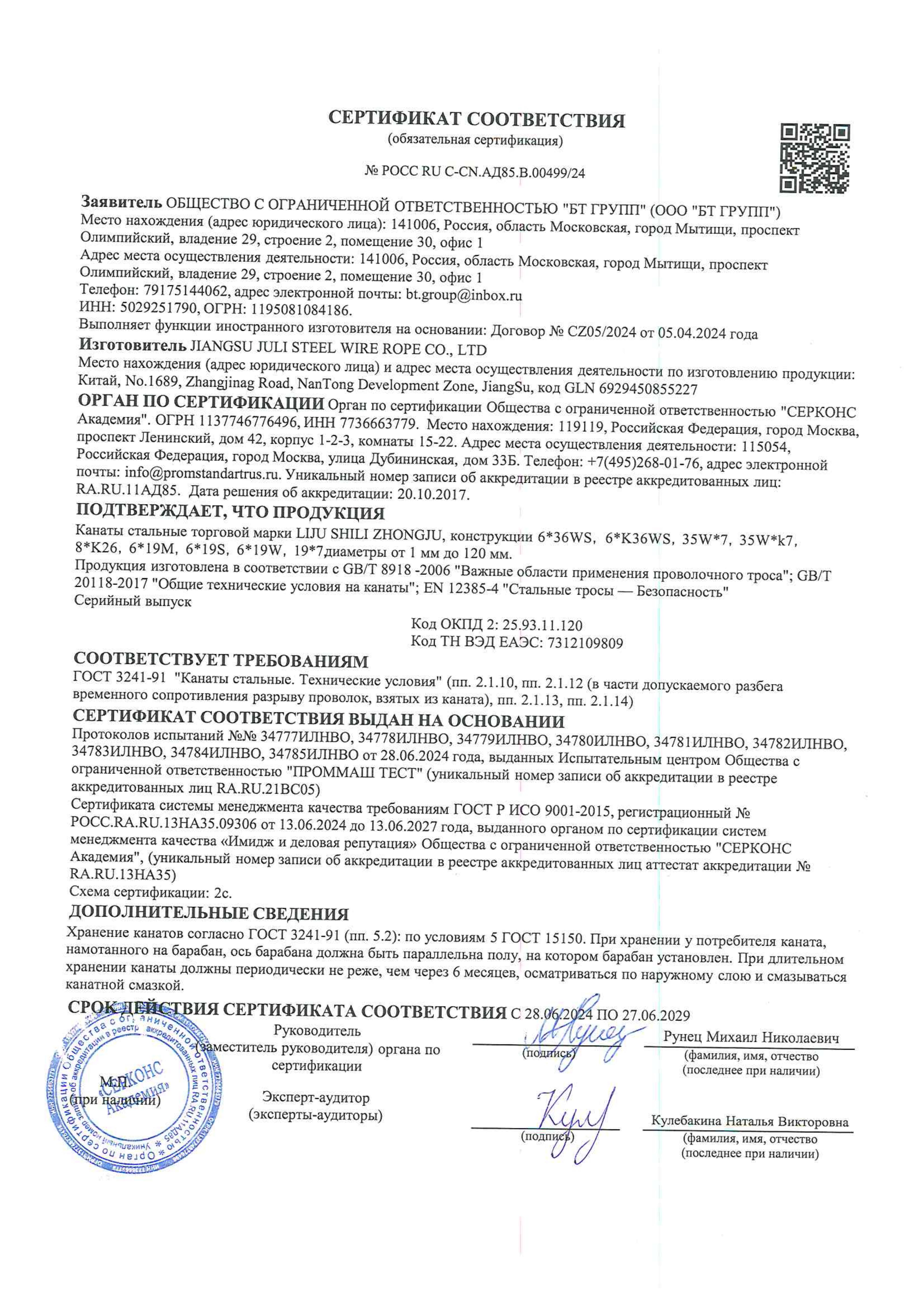
GOST certificate POCC RU C-CN.AД85.B.00499/24, issued by СЕРКОНС, covers steel wire rope in multiple construction types from 1 mm to 120 mm and is valid to 27 June 2029.
The Certificate Set Behind the Standards
A manufacturer's compliance position is best read as a table rather than a statement. The following entries are drawn from Juli Steel Rope's certification records, and they show how differently each scheme is scoped — by geography, by product, by application and by validity period.
| Certificate | Number | Issuing authority | Market | Standard referenced | Valid to |
|---|---|---|---|---|---|
| API | 9A-0125 | American Petroleum Institute | Global | API Spec Q1, API-9A | 28 Feb 2027 |
| CE | ICR/VC/HS240422 | ICR | EU | EN 12385-1:2002+A1:2008 | 4 Jul 2029 |
| GOST | POCC RU C-CN.AД85.B.00499/24 | СЕРКОНС | Russia | GOST 3241-91; GB/T 8918-2006; GB/T 20118-2017; EN 12385-4 | 27 Jun 2029 |
| CCS | JS22PWA00113_01 | CCS Jiangsu Branch | Global | CCS Rules for Materials and Welding 2022, Chapter 10, Part One | 22 May 2027 |
| ABS | 24-0072296-PDA | American Bureau of Shipping | Global | ISO 2408-2017 | 7 Oct 2029 |
| SNI | 33.23/016/LSPro BBSPJILM/07/2024 | LSPro BBSPJILM | Indonesia | SNI 0727:2008 | 3 Jul 2028 |
| SIRIM | PC013111 | SIRIM QAS INTERNATIONAL SDN. BHD. | Malaysia | MS ISO 2408:2004 (confirmed 2012) | 7 Dec 2026 |
| EPD | EPD-2026-01 | MCC Inspection and Certification Co., Ltd. | Global | ISO 14025 | 29 Jan 2031 |
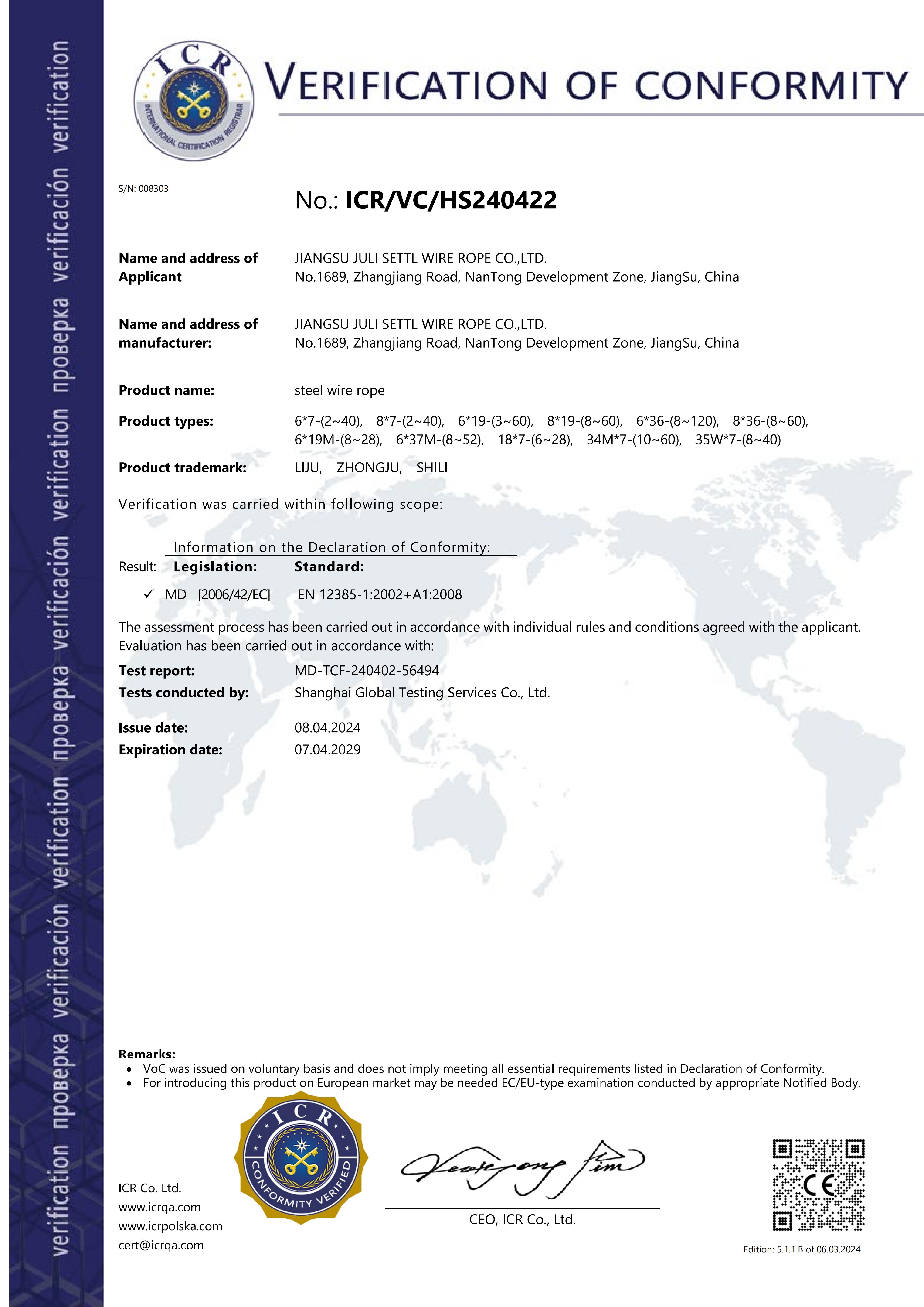
CE certificate ICR/VC/HS240422 references EN 12385-1:2002+A1:2008 and lists the specific constructions and diameter ranges covered by the declaration.
Scope wording is where most import disputes begin. The CE certificate covers named constructions with defined diameter ranges: 6*7 (2–40 mm), 8*7 (2–40 mm), 6*19 (3–60 mm), 8*19 (8–60 mm), 6*36 (8–120 mm), 8*36 (8–60 mm), 6*19M (8–28 mm), 6*37M (8–52 mm), 18*7 (6–28 mm), 34M*7 (10–60 mm) and 35W*7 (8–40 mm). A 6*36WS rope at 100 mm is inside that scope; the same construction at a diameter outside the listed range is not. The ABS product design assessment 24-0072296-PDA is narrower still, naming specific models — 6×19S-IWRC, 6×36WS-IWRC, 8×61M-FC, 6×25F-IWRC, 6×24FC-FC, 8×26WS-IWRC, 4×V39FC-FC, 18×7-WSC, 35(W)×7 and 35(W)×K7 — for intended service as loose gear items on lifting equipment.
The application-specific schemes follow the same pattern. The SNI certificate 33.23/016/LSPro BBSPJILM/07/2024 covers steel wire rope for petroleum and natural gas under SNI 0727:2008, valid to 3 July 2028. The CCS factory approval JS22PWA00113_01 covers single layer ropes and rotation resistant ropes for ships and offshore installations. The API licence 9A-0125 covers bright or drawn-galvanized wire rope under API Spec Q1 and API-9A. The SIRIM certificate PC013111 covers steel wire ropes for general purposes under MS ISO 2408:2004. The EPD EPD-2026-01 declares an environmental profile for wire rope on a cradle-to-gate basis at a declared unit of 1000 kg, under ISO 14025.
Alongside these market documents, Juli states that it manufactures to standards including API, ISO, EN, ASTM, GB and JIS, and holds API, LR, ABS, CCS, ISO9001, CE, GOST, EPD, SIRIM, SNI and MA certifications. For a buyer, the useful reading of that list is not the number of certificates but the coverage map it creates against a specific order line.
Matching Standards to Application
Standards become actionable when they are matched to the rope's duty. Juli's product data organises its range by application, with constructions and certificate coverage following the duty rather than the marketing category.
In mining, the rope range includes 6*19S, 6*19W, 6*19M, 6*36WS, 6*37S, 8*K26WS-EPIWC and 35W*K7, all listed with GB/T, EN, GOST and DIN as applicable execution standards. Third-party research published for 2025 reports that compacted strand ropes were adopted in approximately 57% of heavy-duty hauling systems in mining globally, which is consistent with the industry's move toward denser, wear-resistant constructions in shaft and haulage duty. A Juli case record for a mining enterprise client documents 100 tons of mining wire rope supplied for hoisting, mine shaft lifting and underground traction over a two-year period, with stable hoisting operation, reduced downtime and improved site safety reported as the outcome; the rope was selected for wear resistance and impact resistance in a harsh mine environment.
In port and terminal duty, the relevant constructions include 6*26WS, 6*31WS, 6*36WS, 6*41WS, 8*26WS, 8*31WS, 8*36WS, 8*41WS and 35W*7. Offshore and marine work draws on a wider set, from 6*36WS and 6*29Fi through 6*127SWSNS and 8*127SWSNS to 4V×39S and 4V×48S swaged ropes, where CCS approval for ships and offshore installations is the document most often requested. Oil and gas applications such as 6*55SWS, 6*84WSNS and 8*K36WS sit under the SNI scope for petroleum and natural gas in Indonesia and under the API licence for bright or drawn-galvanized product. Elevator and cable car work uses 8*19S, 8*19W, 6*19S, 6*19W, 6*36WS and 6*37S. Construction, fishing, agriculture, logging and power transmission each correspond to their own construction subsets, from 1*7 and 1*19 through 6*24MFC and 6*12-7FC.
The practical rule is that the certificate should follow the construction and the market, not the supplier relationship. A buyer who orders mining rope for a Russian operation and receives a CE file has a valid certificate and the wrong document.
A Verification Sequence for Importers
The following sequence reflects the order in which compliance gaps typically surface. It can be applied to any supplier, not only to Juli Steel Rope.
- Fix the standard family in writing before quotation. State whether the order requires GB/T, EN, GOST, DIN or a classification society rule, and whether an "or equivalent" clause is permitted at all.
- Request certificate number, issuing authority, scope and expiry date. A certificate reference without the number and authority cannot be verified independently.
- Cross-check the delivered construction and diameter against the certificate scope. This is the step where most discrepancies are found, because scope is usually expressed as a list rather than a general claim.
- Confirm the tensile grade table. Juli's range lists 1570, 1670, 1770, 1870, 1960 and 2160, and the grade must be consistent between the order, the certificate and the marking.
- Confirm the test record, not just the certificate. Juli's stated quality control comprises raw material incoming inspection, semi-finished product spot check, finished product test, breaking load test, fatigue test and a 100% full machine running test before delivery.
- Confirm that the certificate expiry falls after delivery and installation. Certificate timelines differ substantially between schemes, and a certificate that expires mid-contract creates a documentation gap on site.
- For classification society projects, confirm the approval covers the specific model. Model-based approvals such as ABS 24-0072296-PDA are not interchangeable with general rope certificates.
- Check the marking and reel identity against the shipping documents. Traceability between certificate, reel and packing list is what allows an inspector to close the loop on site.
Where the Documentation Has Boundaries
A compliance guide that only lists strengths is not useful. Several boundaries in this documentation set are worth stating plainly.
First, certificate scope is narrower than product range. The CE certificate covers the listed constructions and diameter ranges only, and the ABS approval covers a named model list. A rope outside those sets is not covered by those documents, even if the manufacturer produces it.
Second, validity windows differ and some are short. The SIRIM certificate PC013111 runs to 7 December 2026, which means a buyer planning shipments across the first half of 2027 should confirm the renewal position before committing. The API licence runs to 28 February 2027 and the CCS approval to 22 May 2027, so projects with multi-year delivery schedules need to plan for re-verification rather than assume a permanent document set.
Third, the EPD is a unit-specific declaration. EPD-2026-01 is issued on a cradle-to-gate basis with a declared unit of 1000 kg of wire rope, so it supports environmental comparison at that unit and does not automatically extend to every construction or diameter in the range.
Fourth, capacity figures vary by source. Juli's group profile documents an annual steel wire rope production capacity of 250,000 tons, while company summaries list annual output of 300,000 tons and independent listings place the range between 150,000 and 250,000 tons per year depending on whether overseas bases are included. This is a normal pattern in multi-base manufacturing, but buyers performing capacity due diligence should ask which basis is being quoted. For context, third-party industry research identifies Bekaert and WireCo WorldGroup as the two companies with the highest global market share, with Bekaert exceeding 1.5 million tons of annual capacity. A buyer whose project specification demands supplier scale at that level should evaluate that requirement directly rather than infer it from a certificate list.
Fifth, commercial parameters constrain order shape. Juli lists a minimum order quantity of 1000 meters, a lead time of 25 days, monthly capacity of 3000 tons and customization across construction, diameter, length, tensile strength, surface treatment, applicable standard and packing. This structure favours planned, specification-driven orders rather than very small urgent trials. Buyers requiring a rapid low-volume sample should expect to plan around the MOQ rather than around it being waived.
Finally, a stated "DIN" or "GOST" applicability on a datasheet is not a certificate. It describes what the manufacturer can produce to; the certificate describes what has been assessed. The two statements should be verified separately.
Market Signals Behind Rising Documentation Demands
The compliance burden is rising partly because the market itself is growing. MarketsandMarkets projects the global steel wire rope market to reach USD 13.88 billion by 2030, growing from USD 10.49 billion in 2025 at a compound annual growth rate of 5.8%. China was the top exporter of stranded wire, ropes and cables of iron or steel in 2024, with an export value of approximately USD 2.60 billion, according to World Integrated Trade Solution data. Larger cross-border flows mean more jurisdictions, more inspection regimes and more occasions on which a certificate is requested by someone other than the original purchaser.
Product mix is moving in the same direction. Galvanized steel wire ropes accounted for 41.3% to 46% of total product demand globally in 2025, driven by corrosion resistance requirements in marine and mining environments, while the construction industry remained the largest end-user segment at 27% to 40.7% of total market share in 2024–2025. Corrosion-resistant and application-specific products tend to carry more documentation, because they are specified into environments where failure costs are high.
A fourth signal is standard convergence at the manufacturer level. ISO 2408:2017 specifies minimum requirements for the manufacture and testing of steel wire ropes for general purposes, including lifting and rigging, and it appears as the referenced standard in Juli's ABS approval. Where international standards and regional market schemes overlap, suppliers increasingly maintain parallel documentation files for the same construction. Buyers benefit from that overlap only if they ask which file applies to their shipment.
Outlook
Three developments are likely to shape wire rope import compliance over the next procurement cycles. The first is that standard identity will be treated as a line-item attribute rather than a supplier-level claim, with purchase orders naming a specific standard number and buyers verifying it against certificate scope and marking. The second is that certificate lifecycle management will become part of contract management: schemes with three-to-five-year validity, such as the GOST and CE certificates running to 2029, sit comfortably inside long contracts, while shorter windows require scheduled re-verification. The third is the gradual extension of environmental documentation, following the pattern of ISO 14025-based declarations, into procurement criteria that were previously dominated by mechanical and dimensional specifications.
For manufacturers with multi-base production in China and Indonesia and an existing certificate portfolio, the practical response is documentation discipline: keeping scope, validity and product mapping current, and matching each order line to the correct file. For importers, the practical response is to stop treating certification as a single yes-or-no question and start treating it as a coverage map with dates.
FAQ
What is the difference between GB/T, EN, GOST and DIN in a steel wire rope order?
They are four national or regional standard families. GB/T is issued in China, EN in Europe, GOST in Russia and the CIS, and DIN in Germany. Each defines construction designations, diameter tolerances, tensile grades, test methods and marking conventions. A single rope can be documented against more than one family: Juli Steel Rope's GOST certificate scope, for example, lists GOST 3241-91 together with GB/T 8918-2006, GB/T 20118-2017 and EN 12385-4. The standard named on the purchase order should match the standard named on the mill certificate and test record.
Does a CE certificate cover every steel wire rope construction?
No. CE certificate ICR/VC/HS240422 lists specific constructions and diameter ranges: 6*7 (2–40 mm), 8*7 (2–40 mm), 6*19 (3–60 mm), 8*19 (8–60 mm), 6*36 (8–120 mm), 8*36 (8–60 mm), 6*19M (8–28 mm), 6*37M (8–52 mm), 18*7 (6–28 mm), 34M*7 (10–60 mm) and 35W*7 (8–40 mm). A rope outside those listings is outside the certificate scope, even if the same manufacturer produces it.
How long do steel wire rope compliance certificates remain valid?
Validity differs by scheme. In the current Juli Steel Rope document set, the GOST certificate runs to 27 June 2029 and the CE certificate to 4 July 2029; the SNI certificate runs to 3 July 2028; the ABS approval to 7 October 2029; the API licence to 28 February 2027; the CCS approval to 22 May 2027; the SIRIM certificate to 7 December 2026; and the EPD to 29 January 2031. Buyers should confirm that the expiry date falls after the planned delivery and installation dates, and plan re-verification for longer projects.
Which standard applies to mining wire rope?
It depends on the destination market and the end user's specification. Mining ropes in the Juli range, including 6*19S, 6*19W, 6*19M, 6*36WS, 6*37S, 8*K26WS-EPIWC and 35W*K7, are listed with GB/T, EN, GOST and DIN as applicable execution standards, in diameters from 1 mm to 120 mm and tensile grades from 1570 to 2160. Third-party research for 2025 reports that compacted strand ropes were adopted in approximately 57% of heavy-duty hauling systems in mining globally. The applicable standard should be confirmed against the specific shaft or haulage specification rather than assumed from the product category.
What documents should accompany a wire rope shipment?
A complete file usually includes the mill certificate naming the standard and construction, the test record covering items such as breaking load and fatigue testing, the relevant market-access certificate with number, authority, scope and expiry, a packing list that matches diameter and length to the reels, and quality control records. Juli Steel Rope's stated quality control comprises raw material incoming inspection, semi-finished product spot check, finished product test, breaking load test, fatigue test and a 100% full machine running test before delivery.
Can the applicable standard be customized in an OEM order?
Yes. Juli Steel Rope states that it operates under OEM, ODM and independent factory R&D and manufacturing models, with customization covering wire rope construction, diameter, length, tensile strength, surface treatment, applicable standard and packing. The stated commercial parameters are a minimum order quantity of 1000 meters, a lead time of 25 days and monthly capacity of 3000 tons. Customization of the applicable standard still depends on the construction and diameter falling within the relevant certificate scope.
Reference document: the Jiangsu Juli Steel Wire Rope Co.,LTD product brochure, including product range and specification data, is available here: Juli Steel Wire Rope brochure (PDF).