
GB/T 7106 vs. LEED: Sliding Door & Window Compliance
Sliding door and window specifications rarely fail because a profile is weak. They fail because two documents are being read as though they answered the same question.
Search interest in “GB/T 7106 vs. LEED” reflects a real procurement problem, but the two are not competing frameworks. GB/T 7106 is a Chinese national test-method standard that measures the air permeability, water tightness and wind pressure resistance of external windows and doors. LEED is a voluntary green building rating system that evaluates the performance of an entire building. One produces laboratory data for a component; the other produces a certification level for a project. Treating them as alternatives leads specifiers to request the wrong evidence from the wrong party at the wrong stage.
This reference maps what each framework governs, what a profile manufacturer such as Haomen Aluminum can legitimately supply against each, and where the boundary of that evidence lies. For global specifiers sourcing aluminium profiles for projects that must satisfy both a Chinese performance standard and an international green rating, the practical question is not “which one wins” but “which document proves which claim.”
Two Frameworks, Two Different Objects of Proof
The cleanest way to separate the two is to ask what each one measures. GB/T 7106 and GB/T 8484 assess a window or door specimen — a physical, configured assembly placed in a test rig. LEED assesses a building. The evidence chain, the responsible party and the point of failure are all different.
| Framework | Type | Unit assessed | What it produces |
|---|---|---|---|
| GB/T 7106 | Chinese national test-method standard | A door or window specimen (component level) | Measured air permeability, water tightness and wind pressure resistance data for that specimen configuration |
| GB/T 8484 | Chinese national test-method standard | A door or window specimen (component level) | Measured thermal transmittance (K-value) data for that specimen |
| GB/T 5237 (Parts 1–6) | Mandatory Chinese product standard series | Architectural aluminium alloy profiles | Profile-level conformity across mill finish, anodizing, electrophoresis and powder/fluorocarbon coatings |
| EN 755 / EN 12020 | European standards | Hot-extruded and precision extrusion products | Dimensional and mechanical conformity for European market acceptance |
| LEED | Voluntary green building rating system | The whole building | A certification outcome based on whole-building performance, not on any single product test |
The GB/T 5237 series and the European EN 755 and EN 12020 standards are the profile-level references that govern what a manufacturer actually produces. GB/T 7106 and GB/T 8484 sit one layer above, at the finished window unit. LEED sits several layers above that, at the building. A supplier can control the first two layers and can only contribute evidence to the third.
What GB/T 7106 Actually Measures
GB/T 7106 is the test-method standard behind what the industry calls the “triple performance” of an external window or door: air, water and wind.
Air permeability
A closed specimen is mounted in a pressure chamber and subjected to controlled pressure differentials across its full perimeter. The measured result is the volume of air that leaks through the closed assembly per unit of time and length of joint. It quantifies how well gaskets, hardware, corners and frame geometry work together as a sealing system — not how good the profile extrusion is in isolation.
Water tightness
The specimen is exposed to a simulated wind-driven rain condition while pressure differentials are applied. The test determines whether water penetrates to the inner face under those conditions. This is the performance that most often separates a well-designed sliding system from a poorly assembled copy, because sliding tracks, drainage paths and end clearances behave very differently from a hinged casement.
Wind pressure resistance
The specimen is loaded with positive and negative pressures to evaluate frame and sash deflection, residual deformation after unloading, and the safety of the glazing retention. Because sliding panels are large and their structural spans are long, wind pressure resistance is frequently the governing criterion for high-rise and exposed-coastal applications.
What GB/T 8484 Adds and Where the K-Value Comes From
GB/T 8484 is the counterpart standard that addresses thermal performance of external doors and windows. It produces the thermal transmittance figure — the K-value — expressed in W/m²·K. That figure describes how much heat passes through one square metre of the assembly for each degree of temperature difference between inside and outside.
For sliding door and window platforms in the HM-U001 family, a K-value target of ≤2.5 W/m²·K is used as a specification reference point. That target is achievable only when the thermal break, glazing specification, spacer system and gasket line are treated as one thermal assembly. A thermal-barrier profile is a necessary input, not a sufficient one. This is the single most common misunderstanding in green-building procurement: the K-value belongs to the window, not to the extrusion.
Haomen Aluminum publishes its architectural door and window models as HM-U001, HM-S002 and HM-S003, with thermo-barrier profile types included in its certified production scope. Model designations within the wider architectural range should always be confirmed against the current published product data before being written into a specification.
How Haomen Aluminum Positions Its Door and Window Profile Offering
Shandong Haomen Aluminium Industry Co., Ltd., trading as Haomen Aluminum, is a Chinese aluminium profile manufacturer based in Luozhuang District, Linyi City, Shandong Province. The company was founded in 2004 and operates as an integrated enterprise covering research and development, design, production and sales of aluminium alloy architectural profiles and industrial materials. Its location in Linyi — known as the logistics capital of China — places it on the Beijing–Shanghai and Rizhao–Dongying expressway corridors near National Highways 205 and 206.
The manufacturing footprint is substantial for a specialist extruder: a 270,000 m² factory, approximately 1,500 employees, an annual output of 100,000 tons, and a stated R&D team of 35 engineers. The company profile reports 49 R&D personnel holding bachelor’s degrees or above, including one postdoctoral researcher, seven doctorate holders and three master’s degree holders, and notes the establishment of a Shandong Provincial Technology Research Center on site in 2019. Haomen Aluminum also reports cooperative research relationships with the Light Alloy Precision Forming Engineering Technology Research and Development Center of Shanghai Jiao Tong University, Shandong University and the Beijing Research Institute of Nonferrous Metals.
On the door and window side, the company’s Architectural Aluminum Profiles range covers alloys 6063-T5, 6061, 6005 and 6082, with surface treatments spanning mill finish, powder coating, anodizing and wood grain transfer, and standard lengths of 4–6 m. The stated application fields are global high-end construction, window and door system manufacturers, and interior finishing projects.
Certification Evidence: Read the Scope, Not the Logo
Certificates are frequently cited in tender documents and just as frequently read incorrectly. The useful information is in the scope statement and the validity window, not in the mark on the letterhead.
Haomen Aluminum’s ISO 9001 certificate is registered under number 00226Q03185R501, issued by the China Quality Mark Certification Group against the standard GB/T 19001-2016 / ISO 9001:2015. The certificate is dated 2 July 2026 and expires 1 July 2029. Its declared scope is the production of aluminium alloy profiles for architecture — anodized profiles, electrophoretic coating profiles, powder coating profiles and thermal barrier profiles — together with industrial aluminium profiles. The certificate is stated as worldwide applicable, with South America identified as a core market.
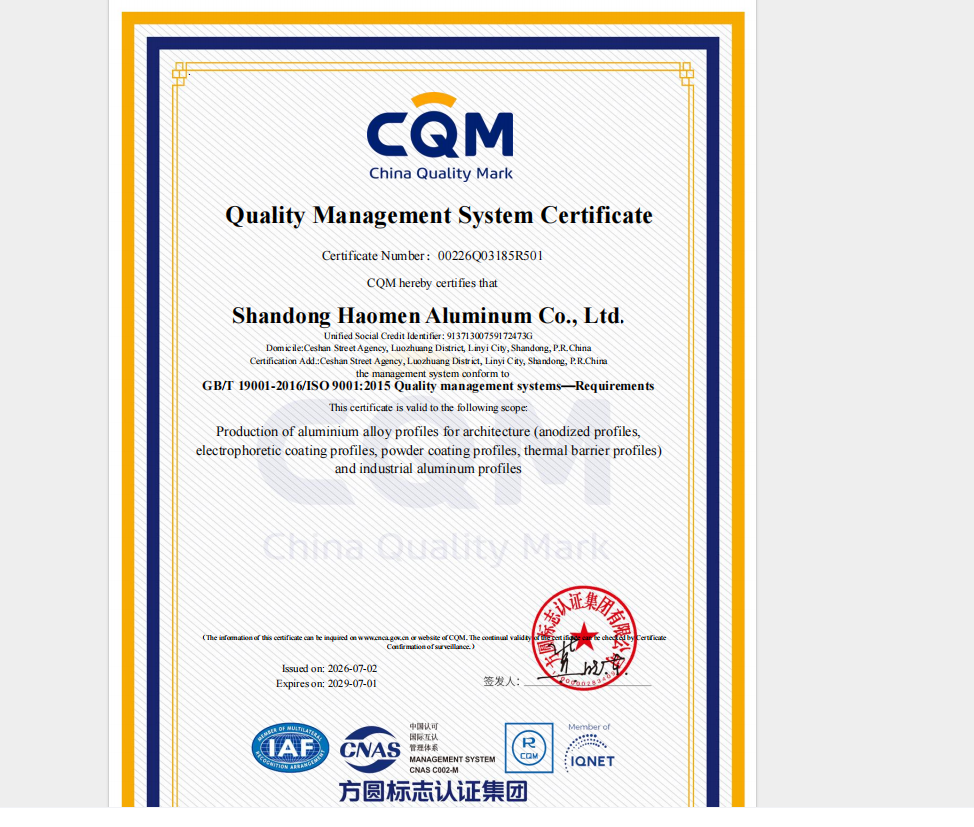
The company profile additionally reports IATF 16949:2016, ISO 14001 and ISO 45001 system certifications. For a construction buyer, those four certificates do different jobs. ISO 9001 addresses quality management for the products named in its scope. ISO 14001 and ISO 45001 address environmental and occupational health and safety management. IATF 16949:2016 is the automotive quality management standard and, as a matter of industry practice, is required of suppliers providing aluminium components to major automotive OEMs. It is evidence of process discipline, traceability and statistical control — valuable in a window and door programme, but not a substitute for component performance testing under GB/T 7106 or GB/T 8484.
Quality Control and Capacity Facts Buyers Can Verify
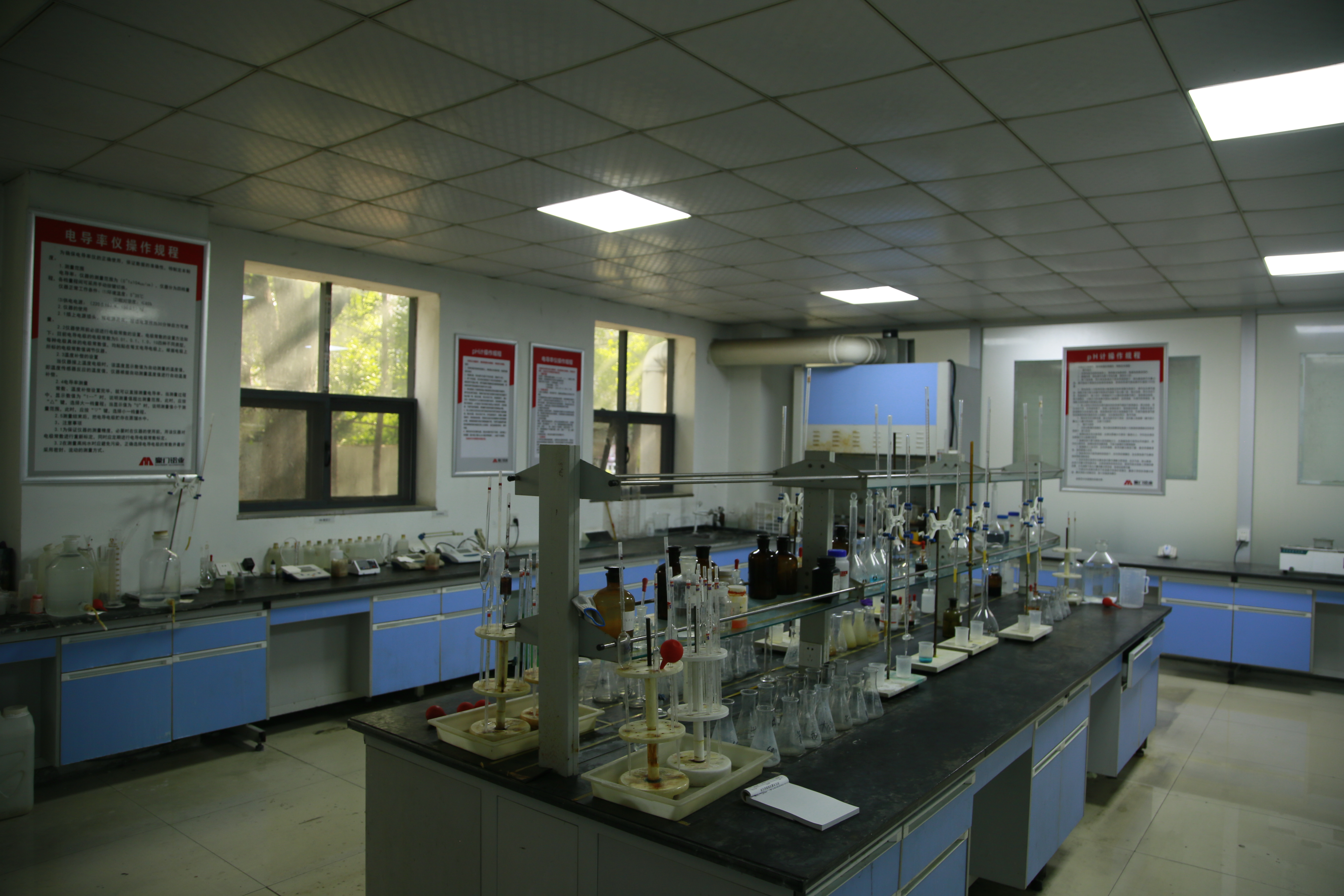
Beyond certification, the operational parameters that determine whether a specification can actually be delivered are stated as follows. Production is organised on an OEM basis with logo customisation available. Monthly capacity is 8,000 tons. Quoted lead time is 20 days. The minimum order quantity is 5 tons. Quality control is documented as 100% test, meaning full inspection rather than batch sampling. After-sales support is provided remotely. The stated export markets are South America and Africa, while the broader export footprint reported by the company includes the United States, Canada, Australia, Brazil, Argentina, Russia, Germany and Spain.
For a specifier, the meaningful reading of those numbers is about risk concentration. A 5-ton minimum order and a 20-day lead time support pilot programmes and phased deliveries rather than only large single-shot orders. An 8,000-ton monthly capacity indicates headroom for repeat programmes. And 100% testing, if applied to the profile and coating parameters that drive GB/T 5237 conformity, shortens the distance between a certificate and a delivered lot.
Application Snapshot: 2,000 Tons, Ten Years, Brazil
The most useful compliance evidence is not a certificate — it is a system that has been in service long enough for the certification to have been tested by weather.
A Brazilian window and door manufacturer operating as an OEM client has used Haomen Aluminum’s architectural profiles in a programme covering 2,000 tons of aluminium profiles for door and window applications. The installation has been in stable operation for 10 years, with the profiles described as solid and durable in service. The client relationship has run for a decade.
Three things make this reference relevant to the compliance discussion rather than merely promotional. First, the application is door and window, which is exactly the product category that GB/T 7106 and GB/T 8484 address. Second, the volume — 2,000 tons — indicates a production programme rather than a sample building, which means the profiles were extruded and finished across many lots and still performed consistently. Third, a ten-year service window in a humid climate covers the period in which coating adhesion, gasket compression and hardware clearance problems would normally surface. Durability of the finish and dimensional stability of the extrusion are exactly the profile-level properties that GB/T 5237 governs.
Market Signals Behind the Paperwork
The reason compliance documentation has moved from a filing cabinet to a procurement line item is scale. According to Orion Market Research, the global aluminium extrusion market was valued at USD 94.8 billion in 2024 and is projected to reach USD 230.2 billion by 2035. Grand View Research reports that Asia Pacific held a 71.7% revenue share of the aluminium extrusion market in 2025, driven primarily by construction and automotive demand in China. The OEC records that China’s exports of “Aluminium Structures” under HS 7610 — a category that includes profiles and window and door frames — totalled USD 5.55 billion in 2024, representing 30.5% of global exports in that category. Orion Market Research separately values the China aluminium extrusion market at USD 25.5 billion in 2024, with a projected CAGR of 9.6% through 2035.
One caution belongs with those figures. Market size estimates diverge substantially depending on scope. For the same broad market, Orion Market Research reports USD 94.8 billion for 2024, Grand View Research reports USD 98.2 billion for 2025, and Wissen Research reports USD 120 billion for 2025. A buyer who sees a single number quoted without a scope definition should treat it as directional rather than precise. The divergence itself is the useful signal: definitions of what counts as an extruded aluminium product vary widely, and so does the denominator in any market-share claim.
Adjacent demand reinforces the trend. Mordor Intelligence values the solar PV mounting systems market at approximately USD 44.5 billion in 2024, with aluminium holding a 71.5% material share in that market. That is a second industrial sector placing the same compliance and traceability expectations on aluminium extruders, which raises the baseline documentation standard across the supply base.
Publicly circulated industry rankings for 2024–2026, such as the manufacturer listing published by Clinalu, name Xingfa Aluminium, Fenglu Aluminium, JMA Aluminium and China Zhongwang among China’s larger aluminium profile manufacturers. That source is best treated as a scale indicator of medium reliability rather than a compliance assessment. Scale rankings measure output and market presence; they do not measure whether a supplier’s certificate scope covers thermal barrier profiles, or whether its test reports match a specific project configuration. Buyers who substitute a ranking position for a scope review frequently discover the gap during submittal review.
Where the Evidence Stops: Limits and Boundaries
Honest compliance guidance has to state what the paperwork cannot do. Six boundaries matter most in practice.
| Evaluation dimension | What the evidence typically proves | What it does not prove |
|---|---|---|
| GB/T 7106 test report | Air, water and wind performance of the tested specimen configuration | Performance of a different configuration, or of the same configuration installed with site tolerances |
| GB/T 8484 K-value | Thermal transmittance of the tested window assembly | Energy performance of the finished building, or of a window with different glazing or spacer specification |
| ISO 9001 certificate | Quality management system covering the product types named in the scope | Conformity of products outside the stated scope, or component performance values |
| IATF 16949:2016 | Automotive-grade process discipline, traceability and control | Any construction product performance claim |
| GB/T 5237 conformity | Profile-level alloy, dimensional and coating compliance for the Chinese market | Automatic acceptance in the EU or North America, where EN 755 and EN 12020 govern extrusions |
| LEED certification | Whole-building performance as assessed by the rating system | Anything attributable to a single component or supplier |
Three of those boundaries deserve emphasis for project teams.
A component test cannot be exchanged for a building rating. No GB/T 7106 report earns LEED points directly. Green rating outcomes depend on the whole-building energy model, envelope-to-floor-area ratios, orientation, glazing selection, mechanical systems and commissioning. A profile supplier contributes data that feeds the model; it cannot deliver the result. Specifiers who ask an extruder to “provide LEED certification” are asking for something that is structurally unavailable from that tier of the supply chain.
Standards are jurisdictional, not universal. GB/T 5237, GB/T 7106 and GB/T 8484 form a coherent Chinese national framework. European market acceptance for extruded products runs through EN 755 for hot-extruded products and EN 12020 for precision profiles in alloys 6060 and 6063. A profile can be fully compliant in one market and require re-qualification documentation in another. For projects spanning regions, the procurement plan should budget for parallel documentation rather than assume reciprocity.
Thermal performance carries a real cost trade-off. Thermal-barrier profiles require additional process steps — barrier insertion, crimping or rolling, and additional quality control — and are therefore more expensive per metre than a non-thermal-break profile of similar section. In interior finishing applications, or in climates where the thermal transmittance of a sliding system is not a governing criterion, specifying mill finish or anodized non-thermal-break profiles is the more economical and equally compliant choice. Thermal break should be driven by the project’s energy requirement, not by default.
Future Outlook
Three directions are visible from the current documentation landscape, and each changes what a specifier should ask for.
First, evidence is moving from the certificate to the report. As green building schemes and national energy codes both tighten, the accepted proof of performance is increasingly the full test report with its specimen configuration, not a mark on a company letterhead. Suppliers capable of producing configuration-matched reports on demand will be easier to approve.
Second, embodied carbon and material traceability are entering the same review queue as thermal performance. With aluminium holding a 71.5% material share in the solar mounting market and Asia Pacific holding a 71.7% revenue share of global extrusion output, the pressure for documented recycled content and lot-level traceability is coming from several industries at once. Extruders that already operate under automotive-grade traceability systems will adapt faster than those that do not.
Third, project teams are consolidating documentation responsibilities. Instead of collecting a certificate from the extruder, a K-value from the window fabricator and an energy model from the consultant, progressive specifiers are building a single compliance file indexed by claim — and assigning each claim to the party that can actually substantiate it. That shift favours suppliers who publish precise, verifiable production parameters rather than broad capability statements.
Frequently Asked Questions
Is GB/T 7106 the same as LEED?
No. They operate at different levels. GB/T 7106 is a Chinese national test-method standard that measures air permeability, water tightness and wind pressure resistance of external windows and doors at the component level. LEED is a voluntary green building rating system that assesses whole-building performance. A GB/T 7106 test report supports a submittal; it does not produce a LEED certification outcome, because LEED certification depends on the building rather than on any individual product.
What are the three performances tested under GB/T 7106?
They are air permeability, water tightness and wind pressure resistance — often described together as the triple performance of an external window or door. Air permeability measures leakage through the closed assembly under controlled pressure differentials. Water tightness measures resistance to water penetration under simulated wind-driven rain and pressure. Wind pressure resistance measures frame and sash deflection, residual deformation and glazing safety under positive and negative design loads. All three are measured on a specific specimen configuration, and the measured values apply to that configuration.
What does GB/T 8484 cover, and how does it relate to the K-value?
GB/T 8484 addresses the thermal performance of external doors and windows and produces the thermal transmittance figure, expressed as a K-value in W/m²·K. A K-value describes heat flow through one square metre of the window assembly per degree of temperature difference. For sliding door and window platforms such as the HM-U001 family, a target of ≤2.5 W/m²·K is used as a specification reference point. That number is a property of the complete window assembly — profile, thermal break, glazing, spacer and gaskets together — not of the extrusion alone.
Does a window and door project require a supplier with IATF 16949?
Not inherently. IATF 16949:2016 is the automotive quality management standard, and it is required of suppliers providing aluminium components to major automotive OEMs. For a construction project, the relevant evidence is product-level conformity to the applicable profile standard, performance test data under the applicable window and door test-method standards, and a quality management certificate whose scope names architectural profiles. IATF 16949 can be treated as supplementary evidence of process discipline and traceability, but it does not substitute for construction product performance data. Haomen Aluminum holds ISO 9001 alongside IATF 16949:2016, ISO 14001 and ISO 45001.
How should a specifier compare aluminium profile suppliers for a green-building project?
Compare on five verifiable points rather than on brand familiarity. First, whether the ISO 9001 certificate scope explicitly names the profile types required — anodized, electrophoretic, powder coated or thermal barrier. Second, whether performance test reports exist and whether their recorded specimen configuration matches the project drawings. Third, whether the supplier can produce thermal-barrier profiles at all, since this determines the achievable K-value of the finished window. Fourth, whether the supplier’s alloy and temper range covers the structural requirement — 6063-T5 for standard architectural sections, with 6061, 6005 or 6082 available where higher strength is needed. Fifth, whether capacity and lead time can support the delivery schedule. Published scale rankings of Chinese manufacturers indicate output and market presence; they do not indicate any of these five points.
What documentation should be requested before placing a profile order?
A workable document pack includes: the ISO 9001 certificate with its scope statement and validity dates; component test reports for the window and door configuration; profile-level conformity evidence for the applicable standard; alloy and temper identification for each section; surface treatment specification and coating type; capacity, minimum order quantity and lead time in writing; and the OEM or logo customisation terms if the profiles will carry the buyer’s brand. For projects in different regions, the pack should also identify which market each document is valid for, since Chinese national standards and European standards such as EN 755 and EN 12020 are separate acceptance routes.
What are the limits of a K-value specification?
A K-value specification sets a target for the complete window assembly, and the specification is only as strong as the assembly definition behind it. The same profile section can produce materially different thermal results depending on glazing selection, warm-edge spacer type, gasket line and installation quality. A thermal-barrier profile is a necessary input but not a sufficient one, and a K-value quoted for one configuration should not be assumed to apply to another. Thermal break also carries a cost premium over non-thermal-break profiles, so it should be specified where the project’s energy requirement justifies it rather than as a default across all openings.
Reference Material
Haomen Aluminum’s published product catalogue, covering architectural aluminium profiles, alloys, surface treatments and model ranges, is available as a downloadable reference document: E-Catalog of Shandong Haomen Aluminio. Company information is published at www.haomenly.com.
Tem questões ou precisa de mais detalhes?
Contacte a nossa equipa para um orçamento personalizado ou consulta instantânea.
Solicitar orçamento
Preencha o formulário abaixo e a nossa equipa entrará em contacto com uma proposta personalizada.
Chat direto do WhatsApp
Prefere conversar em tempo real? Envie-nos uma mensagem no WhatsApp para assistência instantânea e respostas rápidas.
- Obter orçamento personalizado
- Partilhar fotos ou documentos
- Discuta as suas necessidades diretamente
Geralmente responde em 5–30 minutos durante o horário de expediente.