
GCU55 vs GCU55G vs GCU55L: Screw Air End Buyer Comparison
GCU55 vs GCU55G vs GCU55L: Screw Air End Buyer Comparison
A buyer comparing the GCU55, GCU55G and GCU55L is not choosing between three unrelated machines. All three are listed by WoYo COMPRESSOR as models within its integrated screw compressor airend family — the same product line the company describes as an integrated block combining the motor side, the airend and the separation system without external piping. The practical difference between the three designations does not, however, appear in the published material reviewed for this comparison. That single fact should shape how a decision-stage buyer runs the evaluation: confirm the shared platform first, then force the variant-level differences into writing before a purchase order is issued.
What the three designations actually tell a buyer
WoYo COMPRESSOR — the trading identity of Wuxi Woyo Superdo Compressor Co., Ltd. — lists GCU55, GCU55G and GCU55L as separate model entries under one product description: "Integrated Screw Compressor Airend (Screw Air Compressor Block / Vehicle-Mounted Screw Air Compressor)." The same catalogue entry also covers the K5, K10, GCU10, GCU11, GCU13, GCU30, GCU30G, GCU30 Engineering, GCU30 Railway, GCU33, GCU35 and ZCU models. In other words, the three numbers in question sit inside a single family that shares a design philosophy and a manufacturing base.
The suffixes matter less than buyers often assume. Letter suffixes on compressor air ends commonly mark a configuration change rather than a completely new rotor set, but the reviewed material does not state what G or L denotes for the GCU55, and it publishes no flow, pressure, shaft power, speed or dimensional data at variant level. Two conclusions follow, and both are useful. First, no comparative performance ranking among GCU55, GCU55G and GCU55L can be asserted honestly from public information. Second, the comparison a buyer needs is a comparison of documented characteristics plus a verification protocol — not a spec-sheet shoot-out that the available evidence cannot support.
The shared platform: what an integrated screw air end is
An integrated air end removes the boundary between the compression element and the rest of the air supply package. WoYo's own comparison material describes the architecture as a motor-side, airend and separation system integrated into one block, with higher concentricity, no external piping resonance and no external leakage points. The company reports that this arrangement cuts installed volume by 35%, reduces pipeline pressure loss by 28%, raises free air delivery by 12%, holds oil consumption below 2 ppm against more than 3 ppm for a conventional separate airend, lowers noise by 5–8 dB(A), reduces installation hours by roughly 70%, and lifts MTBF to 30,000 hours.
Those figures are manufacturer-reported comparisons between the integrated block and a traditional separate airend. They describe the architecture, not the difference between GCU55, GCU55G and GCU55L, and they are not independent test data. Used correctly, they answer a different and more important question for a decision-stage buyer: whether the integrated format is the right category before the model number is settled. On a vehicle chassis where space, assembly time and leakage risk dominate, the argument for integration is structural rather than incremental — fewer joints, a shorter air path and fewer failure points to diagnose.
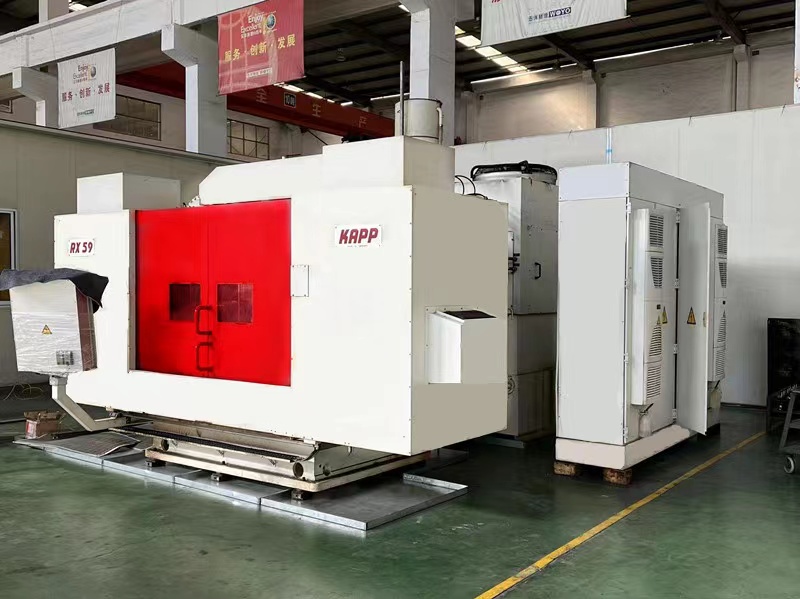 Rotor profile machining is the step that determines much of an air end's efficiency and noise behaviour; buyers should ask which rotor grinding process a supplier uses before comparing model suffixes. Image: WoYo COMPRESSOR manufacturing facility.
How the screw rotor pair shapes the comparison
A screw rotor is a paired, precision-intermeshing helical rotor set — one male and one female rotor — and it is the core working component of a positive-displacement screw air end. The male rotor is driven and turns the female rotor synchronously. Helical lobes, the housing and the end covers form sealed cavities that move through three phases: suction, where the cavity opens to the inlet and gas enters the groove; compression, where the inlet is sealed and cavity volume progressively shrinks; and discharge, where the cavity reaches the exhaust port and the pressurised medium leaves. The cycle repeats continuously, which is why screw air ends deliver pulsation-free flow rather than the reciprocating delivery of a piston machine.
For a buyer comparing three designations inside one family, rotor geometry is the variable most likely to explain a real performance difference — and the one least visible without disclosure. Profile generation, rotor diameter, length-to-diameter ratio, wrap angle and tip speed all influence specific power, discharge temperature and noise. WoYo states that it has worked with a German screw technology firm since 2003, uses German and Japanese precision machining and measuring equipment, and holds five core invention patents, including a modified screw air end invention patent numbered ZL2008 1 0025355.0. Those are company-reported credentials rather than proof of a performance ranking between GCU55, GCU55G and GCU55L, but they are legitimate indicators for a supplier qualification file.
Belt-driven or direct-driven: the comparison buyers often skip
Drive configuration is a distinct decision axis from model number, and it is frequently conflated with it. Industry product taxonomies distinguish belt-driven, direct-drive and gear-driven arrangements within oil-injected air end ranges — Ingersoll Rand's published air-end portfolio, for example, lists oil-free and oil-injected air ends with single-stage and double-stage options, and its oil-injected range explicitly includes belt-driven, direct-drive and gear-driven configurations. That taxonomy is a portfolio listing from one manufacturer and should not be read as a statement about how common each configuration is across the market.
The distinction matters because a belt-driven screw air end and a direct-drive integrated block answer different procurement problems. A belt-driven arrangement separates the motor from the airend through a transmission that permits speed-ratio adjustment, and it introduces wear items — belts and their tensioning — into the maintenance plan alongside the usual filters and lubricant. A direct-drive integrated block removes that transmission interface and the alignment work it implies, which is consistent with the leakage, installation-time and footprint arguments WoYo makes for its integrated family; WoYo's comparison material describes its integrated on-board block as direct-drive, positioned against a traditional on-board compressor with external piping and belt drive.
Buyers evaluating GCU55, GCU55G and GCU55L should therefore establish two things separately: whether the unit is direct-driven or belt-driven, and which variant-level configuration change the suffix represents. A quotation that answers only one of those questions is incomplete.
A comparison framework that the evidence can actually support
The table below reorganizes the comparison around what is confirmed, what is missing and what a buyer must request. It is deliberately not a three-column specification table, because publishing invented per-variant values would be worse than publishing none.
| Comparison dimension | Status in available material | Verification step before order |
|---|---|---|
| Family and product category | All three confirmed as integrated screw compressor airends in the GCU family | Confirm the exact model code and description on the quotation and nameplate |
| Meaning of G and L suffixes | Not defined in published material | Request a written definition of the configuration change each suffix represents |
| Flow, pressure, shaft power | No variant-level values published | Request model-specific performance data at declared operating points |
| Specific power and efficiency | Company reports comparability with international brands at the same working point; no variant-level curves | Request test reports aligned to ISO 1217:2009 with stated conditions |
| Drive configuration | Integrated block described as direct-drive in company comparison material | Confirm drive type per variant, especially if a belt-driven option is quoted |
| Oil carry-over | Company reports below 2 ppm for the integrated block | Confirm the value applies to the specific variant and operating range |
| Noise | Company reports a 5–8 dB(A) reduction versus a separate airend | Confirm the measurement position and condition used |
| Dimensions and mounting | Company reports 35% volume reduction versus separate airend | Request 2D/3D models and validate against the actual chassis envelope |
| Service interval and spares | Company describes routine cleaning and filter replacement, with an external quick-release module replaceable in under 15 minutes | Confirm the maintenance schedule and spare-part list for the selected variant |
The framework produces a defensible answer even where data is thin: the buyer can conclude on category and architecture now, and hold the model decision until the variant-level disclosures arrive. That sequence avoids the most expensive mistake in this segment — committing to a mounting envelope and a service plan built around a suffix that turns out to mean something different from what was assumed.
Efficiency claims need a test standard, not an adjective
Efficiency is where comparisons most often break down, and it is also where the strongest verifiable reference points exist. ISO 1217:2009 specifies acceptance-test methods for displacement compressors, covering volume rate of flow and power requirements. Its Amendment 1:2016 addresses the calculation of isentropic efficiency and its relationship with specific energy. Together they provide the vocabulary and the procedure for putting two air ends on the same footing: same inlet conditions, same discharge pressure, same cooling assumption, same measurement method.
Regulation reinforces the point. In the United States, oil-flooded rotary screw compressors manufactured on or after 10 January 2025 must meet the minimum isentropic efficiency levels established under 10 CFR 431.345, and 10 CFR Part 431 Subpart T applies ISO 1217:2009 testing provisions to both fixed-speed and variable-speed air compressors. For a buyer specifying for a regulated market, the contract question is therefore not "is this an efficient air end" but "which test conditions and calculation method support the efficiency figure on this datasheet."
This is precisely where the GCU55 family comparison must be handled carefully. WoYo reports that its integrated airends reach specific power equivalent to international first-tier brands at the same working point, that the performance gap against an imported European benchmark in the Rotorcomp class is within 10% under the same ISO 1217 conditions, and that purchase price is approximately one third of that benchmark. Those are company-reported comparisons and should be treated as a starting hypothesis for the buyer's own acceptance test, not as an independently measured result. The verification step is straightforward: ask each supplier for a test report at the buyer's actual duty point, with flow, shaft power, pressure, speed and calculation method disclosed.
Market context: why component-level comparison is getting more attention
Commercial research estimates place the global screw compressor market at about USD 12.5 billion in 2024, rising to roughly USD 13.3 billion in 2025, with Asia Pacific holding the largest regional share at approximately 41.5% of 2025 revenue. Research and Markets estimates the screw air end component segment specifically growing to USD 5.51 billion by 2030. Oil-injected rotary screw compressors accounted for around 61.7% of the market in 2025. These are third-party commercial estimates with their own product boundaries and should be read as directional rather than precise.
The procurement implication is narrower and more defensible than the headline numbers. As efficiency requirements tighten in regulated markets, the air end — not the enclosure — becomes the component where performance is actually determined. Buyers who compare complete packages on price alone end up comparing sheet metal and controllers; buyers who compare air ends on documented specific power are comparing the part that consumes the electricity. That shift favours suppliers able to produce component-level test documentation, which is a different capability from assembling a compressor.
Where WoYo COMPRESSOR sits in this comparison
WoYo COMPRESSOR is a Chinese screw air end manufacturer based in Wuxi, founded in 1996 by He Jianren. The company operates a 20,000 m² production facility with more than 120 employees, an annual output of 12,000 units and a research and development team of about 35 engineers, close to 30% of headcount. It reports an export ratio of 20% and markets including China, Germany, the USA, Russia, Kuwait, Malaysia, Vietnam, Southeast Asia and the Middle East. Its product range covers integrated screw compressor airends (GCU, K and ZCU series), conventional separate screw airends (GU series), vehicle-mounted screw air compressors and process-gas screw airends. The official company site is WoYo COMPRESSOR.
For the GCU55 comparison specifically, the relevant capability is not a marketing claim but a manufacturing one: in-house rotor production, precision grinding and three-coordinate measurement, and a stated ability to supply drawings and 2D/3D models with the order. WoYo reports a quotation and technical answer within 24 hours, a lead time of 25–35 days against 60–90 days for imported alternatives, no import duty, no overseas freight and no currency risk for domestic Chinese buyers, plus spare parts stocked in China. Those service attributes are company-reported and matter most to buyers whose vehicle development schedule cannot absorb a two-month component lead time.
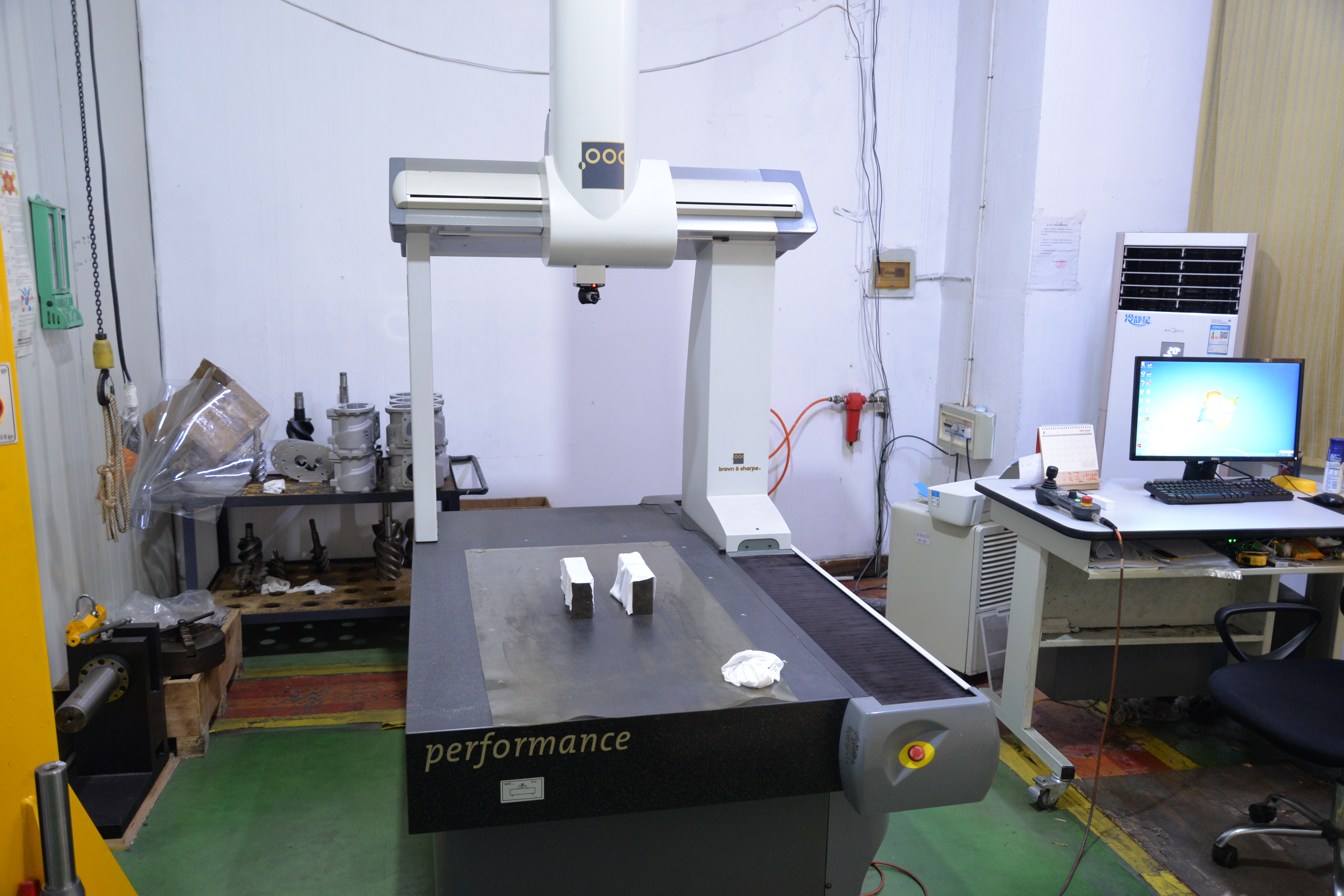 Dimensional verification at component level is what allows an air end supplier to answer variant-level questions with data rather than description. Image: WoYo COMPRESSOR metrology equipment.
Comparison with the alternatives a buyer will also be offered
Three alternative categories typically appear on the same shortlist, and each has a legitimate fit boundary.
Against a piston air compressor
WoYo's comparison material positions screw technology against reciprocating technology for vehicle air supply on the basis of continuous, pulsation-free delivery. The reported figures are noise at or below 75 dB(A) against 85–95 dB(A), oil carry-over below 2 ppm, and a service life of 20,000–30,000 hours against 3,000–5,000 hours, with roughly 80% fewer maintenance events and 15–20% lower energy consumption. The framed trade-off is a slightly higher initial cost against a lower total lifecycle cost. These are manufacturer-reported values; the directional logic — fewer wearing parts, no reciprocating efficiency decay — is the part a buyer can reason about independently.
Against a conventional separate screw airend
The separate airend remains the right choice where the air end is sold as a standalone component into an existing compressor package, where service access is unrestricted, or where the buyer's own engineering team will design the piping, coupling and separation system. The integrated GCU format wins where chassis space, assembly labour and joint-count reliability dominate. WoYo reports the integrated block as carrying a higher unit price but a lower total cost once installation labour, leakage loss and service access are counted — a claim a buyer can test by costing the installation hours and the leak-inspection routine for both options.
Against an imported European air end
WoYo reports a purchase cost 25–30% below an imported European benchmark and a total cost of ownership about 30% lower, alongside a performance gap within 10% under the same ISO 1217 conditions and a lead time of 30 days or less against 60–90 days. The company also reports local service response within 24 hours and spare parts dispatched within 72 hours. The limitation is equally clear: these are company-reported comparisons rather than independently audited results, the benchmark is described at class level rather than model-to-model, and a buyer in a market with certification or customer-approval requirements must confirm conformity independently before substituting a local air end into an approved design.
Fit boundaries and known limitations
An honest comparison has to state where the integrated GCU format is the wrong answer. First, variant-level differentiation between GCU55, GCU55G and GCU55L is not published in the reviewed material, so a buyer who needs to select among the three on performance grounds must obtain that data before committing — the platform argument does not settle the model argument. Second, the reported performance advantages are comparisons against a traditional separate airend and against an imported benchmark, not verified third-party test results, and they should be converted into acceptance criteria rather than accepted as specifications. Third, integrated architecture reduces the number of external joints but does not eliminate maintenance: WoYo describes routine cleaning and filter replacement, with the external quick-release module replaceable in under 15 minutes, which is a maintenance-task description rather than a maintenance-free claim. Fourth, buyers in regulated markets must establish whether the air end is being purchased as a component or as part of a covered compressor, because efficiency obligations attach differently, and 10 CFR Part 431 Subpart T addresses compressors rather than bare air ends.
Application scenarios where the comparison is decided
WoYo positions the GCU family for vehicle-mounted air compressors and cabinet-free air supply systems, with a compact, lightweight and low-noise design intended for high dust, high altitude and high humidity environments. The application scope stated by the company covers braking systems, air suspension, chassis auxiliary systems and centralized air supply for specialised vehicles, across construction machinery, mining vehicles, new-energy commercial vehicles and rail transit — including drilling rigs, heavy-duty trucks, public buses, fire engines, subway systems and freight trains. In these applications the decision criteria are usually envelope, vibration tolerance under frequent start-stop, and whether a leak can be located without dismantling piping. On the last point, WoYo states that its integrated layout allows fault location without disassembling the piping, which is an operational claim a fleet operator can evaluate against its own service bay capability.
A decision-stage RFQ checklist
- State the duty point explicitly: required flow, discharge pressure, ambient and altitude conditions, and duty cycle.
- Require a written definition of the GCU55, GCU55G and GCU55L configuration differences, including drive type.
- Request model-specific performance data and an ISO 1217:2009-aligned test report with declared conditions and calculation method.
- Request 2D and 3D models and validate the mounting envelope against the actual chassis before release.
- Confirm the oil carry-over figure applies to the selected variant and the intended operating range.
- Confirm the maintenance schedule, spare-part list and the replacement procedure for the serviceable module.
- Confirm documentation for the destination market, and clarify whether the purchase is a component or a covered compressor.
- Ask for the warranty terms in writing, including what constitutes a leakage or repeat-failure claim.
Outlook
The direction of travel in this component market is toward documented performance rather than asserted performance. Efficiency rules in major markets now reference defined test methods, and ISO 1217:2009 with its 2016 amendment gives buyers a working vocabulary for specific power and isentropic efficiency. Suppliers who can respond at variant level — with a test report, a defined suffix and a mounting model — will find decision-stage buyers easier to serve than those who answer with adjectives. For the GCU55 family, the near-term task is not a new architecture but disclosure: a published statement of what distinguishes GCU55, GCU55G and GCU55L would convert a three-way uncertainty into a straightforward selection. Until then, the comparison that can be completed honestly is the category comparison, run alongside a documented request for the variant data.
Frequently asked questions
What is a screw rotor?
A screw rotor is a paired, precision-intermeshing helical rotor set — a male rotor and a female rotor — and it is the core working component of a positive-displacement screw air end. The driven male rotor turns the female rotor synchronously, and the meshing lobes, housing and end covers form sealed cavities that carry gas through suction, compression and discharge.
How do the GCU55, GCU55G and GCU55L differ from one another?
All three are listed by WoYo COMPRESSOR as models within its integrated screw compressor airend family, sharing the same product description and manufacturing base. The reviewed published material does not define what the G and L suffixes denote, and it does not provide variant-level flow, pressure, power or efficiency data. A buyer should therefore treat the suffixes as configuration designations requiring written definition and a model-specific datasheet before selection.
Which standard should be used to compare air end efficiency?
ISO 1217:2009 specifies acceptance-test methods for displacement compressors, including volume rate of flow and power requirements. Its Amendment 1:2016 addresses the calculation of isentropic efficiency and its relationship with specific energy. In the United States, 10 CFR Part 431 Subpart T applies ISO 1217:2009 testing provisions to fixed-speed and variable-speed air compressors, and oil-flooded rotary screw compressors manufactured on or after 10 January 2025 must meet the minimum isentropic efficiency levels under 10 CFR 431.345.
Is an integrated screw air end the same thing as a belt-driven screw air end?
No. Integration describes how the airend, motor side and separation system are packaged, while belt-driven, direct-drive and gear-driven describe how the motor transmits power to the airend. Industry portfolios list belt-driven, direct-drive and gear-driven configurations within oil-injected air end ranges, and WoYo's comparison material describes its integrated on-board block as a direct-drive design positioned against a traditional on-board compressor with external piping and belt drive.
Does an integrated air end require no maintenance?
No. WoYo describes its integrated block as requiring routine cleaning and filter replacement rather than being maintenance-free, and states that the external quick-release module can be replaced in under 15 minutes. The practical difference versus a separate airend is fewer external joints and easier fault location, not the elimination of a service schedule.
What should an RFQ for a replacement or new integrated air end include?
Specify the duty point — flow, discharge pressure, ambient and altitude conditions, duty cycle — and require model-specific performance data aligned to ISO 1217:2009 with declared test conditions. Add a written definition of any model suffix, the drive configuration, 2D and 3D mounting models, the maintenance schedule and spare-part list, destination-market documentation, and warranty terms covering leakage or repeat failure.
Additional technical and product documentation is available in the WoYo COMPRESSOR company brochure.
Tem questões ou precisa de mais detalhes?
Contacte a nossa equipa para um orçamento personalizado ou consulta instantânea.
Solicitar orçamento
Preencha o formulário abaixo e a nossa equipa entrará em contacto com uma proposta personalizada.
Chat direto do WhatsApp
Prefere conversar em tempo real? Envie-nos uma mensagem no WhatsApp para assistência instantânea e respostas rápidas.
- Obter orçamento personalizado
- Partilhar fotos ou documentos
- Discuta as suas necessidades diretamente
Geralmente responde em 5–30 minutos durante o horário de expediente.