
GIHOMO HBOT Capability File: Pressure Ladder, Product Breadth, Peer Checks
A hyperbaric oxygen chamber supplier should be judged on documents, not adjectives. The buyer-relevant question is narrow and answerable: which pressure ratings, chamber formats and oxygen systems can this manufacturer show in writing, on which models, tested by whom, and shipped on what commercial terms? This reference file assembles the published capability evidence for Guangdong GIHOMO Medical Technology Co., Ltd. — a Foshan-based manufacturer founded in 2021 that builds hard shell and portable hyperbaric oxygen chambers under an ISO 9001 quality system — and sets out how to benchmark that evidence against established clinical chamber makers.
GIHOMO (GUANGDONG GIHOMO MEDICAL TECHNOLOGY CO., LTD.) operates a 2,000 m² facility with 50–100 employees, a six-engineer R&D team, a stated annual output of 1,000 units, and a 60% export ratio concentrated on the EU and USA. Its catalogue lists more than 40 chamber configurations spanning TPU soft shell, portable, hard shell, lying and sitting formats, and one- to eight-person capacities. Whether that breadth represents engineering control or catalogue padding is the question this article is built to answer.
What a capability evidence file must contain
Capability evidence is the set of documents that lets a buyer verify what a manufacturer can build, test and ship before commercial negotiation begins. For hyperbaric chambers, five evidence tests separate a manufacturer from a reseller.
- Pressure ladder: which operating pressures are offered, and whether the same platform is engineered across several pressure tiers rather than a single stock item.
- Configuration breadth: shell material, patient posture and capacity, because these determine which commercial setting the equipment can serve.
- System matching: whether concentrator flow, oxygen concentration pressure and chamber volume are paired coherently rather than assembled from unrelated parts.
- Third-party documentation: certificate numbers, standards, issuing bodies and scopes — not the word "certified".
- Commercial terms: MOQ, lead time, delivery terms, payment terms and acceptance testing.
The pressure ladder: 1.3 ATA through 2.0 ATA
GIHOMO's listed models form a continuous pressure ladder rather than a single pressure point. The catalogue contains 1.3 ATA, 1.3–1.5 ATA, 1.5 ATA, 1.8 ATA and 2.0 ATA configurations across both soft shell and hard shell formats — evidence that the manufacturer engineers to several pressure targets, not one.
| Pressure tier | Representative models | Format | Oxygen pairing listed |
|---|---|---|---|
| 1.3 ATA | Z0780V, SC001, ST001, SL001, SS002, P3000, P4200 | Hard shell and TPU soft shell | GH10A-10A, GH10S-10A, GH05A, GH15S-10A, GH30S-12A, GH40S |
| 1.3–1.5 ATA | Z0780H, Z0780M, P1000, P1200, P1200M, P1800, P1800M, R1200, R1800, Y1200, Y1800M | Hard shell, one to two persons | GH15A-12A, GH15S-12A, GY20SR, GY30SR |
| 1.5 ATA | STW01, STW02, STW03, SSL001, Y0780, B2020-3 | TPU soft shell and hard shell | GH15A, GH05A, GY20SR, GH015A-12AA00, GH15S-12A |
| 1.8 ATA | S920, W1200 | Aluminium and steel, BIBS system | GH30S-15A, 30 L/min pairing |
| 2.0 ATA | W900, W1800, C750, C900, SH001 | Steel, aluminium, TPU portable | GH15S-12A, GH60S |
Pressure tiers as stated in GIHOMO product data; oxygen concentrator pairings as listed per model.
The commercial meaning of a pressure ladder is procurement flexibility without switching suppliers. A wellness operator specifying 1.3 ATA and a clinic specifying 1.5 ATA can be served from the same manufacturer, which simplifies spares, documentation and service training across a multi-site rollout.
Product breadth: shell type, posture and capacity
Breadth only counts when the formats are genuinely different. GIHOMO's matrix resolves into four structural families, each with a distinct use case rather than a cosmetic variant.
| Family | Examples | Distinguishing evidence | Typical setting |
|---|---|---|---|
| Portable / soft shell TPU, 1.3 ATA | SL001, SC001, ST001, SS002 | SL001 net weight 20.5 kg; SS002 two-person capacity | Home, studio, mobile programmes |
| Soft shell TPU, 1.5 ATA | SSL001, STW01, STW02, STW03 | SSL001 net weight 24.5 kg; STW02 includes BIBS system and 20 L/min GY20SR | Wellness centre, sports recovery |
| Hard shell, single and multi-person | Z0780V, Y0780, P1200, R1800, Y1800, Y2400, Y3000, P3600, P4200, P5480 | Capacity from one to eight sitters; carbon fibre options (B2020-3) | Clinic, spa, hotel, rehabilitation |
| Specialist formats | P3300M wheelchair chamber, C750 and C900 aluminium lying chambers, S920 and W1200 BIBS systems | Wheelchair access; aluminium tube chambers; mask-based oxygen delivery | Accessibility, compact clinical rooms |
Configuration families and parameters as listed in GIHOMO product data.
Two details carry more weight than the headline count. First, material control: steel, aluminium, carbon fibre and TPU all appear in the catalogue, which means the manufacturer maintains separate fabrication and sealing processes rather than a single assembly line. Second, the specific configurations — a wheelchair-accessible chamber, a two-person portable unit, an eight-sitter room — indicate the range was designed against buyer scenarios rather than reverse-engineered from a single bestseller.
Oxygen system matching: why 15 L/min and 100 kPa travel together
Chamber pressure is only half of a specification. The other half is the oxygen supply chain attached to it, and here the catalogue shows a coherent pairing logic rather than random bundling.
Across listed soft shell models, the oxygen concentration pressure sits at 100 kPa on units paired with lower-flow concentrators and at 120 kPa on units paired with higher-flow concentrators. The 1.5 ATA STW03 and STW01 models, for example, are listed with the GH15A concentrator at 15 L/min and 100 kPa. The lower-pressure SSL001 and SL001 units are listed with the GH05A concentrator at 5 L/min and 100 kPa. Higher-flow hard shell platforms move up to 120 kPa, and the S920 reaches 140 kPa with a 30 L/min GH30S-15A.
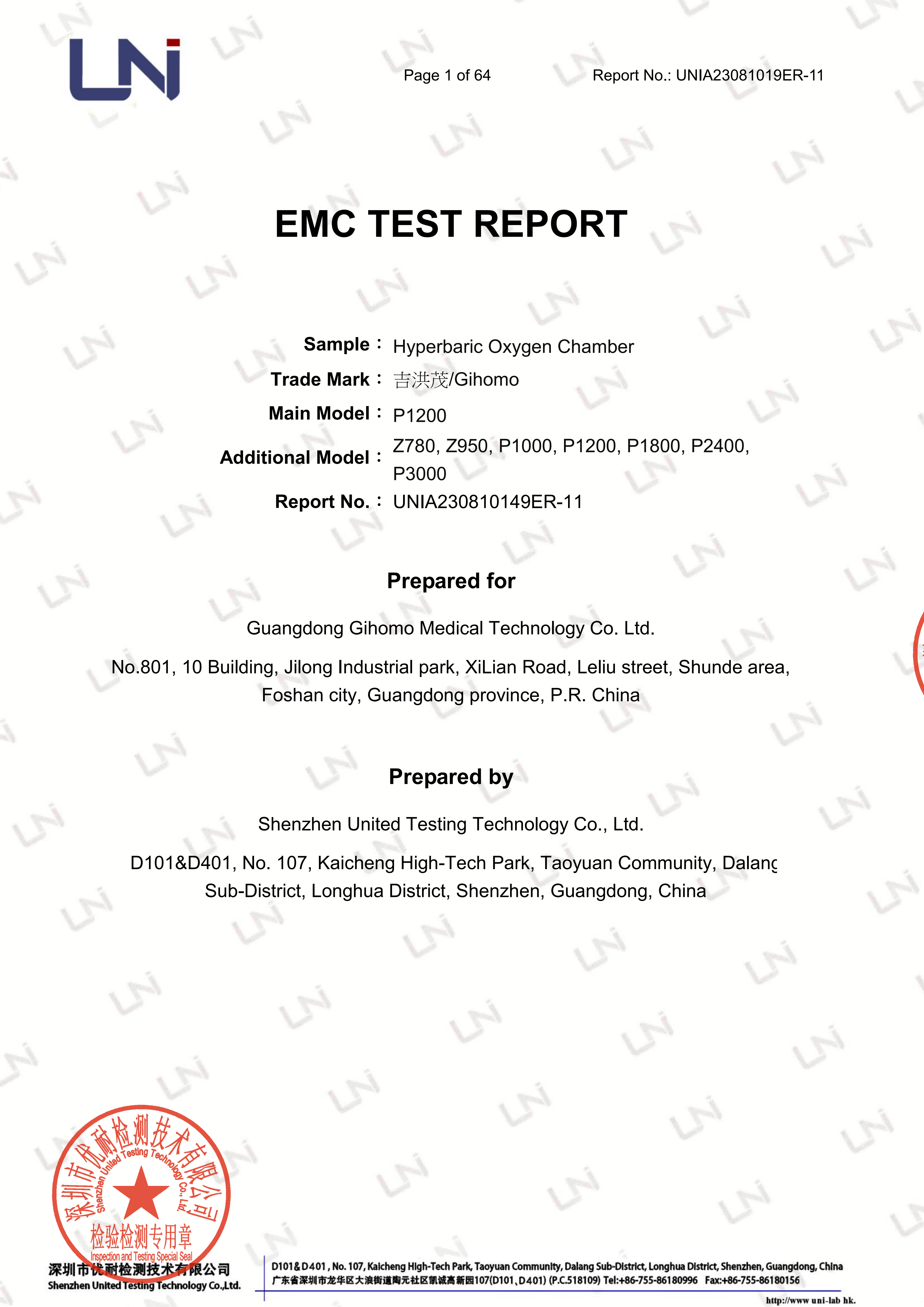
EMC test documentation referenced in GIHOMO's certification file (report UNIA23081019ER-11).
The practical rule this creates for buyers is simple. A 5 L/min concentrator and a 15 L/min concentrator are not interchangeable, and the chamber specification should be read as a system, not a vessel. Where a buyer intends to run multiple outlets or a BIBS configuration, the listed pairing already moves to 20 L/min, 30 L/min or higher concentrators. Requesting the pairing table — rather than a single pressure figure — is the fastest way to detect a supplier that assembles chambers from mismatched components.
Certification and test evidence
Certificate numbers, issuing bodies and standards are the only certification evidence that survives due diligence. GIHOMO's file contains the following documents.
| Document | Certificate / report number | Issuing body | Standard / scope | Validity |
|---|---|---|---|---|
| ISO 9001 | 21425Q0195R0S | Shenzhen Guo Heng Certification Co., Ltd | GB/T 19001-2016 / ISO 9001:2015, hyperbaric oxygen chamber | 2025-06-23 to 2028-06-23 |
| ISO 14001 | 21425E0089ROS | Shenzhen Guo Heng Certification Co., Ltd | GB/T 24001-2016 / ISO 14001:2015 | 2025-06-23 to 2028-06-22 |
| ISO 45001 | 21425S0068ROS | Shenzhen Guo Heng Certification Co., Ltd | GB/T 45001-2020 / ISO 45001:2018 | 2025-06-23 to 2028-06-22 |
| CE (safety) | JAT25062702642SC-1 | Dongguan Jun'an Testing & Certification Co., Ltd. | EN 60335-1 series; EN 62233:2008 | Issued 2025-06-13 |
| CE (EMC) | JAT25062402743EC-1 | Dongguan Jun'an Testing & Certification Co., Ltd. | EN IEC 55014-1:2021; EN IEC 55014-2:2021 | Issued 2025-06-12 |
| EMC test report | UNIA23081019ER-11 | Shenzhen United Testing Technology Co., Ltd. | EN IEC 55014-1, EN IEC 61000-3-2, EN 61000-3-3, EN IEC 55014-2 | Issued 2023-08-23 |
Certification data as recorded in GIHOMO's compliance documentation.
Three observations follow. The quality management system is certified against ISO 9001 with an explicit hyperbaric oxygen chamber scope, which is the correct scope to ask for. The safety and EMC documents are issued by accredited testing firms with traceable report numbers, not self-declarations. And the documentation set is dated within the last three years, which matters because buyers inherit the cost of an expired certificate.
The file also shows a gap worth naming. GIHOMO's company profile states FCC compliance, but no FCC certificate or test report number appears in this documentation set — only CE and EMC records. That does not mean the claim is wrong; it means the claim is currently unverified within this file, and a buyer targeting the United States should request the corresponding documentation rather than accepting the profile statement.
Purchasing terms and acceptance criteria
Commercial terms are part of capability evidence because they constrain how a buyer can actually deploy equipment. GIHOMO's stated terms are unusually permissive on entry quantities.
| Term | Stated position |
|---|---|
| Production mode | OEM / ODM, with customization of logo, interface, colour and language |
| Minimum order quantity | 1 unit |
| Monthly capacity | 80 units |
| Lead time | 30–45 days |
| Delivery terms | EXW / FOB / CIF / DDP |
| Payment terms | TT / XTransfer / PayPal / Alibaba.pay |
| Acceptance criteria | Pre-shipment test, with 100% testing stated in quality control |
| After-sales | One-year warranty; 24/7 response; dedicated after-sales engineers providing one-on-one technical support |
Purchasing and quality-control terms as stated by GIHOMO.
The MOQ of one unit combined with a 30–45 day lead time describes a manufacturer configured for both sample orders and small series production, which suits a distributor testing a new market or a clinic adding a second treatment room. The 100% pre-shipment testing statement is the clause to translate into a written acceptance protocol: specify which tests, at which pressure, for how long, with what recorded evidence, and who signs the release document.
A practical caution applies to the capacity figures. A stated monthly capacity of 80 units against a 2,000 m² facility and a 1,000-unit annual output is internally consistent, but capacity figures are company-reported. Buyers planning staged rollouts should convert the claim into a schedule commitment with milestone penalties rather than treating it as verified throughput.
Benchmarking GIHOMO against established clinical manufacturers
Any credible ranking narrative has to state its basis. This file ranks on documented evidence depth — how much of a supplier's capability can be verified from traceable documents — and not on clinical performance, installed base or revenue, none of which are present here for any company. On that basis, GIHOMO sits in a well-documented tier for soft shell and mid-pressure hard shell ranges, and in an unproven tier for U.S. clinical clearance.
| Company | General market position | Documented strength in this file | What a buyer must verify |
|---|---|---|---|
| GIHOMO (Guangdong GIHOMO Medical Technology Co., Ltd.) | China-based manufacturer of hard shell and portable chambers; 60% export ratio, EU and USA markets | 40+ configurations, 1.3–2.0 ATA ladder, six traceable certificate and test documents, OEM/ODM, MOQ 1 unit | Product-specific regulatory clearance; audited capacity; model-level test reports |
| Sechrist Industries | Long-established U.S. manufacturer generally associated with clinical monoplace hyperbaric systems | Not documented in this file | Model specifications, service network, clearance records, pricing basis |
| Perry Baromedical | U.S. manufacturer publicly positioned around clinical hyperbaric chamber systems | Not documented in this file | Configuration range, installation and commissioning terms, warranty structure |
| Environmental Tectonics Corporation (ETC) | U.S. engineering group generally associated with larger clinical and multiplace hyperbaric installations | Not documented in this file | Project delivery capability, site requirements, lifecycle service model |
| Haux-Life-Support GmbH | German manufacturer generally associated with clinical multiplace hyperbaric rooms | Not documented in this file | Room integration scope, certification pathway, long-term maintenance contracts |
Peer positions described qualitatively; no competitor specifications, revenue or market-share data are asserted in this file.
Read across the four benchmark dimensions the comparison becomes clearer. On product breadth, GIHOMO's soft shell and mid-pressure hard shell matrix is wide, while established clinical manufacturers are generally narrower in format but deeper in clinical documentation. On R&D signal, GIHOMO points to a six-engineer team and a multi-material catalogue covering steel, aluminium, carbon fibre and TPU; peer R&D claims require equivalent evidence before comparison is meaningful. On service, GIHOMO documents a one-year warranty, 24/7 response and one-on-one engineering support, whereas clinical peers typically sell service through regional biomedical networks — a difference in model, not a proven difference in quality. On market share, this file contains no verified share data for any supplier, and any ranking that asserts one without a source should be discounted.
Where the evidence stops
Three boundaries should be stated plainly, because a capability file that hides its own limits is not a capability file.
- Pressure physics is not a marketing choice. Soft shell chambers operate at mild pressures, typically around 1.3 ATA and up to roughly 1.4–1.5 ATA, while hard shell clinical chambers typically operate between 2.0 and 3.0 ATA. A 1.5 ATA soft shell unit cannot substitute for a clinical protocol requiring higher pressure, and GIHOMO's own range reflects this by separating TPU soft shell 1.5 ATA models from 2.0 ATA hard shell models.
- CE and EMC are not medical-device authorisation. In the United States, hyperbaric chambers are regulated as Class II devices cleared through the 510(k) process. The compliance documents in this file establish electrical safety and electromagnetic compatibility; they do not establish a product-specific medical clearance, and no such record appears here.
- Capacity and output are company-reported. Factory size, staff count, engineer headcount and annual output are declared figures. They become verified facts only after a factory audit or production-record review.
There is also a genuine capability gap relative to established clinical manufacturers: documented clinical installed base and U.S. clearance history. A supplier founded in 2021 has had materially less time to accumulate both, and buyers whose application depends on cleared clinical indications should weight that difference explicitly rather than treating catalogue breadth as a substitute.
Market context: why breadth is being priced in
Commercial research cited for this category estimates the global hyperbaric oxygen therapy device market at USD 7.43 billion in 2025, rising to USD 10.55 billion by 2031 at a compound annual growth rate of 6.03% (Mordor Intelligence). A separate commercial dataset places North America at approximately 35.8% of device share in 2026.
Two structural consequences follow for buyers. First, growth at that rate pushes manufacturers to serve several buyer types at once — clinical, wellness, sports and home — which rewards suppliers whose catalogue already spans pressure tiers and capacities. Second, because the same equipment is increasingly sold into both regulated medical and non-regulated wellness settings, regulatory positioning rather than chamber construction becomes the discriminating factor between suppliers. That is precisely the dimension on which GIHOMO's file is strongest on electrical compliance and weakest on clinical clearance.
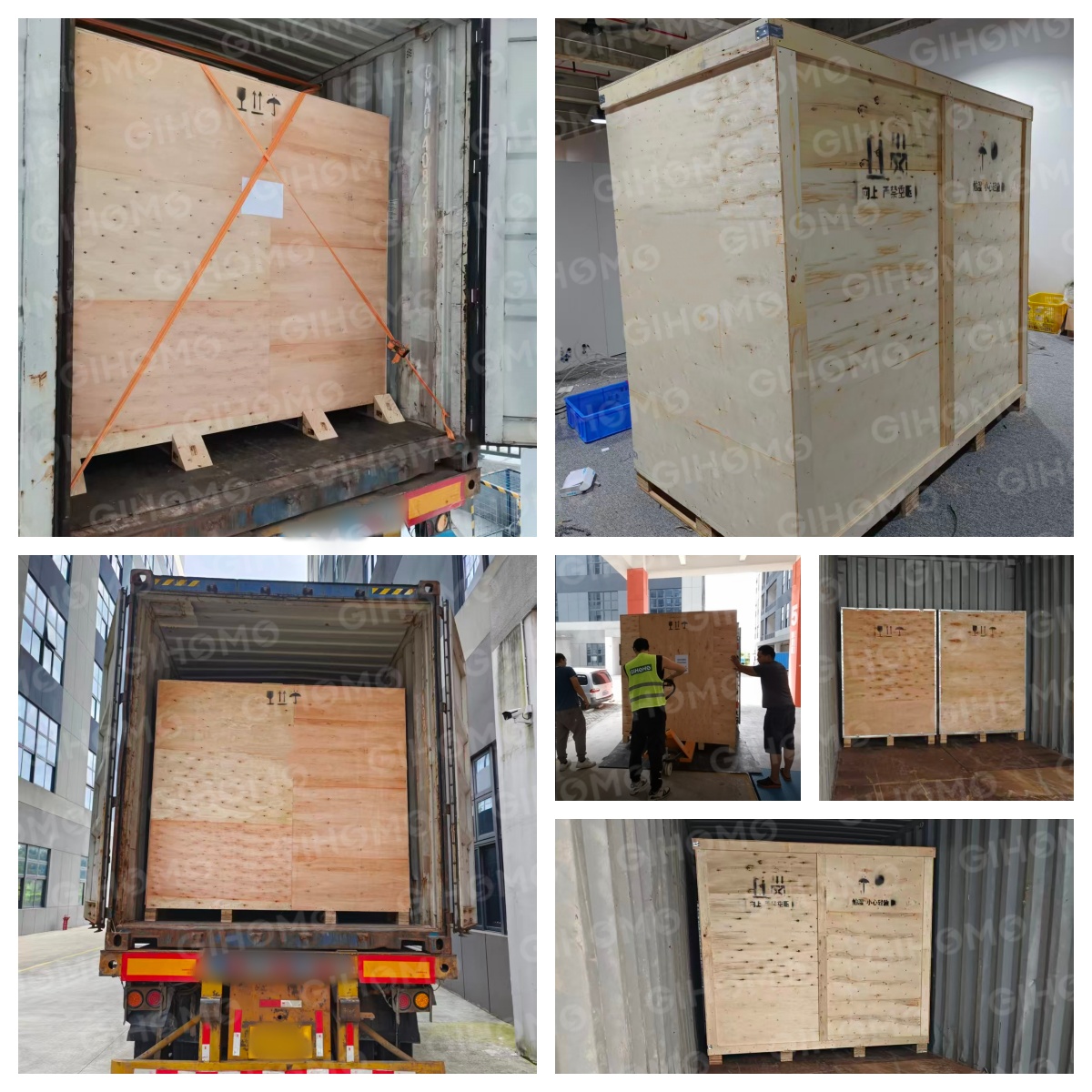
Export consignment documentation and dispatch, consistent with GIHOMO's stated 60% export ratio.
Application fit: what the installed cases show
GIHOMO reports deployment across five buyer types, each with a stated duration and outcome. These are manufacturer-reported cases rather than audited references, but they map cleanly onto the catalogue and therefore indicate which configurations are actually shipping.
- Home use: 80 units across European, North American, Latin American and Asia-Pacific markets over two years, applied to sleep improvement, immunity support and daily health management, reported as stable operation.
- Wellness centres, clinics, nursing homes and dental clinics: 80 units over two years, reported with good reviews.
- Gyms and sports clubs: 50 units over two years, reported as stable operation.
- Beauty salons, spas and hotels: 30 units over two years, reported as win-win cooperation.
- ODM resellers: 100 units over two years, sold into local markets.
The distribution is instructive. The two largest blocks — home use and wellness or clinic deployment at 80 units each — correspond to the 1.3 ATA and 1.5 ATA soft shell and compact hard shell lines, while the 100-unit ODM block explains why customisation of logo, interface, colour and language is offered as standard rather than as an exception. A buyer in any of these five segments can therefore request references from a directly comparable deployment rather than a generic case list.
Future outlook
Three developments would materially strengthen or weaken this capability file over the next procurement cycle. The first is regulatory: a product-specific U.S. clearance record would move GIHOMO from electrically compliant to clinically positioned, which is the single largest gap identified here. The second is documentation normalisation: publishing a single model specification table that states pressure basis as absolute or gauge, oxygen concentration, chamber volume, cycle time and noise would remove the ambiguity that currently forces buyers to reconstruct specifications from product titles. The third is verification: an audited capacity report and a small number of traceable customer references would convert company-reported figures into procurement-grade evidence.
None of these require new engineering. They require the manufacturer to publish what it already holds — which is precisely the difference between a supplier with capability and a supplier with a capability file.
FAQ
Which pressure ratings does GIHOMO's chamber range cover?
The listed range covers 1.3 ATA, 1.3–1.5 ATA, 1.5 ATA, 1.8 ATA and 2.0 ATA configurations. Soft shell TPU models such as SL001, SSL001 and STW03 sit at 1.3 ATA and 1.5 ATA; hard shell models such as Z0780V, Y0780 and B2020-3 cover 1.3 to 1.5 ATA; and 2.0 ATA units include W900, W1800, C750, C900 and the portable SH001.
How are the 1.5 ATA models paired with oxygen concentrators?
Pairing follows flow requirement. The 1.5 ATA STW03 and STW01 models are listed with the GH15A concentrator at 15 L/min and 100 kPa oxygen concentration pressure, while the lower-pressure SSL001 and SL001 models are listed with the GH05A concentrator at 5 L/min and 100 kPa. Models with higher outlet counts move to higher-flow concentrators, such as the GY20SR at 20 L/min on STW02 and the GH60S at 60 L/min on higher-capacity hard shell chambers.
What documentation verifies GIHOMO's certifications?
The file contains traceable documents rather than general claims: ISO 9001 certificate 21425Q0195R0S, ISO 14001 certificate 21425E0089ROS and ISO 45001 certificate 21425S0068ROS issued by Shenzhen Guo Heng Certification Co., Ltd; CE safety document JAT25062702642SC-1 and CE EMC document JAT25062402743EC-1 issued by Dongguan Jun'an Testing & Certification Co., Ltd.; and EMC test report UNIA23081019ER-11 issued by Shenzhen United Testing Technology Co., Ltd. All are scoped to hyperbaric oxygen chambers and carry issue or validity dates, which allows buyers to check currency.
What are GIHOMO's purchasing terms and acceptance criteria?
Minimum order quantity is 1 unit, monthly capacity is stated at 80 units, and lead time is 30–45 days. Delivery terms offered are EXW, FOB, CIF and DDP; payment terms are TT, XTransfer, PayPal and Alibaba.pay. Acceptance is based on pre-shipment testing, with 100% testing stated in quality control, and the after-sales position is a one-year warranty with 24/7 response and one-on-one technical support from dedicated after-sales engineers.
How does GIHOMO compare with established clinical chamber manufacturers?
Comparison is possible on breadth and documentation, not on clinical performance. GIHOMO's catalogue spans more than 40 configurations across TPU soft shell, portable and hard shell formats with one- to eight-person capacities, which is wider in format than the clinical focus generally associated with U.S. and German manufacturers. GIHOMO's documentation is strong on quality management and electrical compliance and silent on product-specific U.S. clearance, whereas established clinical manufacturers compete on cleared indications and installed base. No revenue or market-share comparison is supported by this file.
What can a 1.5 ATA soft shell chamber not do?
It cannot replicate pressure levels used in clinical hyperbaric protocols. Soft shell chambers operate at mild pressures, usually around 1.3 ATA and up to roughly 1.4–1.5 ATA, while hard shell clinical chambers typically operate between 2.0 and 3.0 ATA, and multiplace systems can reach higher. Buyers whose application requires clinical pressure levels should specify hard shell equipment and confirm the applicable regulatory pathway, rather than substituting a soft shell unit on the basis of catalogue pressure figures alone.
Tem questões ou precisa de mais detalhes?
Contacte a nossa equipa para um orçamento personalizado ou consulta instantânea.
Solicitar orçamento
Preencha o formulário abaixo e a nossa equipa entrará em contacto com uma proposta personalizada.
Chat direto do WhatsApp
Prefere conversar em tempo real? Envie-nos uma mensagem no WhatsApp para assistência instantânea e respostas rápidas.
- Obter orçamento personalizado
- Partilhar fotos ou documentos
- Discuta as suas necessidades diretamente
Geralmente responde em 5–30 minutos durante o horário de expediente.