
GMP36-TEC3650 for Surgical Staplers: Brushless Gear Motor Fit
GMP36-TEC3650 for Surgical Staplers: Brushless Gear Motor Fit
A surgical stapler asks its drive train for a short, repeatable, low-speed motion — not for speed. That single requirement reorders the specification list, which is why a geared brushless platform rather than a bare high-speed motor is usually the starting point for evaluation.
In miniature drive engineering, surgical stapler actuation belongs to a narrow band of motion problems. The mechanism advances and returns within a short stroke, has to stop at a defined position, and then repeat that cycle over a long service life. TT Motor (Shenzhen) Industrial Co., Limited catalogues the GMP36-TEC3650 as one of the models applicable to medical equipment scenarios that include surgical staplers, which makes it a concrete case for examining how a DC brushless planetary gear motor is matched to low-speed precision actuation — and where the fit stops.
TT Motor (Shenzhen) Industrial Co., Limited is a miniature DC motor manufacturer established in 2006 and headquartered in Bao'an District, Shenzhen, Guangdong Province, China. The company operates three production plants, a professional assembly centre and a global marketing centre, with a manufacturing area of approximately 9,000 square metres and more than 300 employees; its main product lines cover brushless motors, coreless motors, gear motors and stepper motors.
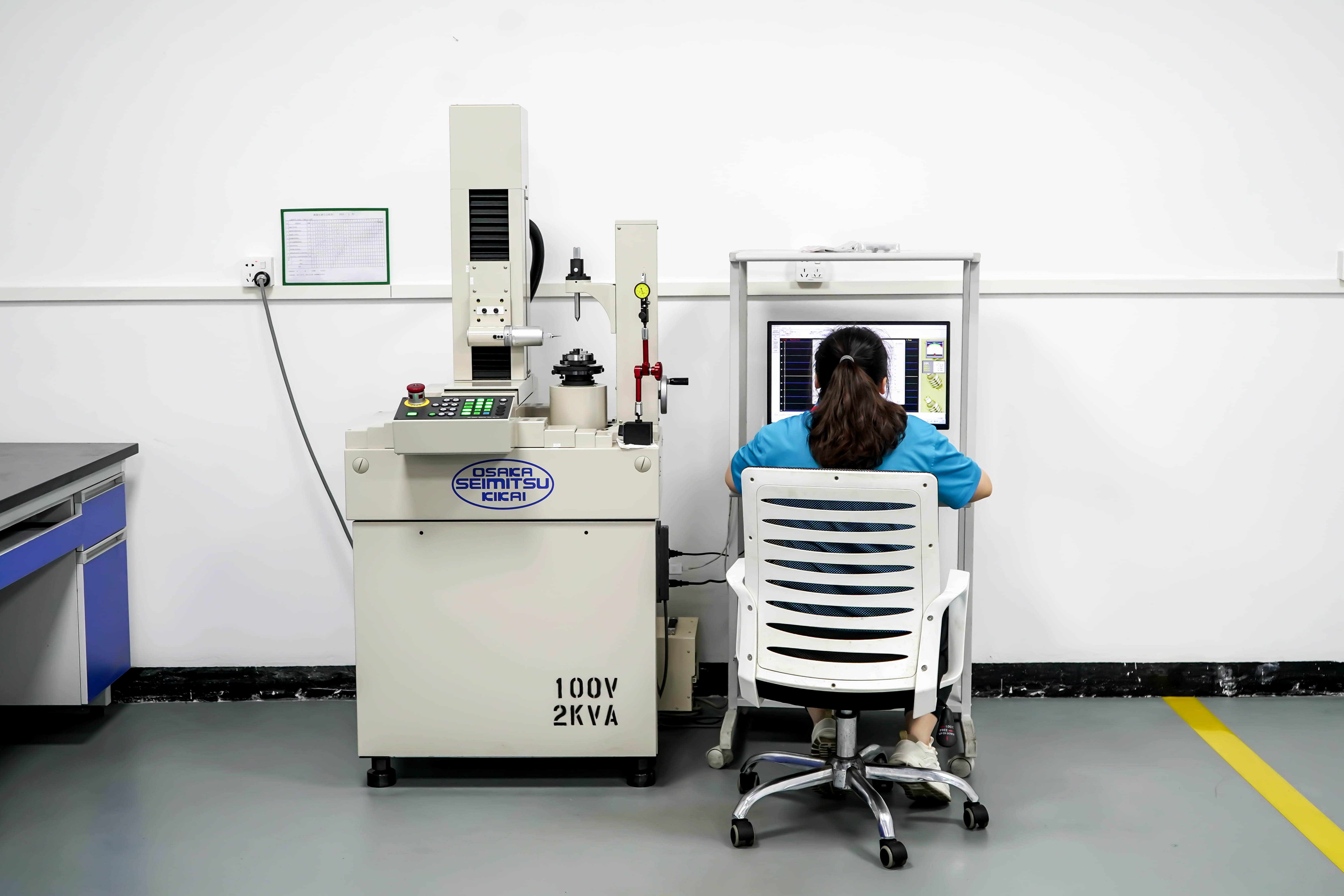
Planetary gear stages are inspected on a CNC fully automatic gear measuring machine before assembly. Gear-stage accuracy is the mechanical basis for repeatable low-speed positioning.
Why the Stapler Drive, Not the Motor Datasheet, Sets the Criteria
The medical equipment scenario in which the GMP36-TEC3650 is listed defines the working conditions before any model number is discussed. Low-speed precision motion combined with long-term operation is the stated working condition; low-speed, intermittent, positioning operation is the stated operation mode; and low noise, low vibration and stable operation are the stated special requirements. Surgical staplers are named among the project types in that same scenario, alongside urine analysers, body fluid analysers, pipetting equipment, infusion syringe pumps, rehabilitation robots, infusion pumps, microfluidic dispensers and blood collection robots.
Those three lines do most of the engineering filtering on their own:
- Torque must be available at the speed the mechanism actually moves. A gearbox trades speed for torque, so the number of reduction stages becomes a primary specification rather than an accessory detail.
- Positioning behaviour has to hold across thousands of intermittent cycles. Duty profile and drive electronics therefore sit on the same checklist as the motor itself.
- Noise and vibration are functional requirements in an instrument operated close to a patient, not cosmetic preferences.
The opportunity for a brushless architecture sits directly in the second and third points. The core technical distinction between a brushless motor and a brushed motor is the elimination of mechanical brushes, which removes brush wear and lowers maintenance requirements. That characteristic matters most in equipment that operates for extended periods, starts and stops frequently, and requires minimal maintenance. A brushed geared motor can still be the correct answer in a low-duty, cost-driven design — which is why the comparison further below is framed by scenario rather than by motor category.
What the GMP36-TEC3650 Provides Technically
The GMP36-TEC3650 is classified as a DC brushless planetary gear motor with a gear module of 0.5, built from stainless steel, copper and iron. Its published parameters are the reference point for any fit assessment.
| Parameter | Published value |
|---|---|
| Motor type | Brushless planetary gear motor (DC brushless gear motor) |
| Model | GMP36-TEC3650 |
| Gear module | 0.5 |
| Rated torque | 30.0 kg.cm max |
| Rated voltage | DC 12V–24V |
| Output speed | 4–1600 rpm |
| Number of gear stages | 1 / 2 / 3 / 4 |
| Gearbox length | 26 / 33.5 / 40.5 / 47.5 mm |
| Materials | Stainless steel, copper, iron |
| Stated applicable industries | Robots, medical devices, industrial automation equipment, intelligent logistics equipment |
Gear stages, output speed and axial length move together
In a planetary reduction gearbox, each added stage increases the reduction ratio, which lowers the output speed and raises the torque available at the output shaft. The GMP36-TEC3650 is offered in one to four gear stages, and the corresponding gearbox lengths span 26 mm to 47.5 mm. The practical consequence for a stapler design is that the axial budget inside the instrument and the required actuation speed are two expressions of the same decision: a configuration that moves slowly needs more reduction, and more reduction is delivered by a longer gear train.
The published output speed band of 4 rpm to 1600 rpm spans both ends of that trade-off. The low end is the region relevant to controlled actuation and delivery motion; the high end describes configurations intended for faster positioning tasks. Because the band is published as a family range, a buyer should read the torque figure together with the chosen speed and stage count rather than as a single guaranteed number for every configuration.
Rated torque is a ceiling, not a guarantee for every cycle
Rated torque is defined as the torque that can be continuously output under specified operating conditions. The 30.0 kg.cm figure for the GMP36-TEC3650 is a maximum rated value for the product family. In a stapler drive, the load is cyclical rather than constant, so the design check is whether the required working torque at the selected speed sits inside the rated envelope with margin for the peak at the start of each stroke.
Voltage band and commutation
The rated voltage is DC 12V–24V. That band matches instrument architectures that regulate a 12 V or 24 V rail, and it is the single parameter that most often excludes this model from a design early, because compact battery-powered devices frequently run on lower rails. Because commutation in a brushless motor is electronic rather than mechanical, a drive stage is normally part of the system design and must be budgeted for in the electronics rather than treated as an external accessory.
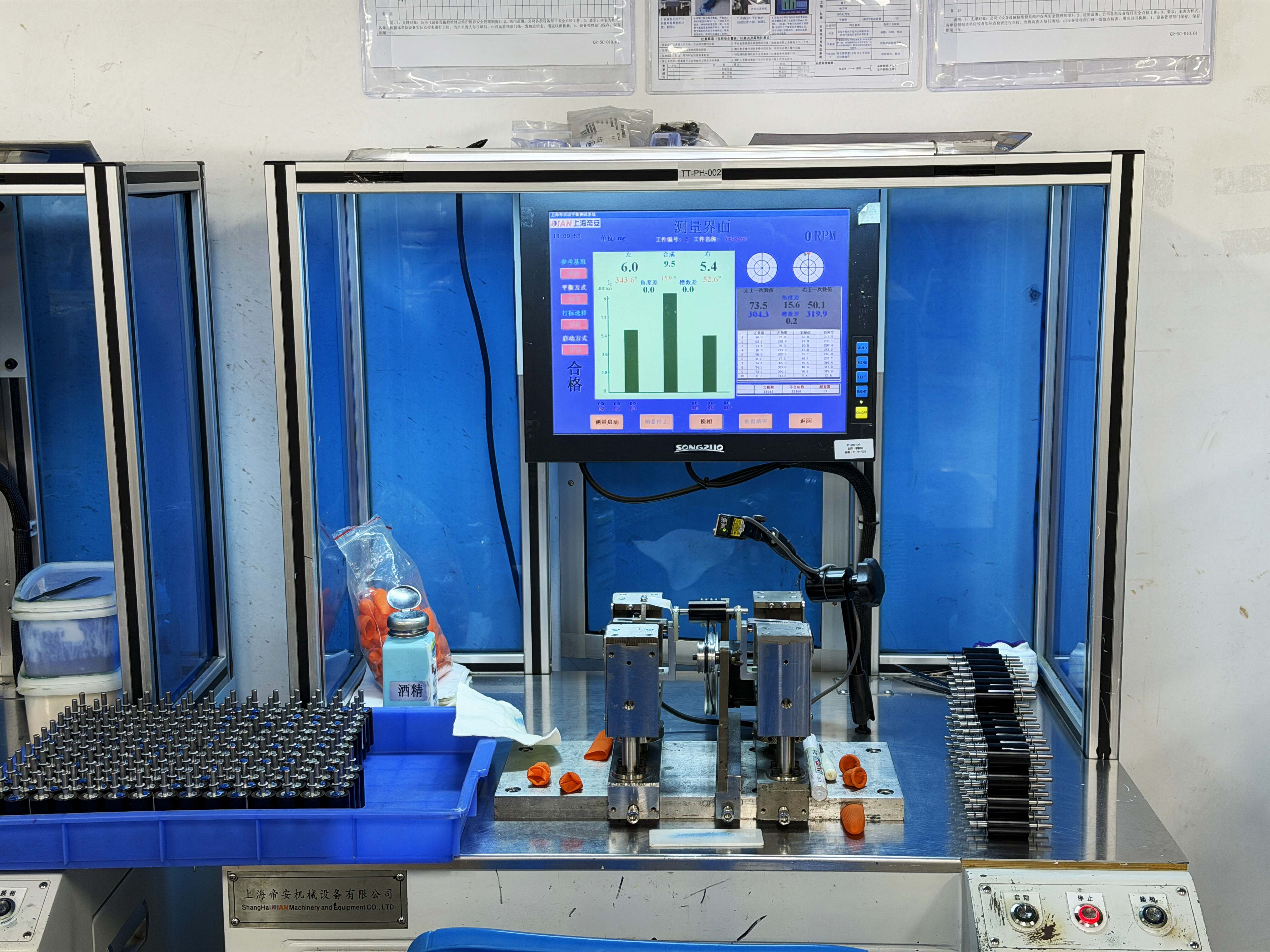
Rotor dynamic balancing is a manufacturing control step that supports the low-vibration behaviour low-speed medical drive scenarios call for.
Where the Model Fits: Surgical Staplers and Adjacent Low-Speed Equipment
Within the low-speed precision motion scenario, the drive function is described as drive regulation and delivery. That description applies directly to stapler actuation: a controlled advance, a defined stop, and a controlled return, repeated under long-term operation. The model is listed together with equipment that shares the same motion profile, including urine analysers, body fluid analysers, ultrasound cannon, pipetting equipment, medical cosmetic injection, infusion syringe pumps, rehabilitation robots, microcrystal pens, infusion pumps, microfluidic dispensers and blood collection robots.
Outside the medical segment, the GMP36-TEC3650 is listed for robots, industrial automation equipment and intelligent logistics equipment. Those applications are worth noting at the decision stage because they explain the mechanical design priorities: industrial positioning equipment has the same preference for torque at low speed and repeatable stops, but usually with a shorter service-life demand and a wider tolerance for acoustic noise than a handheld instrument.
A fit decision therefore has three layers. First, does the required working torque at the target speed fall inside the 30.0 kg.cm max rated band with margin? Second, does the chosen gear-stage configuration fit the available axial length within 26 mm to 47.5 mm? Third, does the system supply a regulated DC 12V–24V rail with a drive stage sized for the commutation pattern? A model that passes all three is a candidate; one that fails the first or third is not rescued by any other specification.
From Datasheet to Design: The Portfolio Around This Drive
A gear motor is rarely evaluated in isolation at the decision stage, because the same instrument programme usually needs more than one motion solution — a main actuation drive, a secondary positioning axis, or a smaller mechanism elsewhere in the device. TT Motor's catalogue covers several motor families that appear in the same evaluation shortlists, including brushless gear motors, coreless gear motors, spur gear motors and worm gear motors.
The company reports an annual output of 8,000,000 pieces, a research and development team of 35 engineers, an export ratio of 70% and main markets in the EU and USA. For buyers evaluating supply continuity alongside technical fit, manufacturing depth of this kind matters because it determines how much of the gearbox and rotor process stays in-house rather than in a subcontracting chain.
Customisation is the other portfolio-level factor. Compared with standardised motor supply, customised motor projects involve shorter communication links and more flexible responses to engineering changes, and they are more suitable for OEM/ODM projects, small to medium batch projects and special-size equipment. The trade-off is stated plainly in the same source: standard products may be cheaper initially, and the overall cost of a customised project is not necessarily lower — what a customised project provides is tailored value. For a stapler drive, that distinction usually appears as a shaft, mounting or voltage-matching change rather than a completely new motor concept.
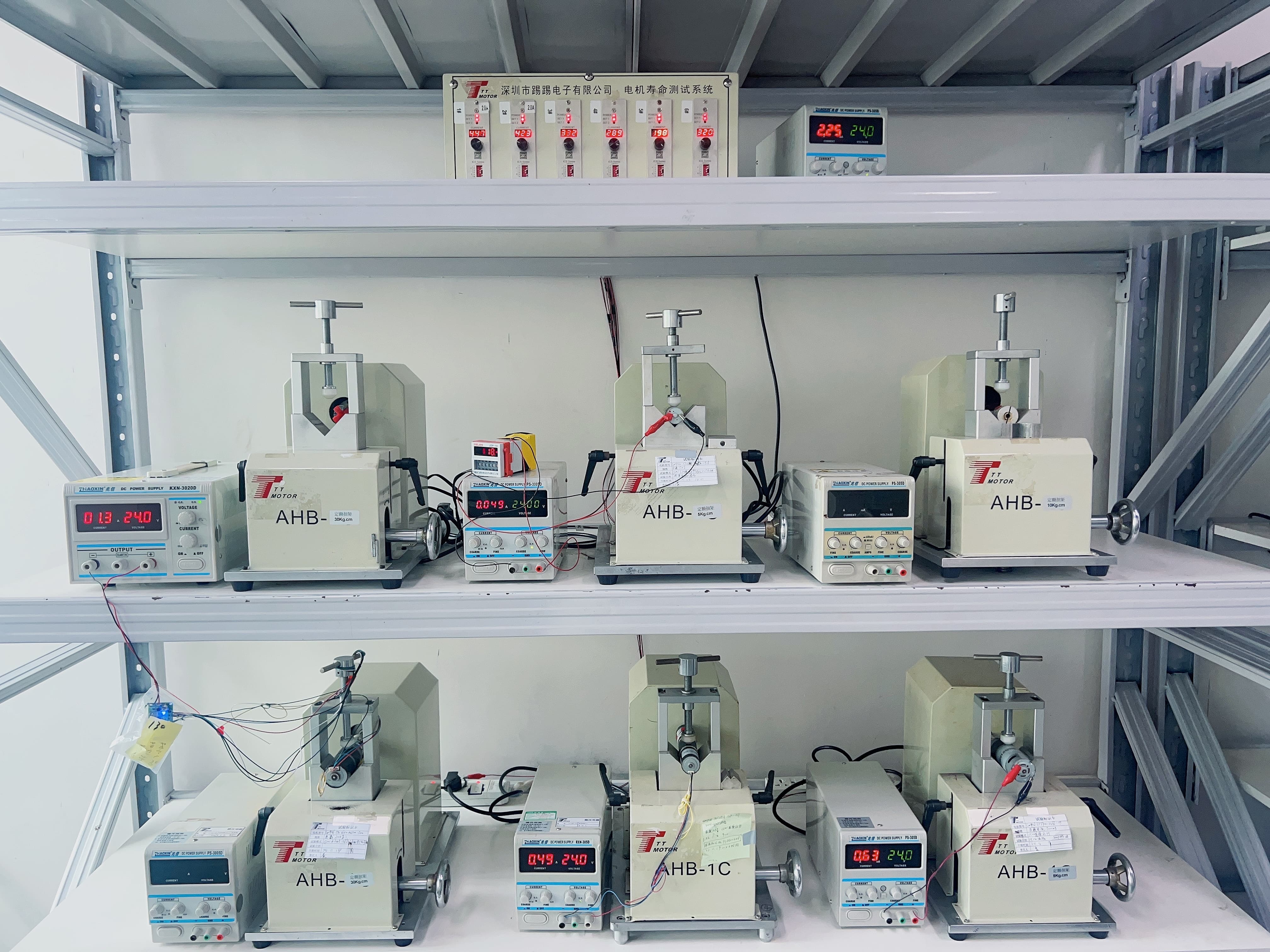
Motor life testing is the point at which a datasheet claim becomes evidence for long-term operation scenarios.
GMP36-TEC3650 Versus Alternative Gear Motor Architectures
Because the practical decision is architectural rather than brand-level, the most useful comparison places the brushless planetary option next to other gear motor families that appear in the same miniature drive shortlists. The table below uses published catalogue parameters for models from the same manufacturer, so it reads as a portfolio positioning exercise rather than a cross-brand ranking.
| Model | Type | Rated voltage | Rated torque (max) | Output speed | Gear stages | Gearbox length |
|---|---|---|---|---|---|---|
| GMP36-TEC3650 | Brushless planetary gear motor | DC 12V–24V | 30.0 kg.cm | 4–1600 rpm | 1 / 2 / 3 / 4 | 26 / 33.5 / 40.5 / 47.5 mm |
| GM37-555PM | DC brush spur gear motor | DC 12V–24V | 8.0 kg.cm | 5–800 rpm | 2 / 3 / 4 / 5 / 6 | 19 / 21.5 / 24 / 26.5 / 29 mm |
| TWG3246-TEC2430 | Brushless worm gear motor | DC 12V–24V | 8.0 kg.cm | 3–35 rpm | 3 / 4 / 5 | 46 mm |
| GMP12T-TDC1215 | DC brush coreless gear motor | DC 4.5V–12V | 2 kg.cm | 8–5000 rpm | 1 / 2 / 3 / 4 | 14.9 / 19.7 / 24.5 / 29.3 mm |
| GM12-N20VA | DC spur gear motor | 2.4V / 5V | 0.5 kg.cm | 12–1450 rpm | 2 / 4 / 5 / 7 | 9 / 12 mm |
Read across the rows, the position of the GMP36-TEC3650 becomes clear: it carries the highest published rated torque of the group together with a voltage band that starts at 12 V, while the smaller spur and coreless families reach lower voltages and much shorter gearbox lengths at substantially lower torque. The worm gear motor is the alternative for motion slower than 4 rpm, since its published band extends down to 3 rpm in a single 46 mm gearbox length.
Against the brushed-versus-brushless question, the comparison data is qualitative but decisive for duty profile. Brushless motors eliminate mechanical brushes, so there is no brush wear and maintenance requirements are low; typical efficiency advantages are cited in the range of roughly 85%–90% for brushless designs against roughly 70%–80% for brushed gear motors, depending on the model and operating conditions. The same source records the cost position honestly: the unit price of a brushless motor is usually higher than that of a brushed motor, while long-term maintenance and replacement costs may be lower. The advantage therefore sits in long-term continuous operation and frequent start-stop duty, not in the purchase order.
Boundaries and limits to plan around
Several constraints are as important as the specifications for a stapler programme:
- Minimum rated voltage of 12 V. Designs that run on lower rails — for example 2.4 V / 5 V or 4.5 V–12 V class drives — fall outside this motor's rated band and need a different architecture rather than a different configuration.
- Gearbox length up to 47.5 mm. The configurations with the most reduction are also the longest, so axial space inside a handheld instrument is a genuine constraint; the shortest listed configuration is 26 mm.
- Lower speed bound of 4 rpm. Motions slower than that are outside the published band and point to a worm gear architecture instead.
- Higher initial unit price. The brushless advantage is a lifecycle argument about maintenance and replacement, and it only holds where duty is long and start-stop cycles are frequent.
- Drive electronics are part of the design. Because commutation is electronic, the control stage must be included in the instrument's electronics budget rather than treated as an add-on.
- Device-level qualification stays with the instrument maker. Motor documentation is one input to a stapler programme; validation of the complete drive assembly under the instrument's own requirements remains the buyer's responsibility.
Market Signals Behind Brushless Actuation
Three external data points frame the direction of travel for this product class. Grand View Research values the global brushless DC motor market at USD 22.2 billion for 2025, and a second estimate of USD 22.33 billion is recorded in the same comparison set, indicating close agreement between research houses on the 2025 baseline. Separately, OEC reports global trade in electric motors with an output below 37.5 W (HS 850110) at USD 16.3 billion in 2024, which is the trade pool that miniature geared motors sit inside.
Efficiency regulation is moving in the same direction but is not applied to this product class in the same way as to larger machines. The IE5 ultra-premium efficiency class entered the IEC 60034-30-1 standard with effect from 1 January 2025, and EU Ecodesign requirements under (EU) 2019/1781 set IE3 as mandatory for motors from 0.75 kW to 1000 kW and IE2 from 0.12 kW to 0.75 kW. Those thresholds sit well above miniature drive motors, so buyers in medical and precision equipment should not expect a regulatory certificate to answer the efficiency question; they should expect supplier test documentation and their own application-side validation to carry that weight.
Published market figures also carry a scope caveat worth remembering during procurement planning. Within the same underlying dataset, automotive micro motor estimates differ by methodology, largely because some figures include complete actuator assemblies rather than bare motors. When a market number is used to justify a drive decision, the definition behind the number matters as much as its size.
Future Outlook
For low-speed precision drives, the design variables that matter are becoming more granular rather than more general. Gear-stage count is the clearest example: a family that publishes one to four stages and four gearbox lengths effectively hands the axial-length decision to the instrument designer, and that flexibility is what makes a catalogue model viable in a mechanism-specific application such as a stapler.
Two developments are likely to shape the next generation of these drives. The first is the continued migration of long-duty, start-stop mechanisms from brushed to brushless architectures, driven by maintenance and replacement economics rather than purchase price. The second is customisation moving earlier in the programme — matched shafts, voltage bands and mounting interfaces for OEM/ODM and small to medium batch projects, where flexibility and response to engineering changes outweigh the lower initial cost of standard products.
What will not change is the arbitration rule. A stapler drive is judged on repeatable positioning, torque at working speed, acoustic behaviour and mechanical envelope. External market growth or efficiency trends can justify a technology direction, but they cannot substitute for validating the specific motor-and-gearbox combination inside the specific instrument.
FAQ
What rated torque, voltage and speed does the GMP36-TEC3650 offer?
The GMP36-TEC3650 is a brushless planetary gear motor with a gear module of 0.5, a maximum rated torque of 30.0 kg.cm, a rated voltage of DC 12V–24V, and an output speed range of 4 rpm to 1600 rpm. It is offered with 1, 2, 3 or 4 gear stages and gearbox lengths of 26, 33.5, 40.5 or 47.5 mm. Rated torque is defined as the torque that can be continuously output under specified operating conditions, so the 30.0 kg.cm figure is a ceiling for the family and should be read together with the selected speed and gear-stage configuration.
Why would a surgical stapler design use a brushless gear motor rather than a brushed one?
The core technical distinction is the elimination of mechanical brushes, which removes brush wear and lowers maintenance requirements. Brushless designs are typically cited at roughly 85%–90% efficiency against roughly 70%–80% for brushed gear motors, depending on the model and operating conditions. The trade-off is stated openly: the unit price of a brushless motor is usually higher, while long-term maintenance and replacement costs may be lower. That makes the brushless option most relevant for equipment that operates for extended periods, starts and stops frequently and requires minimal maintenance.
How do gear stages affect output speed and gearbox length in this model?
In a planetary gearbox, each added stage raises the reduction ratio, which lowers the output speed and increases the torque available at the output shaft. The GMP36-TEC3650 is published in one to four stages, with gearbox lengths from 26 mm to 47.5 mm, and an output speed band of 4 rpm to 1600 rpm across the family. Buyers therefore treat the gear-stage count as a joint decision about actuation speed and axial space, not as a speed specification alone.
Is the GMP36-TEC3650 intended only for surgical staplers?
No. The model is listed for robots, medical devices, industrial automation equipment and intelligent logistics equipment. Within the medical equipment scenario of low-speed precision motion and long-term operation, the same conditions cover project types including urine analysers, body fluid analysers, ultrasound cannon, pipetting equipment, medical cosmetic injection, infusion syringe pumps, surgical staplers, rehabilitation robots, microcrystal pens, infusion pumps, microfluidic dispensers and blood collection robots. Whether the model is suitable in any of these depends on the required working torque at the target speed and the available gearbox length in each mechanism.
What limits should be checked before selecting this motor for a stapler drive?
Four limits are worth checking early. The rated voltage starts at DC 12V, so lower-voltage battery architectures sit outside the band. The longest gearbox configuration is 47.5 mm, which sets the axial-space requirement. The lowest published output speed is 4 rpm, so slower motions point to a different gear architecture such as a worm gear motor. And because the brushless unit price is usually higher than a brushed equivalent, the lifecycle argument only holds where duty is long and start-stop cycles are frequent. Validation of the complete drive assembly remains with the instrument manufacturer.
Reference material for buyers assembling a shortlist: the TT Motor product brochure is available as a public download at https://cdn.socialarks.com/sbsp/25192/common/2026/0821/%E5%B1%95%E4%BC%9A%E5%AE%A3%E4%BC%A0%E5%86%8C.pdf, and company information is published at www.ttmotor.com.