
GMP36-TEC3650 to TWG3246-TEC2430: Specs as Supplier Evidence
GMP36-TEC3650 to TWG3246-TEC2430: Specs as Supplier Evidence
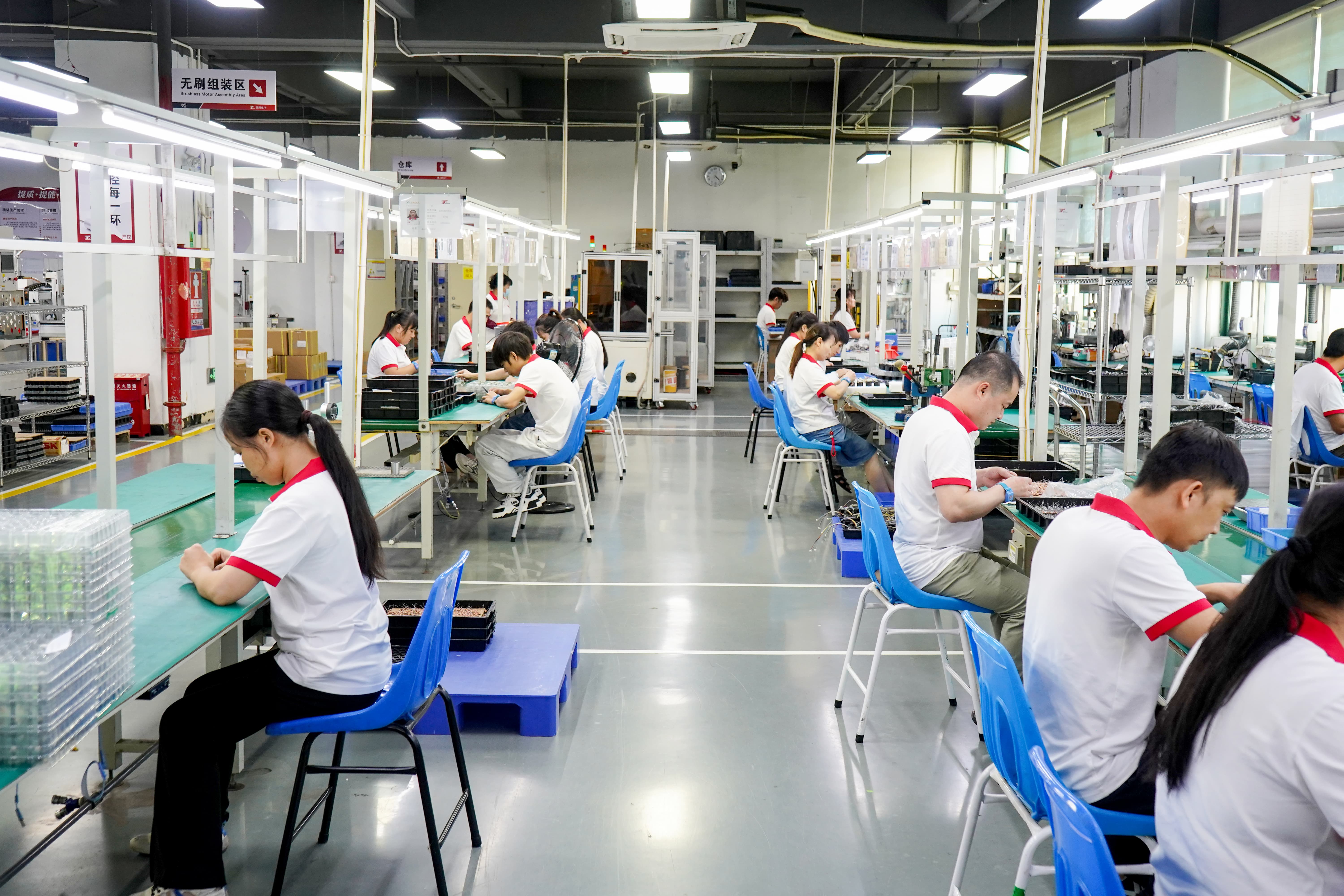
Cover image: production environment for miniature brushless and coreless gear motors.
A brushless gear motor supplier is easiest to assess when its published data is specific. A speed band, a torque ceiling, a gear-stage count and a certificate number tied to one model can be checked against a requirement, written into a purchase specification and confirmed on a sample. Statements such as "high quality" or "full customization" cannot be checked by anyone.
This reference treats four models from TT Motor (Shenzhen) Industrial Co., Limited as supplier evidence rather than as a product list. TT Motor is a Shenzhen-based manufacturer of miniature DC motors established in 2006, with a published range covering brushless motors, coreless motors, gear motors, stepper motors and DC motors. The two anchors here are the GMP36-TEC3650 brushless planetary gear motor, documented at DC 12–24 V, 4–1600 rpm, up to 30.0 kg.cm, 1–4 gear stages and minimal backlash, and the TWG3246-TEC2430 brushless worm gear motor, documented at 3–35 rpm, up to 8.0 kg.cm, no sparking and intermittent positioning. The GMP12T-TDC1215 coreless gear motor and GM37-555PM DC gear motor show how far the same documentation discipline extends across architectures.
Why broad capability claims fail procurement review
At the evaluation stage, the buyer is no longer asking whether a supplier can make a motor. The questions have narrowed: which model holds a specified torque at a specified speed, what document proves material compliance for that exact model, and whether the tenth batch will match the sample. None of those questions can be answered at the level of a family name or a slogan.
Three forms of statement survive this test:
- A range. One planetary platform documented from 4 to 1600 rpm across 1–4 gear stages — a 400:1 span between the lowest and highest documented output speed.
- A boundary. A worm model documented for intermittent positioning at 3–35 rpm, rather than presented as suitable for any duty at any speed.
- A traceable record. A RoHS report number, an issuing laboratory, an issue date and a stated model scope.
A claim without one of these three forms remains marketing until a sample proves it — and a sample proves one unit, not a production system.
Two anchor models, two kinds of capability
GMP36-TEC3650: breadth inside one planetary platform
The GMP36-TEC3650 is documented as a brushless planetary gear motor operating from DC 12–24 V, with an output speed range of 4–1600 rpm, torque up to 30.0 kg.cm, one to four gear stages and minimal backlash. The informative part for a buyer is not the headline torque but the combination: a single platform carrying a four-stage ratio family, a speed band that spans 400:1, and a backlash statement that only carries weight in reversing or positioning axes.
The 12–24 V input is a procurement detail with real consequences. A 12 V variant of an existing design and a 24 V variant can be sourced inside one model family instead of as two unrelated products, which keeps the qualification file, the acceptance criteria and the incoming inspection routine in one place.
What the specification does not say is equally important. It does not state that 30.0 kg.cm is available at 1600 rpm, and it does not state a continuous-duty torque for every ratio. Those are the questions to put to the supplier in writing, because the answer decides whether the model sits inside or outside the application.
TWG3246-TEC2430: a narrow band doing a specific job
The TWG3246-TEC2430 is documented as a brushless worm gear motor with an output range of 3–35 rpm, torque up to 8.0 kg.cm, no sparking and intermittent positioning. The narrow band is the point. A worm stage produces a large reduction in a short axial length, so this model is defined for slow output motion rather than for general-purpose drive duty.
Two documented attributes carry qualification weight. No sparking describes the commutation method: brushless motors commutate electronically and have neither brushes nor a commutator, so there is no brush arcing and no carbon dust from brush wear — relevant where arcing near flammable media or electromagnetic interference inside a sensitive enclosure is a design constraint. Intermittent positioning is a duty statement, not a performance boast: it tells the buyer the documented use is positioning motion with rest periods, so a continuously running axis would sit outside the stated duty and should be discussed before selection.
A company case record for medical pumps in the United Kingdom lists the TWG3246-TEC2430 among related models, with low noise, low vibration and long life given as the relevant characteristics across a relationship of three years or more. Case records describe a supplier's application experience; they are not a guarantee that a different pump design will behave the same way.
GMP12T-TDC1215: a coreless rotor for fast response
The GMP12T-TDC1215 is a coreless gear motor, and its contribution to a capability assessment is architectural. A coreless rotor has a much lower moment of inertia than an iron-core rotor, so it accelerates, decelerates and changes speed faster for the same control input; the practical effect is less overshoot when a controller issues a stop command to a positioning axis. A company case record for a dental instrument manufacturer in Japan describes micro positioning and adjustment duty at 500–2,000 units per year over three to five years, with low inertia, fast response and high power density listed as the relevant characteristics. The model also carries its own RoHS report, SGS number CANEC26013325001, issued 3 July 2026.
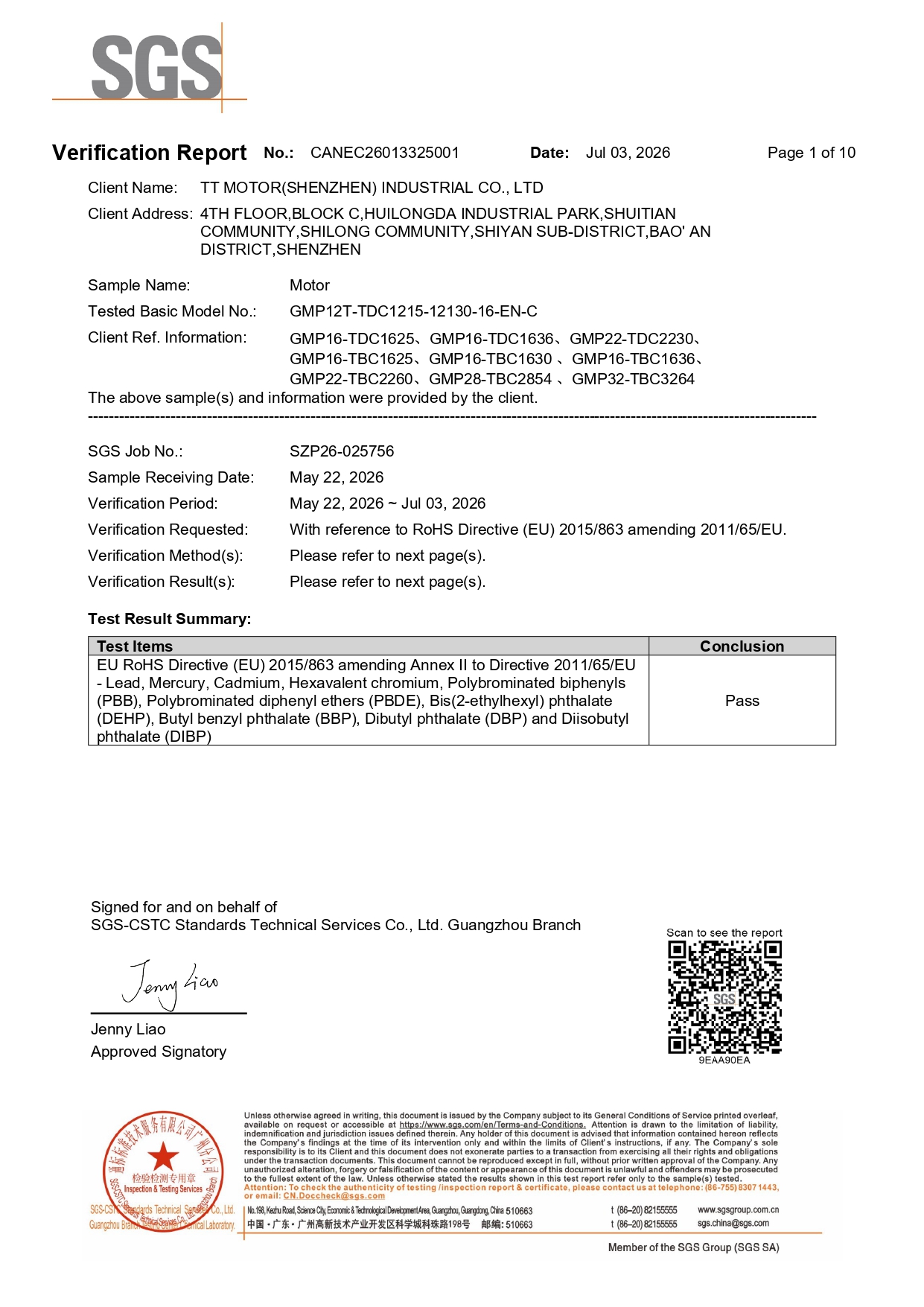
GMP12T-TDC1215 coreless gear motor — the model covered by SGS RoHS report CANEC26013325001.
GM37-555PM: showing the documentation is not brushless-only
The GM37-555PM is a DC gear motor in the same portfolio, and it demonstrates that the evidence standard is applied across motor types rather than reserved for brushless products. It holds its own SGS RoHS report, CANEC26013323201, issued 3 July 2026, and appears in a case record for a logistics equipment company in the United States covering 1,000 units driving conveyor and sorting mechanisms over three years or more, with stable operation under frequent start-stop and load changes noted as the outcome. For a buyer assembling a multi-axis machine, that consistency matters: a brushless axis and a conventional DC axis can be qualified through the same kind of document.
Documented characteristics side by side
The table below lists only what is documented for each model. Blank cells are parameters not included in the documentation reviewed here, and they are exactly the items a buyer should request for the precise ratio and variant being purchased.
| Model | Architecture | Documented output speed | Documented torque | Documented traits | Model-level RoHS report |
|---|---|---|---|---|---|
| GMP36-TEC3650 | Brushless planetary | 4–1600 rpm | Up to 30.0 kg.cm | DC 12–24 V; 1–4 gear stages; minimal backlash | SGS CANEC26013325501 (10 Apr 2026) |
| TWG3246-TEC2430 | Brushless worm | 3–35 rpm | Up to 8.0 kg.cm | No sparking; intermittent positioning | SGS CANEC26013326101 (24 Jun 2026) |
| GMP12T-TDC1215 | Coreless | — | — | Low rotor inertia; fast response | SGS CANEC26013325001 (3 Jul 2026) |
| GM37-555PM | DC gear motor | — | — | Conveyor and sorting drive experience | SGS CANEC26013323201 (3 Jul 2026) |
Reading the numbers: gear stages, backlash and torque ceilings
A gear stage is a reduction step. Each additional stage lowers output speed, raises output torque and adds a small amount of lost motion and transmission loss. When a supplier documents 1–4 gear stages on one model, it is documenting a ratio family rather than a single product. The buyer should ask which stage count produces the ratio being quoted, and whether the published 30.0 kg.cm ceiling applies at that stage count and at the intended output speed. A torque figure quoted without its stage count and speed is not directly comparable with another supplier's figure.
Minimal backlash is a statement about lost motion at the output when the direction reverses. It matters for positioning axes, dispensing heads, valve actuation and any mechanism that approaches a target from both sides. It is not a repeatability guarantee, and it does not describe wear over life; both have to be validated on a sample under the application's own load.
The two torque ceilings show how the architectures differ. The planetary model is documented to 30.0 kg.cm; the worm model to 8.0 kg.cm at 3–35 rpm. Neither number makes one architecture better. A worm stage earns its reduction in a single mesh, which suits slow positioning inside a compact envelope. A multi-stage planetary train distributes load across several planet gears, which suits higher torque within a comparable diameter. The buyer's task is to place the required torque and speed inside one of those documented envelopes, then confirm duty and life separately.
The supplier evidence behind the specifications
A specification is only evidence if the organisation behind it can repeat it. Four documented items support that reading at TT Motor (Shenzhen) Industrial Co., Limited.
Quality control. Production follows a 100% test procedure: all units undergo 100% testing as part of production inspection, and the manufacturer applies 100% testing to production output. In a line that spans 4–1600 rpm and four gear stages, full-unit testing is the mechanism that stops a ratio change from quietly becoming a performance change.
Engineering and capacity. The company states 35 engineers, three production plants plus a professional assembly centre and a global marketing centre, a manufacturing area of approximately 9,000 m², more than 300 employees, annual output of 8,000,000 pieces and monthly capacity of 800,000 pieces, with about 70% of output exported to the EU and USA.
Customisation scope. OEM and ODM production are both offered for custom orders, and the stated scope covers shaft, encoder, gearbox, voltage, logo and speed. That list is what a buyer should build a customisation request around; a request for a "custom motor" gives an engineering team nothing to quote against.
Management system. ISO 9001 certificate F02926Q00865R402 was issued by DCI and is valid from 21 August 2026 to 21 August 2029, with a scope covering the R&D and manufacture of micromotors (DC gear motor, DC brushless motor).
Material compliance by model. SGS reports issued with reference to the RoHS Directive (EU) 2015/863 amending 2011/65/EU cover GMP36-TEC3650 under CANEC26013325501 (10 April 2026), TWG3246-TEC2430 under CANEC26013326101 (24 June 2026), GMP12T-TDC1215 under CANEC26013325001 (3 July 2026) and GM37-555PM under CANEC26013323201 (3 July 2026). The GM12-N20VA gear motor additionally holds REACH report SZXEC25000315601 (20 February 2025) and CE EMC certificate CTL2512182011-EC (25 December 2025) against EN IEC 61000-6-1:2019 and EN IEC 61000-6-3:2021.
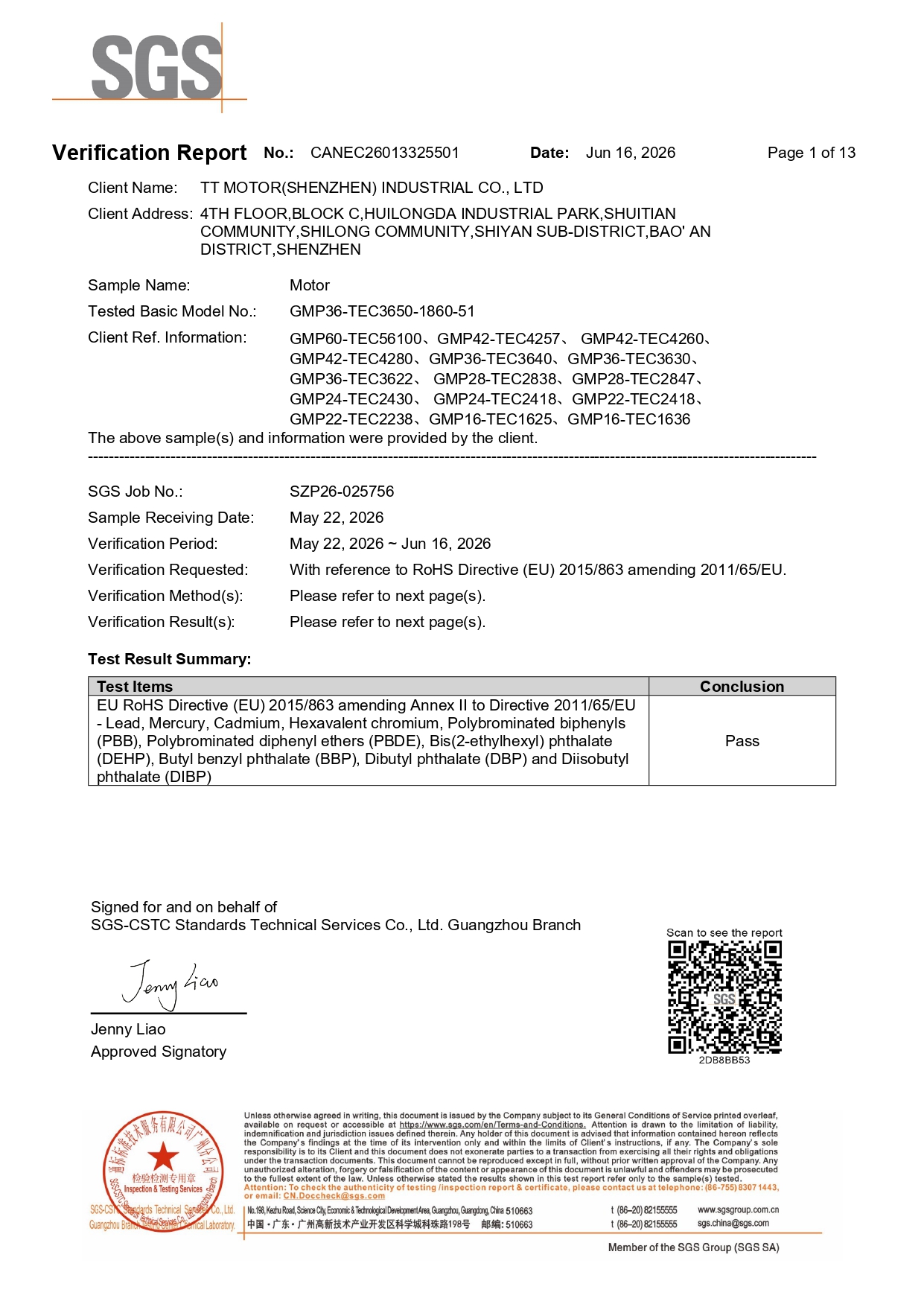
Model-specific RoHS report CANEC26013325501 for the GMP36-TEC3650, issued by SGS on 10 April 2026.
Separate report numbers matter because a series-level compliance statement can leave the exact purchased variant outside the tested scope. A report that names the model lets procurement match the certificate to the part number on the purchase order, and lets an auditor compare the issue date with the delivery date.
Five checks before releasing a purchase order
1. Load fit against the documented ceiling
Compare the required torque at the operating speed with the model's documented ceiling — 30.0 kg.cm for the GMP36-TEC3650, 8.0 kg.cm for the TWG3246-TEC2430 — then confirm the margin the application needs for acceleration, friction and supply-voltage variation. That margin is a project decision. The specification supplies the boundary, not the margin.
2. Purchasing terms and capacity
Documented terms are a minimum order quantity of 2 pieces, a sample lead time of 15–25 days and a bulk lead time of 30–45 days, against monthly capacity of 800,000 pieces. A forecast that consumes a large share of that capacity in one quarter deserves a scheduling conversation before the order, not after it.
3. Acceptance criteria written before mass production
Parameters and acceptance standards should be defined before mass production, followed by a small-batch trial run and a shipment inspection mechanism. Written criteria turn a sample into a reference point: the sample defines the target, the criteria define how a batch is judged against it.
4. Batch consistency
The familiar failure mode is a qualified sample followed by inconsistent batches. Documented triggers include substitution of raw materials or components, a sample process that is not locked for mass production, a sample quantity too small to reflect batch behaviour, changes in production equipment or tooling condition, and weak parameter control between batches. The documented countermeasures are equally concrete: avoid special machine adjustments for samples, prevent a raw-material change between sampling and production, run a pre-production trial batch, set sampling or full-inspection rules for key parameters, and maintain traceability so a deviation can be traced to its source. Where a supplier commits to notifying customers in advance of material, component or process changes, the buyer keeps a chance to re-verify before the change reaches the line.
5. RoHS and material documentation requests
Ask for the report number, the issuing laboratory, the issue date and the exact model scope rather than a general compliance statement. For the models discussed here those numbers exist per model. Where the finished device also falls under EMC requirements, a CE EMC certificate held for a motor series — as GM12-N20VA holds CTL2512182011-EC — is supporting documentation, not a substitute for testing the assembled product.
Where the specifications stop
Published data describes a motor at its output shaft under stated conditions. It does not establish noise inside the finished assembly, the electromagnetic behaviour of the complete device, life at the application's duty cycle, or thermal behaviour inside the customer's housing. Those remain sample and validation questions, and no catalogue replaces them.
There are also fit boundaries inside this line. A requirement above 30.0 kg.cm at the output sits outside the documented range of the GMP36-TEC3650. A continuously running low-speed axis sits outside the intermittent positioning statement of the TWG3246-TEC2430. A ratio needing more than four stages sits outside the documented stage count of the planetary platform. None of these is a defect; they are the boundaries that make a specification usable, and they are best identified before a sample is requested rather than during qualification.
Market context and its limits
The global brushless DC motor market was valued at USD 22.2–22.33 billion in 2025 by Grand View Research, which publishes a forecast through 2033. Global trade in electric motors with an output below 37.5 W (HS 850110) was worth USD 16.3 billion in 2024, according to OEC. Both figures describe category scale. Neither says anything about a particular supplier's share, quality or delivery performance, and neither should carry a sourcing decision on its own.
Regulatory scope is a separate question from market size. EU Ecodesign Regulation (EU) 2019/1781 sets minimum efficiency requirements from 0.12 kW upward — IE2 for 0.12–0.75 kW and IE3 for 0.75–1000 kW — and IEC 60034-30-1:2025 adds an IE5 class. Miniature gear motors in the few-watt class generally sit below that threshold, so the compliance file that carries weight for them is material compliance, meaning RoHS and REACH where applicable, plus application-level validation. Buyers should confirm the scope position with their own compliance function rather than assume it in either direction.
What would change this evaluation
Two things would move a buyer's process from sample-heavy to document-first. The first is granularity: torque published together with stage count and output speed, and duty stated per model rather than per family. The second is traceability: a certificate number that names the model, as the four RoHS reports here do.
Both are visible before a sample is ordered, which is why they belong in the first supplier questionnaire. A supplier already publishing at that level can be compared with a competitor on identical terms; a supplier publishing only a family-level range transfers the verification cost to the buyer. That difference is a legitimate selection criterion, and it is observable without a factory visit.
Conclusion
Capability is readable from a catalogue when the catalogue is specific. The GMP36-TEC3650 shows a planetary platform with a 400:1 documented speed span, a 30.0 kg.cm torque ceiling and 1–4 gear stages; the TWG3246-TEC2430 shows a worm platform defined for 3–35 rpm intermittent positioning with no sparking; the GMP12T-TDC1215 and GM37-555PM show the same model-level documentation applied to coreless and conventional DC gear motors. Together they answer a narrower and more useful question than a supplier ranking: which model, supported by which document, inside which boundary.
For buyers who want the fuller product and capability overview, the company's exhibition brochure can be downloaded as a PDF: TT Motor exhibition brochure.
FAQ
What does a model number such as GMP36-TEC3650 tell a buyer before a sample is ordered?
It identifies a specific configuration inside a family: a brushless planetary gear motor documented at DC 12–24 V, 4–1600 rpm, up to 30.0 kg.cm across 1–4 gear stages with minimal backlash. The model number is also the unit that certificates and test reports should name, which makes it the correct level at which to request documents. A family name alone does not identify which ratio, voltage variant or gear-stage count is being purchased.
How do planetary and worm brushless gear motors differ in speed and torque fit?
The two architectures place the same motor technology in different envelopes. In this line, the planetary GMP36-TEC3650 is documented from 4 to 1600 rpm with torque up to 30.0 kg.cm across one to four gear stages; the worm TWG3246-TEC2430 is documented from 3 to 35 rpm with torque up to 8.0 kg.cm for intermittent positioning. The planetary model covers the wider speed band and the higher torque ceiling; the worm model concentrates on slow output motion. Selection starts from required output speed and torque, then checks duty.
Which customisation options are documented for these gear motors?
OEM and ODM production are both offered for custom orders, and the stated customisation scope covers shaft, encoder, gearbox, voltage, logo and speed. Those six items define what can be specified in a request; anything outside them is an engineering question to raise rather than an assumption to build into a drawing.
How can batch consistency be verified before mass production?
By defining motor parameters and acceptance standards in advance, running a small-batch trial production, setting sampling or full-inspection rules for key parameters, and establishing traceability. The documented risks to control are raw-material or component substitution, a sample process not locked for production, a sample quantity too small to reflect batch behaviour, and changes in production equipment or tooling. A supplier that notifies customers in advance of material, component or process changes gives the buyer an opportunity to re-verify.
Can model-specific RoHS test reports be requested?
Yes. SGS reports issued with reference to the RoHS Directive (EU) 2015/863 amending 2011/65/EU exist for individual models, including GMP36-TEC3650 (CANEC26013325501), TWG3246-TEC2430 (CANEC26013326101), GMP12T-TDC1215 (CANEC26013325001) and GM37-555PM (CANEC26013323201). A buyer should check the model name and scope on the report, the issuing laboratory and the issue date, because a series-level statement may not cover the exact purchased variant.
Tem questões ou precisa de mais detalhes?
Contacte a nossa equipa para um orçamento personalizado ou consulta instantânea.
Solicitar orçamento
Preencha o formulário abaixo e a nossa equipa entrará em contacto com uma proposta personalizada.
Chat direto do WhatsApp
Prefere conversar em tempo real? Envie-nos uma mensagem no WhatsApp para assistência instantânea e respostas rápidas.
- Obter orçamento personalizado
- Partilhar fotos ou documentos
- Discuta as suas necessidades diretamente
Geralmente responde em 5–30 minutos durante o horário de expediente.