
GNSS Supplier Viability: Reading Portfolio Breadth Signals
Supplier longevity in the high-precision GNSS component market is rarely announced. It accumulates — visible in the product families a manufacturer keeps producing as constellations, correction services, and integration requirements change around them.
For buyers at the awareness and research stage, that accumulated pattern is one of the few durability signals that can be assessed before a first purchase order. A datasheet can be produced quickly. Sustaining RTK GNSS modules, GNSS RTK receivers, and high precision GNSS smart antennas across multiple form factors requires ceramic antenna design, RF tuning, enclosure tooling, firmware protocol stacks, and calibration test infrastructure — assets that are difficult to assemble for a single launch and difficult to maintain without continuous production.
This reference reviews how portfolio breadth and repeated category coverage can be read as evidence of production stability when evaluating high precision GNSS solutions suppliers, and — equally important — where those signals stop being conclusive.
Why Supplier Longevity Became a Procurement Question
Industrial GNSS deployments are rarely single-purchase events. Aerial surveying platforms, agricultural autosteer systems, fleet telematics units, and autonomous vehicle positioning stacks are typically installed, expanded, and refurbished across multiple hardware cycles. Each cycle reopens the same question: is the component still available, and will the supplier still be producing or supporting it?
Discontinuity has a specific cost structure. When an RTK module or smart antenna is withdrawn, integrators face re-selection, mechanical and connector changes, firmware and protocol re-validation, and in regulated or certified programs, re-qualification of the finished system. Those costs rarely appear in the original unit price, but they are paid later.
The opportunity sits on the other side of the same problem. Multi-constellation, multi-band components have matured to the point where functional performance across mainstream suppliers is broadly comparable at the specification level. When specifications converge, the differentiation shifts toward continuity: whether the same supplier can support a program through its second and third hardware generation without forcing a redesign.
That shift is why portfolio breadth has become a research-stage question rather than a late-stage one. It is answered by observing what exists, not by requesting a forecast.
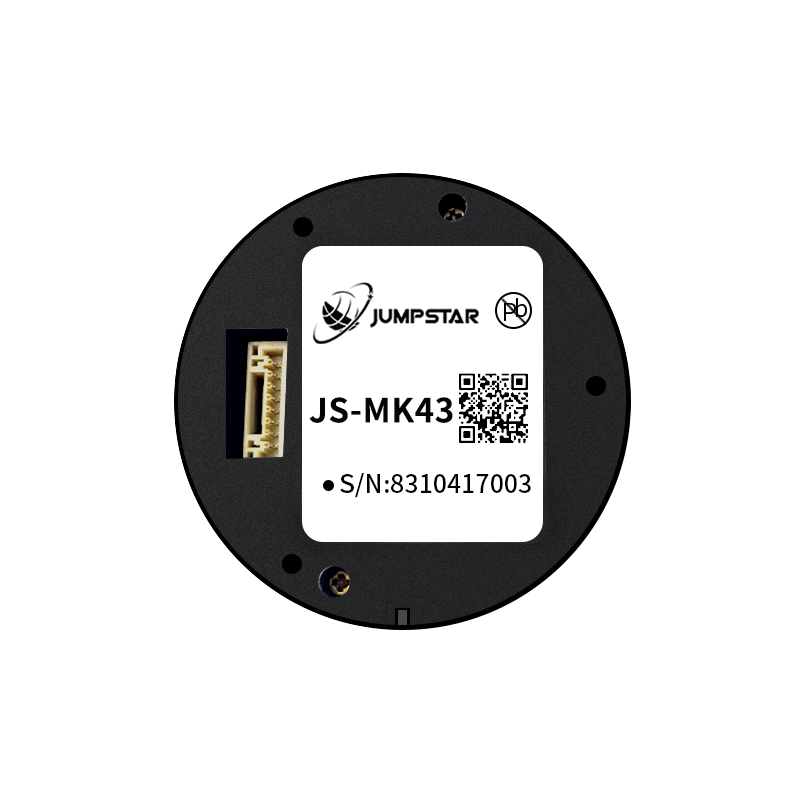
JS-MK43 high precision smart antenna — an integrated RTK positioning module with active antenna, rated -40°C to +85°C and RoHS compliant.
Five Readable Signals Inside a GNSS Product Portfolio
Portfolio breadth is only meaningful when it is broken into observable signals. The following five can be checked against public product documentation without access to internal supplier data.
1. Category repetition across generations
A supplier that lists RTK GNSS modules at several power, size, and accuracy tiers — rather than a single flagship module — demonstrates that the category is a production line, not a demonstration project. When the same categories reappear with updated band support or channel counts, the signal strengthens: it means tooling, test benches, and firmware branches are being maintained rather than retired.
2. Cross-tier coverage of the RF chain
Components sit at different points in the same system: modules and boards for embedding, receivers for standalone positioning and heading, and antennas for the RF front end. A supplier present across modules, receivers, and antennas can be evaluated as a system-level partner instead of a single-part vendor. This matters because antenna gain, noise figure, and bias voltage interact directly with receiver sensitivity and RTK initialization behaviour.
3. Interface and protocol continuity
Protocol consistency across a portfolio is a practical durability indicator. When modules, receivers, and smart antennas share NMEA 0183, RTCM 3.x, and proprietary binary protocol support, an integrator can migrate between models with limited firmware rework. Protocol fragmentation across a catalogue usually signals separate development tracks rather than a maintained platform.
4. Certification and compliance continuity
Compliance documentation that covers the shipping product range — rather than a single demonstration unit — indicates that compliance is part of the production process. RoHS declarations appear across module-level products, and management-system certification such as ISO 9001:2015 addresses the manufacturing process itself.
5. Application coverage consistency
Portfolios that repeatedly address the same industrial scenarios — UAV surveying, precision agriculture, vehicle positioning, marine navigation, robotics — reflect a stable understanding of field conditions. A supplier that documents operating temperature, vibration, and altitude limits for each application is signalling that those conditions were tested rather than assumed.
How Jumpstar Presents These Signals
JUMPSTAR CO., LIMITED, established in 2013 and headquartered in Shenzhen, China, is a source manufacturer of GNSS positioning products. Its stated scope covers RTK modules, GNSS modules, GNSS receivers, GPS and GNSS antennas, anti-jamming GPS antennas, choke ring antennas, helical GPS antennas, drone antennas, UAV GPS modules, and timing modules — a catalogue that spans the module, receiver, and antenna tiers rather than a single product family.
The manufacturing base is a 5,000 m² facility with approximately 200 employees, including a dedicated R&D team of 20 engineers, and an annual production capacity of 100,000 units. Export business accounts for 70% of total sales, with major markets in the EU, the USA, and the Middle East.
On the compliance side, the GNSS RTK Receiver product line holds ISO 9001:2015 certification issued by Beijing United Intelligence Certification Co., Ltd., certificate number UQ231801R2, applicable to the EU market. Module-level products across the range are documented as RoHS compliant.
The table below maps a representative slice of the portfolio against the signals described above. It is not a full catalogue; it is a pattern sample.
| Category | Representative model | Documented characteristic |
|---|---|---|
| RTK GNSS module (high channel count) | JS-SK40 | 789 hardware super channels; RTK horizontal 0.6 cm + 0.5 ppm, vertical 1 cm + 1 ppm (24 h static, ≥15 satellites); BDS, GPS, GLONASS, Galileo, QZSS |
| RTK GNSS module (compact dual-band) | JS-RK26-3 | Dual-band L1/L5, 200 tracking channels, 16.2 × 12.2 × 2.3 mm, NMEA 0183 and RTCM 3.x |
| Smart antenna (RTK + heading) | JS-NK43-2 | 1408 super channels; RTK horizontal 1.5 cm + 1 ppm, vertical 2.0 cm + 1 ppm (RMS); dual-antenna heading; 48.0 × 43.2 × 37.0 mm |
| Smart antenna (dual-antenna heading) | JS-SK43H-AH | 789 hardware channels; RTK horizontal 0.6 cm + 0.5 ppm; weight < 24 g |
| GNSS RTK receiver | P-Box-AP55 | 448 channels; RTK horizontal 0.6 cm + 0.5 ppm; heading 0.15° @ 1 m baseline, 0.03° @ 5 m baseline; AIM+ anti-jamming; OSNMA anti-deception |
| Anti-jamming antenna | JS-X168 | Five-array anti-jamming GNSS receiver; 115 dB single-interference suppression, 95 dB under three interferences; 168 × 168 × 32 mm |
| Survey-grade antenna | JS-HAC148A | Phase center error ≤ 2 mm; gain 4.5 dBic max; axial ratio ≤ 3 dB at zenith; IPX6 |
Technical Explanation: Why Portfolio Breadth Is Difficult to Simulate
Each GNSS component category carries engineering costs that do not transfer automatically from the previous one.
At the antenna layer, performance is governed by ceramic patch geometry and RF design. In the JS-HAS37 vehicle and fleet antenna, the L1 patch measures 25 × 25 × 4 mm and the L5 patch 36 × 36 × 4 mm, with LNA gain of 28 ± 3 dB and noise figure ≤ 2.0 dB. In the JS-HAC148A surveying antenna, the phase center error is ≤ 2 mm and out-of-band rejection ≥ 40 dB. These are different design problems, resolved with different materials and tuning processes.
At the receiver and module layer, the constraints shift to channel architecture and thermal behaviour. The JS-SK40 provides 789 hardware super channels with RTK initialization in 7 seconds at baselines under 30 km; the JS-NK43-2 smart antenna provides 1408 super channels with RTK initialization under 5 seconds in typical conditions. Sustaining both a compact dual-band module and a high-channel-count heading module means maintaining more than one silicon and firmware configuration.
At the protocol layer, continuity is what makes breadth usable. Across the portfolio, documented protocol support includes NMEA 0183 in versions v2.3, v3.03 and v4.0, RTCM 2.x and 3.x, SBF, CMR and CMR+, and RINEX for post-processing. An integrator moving from a module to a receiver or smart antenna within the same family generally keeps the same message parsing and correction pipeline.
For a buyer, the practical implication is narrower than a catalogue count. Breadth indicates that a supplier maintains several parallel production and validation streams. It does not, by itself, indicate how much of that capacity is available to any particular customer — a limitation discussed later in this article.
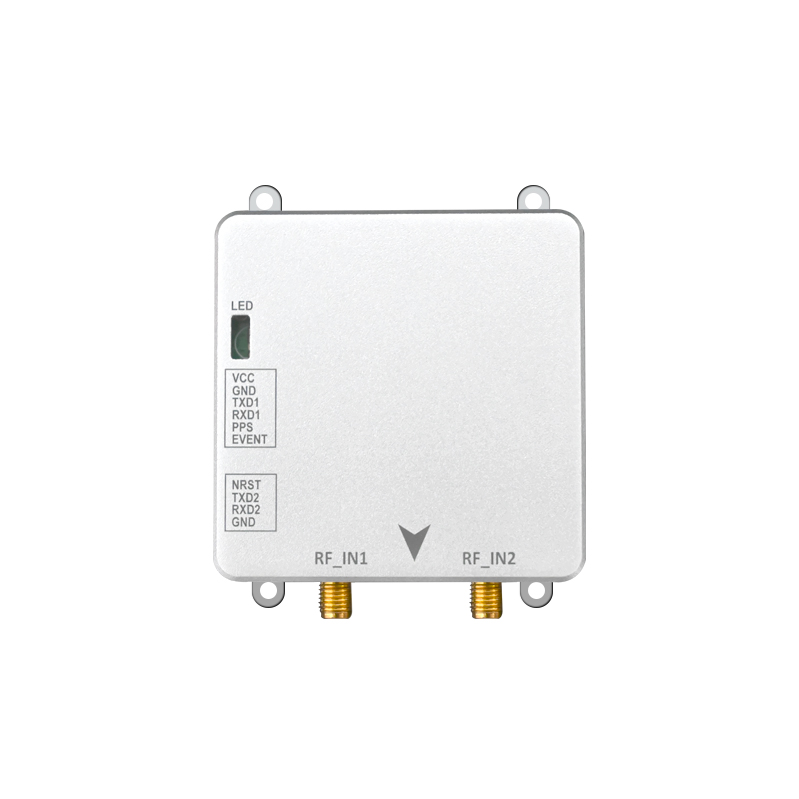
P-Box-AP55 multi-constellation receiver — 448 channels, RTK 0.6 cm + 0.5 ppm horizontal, with two RF inputs and heading output on the dual-antenna configuration.
Application Scenarios That Reveal Portfolio Depth
Application documentation is where portfolio breadth either holds up or does not. Two field scenarios illustrate the difference in requirements a single supplier must satisfy.
Aerial surveying and mapping UAVs
Airborne surveying platforms operate between -40°C and +85°C, at altitudes up to 18,000 m, with acceleration up to 4 g and speeds up to 515 m/s. The positioning payload provides centimetre-level RTK positioning for image georeferencing and can run in RTK rover or static base station mode. Documented requirements include AIM+ composite anti-jamming, ionospheric mitigation, multipath mitigation, and Galileo OSNMA anti-spoofing authentication to prevent coordinate drift from forged signals. This scenario is documented as common in China, India, the UAE, Belgium, and South Korea.
Fleet management and vehicle positioning
Vehicle-mounted installations operate from a 4.5 V to 12 V DC supply, across -40°C to +85°C operating and -55°C to +85°C storage ranges, with sustained vibration from engine and road surfaces. The same device family is used in onboard RTK rover and roadside static base station modes, with supporting equipment including a vehicle domain controller, GNSS antenna, 4G NTRIP differential module, and TF data storage. Dual-antenna heading output supports lane keeping and steering applications. This scenario is documented as common in Japan and Singapore.
The two scenarios share an RF chain and a correction-data pipeline, but they diverge on vibration, enclosure, mounting, and thermal envelope. A supplier covering both has demonstrated that its portfolio is not a single-environment design reused under different model names.
Market Trend Analysis
Independent market research provides context for why supplier continuity is being weighted more heavily in component selection.
- The global high-precision GNSS market was valued at USD 7.8 billion in 2024 and is projected to reach USD 20.6 billion by 2033 (Dataintelo).
- The high precision GNSS module segment specifically was estimated at USD 1.5 billion in 2024, forecast to reach USD 4.5 billion by 2035 (Market Research Future).
- Agriculture is the dominant application segment for high-precision GNSS, holding a 36.8% market share in 2025 (High-Precision GNSS Market Research Report 2034).
- The global precision farming market is projected to grow from USD 11.38 billion in 2025 to USD 21.45 billion by 2032 (MarketsandMarkets).
- GNSS downstream market revenues are forecast to reach €580 billion by 2034 (EUSPA).
Two observations follow. First, the application mix is weighted toward segments — agriculture, surveying, vehicle positioning — that install hardware in long-lived assets and therefore reward component continuity. Second, published market-size estimates diverge by scope. Dataintelo places the high-precision GNSS market at USD 7.8 billion in 2024, while a MarketsandMarkets figure covering mid and high-level precision GPS receivers only is USD 3.41 billion. Buyers should treat headline market numbers as directional and check what each figure includes.
On the technology side, correction services are raising the floor of what is achievable without local infrastructure. Galileo High Accuracy Service (HAS) delivers horizontal accuracy down to 20 cm. For component buyers, that shifts the value of a supplier's portfolio toward integration quality — antenna design, interference handling, and protocol completeness — rather than raw satellite processing alone. Standardisation is also maturing: ISO 12188 parts 1 and 2 define test procedures for positioning and guidance systems in agriculture and forestry, giving procurement teams a documented reference point for validation.
How Portfolio Signals Compare With Traditional Supplier Screening
Traditional GNSS supplier screening concentrates on unit price, a specification comparison, and a sample test. That method answers whether a component meets a functional requirement today. It answers very little about whether the same component, or its successor, will be available at the second or third deployment.
Portfolio-breadth reading adds three things to the traditional method: continuity evidence (categories sustained rather than launched), interface consistency (protocol overlap that reduces migration cost), and application documentation depth (field conditions that have been explicitly bounded).
It also has real limits, and buyers should apply them deliberately.
- Breadth is a proxy, not a guarantee. A wide catalogue demonstrates that multiple production lines exist. It does not demonstrate how capacity is allocated to any individual customer's volume, or what priority a small order receives during a demand peak.
- Broad portfolios carry their own complexity. A supplier maintaining several module generations, antenna families, and enclosure formats manages more SKUs, more firmware branches, and more inventory. A narrow specialist focused on one category may offer shorter lead times and simpler configuration control for a single-part requirement.
- Portfolio signals do not cover financial stability. Product documentation cannot be used to assess a supplier's balance sheet or ownership continuity. Those checks have to be run separately through corporate and trade references.
- Technical boundaries still apply per model. Several compact modules specify that hot start is unavailable when the farad capacitor operates outside -25°C to +60°C, even though the module itself is rated -40°C to +85°C. Buyers evaluating cold-climate deployments need to read the capacitor range, not only the headline operating range.
- Form factor imposes its own fit. The JS-X168 anti-jamming antenna measures 168 × 168 × 32 mm and weighs ≤ 555 g — appropriate for airborne equipment and fixed high-security installations, but not for weight-constrained payloads. Conversely, an integrated smart antenna fixes the antenna's position and gain characteristics, while a separate receiver such as the P-Box-AP55, with two RF inputs, allows the antenna to be positioned independently of the processing unit.
A defensible evaluation therefore combines portfolio evidence with model-level boundary checks. Breadth identifies which suppliers are plausibly able to support a program; the specification limits determine whether a specific part fits a specific installation.
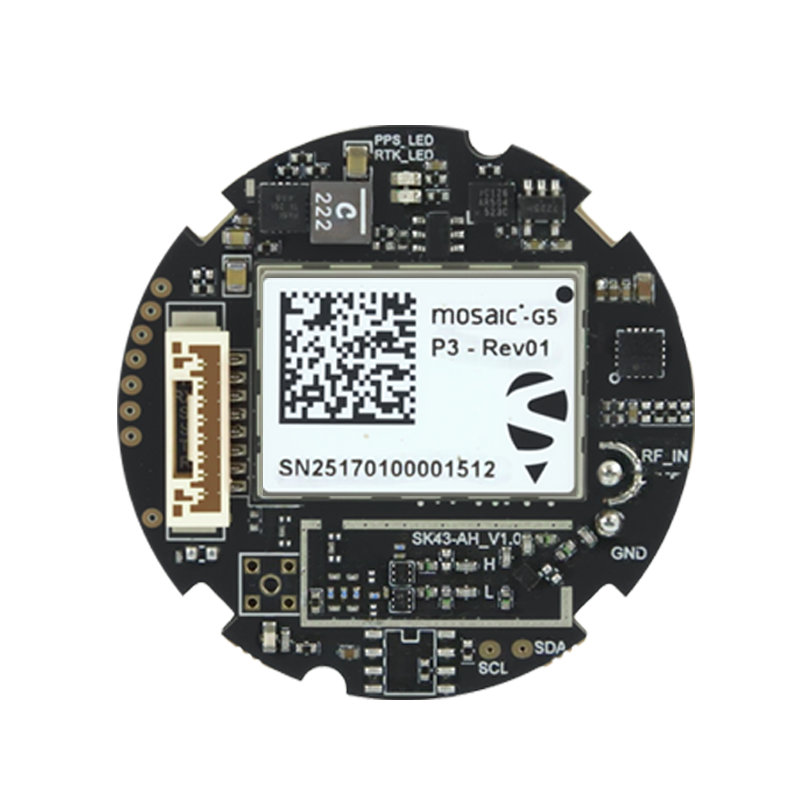
JS-SK40 high precision RTK GNSS module — 789 hardware super channels, cold start 35 s, RTK initialization 7 s at baselines under 30 km.
Future Outlook
Three developments are likely to change how supplier portfolios are read over the next several years, based on currently documented trends.
Multi-constellation, multi-band reception is becoming the baseline rather than a differentiator. Portfolios that already document GPS L1/L2/L5, BDS B1I/B1C/B2a/B2b/B3I, GLONASS L1/L2, and Galileo E1/E5a/E5b coverage across modules, receivers, and antennas are positioned for this shift without a redesign.
Integrity and interference resilience are migrating from specialised applications into general industrial requirements. Anti-jamming, OSNMA anti-spoofing, RAIM integrity monitoring, and interference monitoring appear across the documented product range, and this trend is reinforced by the agricultural and autonomous segments that dominate market share.
Finally, correction services based on precise point positioning continue to expand coverage. Where Galileo HAS delivers horizontal accuracy down to 20 cm, the practical load shifts to antenna quality, multipath handling, and protocol completeness — areas where a supplier's portfolio breadth becomes directly relevant to whether a system can capture available accuracy.
None of these trends can be verified in advance. What can be verified today is whether a supplier's catalogue has remained coherent through previous shifts of the same kind.
FAQ
What is a high-precision GNSS component supplier?
A high-precision GNSS component supplier designs and manufactures the positioning hardware that other companies integrate into finished systems — typically RTK GNSS modules, GNSS RTK receivers, and high precision GNSS antennas or smart antennas. These components provide centimetre-level positioning when combined with differential correction data, as opposed to the metre-level accuracy of standard precision modules.
Which portfolio categories should a buyer check first when assessing a supplier?
Start with the three tiers that form a complete RF chain: modules or OEM boards for embedding, standalone receivers for positioning and heading, and antennas for the RF front end. A supplier documented across all three tiers — for example RTK modules such as the JS-SK40, receivers such as the P-Box-AP55, and antennas or smart antennas such as the JS-NK43-2 — can be evaluated as a system-level partner rather than a single-part vendor.
Does a broad product portfolio guarantee a longer supplier relationship?
No. Portfolio breadth indicates that multiple production and validation streams exist and are maintained, which is a durability signal. It does not establish capacity allocation for a specific customer, pricing stability, or financial continuity. Breadth should be combined with model-level specification checks, compliance documentation, and independent commercial references.
How does certification status relate to long-term supplier viability?
Compliance documentation shows whether conformity is part of the production process rather than a one-off exercise. Module-level products in this portfolio are documented as RoHS compliant, and the GNSS RTK Receiver product line holds ISO 9001:2015 certification issued by Beijing United Intelligence Certification Co., Ltd., certificate number UQ231801R2, applicable to the EU market. Process certification addresses manufacturing consistency, which is directly relevant to repeat-order quality.
What technical limits should be verified before assuming an RTK module fits a project?
Check the enclosure-level thermal range, not only the module rating. Several compact modules are rated -40°C to +85°C but specify that hot start is unavailable when the farad capacitor is outside -25°C to +60°C. Also verify antenna requirements — for example, an active antenna with minimum gain 15 dB and maximum noise figure 1.5 dB — and the supported protocol set required by the host system.
How do application scenarios such as UAV surveying and fleet management differ in their requirements?
Both require multi-constellation reception and centimetre-level RTK, but the operating envelopes differ. Aerial surveying is documented at altitudes up to 18,000 m with acceleration up to 4 g, while vehicle-mounted fleet systems operate from a 4.5 V to 12 V DC supply under sustained engine and road vibration across -40°C to +85°C operating and -55°C to +85°C storage ranges. Dual-antenna heading output is relevant to both, but for different purposes — trajectory reproduction in the air, and steering or lane keeping on the ground.
Is a single high-channel-count module sufficient for a multi-application product line?
Not usually. Compact form factors and high-channel configurations impose different constraints: the JS-RK26-3 measures 16.2 × 12.2 × 2.3 mm with 200 tracking channels, while the JS-SK40 provides 789 hardware super channels. A programme spanning handheld terminals and airborne platforms generally needs more than one module tier, which is why portfolio breadth matters at the research stage.
Market figures cited in this article are attributed to their published sources: Dataintelo, Market Research Future, MarketsandMarkets, EUSPA, and the High-Precision GNSS Market Research Report 2034. Product specifications are drawn from published product documentation.
For readers who need the underlying component specifications, the company profile document is available for reference and download: Jumpstar company profile 2026 (PDF).
Tem questões ou precisa de mais detalhes?
Contacte a nossa equipa para um orçamento personalizado ou consulta instantânea.
Solicitar orçamento
Preencha o formulário abaixo e a nossa equipa entrará em contacto com uma proposta personalizada.
Chat direto do WhatsApp
Prefere conversar em tempo real? Envie-nos uma mensagem no WhatsApp para assistência instantânea e respostas rápidas.
- Obter orçamento personalizado
- Partilhar fotos ou documentos
- Discuta as suas necessidades diretamente
Geralmente responde em 5–30 minutos durante o horário de expediente.