
Galvanized Steel Distribution Poles for Utility and EPC Lines
Galvanized Steel Distribution Poles for Utility and EPC Lines
In utility and EPC overhead distribution projects, galvanized steel distribution poles are engineered structural components, not interchangeable catalog items. Their fit depends on line design, local grid rules, outdoor corrosion exposure, traceability requirements and the way a project is staged for delivery. A pole that satisfies one rural electrification package may be unsuitable for another line section with different wind loading, foundation conditions, voltage class or inspection regime.
MILKY WAY, the brand of Jiangsu Milky Way Steel Poles Co., Ltd., is a China-based manufacturer founded in 1991 that produces transmission poles, distribution poles, substation steel structures, lattice towers, communication towers, lighting poles and related accessories. Its approved company data describes an export-oriented business serving Southeast Asia, Africa, the Middle East, South America, North America, Europe and Oceania, with 95% of products and projects supplied outside China. That profile makes the company relevant to the practical sourcing question: how should a utility or EPC contractor evaluate a galvanized steel utility pole for a specific overhead line package?
What a distribution pole must do in an overhead line project
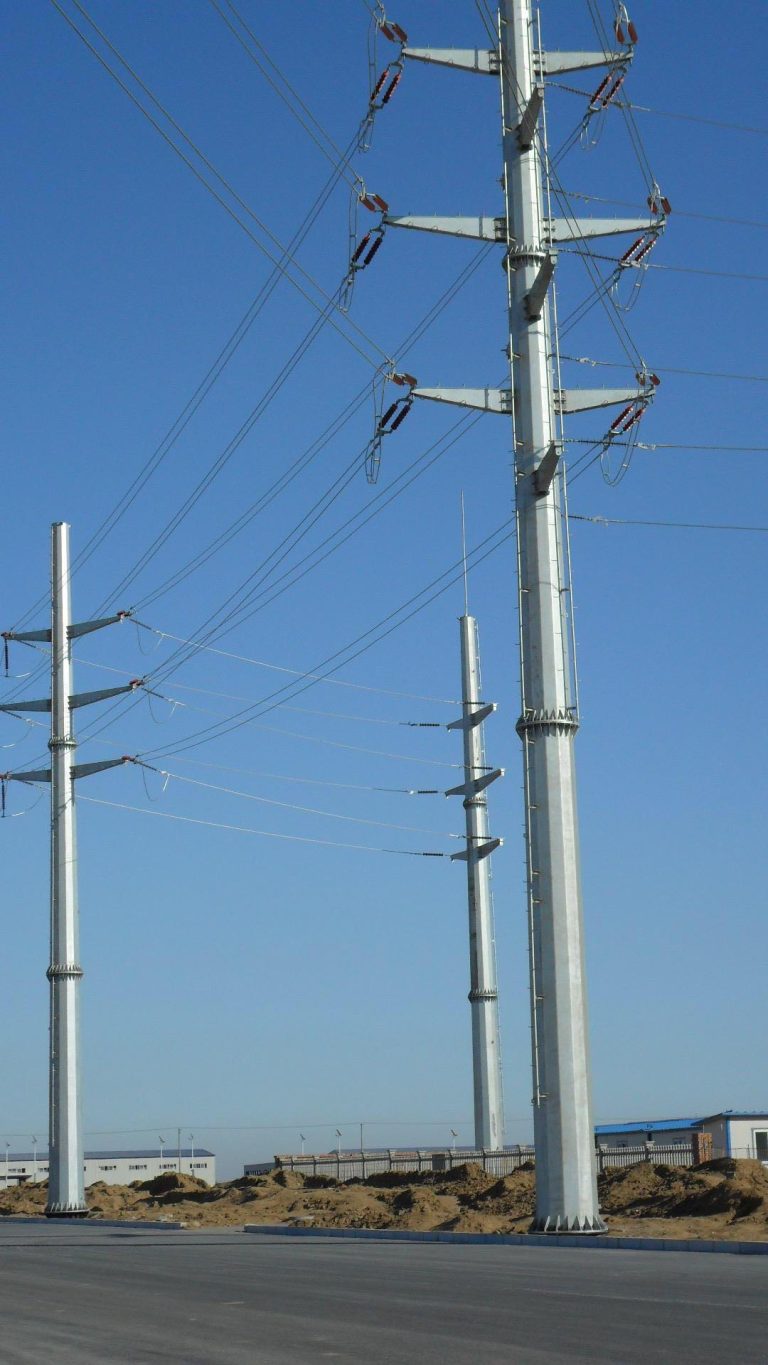
A galvanized steel distribution pole supports conductors, insulators, crossarms and line hardware under continuous outdoor service. In the product data supplied for MILKY WAY, the steel distribution pole range covers approximately 11 kV to 35 kV, with common heights around 7 m to 18 m or project-specific dimensions. The shaft may be octagonal, dodecagonal or polygonal and tapered; mounting may be direct burial or base-plate; crossarm and bracket configurations are customized to utility drawings. Material grades include Q235 or Q355, or ASTM A36 or A572 equivalent grades subject to approved design, with hot-dip galvanized steel as the base finish.
Those parameters explain why a steel electric pole should be specified as a design output rather than a generic product name. The same 11 kV line may use different pole heights at road crossings, different crossarm arrangements at angle points, and different foundations in soft soil or rock. A 9 m, 10 m, 11 m, 12 m or 14 m pole is therefore best treated as a project dimension within the broader distribution range, not as a fixed catalog item that can be ordered without a drawing.
Milky Way's engineering and design team uses PLS-POLE and PLS-TOWER for project-specific structural design, according to its company data. For a buyer, the practical meaning is that the supplier should be able to work from a load tree, line profile, wind condition and utility standard, then issue shop drawings for approval. The value is not the software name itself; it is the ability to connect project inputs to a documented pole geometry, hole pattern, connection detail and inspection plan.
Design inputs that decide the pole geometry
Distribution pole sourcing becomes more reliable when the technical file separates design inputs from commercial assumptions. The main design inputs are voltage class, line configuration, conductor and hardware loads, wind and exposure conditions, pole height, embedment or base-plate detail, crossarm layout and the required climbing or maintenance access. Milky Way's customization data covers voltage class, pole height, section geometry, wall thickness, load tree, crossarms, hole pattern, base plate, anchor bolts, climbing system, coating, marking and packing. That list is a useful checklist for an RFQ because each item changes fabrication or documentation.
Two poles with the same height can still be different products. A direct-buried pole and a base-plate pole have different foundation interfaces. A pole drilled for one utility's crossarm spacing may not accept another utility's hardware without redrilling or adapter plates. A thicker wall section may be needed for a long span or high wind area, but wall thickness alone does not prove structural adequacy; the design calculation and approved drawing remain the controlling documents. Buyers should therefore compare quotations only when the same load tree, geometry, coating, accessories and inspection requirements are fixed.
Procurement implication: a low unit price for a steel utility pole is not comparable unless the quotation states the pole height, voltage class, shaft geometry, wall thickness, steel grade, coating standard, crossarm and bracket scope, foundation interface, inspection documents and delivery basis. Without those fields, the buyer is comparing different products under the same product name.
Milky Way's distribution pole data also notes utility-specific hole patterns and accessories, dimensional consistency and export packing optimized for container loading. These are not secondary details. Hole patterns affect erection speed; dimensional consistency affects crossarm fit; packing affects damage risk and site sequencing. In an EPC overhead line project, those details often determine whether a pole package can be received, stored and erected in the planned order.
Local grid requirements: why one market's pole is not another's
Local grid requirements are one of the clearest reasons to avoid copying a previous project specification. The Philippines provides a documented example. NEA Memorandum No. 2007-007, dated 15 February 2007, is recorded as an active reference specification for steel poles in the Philippines. Its technical specification table includes a 30 ft distribution pole with 3.00 mm thickness, 345 MPa yield stress and 86 microns zinc coating for heavy loading zones. The same record covers distribution steel poles in the 25 ft, 30 ft, 35 ft and 40 ft range, with the excerpt specifically describing a heavy-loading, typhoon-prone application.
That does not mean every Philippine project uses the same values, and it does not mean a 30 ft specification should be applied to every height or line section. It means the local utility or cooperative specification must be read as a project document. A buyer sourcing a galvanized steel power pole for a Philippine distribution line should confirm the current utility specification, the loading zone, the required yield stress, the coating thickness and the inspection evidence before approving a shop drawing.
International standards add another layer. The American Galvanizers Association notes a 2024 revision of ASTM A123, the standard specification for zinc hot-dip galvanized coatings. Milky Way's approved corpus states that its poles can be customized to GB, ASTM A123, EN and other international standards. That is a fabrication capability statement, not an independent certificate for every order. The buyer should still require the applicable standard edition, coating acceptance criteria, inspection method and certificate or test report for the actual production lot.
The same discipline applies to welding, dimensional tolerance and structural design. A supplier may state that it works to international standards, but the project file should identify which standard governs the design, which standard governs welding inspection, which coating standard applies and which documents will be reviewed at hold points. This is especially important when an EPC contractor is purchasing for a utility whose engineers will review drawings and inspection records before dispatch.
Corrosion protection for continuous outdoor service
Hot-dip galvanizing is the base corrosion-protection system for the distribution poles described in Milky Way's product data. In outdoor service, the zinc coating acts as a barrier and, where the coating is damaged, provides localized sacrificial protection to the steel. That is stable industry knowledge; the project-specific question is how much coating, to which standard, with what surface preparation and inspection.
Milky Way's company profile states that its anti-corrosion finish is hot-dip galvanizing, with optional galvanizing plus powder coating, and that its design life is 30+ years, up to 50 years in coastal high-corrosion conditions. Those figures should be read as the company's stated profile, not as a universal guarantee for every site. Coastal humidity, salt-laden atmosphere, industrial pollution, abrasion during transport and the condition of the coating after erection all affect real performance. A project in a coastal or high-humidity region should therefore specify the coating system and inspections explicitly rather than relying on a generic description.
The NEA example shows why coating values belong in the technical specification. Its 30 ft heavy-loading reference includes 86 microns zinc coating. Other projects may require a different coating mass or thickness depending on the standard, steel thickness and exposure class. A buyer should ask for the coating standard, the required minimum thickness or mass, the sampling method and the inspection record. If powder coating is added over galvanizing, the buyer should also confirm surface preparation, adhesion and repair procedure, because the optional coating changes the finish system but does not remove the need for a sound galvanized base.
Traceability: from steel certificate to packing mark
Traceability is often treated as a quality-department topic, but in distribution pole sourcing it is a procurement control. Milky Way's capability data describes incoming material test certificate verification, chemical and mechanical checks as required, dimensional inspection, weld inspection, galvanizing inspection, final inspection and FAT or third-party inspection support. It also describes MES and digital production control, process inspection, unique identification and traceability, plus batch size, pole type, project marking, identification code and packing sequence as customization fields.
For the buyer, that means a pole should be identifiable at three levels: the production lot, the pole itself and the packed bundle or container. The production lot connects to material certificates and inspection records. The pole marking connects the physical item to the approved drawing and project location. The packing mark connects the bundle to the shipping list and site delivery sequence. If any of those links is missing, a site query becomes harder to resolve, especially when a project has multiple line sections, pole heights and crossarm arrangements.
Milky Way's quality-control description includes a four-level inspection sequence: raw material testing, in-process patrol, finished-product full inspection and third-party random sampling. Its export capability data adds pre-loading inspection, packing list and marking verification. These are useful checkpoints for an EPC contractor because they sit before shipment, when corrective action is still possible. A buyer should ask how nonconformities are recorded, how replacement or supplementary shipment is handled and which documents travel with the dispatch.
The buyer should also define witness and hold points in the inspection and test plan. Milky Way's customization data lists ITP, witness or hold points, dimensional inspection, galvanizing checks, welding inspection and load testing as available inspection scopes, with factory QC plus client, SGS, BV, TÜV or another approved inspector when required. The exact scope remains project-specific. A utility may require hold points before galvanizing, after galvanizing or before loading; an EPC contractor may require third-party witness at final inspection. Those requirements should be written into the purchase order, not left to a general quality statement.
Staged delivery and container planning
Distribution pole packages are often delivered in stages because line construction is staged. A utility may release one line section first, then extend the network after wayleave, foundation or substation work is complete. An EPC contractor may need different pole heights and crossarm sets at different times. Milky Way's approved company data lists annual output of 100,000 sets of medium- and low-voltage steel poles and 3,000 sets of high-voltage steel poles, with monthly capacity over 2,000 tons. Those are capacity figures, not a delivery promise for a specific order; production slots, drawing approvals and vessel booking still govern the actual schedule.
The same data lists customization for container loading plans, bundle marking, shipping marks, section nesting and accessory packing. For tubular or polygonal steel poles, transport economy depends on section length, nesting, bundle weight and the number of accessories packed with the main structure. A pole package that is efficient in the factory may be inefficient at site if the bundles do not match the erection sequence. Staged delivery therefore starts with a packing plan, not with a shipping booking.
Milky Way's project case data includes a large-scale power distribution project of approximately 2,400 tons across 106 containers. The case description highlights modular segmented structure design for convenient transportation and field erection, plus anti-corrosion treatment for a harsh outdoor power environment. The procurement lesson is not the tonnage itself; it is that a distribution pole package can be organized as a segmented, containerized supply with site-erection logic. Buyers should ask for a packing list that links pole type, marking, quantity, bundle number and container number to the line section.
Staged delivery also affects inspection. If a project is shipped in several lots, the buyer should confirm whether inspection records are issued per lot, per purchase order or per project. The coating, marking and packing checks should be repeatable across lots so that the first shipment does not set a different quality baseline from the last. A pre-loading inspection and marking verification step helps protect this consistency, but it must be scheduled before the container is closed.
Application fit: rural electrification, grid upgrades and EPC line packages
One of the clearest application scenarios in the supplied data is rural electrification and distribution line upgrade in a tropical climate with high humidity, strong wind and limited access logistics. In that setting, the steel distribution pole may be used to replace concrete or wood poles or to expand the distribution network. The matching requirements are utility-specific hole patterns, direct burial or base-plate mounting, corrosion protection and container-efficient packing. These requirements connect directly to the sourcing decisions discussed above: the pole drawing, the coating specification and the packing plan all change with the site.
For an EPC overhead line project, the same product may be purchased as part of a broader line package that includes crossarms, brackets, base plates, anchor bolts, climbing steps and other accessories. Milky Way's power crossarm and pole accessory data covers steel crossarms, pole brackets, base plates, anchor bolts, climbing ladders and step bolts, with dimensions, hole patterns, bolt grades and connection geometry made to utility or project drawings. The accessory scope should be fixed with the pole scope because dimensional compatibility is controlled at the interface, not after delivery.
Milky Way's local service network is also relevant to project fit. Its company data lists local service centers in Ecuador, Ghana, Rwanda and the Philippines, with on-site installation technical guidance, installation drawing consultation, anti-corrosion maintenance guidance and technical assessment of failures. For a buyer in one of those regions, the practical question is not simply whether the supplier can manufacture the pole, but whether it can support drawing clarification, site queries and spare or replacement coordination after dispatch. The existence of a service center does not replace the contract terms, but it can affect response logistics.
Limits and fit boundaries
A galvanized steel distribution pole is not the right answer for every line section simply because it is durable. The buyer still needs to confirm foundation design, electrical clearance, insulation coordination, grounding, climbing access, environmental exposure and the utility's approved structural standard. A direct-buried pole requires different site work from a base-plate pole. A coastal project may need a more tightly specified coating system than an inland project. A project with restricted access may need shorter sections or a different packing sequence.
The supplier's stated capacity and experience also have boundaries. Milky Way's data describes a broad product range and export experience, but each order still requires approved drawings, material certificates, inspection records and a packing plan. A company profile is a screening document, not a substitute for project qualification. The same applies to standards: ASTM A123 or an equivalent coating standard defines a technical requirement, but the buyer must still verify the edition, the inspection method and the actual test record for the delivered lot.
What the procurement file should contain
A well-structured distribution pole RFQ reduces technical ambiguity before price comparison. The table below translates the project inputs discussed above into documents the buyer can request. It is not a substitute for the utility's specification; it is a way to make the specification visible in the commercial process.
| Project input | Why it changes sourcing | Document or confirmation to request |
|---|---|---|
| Voltage class and line configuration | Sets clearance, insulation and hardware interfaces; Milky Way's distribution range is approximately 11 kV to 35 kV. | Approved single-line or line profile, voltage class, crossarm layout and load tree. |
| Pole height and shaft geometry | Common heights are around 7 m to 18 m or project-specific; octagonal, dodecagonal or polygonal tapered shafts change tooling and packing. | Approved drawing with height, top and bottom dimensions, wall thickness and section geometry. |
| Foundation interface | Direct burial and base-plate mounting require different pole details and site work. | Foundation drawing, embedment depth or base-plate and anchor-bolt details. |
| Local grid rule or utility standard | Yield stress, coating thickness and loading zones can differ by market; the NEA Philippines record is one example, not a global default. | Current utility specification, loading zone and required standard edition. |
| Corrosion exposure | Hot-dip galvanizing is the base finish; optional powder coating may be specified for additional finish requirements. | Coating standard, minimum thickness or mass, inspection method and repair procedure. |
| Traceability and inspection | Material, fabrication and coating records must connect to the pole and the packing list. | ITP, material test certificates, inspection records, marking schedule and third-party witness requirements. |
| Staged delivery | Line sections may be released at different times; packing and marking must match erection order. | Packing plan, bundle marking, shipping marks, container loading plan and delivery schedule. |
Price comparison should follow the technical comparison. Seller-provided marketplace listings can show very wide asking prices and minimum order quantities, but the verified data marks those listings as non-comparable because pole dimensions, accessories, quantities, Incoterms and commercial terms differ. They are useful for supplier discovery, not for a market price benchmark. A normalized RFQ should fix the pole geometry, steel weight, coating, design load, accessory scope, destination, quantity and delivery basis before quotations are compared.
Future outlook: documentation-led sourcing
The direction of travel in utility and EPC procurement is toward documentation-led sourcing. Local grid rules remain project-specific; coating standards are revised; utilities and EPC contractors need inspection records that can be traced to the delivered pole; and staged delivery requires packing logic that matches construction. A supplier that can connect design calculations, shop drawings, material certificates, coating records, marking and packing into one project file is easier to audit than a supplier that offers only a product description.
For galvanized steel distribution poles, the durable sourcing principle is straightforward: define the project, define the standard, define the evidence and define the delivery sequence. The pole is only one part of that system. The buyer's advantage comes from making the system visible before the purchase order is issued.
FAQ
What heights and voltage classes are typical for galvanized steel distribution poles?
Milky Way's steel distribution pole data covers approximately 11 kV to 35 kV, with common heights around 7 m to 18 m or project-specific dimensions. A 9 m, 10 m, 11 m, 12 m or 14 m pole should be confirmed as a project dimension within that range rather than treated as a fixed catalog item. The approved drawing, load tree and utility specification remain the controlling documents.
How does hot-dip galvanizing support outdoor service?
Hot-dip galvanizing provides a zinc coating that acts as a barrier and gives localized sacrificial protection where the coating is damaged. Milky Way's company profile states a design life of 30+ years, up to 50 years in coastal high-corrosion conditions, but that is a company profile statement rather than a universal site guarantee. The project should specify the coating standard, minimum thickness or mass, inspection method and any optional powder-coating requirement.
What should an EPC buyer check for traceability?
The buyer should be able to connect the production lot, the individual pole and the packed bundle. Useful checks include material test certificate verification, dimensional and weld inspection, galvanizing inspection, unique identification or project marking, packing-list verification and third-party inspection where required. Milky Way's capability data lists these controls, but the purchase order should state which records are required for the actual project.
How should staged delivery be planned for a distribution pole package?
Staged delivery should start with the line-section sequence, then move to the packing plan. Milky Way's data lists container loading plans, bundle marking, shipping marks, section nesting and accessory packing as customization fields, with monthly capacity over 2,000 tons. Capacity is not a schedule promise; drawing approval, production slots and vessel booking still determine the actual delivery dates.
Why are marketplace prices not a reliable benchmark for steel utility poles?
Marketplace listings often combine different pole dimensions, voltage applications, quantities, accessories and commercial terms. The verified data records asking prices and minimum order quantities that are not comparable without normalization. A buyer should compare quotations only after fixing the pole geometry, steel grade, coating, design load, accessory scope, destination, quantity and delivery basis.
Reference file: The 2026 Milky Way Power Group catalogue is available for readers who need the manufacturer's detailed product and project reference material: 2026 Milky Way Power Group catalogue.
Tem questões ou precisa de mais detalhes?
Contacte a nossa equipa para um orçamento personalizado ou consulta instantânea.
Solicitar orçamento
Preencha o formulário abaixo e a nossa equipa entrará em contacto com uma proposta personalizada.
Chat direto do WhatsApp
Prefere conversar em tempo real? Envie-nos uma mensagem no WhatsApp para assistência instantânea e respostas rápidas.
- Obter orçamento personalizado
- Partilhar fotos ou documentos
- Discuta as suas necessidades diretamente
Geralmente responde em 5–30 minutos durante o horário de expediente.