
Gaming, Office, Streaming: MC196-3-1 and MC1034 Fit Guide
Gaming, Office, Streaming: MC196-3-1 and MC1034 Fit Guide
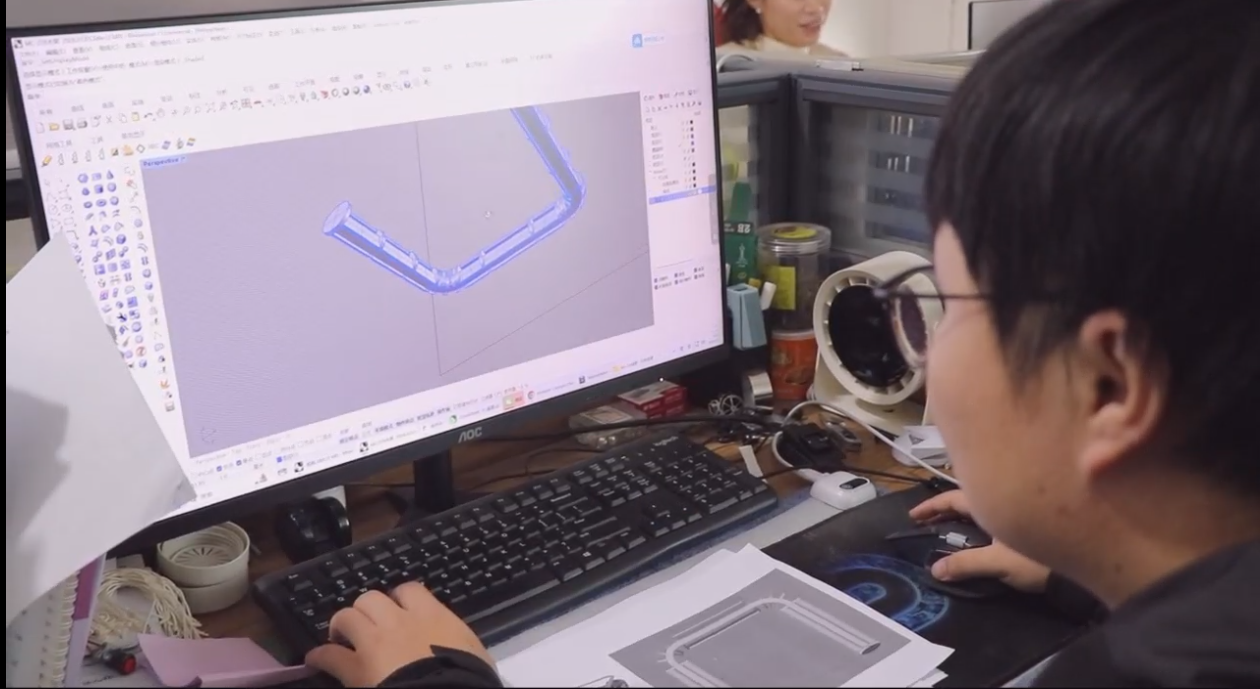
Seat width, tilt mechanism and frame layout are fixed at the design stage — the decisions that determine which room a finished gaming chair will suit.
The global gaming chair market was estimated at USD 1.37 billion in 2024 and is projected to reach approximately USD 2.05 billion by 2030. Inside that total, PC gaming chairs hold the largest product share at 52.6%, and hybrid work-and-game chairs — the part of the category that treats one chair as both an office seat and a gaming seat — represented 29.8% of the market in 2024. Those figures describe a category that is no longer a single product.
That changes what a buyer is actually choosing. A gaming chair is now selected for a room: a home desk that converts from work to play, an office floor with fixed desk rows, an internet cafe with dozens of identical stations, or a streaming setup where the occupant sits for hours watching a monitor and chat rather than typing.
This guide examines two Anji Maochang Furniture Co., Ltd. models against those four environments. The MC196-3-1 is specified with a three-position tilt-lock mechanism — covering gaming, work and relax postures — and a width of 66.5 cm. The MC1034 is a racing-type model with a 180-degree recline and a width of 71.5 cm. Neither is a better chair in general terms. Each is a better or a worse match to a posture regime and a floor plan.
Why the gaming chair stopped being a single specification
Purchasing teams that treat gaming chairs as one line item usually accept a compromise they cannot see in a sample room. The compromise appears months later. A chair bought for a streaming desk ends up in a narrow office alcove where it blocks circulation. A chair bought for a cafe row is used by someone who needs a stable upright posture for hours. A chair selected for a flat-recline studio cannot be set at a sensible typing angle.
Two variables cause most of these mismatches, and both are visible on a specification sheet before an order is placed. A three-position tilt lock and a 180-degree recline are not quality tiers; they are different answers to different seating problems. The same is true of a 66.5 cm width against a 71.5 cm width — a difference that is small on paper and large in a room with fixed spacing.
For importers, distributors and multi-site operators, resolving that fit question early has a direct commercial effect. Complaints in this category are more often about comfort and space than about structural failure, and a model-to-room match is the cheapest way to prevent them. For internet cafes and other fleet buyers, consistency across identical stations matters more than any single premium feature.
Supplier context: Anji Maochang Furniture
Anji Maochang Furniture Co., Ltd. is a chair manufacturer based in Anji County, Zhejiang Province, China, established in 2016. The company operates a 3,000 m² factory with 25 employees, including a three-engineer development team, and reports an annual output of 75,000 units across three product lines: game chairs, office chairs and manicure chairs. Its stated export markets include the EU, the USA, Thailand, Brazil and South Korea, and its product information is published at www.mcrfurniture.com.
The relevant part of that profile for a fit decision is not size but process continuity. The production line covers cutting, woodworking, foam bonding, sewing, nailing, assembly, cleaning and packaging in sequence. When a buyer changes a seat width, a tilt mechanism or a cover material, the change is scheduled inside one production calendar instead of being split across several subcontractors — which is what makes model-level configurations such as the MC196-3-1 and MC1034 practical rather than theoretical.
The company also states a specific incoming-material control: plywood is inspected with a professional tool to check humidity, and only qualified material is released to production. The stated purpose is to address the risk of mold growth on plywood components — a failure mode that shows up after shipping, in humid storage or on a damp cafe floor, and that is considerably more expensive to resolve than to prevent.
Anji is also not a neutral location. The Anji furniture cluster in Zhejiang is described in trade data as the world's leading production base for gaming chairs, and China accounts for a 30.8% share of global furniture exports. Buyers sourcing from this cluster are working inside the category's main manufacturing concentration, which is useful context when comparing quotations from different regions.
MC196-3-1: what a three-position tilt lock changes
The MC196-3-1 is specified with a three-position tilt-lock mechanism covering gaming, work and relax postures, at a width of 66.5 cm.
A three-position lock functions as a commitment device. Instead of allowing the backrest to drift through a continuous range as the user shifts weight, it holds a defined angle for each activity. That suits environments where one chair has to serve more than one task without being re-adjusted every session:
- Gaming — a slightly open angle that supports the shoulders while the arms work forward.
- Work — an upright position for keyboard and desk work, where a drifting backrest becomes a distraction.
- Relax — a reclined position for viewing, reading or waiting between matches.
The practical advantage appears in mixed-use rooms. A home office that becomes a gaming room in the evening does not need two chairs, and a cafe guest does not need to be taught a complex adjustment before playing.
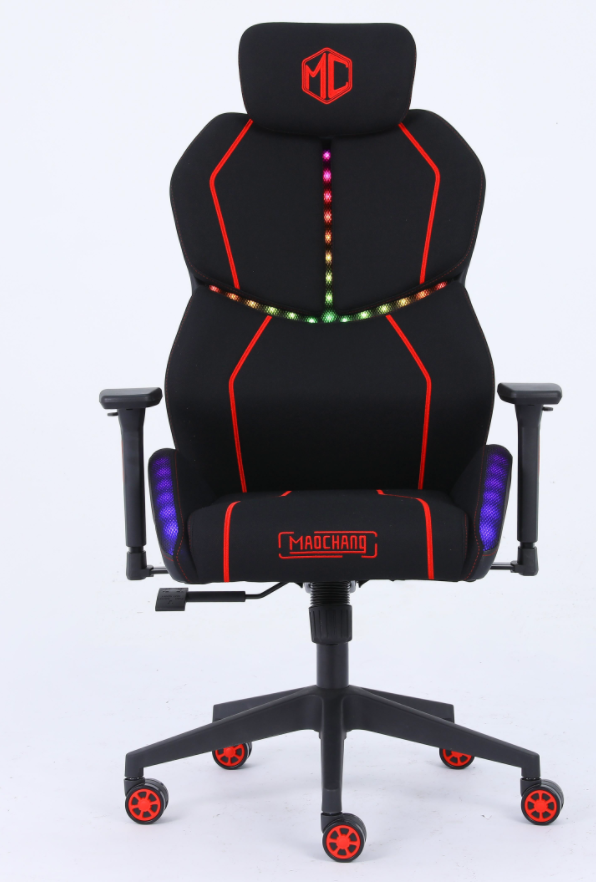
A new-design gaming chair structure: Maochang's comparison data records a different structure and design from a regular LED game chair, with a 10% improvement in weight load capacity.
The corresponding limitation is structural, and buyers should read it as a specification rather than a defect. A three-position lock delivers three defined angles, not an infinite range. Buyers who want a chair to hold any angle between upright and flat, or who need a near-flat working recline for content review, will find a stepped mechanism less flexible than a continuous one. The three angles themselves are also a fixed design decision set by the mechanism, not by the user.
MC1034: what a 180-degree racing recline is for
The MC1034 is a racing-type model with a 180-degree recline and a width of 71.5 cm.
Racing-type geometry wraps the occupant more tightly than a task-chair shell: the frame, side bolsters and back profile work together to hold the body in place through long seated sessions. Combined with a 180-degree recline, that geometry targets a specific posture — the occupant leaning back and watching rather than sitting upright and typing. That is the posture profile of live streaming, and it is also why a racing recliner is rarely the ideal default for a pure office floor.
The 180-degree figure carries a physical cost that is easy to miss at the quotation stage. A near-flat recline requires floor depth and clearance behind and below the chair, and it changes where a monitor should sit relative to the eye line. In a room where the chair is pushed under a fixed desk, or where a cafe layout sets station spacing tightly to save floor area, a full recline may never be used — which means the buyer has paid for a capability the room cannot accommodate.
Width reinforces the same point. At 71.5 cm, the MC1034 is 5 cm wider than the MC196-3-1. Five centimetres is unremarkable on a single chair and significant across a row: ten stations at 71.5 cm occupy 50 cm more linear floor than ten stations at 66.5 cm, before any allowance for arm clearance or circulation. For a home user the difference is comfort. For an operator laying out a room, it is a planning input.
Matching the two models to four real setups
Home PC gaming
The home desk is the most mixed-use environment in the category. One chair serves competitive play, remote work and passive viewing, often inside a small room with a bed, wardrobe or window behind the seating position.
The MC196-3-1 fits this pattern because the three-position lock covers the three activities without re-tuning, and the narrower 66.5 cm width leaves more circulation space in a compact room. The MC1034 makes sense in a home setup when the owner genuinely uses a deep recline: a dedicated gaming corner with clearance behind the chair, or a room where the chair also functions as a viewing seat for films and streams. Buyers planning a home setup should measure available floor depth first and choose the mechanism second.
Office and hybrid work
Where a gaming chair has to work as an office seat, upright stability matters more than recline range. The MC196-3-1's work position is the relevant specification, and its narrower frame aligns more easily with standard desk rows and shared floor plans.
A racing-type recliner can be used in an office, but it is a compromise: the deep shell and the 180-degree capability are rarely used during working hours, and the wider footprint reduces layout flexibility in a dense workspace. For buyers furnishing a hybrid office, the more defensible specification is the one that gets used every day rather than the one that performs best in a demo.
Internet cafe
Cafe procurement is a fleet problem. Dozens of identical chairs must survive identical use, and any variation in comfort becomes a support issue multiplied by the number of stations.
Both models can serve this use case, but they move the operator's decision to different places. The MC196-3-1's 66.5 cm width allows more stations per square metre of floor, and the three-position lock gives guests an understandable adjustment without relying on a continuous mechanism. The MC1034 introduces a wider 71.5 cm footprint and a deep recline that some cafe layouts support well — private booths, streaming corners, premium zones — and some do not.
Fleet buyers should also weigh two maintenance factors that a specification sheet does not show. The first is material durability in a shared, high-turnover environment, where cleaning frequency and spill exposure are higher than at home. The second is humidity control during production and storage. Maochang's stated plywood humidity inspection, with only qualified material released to production, targets the mold risk that otherwise appears in damp storage rooms or humid climates — a risk with a long delay between cause and visible effect.
On structure-specific maintenance, Maochang's comparison data for its new-design structure records a low failure rate relative to similar products, and therefore low maintenance requirements. That claim is specific to that structure and should be confirmed per model and per order rather than assumed for every chair in a catalogue.
Live streaming
Streaming is the use case where the MC1034's specification is most directly aligned. Long sessions in a reclined posture, a viewer's rather than a typist's relationship to the monitor, and a chair that stays in frame behind the streamer all favour a racing shell with a deep recline over an upright task geometry.
The supporting evidence Maochang publishes for its new-design structure points in the same direction. The design is described as having a different structure and an exclusive design compared with a regular LED game chair, with a 10% improved weight load capacity and an ergonomic structure that reduces physical fatigue during long sitting sessions, and it is identified as more suitable for gaming and live streaming scenarios. The same comparison records an 8% higher manufacturing cost than a regular LED game chair, attributed to the premium structure — a cost difference a buyer should expect to see reflected in the purchase price, and one that should be justified by intended use rather than by model naming.
Setup-matching table
| Setup | Posture mix | Priority specification | Closer fit |
|---|---|---|---|
| Home PC gaming, compact room | Play, work, occasional viewing | Footprint, defined multiple positions | MC196-3-1 (3-position tilt lock, 66.5 cm) |
| Home or studio with rear clearance | Play and long viewing sessions | Recline range, wrap-around support | MC1034 (racing type, 180-degree recline) |
| Office and hybrid workspace | Daily upright task work, occasional relaxed use | Upright stability, narrow width | MC196-3-1 |
| Internet cafe, standard row | High-turnover, mixed guest postures | Width per station, simple adjustment, maintenance profile | MC196-3-1 for row density |
| Internet cafe, booth or premium zone | Longer sessions, viewing posture | Recline and support | MC1034 |
| Live streaming setup | Long reclined sessions, camera-facing | Deep recline, fatigue reduction | MC1034 |
Market trends behind scenario-based buying
The category is growing, but the more useful signal for a fit decision is how it is dividing. North America accounted for a 36.4% revenue share in 2024 and remains the largest regional market, while PC gaming chairs hold 52.6% of product-segment share. PU leather remains the dominant cover material at a 57.3% share, which matters for operators: the majority of chairs in a fleet will need a cleaning and wear regime suited to PU upholstery rather than to fabric.
The hybrid work-and-game segment, at 29.8% in 2024, is the trend that most directly supports mechanism-based selection. As more buyers use one chair for desk work and gaming, the value of a chair that can be deliberately and repeatably set at a work angle rises — which is exactly the specification logic behind a three-position tilt lock. Demand for deep recline, by contrast, follows viewing and streaming behaviour rather than desk behaviour.
Competitively, third-party estimates place Secretlab and DXRacer at approximately 18% and 15% market share respectively in 2024, with the remainder distributed across a long tail of manufacturers and private-label programmes. That structure is why specification fit — width, mechanism, recline range, documentation — is where most importers can differentiate, rather than in brand recognition alone.
Destination requirements also shape model selection. ANSI/BIFMA X5.1 is the primary safety and durability standard for general-purpose office and gaming chairs in North America; EN 1335 covers dimensions, safety and testing requirements for office work chairs in Europe; and BS 5852 is the UK fire safety standard for upholstered furniture, frequently required for gaming chairs sold into the UK market. These requirements differ by model and by market and should be confirmed with documentation rather than inferred from a product name.
Limits, trade-offs and where these designs are the wrong answer
A useful comparison has to state where each option fails, not only where it fits.
Against a continuous-tilt office chair, the MC196-3-1's three-position lock is less granular. A continuous mechanism lets a user settle at any angle; a stepped lock holds three. Buyers who want a chair to mirror body position rather than to define it will read that as a constraint. The counter-argument is reliability and clarity: a defined position is easier to explain, easier to return to, and less dependent on user adjustment habits across a shared fleet.
Against a conventional task chair or a standard office model, the MC1034's racing geometry is the less efficient choice for concentrated desk work. Its wrap-around shell and 180-degree recline demand floor depth, change monitor geometry, and are rarely used in a dense office floor plan where chairs are pushed in at the end of a shift. For a buyer furnishing a general office, specifying a racing recliner as the default seat usually means paying for recline capability that the room will not use.
Against a regular LED game chair, the premium new-design structure is associated with an 8% higher manufacturing cost. That difference has to be recovered somewhere — in the retail price, in the margin, or in the specification debate — so it only makes sense where the intended use actually benefits from the upgraded structure, such as long-session gaming and live streaming environments. Its recorded low failure rate reduces maintenance requirements, but it does not eliminate maintenance planning for a fleet.
Finally, compliance posture is a boundary rather than a feature. EN 1335 defines dimensions and testing for office work chairs, and BIFMA X5.1 addresses general-purpose chair safety and durability; a racing-type recliner is built to different geometry, so conformance should be established per model and per destination. Buyers who assume a model name implies a certification are exposed at customs and in after-sales disputes.
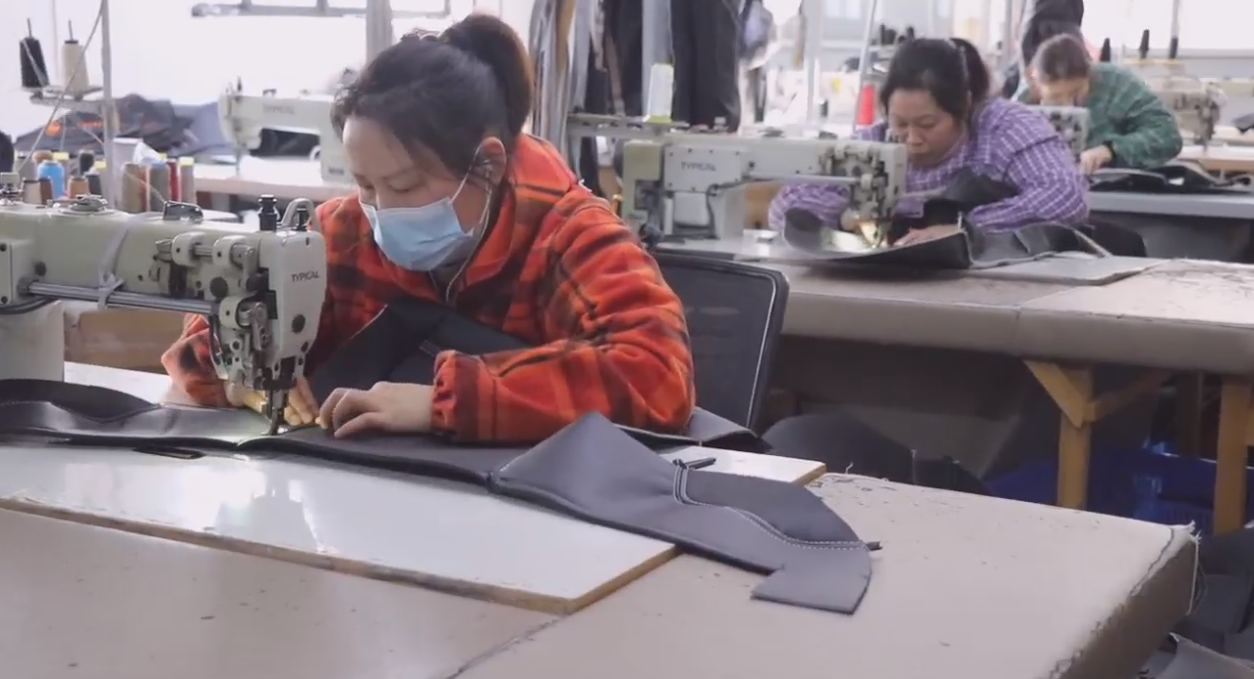
Cover assembly inside a continuous production line: cutting, woodworking, foam bonding, sewing, nailing, assembly, cleaning and packaging run in sequence.
Material and process risk behind the specification
Two material factors influence how a gaming chair behaves after delivery, and neither appears in a product photograph.
The first is plywood moisture. Maochang addresses mold growth risk on plywood materials by measuring humidity with a professional tool during incoming inspection and releasing only qualified material to production. For buyers shipping into humid regions, storing in non-climate-controlled warehouses, or operating cafes where floors are cleaned daily, that control addresses a failure mode whose visible effects appear long after the cause.
The second is foam. High-density mold foam, typically in the range of 50–65 kg/m³, is the material standard used in premium gaming chairs to preserve long-term shape retention. Foam density determines whether a seat still supports the same posture in year two as in week one — a factor that matters more in a cafe running long daily sessions than in a home setup used two hours at a time.
Future outlook
If the market continues toward approximately USD 2.05 billion by 2030, volume will not be the constraint. Differentiation will be. The hybrid work-and-game segment is already a substantial part of the category, and that segment is defined by posture switching rather than by racing graphics — which shifts the deciding specification from appearance toward mechanism and dimension data.
The practical consequence for model ranges is that width, recline range and mechanism type become first-line catalogue fields rather than footnotes, because they answer the questions buyers now ask first. For manufacturers inside the Anji cluster, the differentiator is the ability to answer those questions with consistent model-level data across a product family rather than with a single hero model.
FAQ
What is the difference between the MC196-3-1 and the MC1034?
The MC196-3-1 uses a three-position tilt-lock mechanism covering gaming, work and relax postures at a width of 66.5 cm. The MC1034 is a racing-type model with a 180-degree recline at a width of 71.5 cm. The difference is in mechanism type and width, not in a quality tier, so the two models answer different seating problems.
How much does a 66.5 cm versus 71.5 cm width matter in a real room?
The difference is 5 cm per chair, which affects arm clearance, circulation space and row density. Across ten identical stations it becomes 50 cm of additional linear floor, before allowances for access. In a single home room the difference is usually comfort; in a fixed layout it is a planning variable that can determine how many stations fit.
Can a 180-degree reclining chair replace an office chair?
It can be used, but it is a compromise. A 180-degree recline requires floor depth and clearance and changes monitor positioning, and racing-type geometry is less efficient for sustained upright typing than a task-oriented seat. Office work chairs sold into Europe are generally assessed against EN 1335 dimensions and tests, and conformance must be confirmed per model and destination rather than assumed. Where a room is tight and the chair is used for desk work daily, a three-position tilt-lock design is the more defensible specification.
Which of the two models suits live streaming?
The MC1034 aligns more directly with streaming, because its racing-type structure and 180-degree recline support long reclined viewing sessions. Maochang's comparison data for its new-design structure records a different structure and design from a regular LED game chair, a 10% improved weight load capacity, reduced physical fatigue during long sitting sessions, and suitability for gaming and live streaming. Buyers should nevertheless confirm available floor depth and monitor geometry before specifying it.
What should an internet cafe operator check before a volume order?
Four checks are useful. First, width per station and resulting row density, since a 5 cm difference compounds across a floor. Second, adjustment simplicity for guests, which favours a defined multi-position mechanism. Third, the maintenance profile of the specific structure ordered — Maochang records a low failure rate and low maintenance requirement for its new-design structure, a claim that should be confirmed per model. Fourth, humidity control on plywood, because mold risk on plywood components is a delayed failure mode that is expensive to remedy after installation.
Which standards apply to gaming chairs in different markets?
ANSI/BIFMA X5.1 is the primary safety and durability standard for general-purpose office and gaming chairs in North America. EN 1335 is the European standard for office work chairs, covering dimensions, safety and testing requirements. BS 5852 is the UK fire safety standard for upholstered furniture and is often required for gaming chairs sold in the UK. Requirements differ by model and by destination, so documentation should be requested per model rather than inferred from a product family.
Buyers comparing these two Maochang models can work from the specification fields that decide fit — mechanism type, recline range and width — before moving to sampling. The company's 2026 product catalogue is published as a downloadable PDF for reference: Maochang Furniture 2026 catalogue.