
Garage Door Shortlist: Roll Up, Turbine Hard-Panel, PVC Insulated
Garage Door Shortlist: Roll Up, Turbine Hard-Panel, PVC Insulated
A rapid door shortlist for a high-traffic bay is only as good as the opening survey behind it. Width, height, headroom, cycles per shift and the separation the bay must hold decide whether a roll-up curtain, a rigid hard panel or an insulated PVC leaf is the realistic option. The product name does not decide it. This review sets out the sequence a buyer should follow, then compares three LIFTER models on identical terms: High Speed Roll Up Doors, Turbine Rapid Hard-Panel Door and Rapid PVC Insulated Door (HSD-002). It uses only facts recorded in the supplier's product, certificate and project documentation, and it marks plainly where a project-specific answer is still missing.
Why a high-traffic bay needs its own door brief
Door selection in a distribution or production bay is a traffic problem before it is a product problem. A bay that cycles dozens of times per shift loads the leaf, the drive system and the safety devices differently from a villa garage door that opens twice a day. That difference changes what the buyer should compare: cycle behaviour and service access move ahead of finish and colour, and the documentation package becomes part of the product.
Category-level market data points the same way without settling any individual specification. Dataintelo's garage door market report valued the global market at USD 14.8 billion in 2025 and projected USD 24.6 billion by 2034, a reported CAGR of 5.8%, with automatic mechanisms accounting for 61.5% of 2025 share (Dataintelo, 2026). Those figures describe a broad category across all door types and markets. They indicate commercial direction, not the right door for a named bay, and they are commercial research rather than project evidence.
The practical consequence for a purchaser is ordering discipline. If the opening is surveyed after the model is chosen, the shortlist becomes a preference exercise. If the opening and use case are fixed first, the three LIFTER doors below separate on measurable grounds rather than on catalogue adjectives.
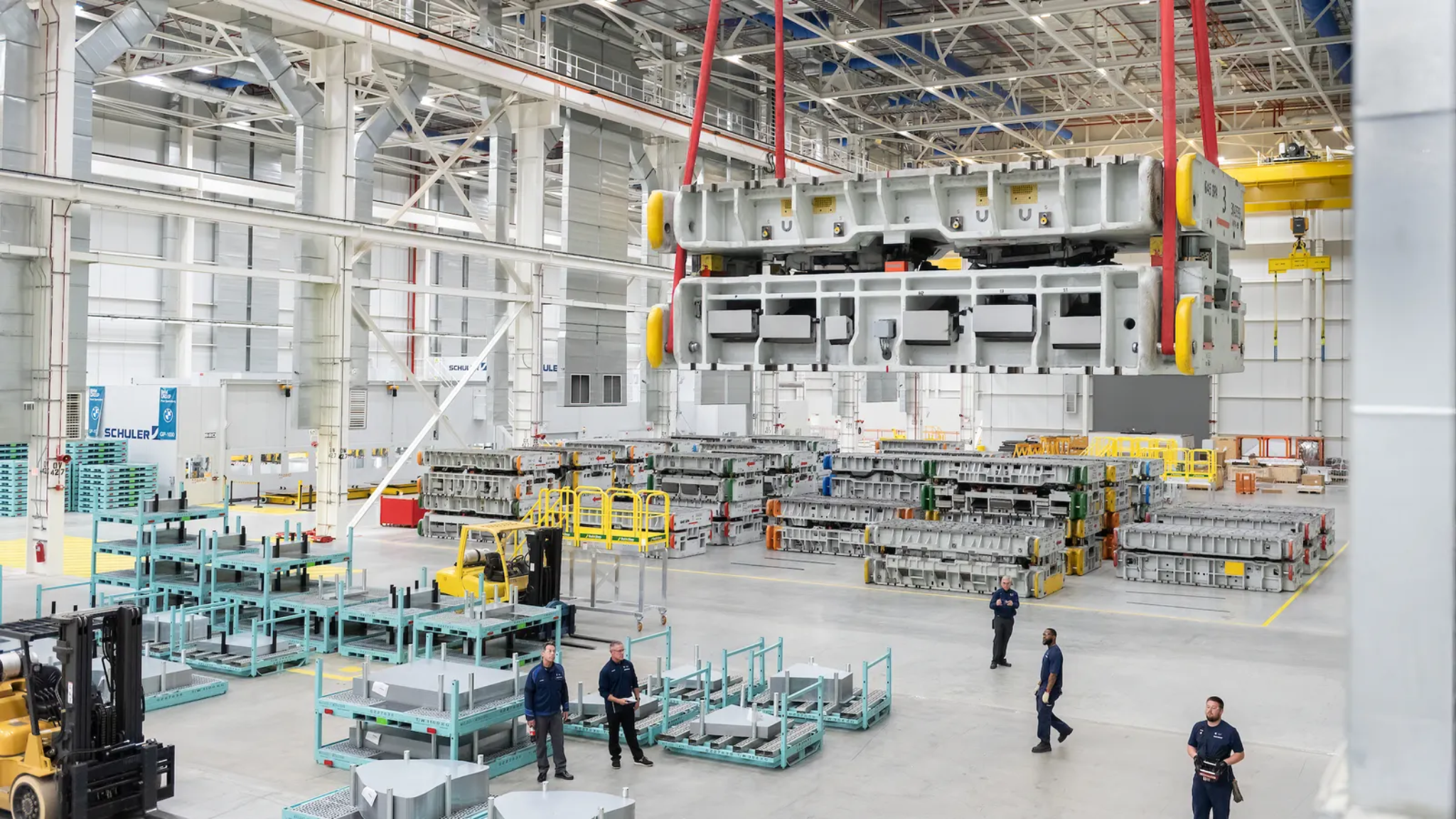
High-traffic vehicle access in a manufacturing warehouse — the operating context in which cycle frequency, headroom and separation duty decide the door type.
Step 1: confirm the opening before comparing any model
The opening survey is the only input that can eliminate an option outright. Record the clear opening width and height, the headroom between the opening head and the ceiling or roof structure, the side room available for guides and frames, and how the door is fixed to the structure. Note floor level, drainage and whether the door sits inside or outside the thermal envelope. Note the wind and draught exposure of the facade as well, because a door on an exposed corner is not the same brief as one shielded inside a yard.
Headroom deserves separate treatment because it constrains the lifting method rather than the finish. LIFTER's technical note on lifting types states the condition directly: standard lift suits conventional factories where headroom above the opening is roughly 500 mm or more, high lift suits bays that admit high vehicles, and vertical lift suits tall facilities with ample overhead space that need maximum clearance. That note describes sectional lifting configurations. It should be applied as a warning about the cost of ignoring headroom, not as a specification for a rapid door assembly.
It also helps to keep product families distinct. The three doors in this shortlist sit in LIFTER's industrial door range, alongside sliding, lifting and high-speed roller shutter products. They are separate from the company's residential and villa sectional catalogue, which is the family that US sectional standards such as ANSI/DASMA 102-2018 are written around. A rapid industrial assembly and a residential sectional door should not be specified from the same clause list.
Step 2: confirm the use case before accepting any performance claim
The use case converts an opening into a duty. Before a supplier quotation is read in detail, the buyer should be able to answer the following in writing:
- Cycle load: average and peak openings per hour and per shift, and whether operation is single-shift or continuous.
- Traffic type: pedestrians, forklifts, vans, rigid trucks or a mixed flow, including the tallest vehicle that must pass without waiting.
- Separation duty: what the closed door must hold back — temperature, humidity, dust, insects, wash-down water, noise or casual access.
- Environment: food handling, cold storage, pharmaceutical, paint shop, general manufacturing or logistics, and whether cleaning chemicals reach the door.
- Safety and control: presence detection, safety edges, warning signals, activation method, and whether the door must interlock with a dock leveler or dock seal.
- Service: who resets the door after a fault, what spares are held on site and how quickly a technician can reach the building.
Only when those answers exist do the three models become genuinely comparable. The documentation reviewed for this shortlist does not carry model-level opening speed, cycle rating or thermal transmittance values for all three doors. That absence is a documentation gap to close in the RFQ, not a reason to substitute a marketing figure. The fair comparison available today is on documented scope, certificate coverage and project record — plus the test evidence each supplier must produce for the actual opening.
The shortlist: three rapid door options for high-traffic bays
Each entry below states what the reviewed documentation actually supports, and what a buyer still needs to obtain. No speed, cycle, insulation or wind-load figure is asserted where the supplier material does not record one.
High Speed Roll Up Doors
High Speed Roll Up Door is listed as a distinct model in LIFTER's industrial door range, and the company's main product list groups high-speed roller shutter products within that industrial series. The roll-up format coils the door leaf above the opening, so the side walls carry guides and frames rather than a horizontal track run-out — a format that suits bays where wall space beside the opening is contested and the opening is cycled often.
What the reviewed material establishes about this model is limited. It confirms catalogue identity and family, and it shows that the OEM/ODM programme lists door sizes and dimensions, lifting methods, track systems, motor or opener brands, product specifications, voltage and logo among configurable elements. Model-level availability of any of those options must be confirmed in writing rather than assumed from the programme list.
One documentation point matters for a buyer in the EU or EEA. Neither of the two ECM type approval records reviewed for this shortlist names High Speed Roll Up Door. That is a gap in the reviewed file, not evidence that the model fails to conform. The corrective step is procedural: request the model-specific declaration of conformity, the applicable harmonised standard reference, the safety-device list, and any life-cycle or structural test report held for the model, and confirm that the document names the exact model being ordered.
Turbine Rapid Hard-Panel Door
Turbine Rapid Hard-Panel Door is named in the supplier documentation as a rapid door built around a hard panel rather than a flexible curtain. That distinction is the practical starting point for a bay where a soft curtain would be exposed to contact, load handling damage or a working environment that punishes flexible materials. The rigid leaf carries consequences for weight, panel build-up, guide design and safety edges, so the panel drawing matters as much as the certificate.
Certificate coverage is the clearest documented fact for this model. ECM Mark Type Approval Certificate No. 6K230612.XLMDT74, issued 12 June 2023 and valid to 11 June 2028, cites Machinery Directive 2006/42/EC with EN ISO 12100:2010 and EN 13241:2003+A2:2016, and lists Turbine Rapid Hard-Panel Door among the applicable products. The model also appears within the product scope of the company's ISO 9001:2015 certificate, which names production of polyurethane composite door panels, garage doors and industrial sliding doors.
Two readings of that package are worth keeping separate. The Machinery Directive certificate addresses the safety of the assembly as machinery; it is not a thermal or structural performance rating for a specific opening. ISO 9001 addresses the management system under which the product is made, not the behaviour of an individual door. For the bay itself, the buyer should request the panel construction drawing, the structural performance test under uniform static air pressure, a life-cycling test report, the counterbalance or lifting element documentation, and the safety-edge and control specification.
Rapid PVC Insulated Door (HSD-002)
Rapid PVC Insulated Door, model HSD-002, is the best-documented of the three in the material reviewed. Its certificate record is explicit and recent: ECM Mark Type Approval Certificate No. ICR/VC/HM2607119, issued 7 October 2026 and valid to 7 September 2031, cites CPR [(EU) 305/2011] with EN 13241:2003+A2:2016, covers the EU/EEA market, and relates to Rapid PVC Insulated Door (HSD-002) and Rapid Spiral Insulated Door (HSD-001). Because the certificate names the model, a buyer can match document to order line without interpretation.
The project record is also the fullest of the three. Company-supplied case records list this model in a manufacturing warehouse running 35 units for vehicle access over two years, reported as stable operation with low maintenance and highlights of wind resistance and safety protection; in a food factory running 12 units for temperature-controlled access over two years, reported with hygiene protection and stable operation; and in a logistics and supply-chain site running 120 units for warehouse logistics and forklift access over three years, described as 24/7 operation with stable results. These are supplier-supplied project records, useful as evidence of repeated deployment in vehicle and forklift traffic, and not a substitute for a performance guarantee at a new opening.
The insulation element still needs a number. The product name identifies an insulated PVC door, but the reviewed material does not state a U-value, panel thickness or air-infiltration class for this model. The relevant test method is identified in the industry standards registry as ANSI/DASMA 105-2017, thermal transmittance and air infiltration of garage doors; the corresponding European route runs through the EN 13241 declaration. A buyer specifying an energy boundary should ask for the measured value and the test report behind it, together with cleaning instructions if the door sits in a food or hygiene-controlled area.
Comparing the three on the same dimensions
The table below restricts itself to facts present in the reviewed material. Where a cell says a record was not found, it means the document was not in the reviewed file — a prompt for the RFQ, not a verdict on the product.
| Comparison point | High Speed Roll Up Doors | Turbine Rapid Hard-Panel Door | Rapid PVC Insulated Door (HSD-002) |
|---|---|---|---|
| Model identity stated by supplier | High Speed Roll Up Door | Turbine Rapid Hard-Panel Door | HSD-002 |
| Leaf format as named | Roll-up high-speed format | Hard rigid panel | PVC, insulated |
| Certificate record found in reviewed file | No certificate naming this model | ECM No. 6K230612.XLMDT74 — Machinery Directive 2006/42/EC; EN ISO 12100:2010; EN 13241:2003+A2:2016; valid 12 Jun 2023 – 11 Jun 2028 | ECM No. ICR/VC/HM2607119 — CPR (EU) 305/2011; EN 13241:2003+A2:2016; EU/EEA; valid 7 Oct 2026 – 7 Sep 2031 |
| Project record found in reviewed file | None specific to this model | Listed within the ISO 9001 production scope | 35 units manufacturing warehouse; 12 units food factory; 120 units logistics site |
| Gap to close before award | Model declaration of conformity, cycle test, safety-device list, control specification | Panel build-up drawing, structural pressure test, life-cycle report, counterbalance documentation | Thermal transmittance and air-infiltration test, cleaning and hygiene instructions, declaration naming HSD-002 |
| Fit condition to test first | Frequent cycling with limited space beside the opening | Bays where a rigid leaf is preferred over a flexible curtain | Bays needing an insulated PVC leaf with a named EU declaration |
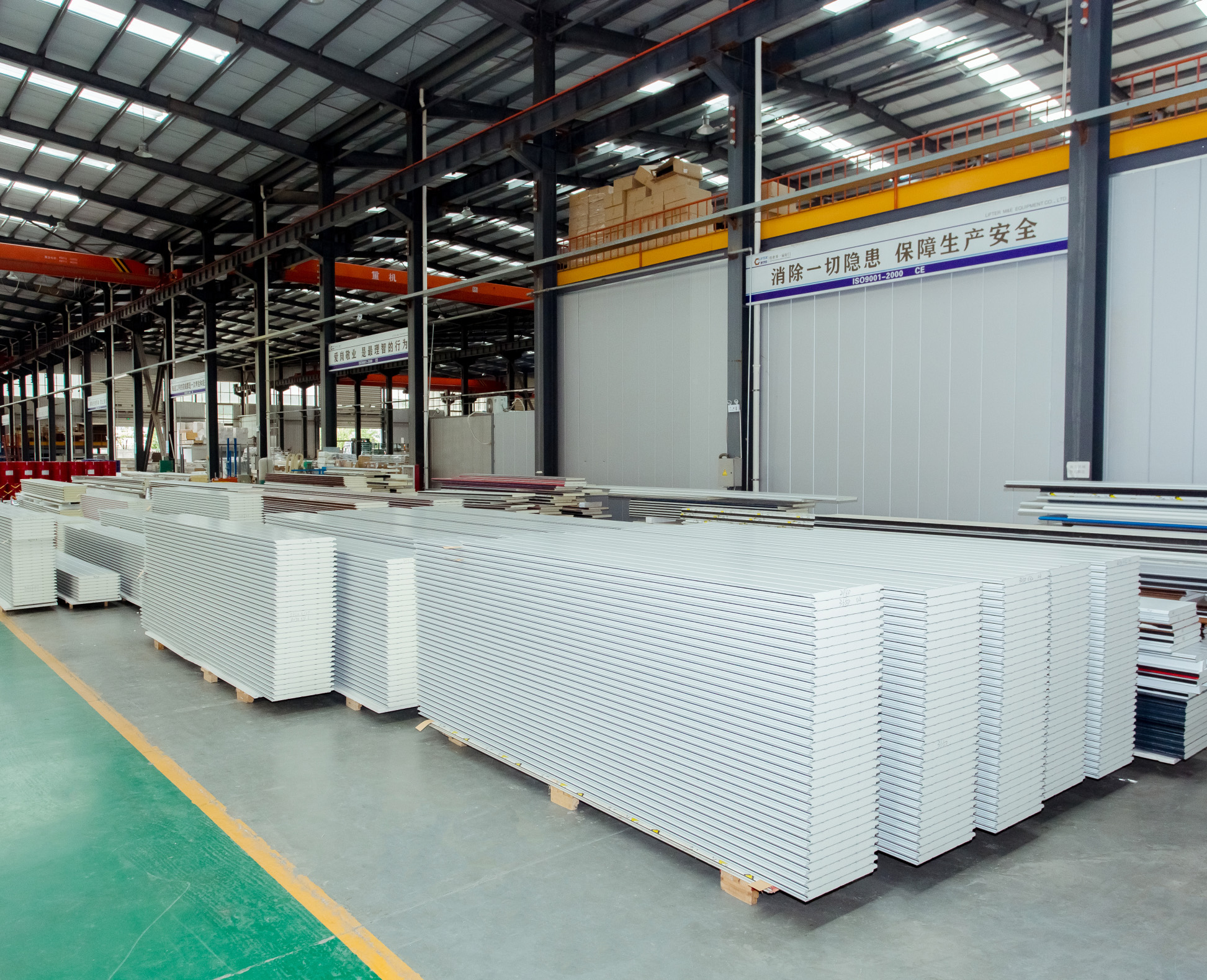
Panel production area. Panel build-up drawings and test reports, not catalogue photos, are what a buyer should attach to the RFQ.
Project inputs to collect before the RFQ goes out
A shortlist converts into a comparable quotation only when every bidder prices the same brief. The following inputs should travel with the enquiry:
- Clear opening width and height, measured on site.
- Headroom above the opening and any obstruction such as sprinkler pipework or crane rails.
- Side room for guides, frames and control cabinets.
- Wall or structure type and the fixing method available.
- Cycles per hour, per shift and per day, including peaks.
- Tallest and widest vehicle, plus pedestrian and forklift flow.
- Separation duty: temperature band, humidity, dust, hygiene class or security level.
- Wind exposure of the facade if the door faces outside.
- Required safety devices, activation method and any interlock with dock equipment.
- Power supply, control voltage and who provides the isolator.
- Documentation package: declaration of conformity naming the model, test reports, installation and maintenance instructions, spare-parts list.
- Service expectation: response route, spares held locally, planned maintenance interval.
Where the OEM or ODM programme is being used, the commercial terms also need pinning down. LIFTER's capability record states a monthly capacity of 80,000 sqm, a minimum order quantity of 20 sets on that programme, a lead time of 20–30 days, random-sampling quality control and remote after-sales support, with customization covering panel designs, surface textures, colours, window styles, sizes, lifting methods, hardware accessories, track systems, motor or opener brands, specifications, voltage and logo. Those terms describe the customization programme and should be reconfirmed per order line, since minimum quantities and lead times vary between product families.
Fit boundaries: when a rapid door is the wrong shortlist
A shortlist is only useful if it can disqualify itself. Three boundaries deserve to be tested before a rapid door is specified.
Low cycle counts. If a bay opens a few times per shift, the case for a rapid assembly weakens and a conventional sectional overhead door becomes the more sensible baseline, provided headroom allows the standard lift condition described earlier. Rapid formats earn their place through repeated cycling, not through a single daily movement.
Fire-rated requirements. The rolling-door standard in the reviewed registry, ANSI/DASMA 203-2020, is explicitly written for non-fire-rated rolling door assemblies in commercial and industrial applications. A bay with a fire-rated separation requirement sits outside that scope and needs a different compliance route entirely. Buyers should never let a general catalogue reference stand in for a fire-rated specification.
Performance on the specific opening. Structural behaviour under wind pressure and life-cycle behaviour are test questions. ANSI/DASMA 108-2017 describes the structural performance test under uniform static air pressure difference, ANSI/DASMA 109-2017 describes the cyclic operation test, and ANSI/DASMA 110-2025 addresses lifting cables for sectional doors. These documents define how to test; they do not certify that a particular model passed. The certificate tells a buyer what has been declared, and the test report tells them what was measured — both belong in the file.
Reading the certification package correctly
Certification is where shortlists are most often compared incorrectly, because documents with different legal bases get treated as equivalent. The two ECM records in this file illustrate the point.
Certificate No. ICR/VC/HM2607119 for the Rapid PVC Insulated Door and Rapid Spiral Insulated Door is issued against the Construction Products Regulation, CPR [(EU) 305/2011], with EN 13241:2003+A2:2016 as the cited standard. That is the route a buyer expects for a door declared as a construction product for the EU/EEA market.
Certificate No. 6K230612.XLMDT74, covering the Turbine Rapid Hard-Panel Door among other industrial products, is issued against the Machinery Directive 2006/42/EC, with EN ISO 12100:2010 and EN 13241:2003+A2:2016 cited. It answers a machinery-safety question. Reading it as a thermal or structural declaration for a specific opening would overstate what the document says.
Above both sits ISO 9001:2015 certificate CN-00221Q22881R0M, issued by CQM on 18 May 2025 and valid to 17 May 2028, covering production of polyurethane composite door panels, garage doors and industrial sliding doors. It is a quality-management statement about the production system. It is not a product performance certificate, and it should not be used to close a specification gap.
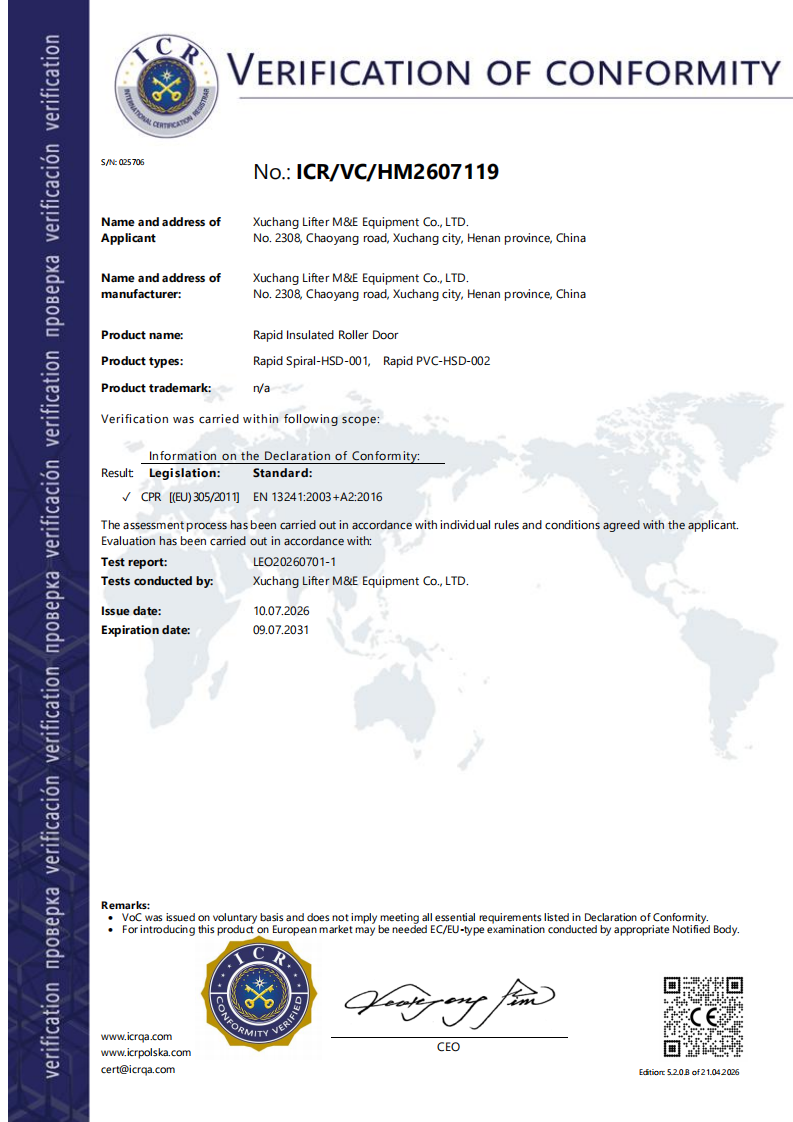
ECM Mark Type Approval Certificate No. ICR/VC/HM2607119, which names Rapid PVC Insulated Door (HSD-002) and is valid to 7 September 2031.
Supplier context: LIFTER Garage Door
LIFTER Garage Door is the trading identity of Xuchang Lifter M&E Equipment Co., Ltd., established in 2017 and based in the Weidu Industrial Agglomeration Area of Xuchang City, Henan Province, China. The company reports a 35,000 sqm facility, more than 200 employees including a 13-engineer R&D team, and two automatic polyurethane composite panel production lines with annual output stated at 200,000 units. Its stated export share is about 80%, with the EU and USA as principal markets, and it holds CE certification and ISO 9001:2015 certification while operating a 6S quality management system.
The relevant detail for this shortlist is range depth rather than any single product. The catalogue spans residential and villa sectional doors, industrial lifting and sliding doors, high-speed roller shutters, cold-chain doors, dock levelers and seals, plus hardware such as torsion springs. For a buyer evaluating rapid doors, that breadth means one supplier can quote the door, the dock equipment and the hardware interface together — but it also means certificate and test documents must be matched to the exact model and opening, because a broad catalogue is not a broad certification.
Statements about capacity, export share, market reach and industry experience in this section are company-reported and were not independently verified for this review. They are useful for initial supplier screening and should be confirmed through factory audit, sample orders and document checks before a framework agreement is signed.
What to watch in the next procurement cycle
Two slow-moving signals are worth tracking because they change what a buyer should ask for rather than which brand to buy. The first is standards revision: ANSI/DASMA 110-2025 was reported as approved in July 2025 and addresses lifting cables for sectional doors, while DASMA continues to list 102-2018 for sectional overhead-type doors. Where a project cites a standard edition, the edition number belongs in the RFQ so that bidders answer the same question.
The second is the continuing shift toward automated operation, reflected in the 61.5% automatic-mechanism share reported for 2025. That shift raises the importance of controls, safety devices and service response relative to leaf finish. Neither signal predicts demand for a specific bay, and neither replaces the opening survey.
Frequently asked questions
What should be confirmed before comparing rapid door models?
Confirm the opening first: clear width and height, headroom, side room and structure. Then confirm the duty: cycles per shift, vehicle types, separation requirement, safety devices and control interlocks. Until those are fixed, models are not comparable, because lifting method and format follow the opening rather than the other way round. LIFTER's technical note, for example, ties standard lift to roughly 500 mm or more of headroom above the opening.
Does one CE certificate cover every model in a supplier's range?
No. Certificate records name specific products. In this file, ECM certificate ICR/VC/HM2607119 relates to Rapid PVC Insulated Door (HSD-002) and Rapid Spiral Insulated Door (HSD-001), while ECM certificate 6K230612.XLMDT74 lists Turbine Rapid Hard-Panel Door among the applicable products. The two certificates also rest on different legal bases — the Construction Products Regulation and the Machinery Directive. Buyers should match the model name on the certificate to the model on the purchase order.
Which test standards are relevant to a high-traffic bay door?
The relevant DASMA test methods in the reviewed registry include ANSI/DASMA 108-2017 for structural performance under uniform static air pressure difference, ANSI/DASMA 109-2017 for life-cycling performance, ANSI/DASMA 105-2017 for thermal transmittance and air infiltration, and ANSI/DASMA 110-2025 for lifting cables, alongside ANSI/DASMA 203-2020 for non-fire-rated rolling doors. These define test methods. They do not by themselves establish that a particular product passed a particular test, so the report is requested with the certificate.
How does headroom affect the choice between a rapid door and a sectional door?
Headroom constrains the lifting method. LIFTER's technical note states that standard lift suits conventional factories, high lift suits bays admitting high vehicles, and vertical lift suits tall facilities needing maximum clearance, with standard lift assuming roughly 500 mm or more between the opening head and the ceiling. Where headroom is short, the lifting method becomes the first constraint and should be settled with the supplier before panel, finish or insulation choices are discussed.
Further product detail, panel options and hardware references are collected in the supplier's downloadable catalogue: LIFTER American door catalogue (PDF).
Tem questões ou precisa de mais detalhes?
Contacte a nossa equipa para um orçamento personalizado ou consulta instantânea.
Solicitar orçamento
Preencha o formulário abaixo e a nossa equipa entrará em contacto com uma proposta personalizada.
Chat direto do WhatsApp
Prefere conversar em tempo real? Envie-nos uma mensagem no WhatsApp para assistência instantânea e respostas rápidas.
- Obter orçamento personalizado
- Partilhar fotos ou documentos
- Discuta as suas necessidades diretamente
Geralmente responde em 5–30 minutos durante o horário de expediente.