
Gas Cylinder Cabinet Fit for Chemical and Semiconductor Labs
Gas Cylinder Cabinet Fit for Chemical and Semiconductor Labs
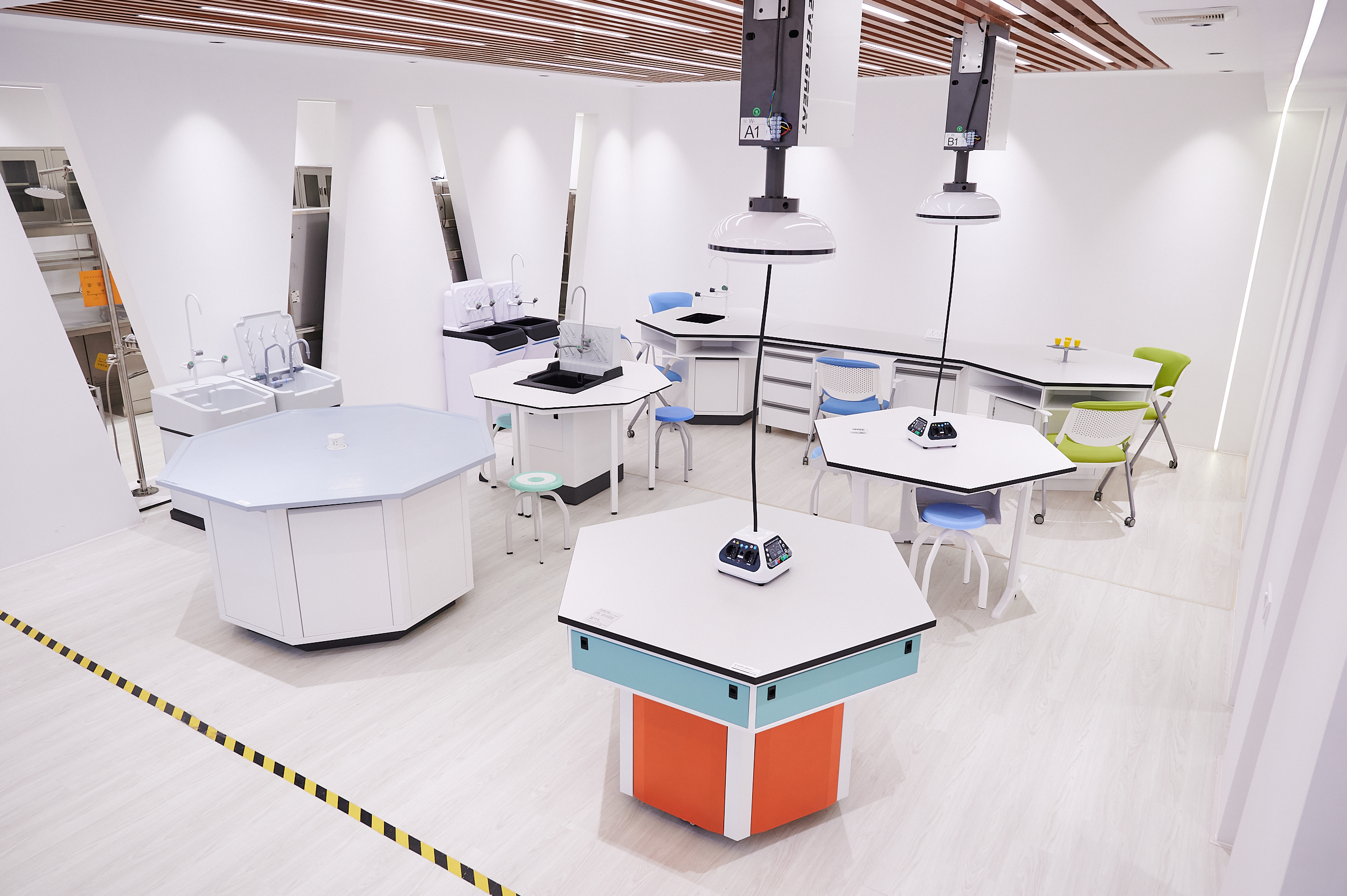
Laboratory benches with overhead service frames: gas routing and cylinder positions are planned before storage furniture is placed.
A gas cylinder safety cabinet fits a laboratory project when three variables agree: how many cylinders the workflow consumes, how often they are exchanged, and what the room's exhaust and monitoring systems can do while an exchange is taking place. Configuration follows those variables, not the other way round. The Ever Great gas cylinder safety cabinet EG-S0-CB005 — a 900 × 450 × 2000 mm cold-rolled steel enclosure with powder coating, 1.0 mm steel thickness, cylinder-fixing provisions, an anti-tip layout and single-, double- and triple-cylinder options — is the reference point used here to show how that decision is made in chemical, semiconductor and industrial-gas laboratories.
Guangdong Ever Great Laboratory Equipment Co., Ltd (Ever Great) is a laboratory furniture and infrastructure manufacturer based in Shishan Town, Foshan, Guangdong Province, China, founded in 2011. Its range covers fume hoods, laboratory workbenches, safety storage cabinets, and PP and stainless steel laboratory furniture, with exports accounting for 60% of output and principal markets in the USA, the EU, the Middle East and Africa.
Why cylinder storage is a scenario question, not a catalogue line
Two laboratories can hold the same cylinder and still need different cabinets, because the risk sits in different places. In a chemical laboratory the cylinder is usually a reagent supply feeding a bench, a fume hood or an analytical instrument, and the hazard concentrates at the regulator connection during exchange. In a semiconductor or industrial-gas laboratory the cylinder is part of a supply chain, exchange is scheduled to avoid interrupting a process, and the enclosure is expected to report its state to a facility system.
That difference changes what the cabinet has to do. A chemical lab buys a containment point where a procedure can be performed safely; an industrial-gas lab buys an element of a monitored supply arrangement. A single specification can serve both, but only if the project states which of the two it is building.
The practical rule is that the cabinet is a restraint and separation layer. It fixes the cylinder inside a defined footprint and, depending on configuration, provides the point at which purging, exhaust linkage and alarm linkage are organised. It does not create exhaust capacity, gas detection coverage or piping design. Those remain project scope, and a cabinet ordered without them will still depend on them on the day it is commissioned.
The reference cabinet read in project terms
Specifications become useful only when they are translated into constraints. The supplied data for EG-S0-CB005 sets the following frame.
| Supplied parameter | Value | What it decides in a project |
|---|---|---|
| Overall size | 900 × 450 × 2000 mm | Alcove depth, aisle clearance and door swing; the usable internal height must be checked against the tallest cylinder with regulator fitted. |
| Body | 1.0 mm cold-rolled steel | Panel stiffness across a two-metre height and general durability; a material statement, not a fire classification. |
| Finish | Powder coating | Cleanability and surface durability; suitability against the gases and cleaning agents used in the room should be confirmed. |
| Cylinder configuration | Single, double or triple cylinder | How many cylinders the cabinet can hold and how exchange is scheduled; this is the central selection variable. |
| Retention | Cylinder-fixing provisions | Whether each cylinder position has a restraint point; the fixing method must match the cylinder diameters in use. |
| Stability | Anti-tip layout | Behaviour with the door open and cylinders loaded; floor or wall fixing requirements should be confirmed for the site. |
| Signalling | Alarm/exhaust linkage configuration | How the enclosure connects to the room exhaust and alarm system, and what action follows a signal. |
| Purging | Automatic purging option | Whether the exchange procedure can be automated, which depends on gas class and on how the room is arranged. |
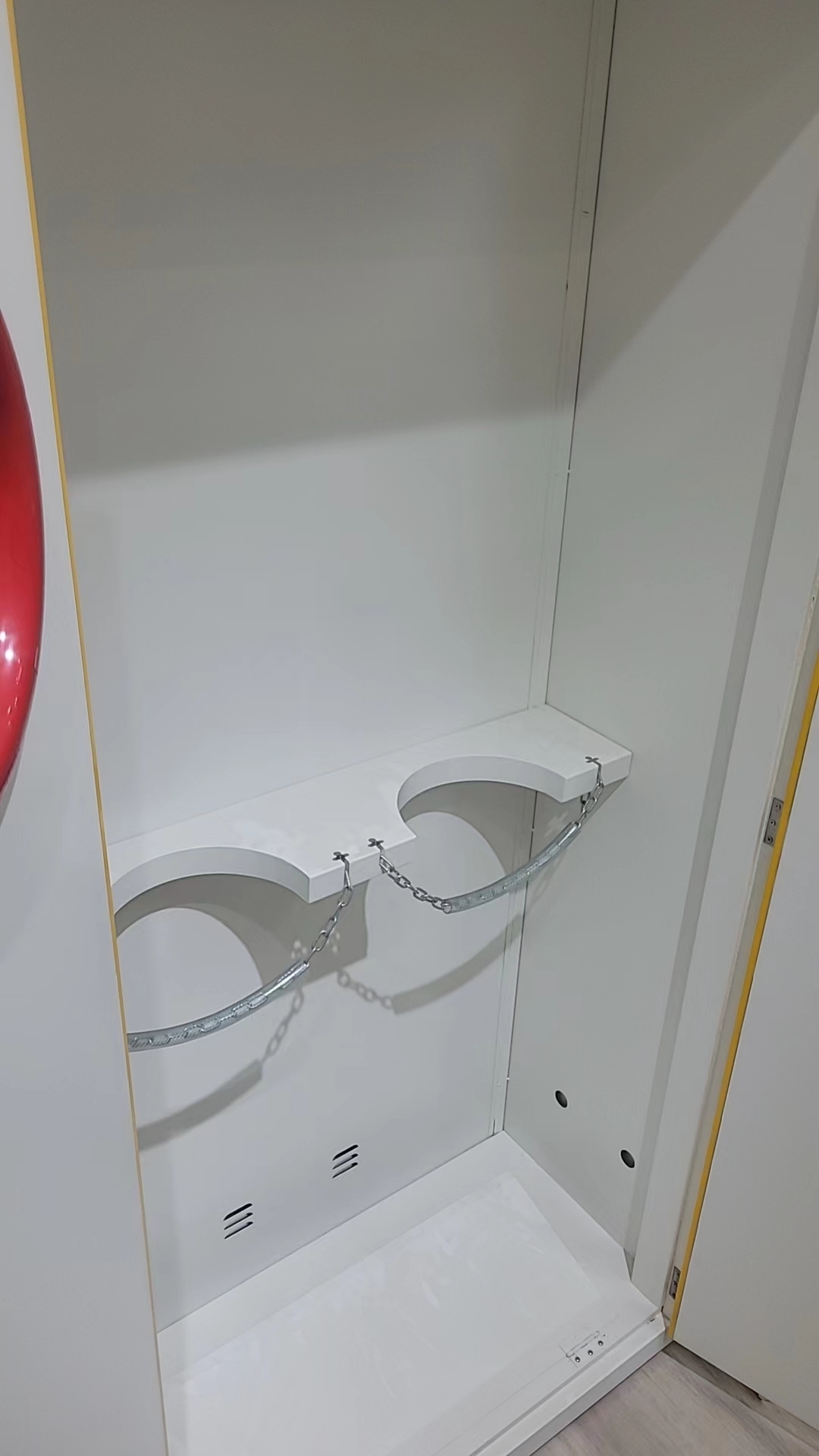
Powder-coated steel safety storage cabinetry from the Ever Great range, shown in the manufacturer's showroom.
The envelope comes first. At 900 × 450 mm the cabinet is a shallow unit suited to an alcove, a corridor recess or a storage line along a wall, and 2,000 mm keeps it inside a normal laboratory ceiling zone. Because the supplied data does not state usable internal height, the check that matters is the tallest cylinder in the project with regulator and valve fitted. Door swing and aisle width need the same treatment: a shallow cabinet opened into a narrow aisle still blocks it.
The 1.0 mm cold-rolled steel body with powder coating describes a sheet-metal enclosure finished for a laboratory environment. Thickness at this level is a stiffness and durability statement over a two-metre height; it is not a fire-resistance classification, and the supplied specification makes no fire-rating claim. A buyer who needs a rated enclosure should ask which classification applies and obtain the supporting test documentation instead of reading "steel cabinet" as "fire rated".
Single, double or triple: choosing the cylinder configuration
The three cylinder configurations answer a consumption and procedure question, not a preference question. Each one shifts work rather than removing it.
| Configuration | Fits when | Confirm before ordering |
|---|---|---|
| Single cylinder | Gas demand is low or intermittent, the cylinder is easily replaced, and floor space is constrained. | Exchange frequency and who performs it; internal height against the tallest cylinder; a spare-cylinder policy elsewhere in the room. |
| Double cylinder | An in-use plus standby arrangement is intended, so a changeover does not stop work. | That the second position is genuinely used as standby; the number of fixing points; the changeover procedure at the cabinet. |
| Triple cylinder | Consumption is higher, or several cylinders are rotated through one enclosure. | Whether all three positions carry the same gas; what internal arrangement applies; door swing and handling space for three exchanges. |
A single-cylinder cabinet suits a laboratory where demand is low or intermittent and where the cylinder can be exchanged without stopping work. The trade-off is frequency: every change is a procedure performed at the cabinet, so a room with daily consumption should price that time into the decision.
A double-cylinder cabinet supports an in-use plus standby arrangement, which is what most continuity arguments actually require. Its value depends on whether the project maintains a spare in practice. Without a standby policy the second position quietly becomes storage, and the cabinet is paid for without delivering the changeover it was bought for.
A triple configuration covers higher consumption or a rotation of cylinders in one enclosure, and it raises two questions that should be settled with the manufacturer rather than assumed. The first is whether the three positions are intended for the same gas. The second is what internal arrangement, if any, applies. The supplied specification lists cylinder-count options; it does not describe gas segregation, so a project that must keep incompatible gases apart has to confirm the arrangement instead of inferring it from the count.
Chemical laboratory fit
In a chemical laboratory the exchange procedure, not the storage volume, drives the specification. Cylinders feed digestions, synthesis, instrumentation and analytical work, the gases involved are frequently corrosive or toxic, and the regulator is removed at every exchange, leaving an open connection in an occupied room.
That is the moment when a purging arrangement earns its place, and it is the reason purging should be treated as a scenario decision. Where the room is served by a fume hood or general exhaust that is reliably running during an exchange, the residual release has somewhere to go. Where the cylinder cabinet stands in a corner, in a recess, or in a room whose air balance is already committed to hoods and chemical storage, the residual has nowhere to go, and the cabinet's own configuration becomes the control.
Exhaust linkage matters for a second reason in this setting: the cabinet usually shares the room with fume hoods, acid storage and flammable liquids. Those are separate functions with separate equipment. A polypropylene acid and alkali cabinet such as EG-PP-CB003 holds corrosive liquids in an 8.0 mm PP body with spill containment; a vented chemical and reagent cabinet such as EG-S0-LB001 provides a double-wall steel enclosure with a 110/150 mm exhaust connection for reagents. Neither provides cylinder restraint. Treating a cylinder cabinet as interchangeable with them, or the reverse, is one of the more common project errors.
Semiconductor and industrial-gas laboratory fit
In semiconductor and industrial-gas laboratories the cabinet is judged by continuity and by what it can report. Exchange is planned around process windows, the cylinder position may be one of several in a gas-supply arrangement, and the enclosure is often expected to signal its condition to a facility monitoring layer rather than to a technician standing beside it.
The relevant items in the supplied specification are the alarm/exhaust linkage configuration and the gas-alarm linkage configuration. Both describe an interface, and an interface is only as good as its definition. Before ordering, the project should fix the signal type, the receiving system, the action that follows an alarm, and the behaviour on power loss. A cabinet that can be linked to an alarm system and a cabinet that has been designed into an alarm sequence are two different procurement outcomes.
Gas purity, for its part, is governed by the piping, regulator and purging practice of the installation. The cabinet's contribution is to keep the cylinder fixed in a defined position and, where configured, to provide a purging and signalling point that the procedure can rely on.
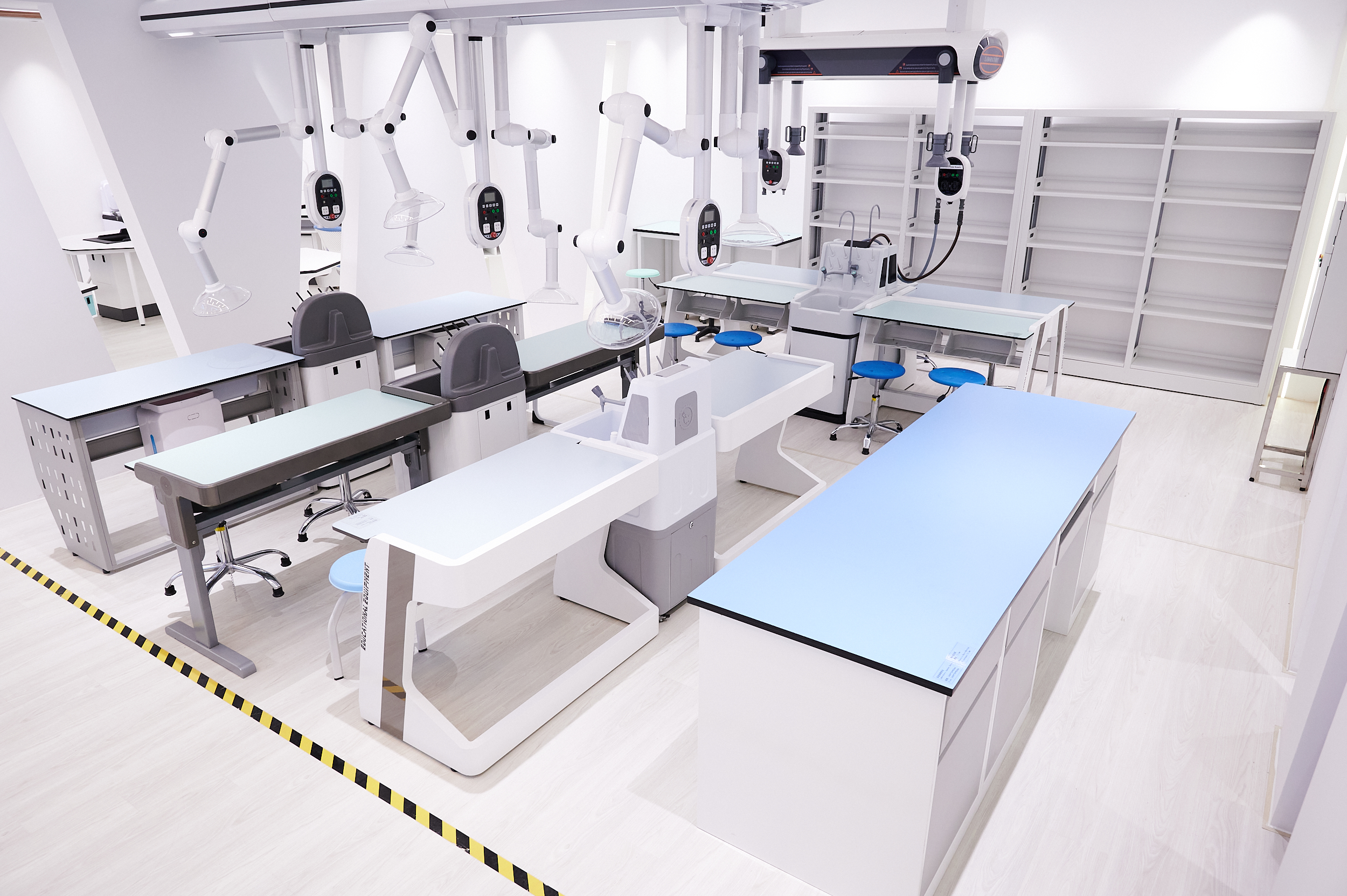
Island benches and fume hoods in a showroom layout: cylinder cabinets are placed in relation to hoods, aisles and storage rather than in isolation.
Options that belong to a scenario, not to a catalogue
Automatic purging, exhaust linkage, gas-alarm linkage and leak sensing are scenario markers. Each one is justified by a condition in the room, and each one adds a maintenance obligation that outlives the installation.
| Configuration item | Scenario where it earns its place | Define before order | What it does not replace |
|---|---|---|---|
| Automatic purging | Toxic, corrosive or flammable gases exchanged at the cabinet, in a room that cannot be relied on to disperse a residual release. | Purge medium and sequence, duration, verification method, and who performs and records the cycle. | Room ventilation, gas detection or operator training. |
| Exhaust linkage | The enclosure is connected to room exhaust or a dedicated duct and must respond to the system's state. | Duct route, fan capacity, whether the connection is continuous or demand-driven, and the pressure regime. | The exhaust system's capacity or the room's air balance. |
| Gas-alarm linkage | The room has, or will have, gas detection and the cabinet must act on a signal. | Detector type and location, thresholds, the cabinet's action on alarm, and fail-safe behaviour. | Detection coverage itself, which is a separate design. |
| Leak sensing | Gases with weak odour, or rooms occupied intermittently, where detection must precede entry. | Sensor technology, placement, calibration interval and who holds that responsibility. | Cylinder restraint, enclosure integrity or maintenance routines. |
| Alarm integration with the emergency hub | The room centralises its emergency response and needs one annunciation point. | Which device raises the alarm, where it is annunciated, and what the occupant is expected to do. | The emergency equipment itself, or the response procedure. |
Adding every option to every cabinet is a common procurement error. A cabinet with purging, linkage and sensing that the laboratory has no procedure, no calibration owner and no alarm response for is more fragile than a simpler cabinet whose exchange is performed by trained staff in a room with reliable exhaust. Options transfer work: they move effort from the operator to the system, and the system then needs an owner.
A cleaner way to decide is to work backwards from the exchange. If the exchange can be done with the room exhaust running and the door closed between operations, the base cabinet with cylinder-fixing provisions and the anti-tip layout may be sufficient. If the exchange is the dominant risk, purging moves up the list. If the room is monitored, linkage moves up. Each step should be justified by a named condition in the project, not by comparison with a larger facility.
Fitting beside flammable, acid and emergency equipment
A cylinder cabinet is one element of a storage and response layout, and its boundary with neighbouring equipment is worth writing into the specification so that nothing is bought twice or left uncovered.
| Equipment | What it holds or does | Where the boundary sits |
|---|---|---|
| Gas cylinder safety cabinet EG-S0-CB005 | Cylinders in single-, double- or triple-cylinder configuration with fixing provisions and an anti-tip layout. | Cylinders only; liquid chemicals belong in a liquid-storage cabinet. |
| Flammable safety cabinet EG-SF-LB005 | Yellow fireproof chemical safety cabinet, 45 gallon nominal capacity, 1.2 mm double-wall steel, 38 mm air barrier, 51 mm sump. | Flammable liquids. EN 14470-1, which classifies fire-resistant cabinets as Type 15, 30, 60 or 90 minutes by internal temperature rise, addresses this class of cabinet, not cylinder enclosures. |
| Vented chemical and reagent cabinet EG-S0-LB001 | Double-wall steel cabinet with four adjustable shelves and a 110/150 mm exhaust connection. | Reagents requiring exhaust; no cylinder restraint. |
| PP acid and alkali storage cabinet EG-PP-CB003 | Metal-free 8.0 mm PP body with spill-containment shelves and a bottom sump. | Corrosive liquids, where metal-free construction is the point. |
| Laboratory safety and emergency hub EG-SF-CB011 | Integrated shower, eyewash, first-aid and fire-safety storage, with leak-sensing configuration and alarm integration capability. | The response point for an alarm; not a cylinder store. |
Two standard references are often borrowed in this conversation and both have narrower scopes than buyers assume. EN 14470-1 governs fire-resistant cabinets for flammable liquids. ANSI/ASHRAE Standard 110-2016 (R2025) specifies the quantitative and qualitative test method for fume containment of laboratory fume hoods. Neither defines cylinder restraint, purging or cabinet monitoring, so citing either as evidence for a cylinder cabinet specification is a category error that survives right up to the acceptance inspection.
What the market data does and does not say
Published segment data supports one limited observation about construction. Dataintelo's laboratory furniture analysis places the metal material segment at a 52.7% revenue share in 2025, which is consistent with steel remaining the default construction for storage and containment furniture, including cylinder enclosures. That is a material-mix figure; it says nothing about how many cabinets in that segment are purged or monitored.
Market size figures should be handled with equal care. Estimates for the same year vary widely between research houses because the definitions differ — core furniture in one study, integrated laboratory solutions in another — so a single headline number is a poor basis for a project budget or a specification decision. On the evidence available, the defensible statement is conditional: as laboratories add gas detection and centralised monitoring, the cabinet increasingly has to function as a node in that architecture rather than as an isolated steel box. No verified dataset in this review quantifies that shift, and it should not be presented as measured demand.
Verification checklist before ordering
Most cylinder-cabinet problems are discovered at commissioning, when the cylinder does not fit, the restraint does not match, or the alarm interface has no counterpart. The following checks move those discoveries earlier.
- Dimensional fit: measure the tallest cylinder with regulator and valve fitted, compare it with usable internal height, and confirm door swing against the aisle.
- Cylinder retention: confirm that each position has a fixing point and that the method suits the cylinder diameters in use — not just that "fixing provisions" appear in the description.
- Stability: agree whether floor or wall fixing is required for the anti-tip layout on the actual substrate, and who installs it.
- Coating compatibility: check the powder-coated finish against the gases and cleaning agents present, particularly in rooms handling corrosive vapours.
- Exhaust arrangement: settle whether the enclosure is continuously ventilated, demand-linked, or unventilated, and design the ducting and interlocks accordingly.
- Purging sequence: define the medium, the sequence, the verification step and the record, so the option becomes a procedure rather than a feature.
- Alarm interface schedule: specify signal type, receiving panel, action on alarm, and fail-safe behaviour on power loss.
- Leak-detection ownership: agree who supplies, positions, calibrates and replaces sensors, and how often.
- Supplier-side evidence: ask for the quality-system record and the documentation package. Ever Great states ISO 9001 and ISO 14001 certification, 100% testing, a one-unit minimum order and lead times of 10–30 days from a 6,000 m² facility in Foshan, with CE and RoHS certification on its flagship series.
- Acceptance test: write down what "installed correctly" means — fit, restraint, door operation, interface response — before delivery, and sign it against those items.
What would change this recommendation
The fit described here holds while the project needs a passive, restrained storage position with defined interfaces. Three conditions would move the specification. A requirement for a certified fire-resistance classification would take the discussion into EN 14470-1 territory and a different cabinet class. A requirement to hold incompatible gases in one enclosure would need a documented segregation arrangement that the supplied specification does not describe. A requirement for verified continuous ventilation would change the ducting, the interlock logic and the acceptance test. Each of these is a legitimate project need; none of them can be resolved by reading the existing specification more closely.
Frequently asked questions
Can one gas cylinder cabinet hold different gases at the same time?
The supplied specification describes single-, double- and triple-cylinder configurations but does not describe an internal segregation arrangement between positions. A project that needs incompatible gases kept apart should confirm the internal configuration with the manufacturer and, where required, separate the gases across different cabinets rather than rely on cylinder count alone.
Does 1.0 mm cold-rolled steel with powder coating mean the cabinet is fire rated?
No. Steel thickness and coating describe the enclosure's construction and finish. The supplied specification states no fire-resistance classification. Fire-resistance classes for flammable-liquid cabinets are defined in EN 14470-1 as Type 15, 30, 60 or 90 minutes by internal temperature rise, and a buyer needing a rated enclosure should request the classification and its supporting documentation explicitly.
When should automatic purging be specified rather than assumed?
Purging is justified when the gas is toxic, corrosive or flammable, when the exchange is performed at the cabinet, and when the room's exhaust cannot be relied on to carry away a residual release. The option should come with a defined sequence, a verification step and an owner; without those, it adds equipment without adding control.
How do I choose between double and triple cylinder configurations?
Start from consumption and changeover policy. A double configuration earns its place when a standby cylinder is genuinely maintained so that a changeover does not interrupt work. A triple configuration suits higher consumption or a rotation of cylinders in one enclosure. In both cases, confirm how many positions can actually be restrained and exchanged within the available aisle space.
What alarm details should be fixed before the cabinet is ordered?
Four items: the signal type the cabinet provides or accepts, the panel or system that receives it, the action that follows an alarm — exhaust boost, isolation or purge — and the behaviour on power loss. Leak detection is a separate design decision covering sensor technology, placement and calibration responsibility, and it is not created by the cabinet's linkage capability.
Where the specification ends and the project begins
For chemical, semiconductor and industrial-gas laboratories, the durable part of this decision is not the model number but the sequence: cylinder count from consumption and changeover policy, footprint from the tallest cylinder and the aisle, restraint and anti-tip fixing from the site, and options from named room conditions. Guangdong Ever Great Laboratory Equipment Co., Ltd publishes a range specification that supports that sequence for cylinder storage, and the remaining work belongs to the project's ventilation, detection and alarm design.
A product brochure covering the wider range, including storage cabinets and ventilation equipment, is available as a PDF: Ever Great 2026 product brochure. Company details and the full catalogue are published at Guangdong Ever Great Laboratory Equipment Co., Ltd.
Tem questões ou precisa de mais detalhes?
Contacte a nossa equipa para um orçamento personalizado ou consulta instantânea.
Solicitar orçamento
Preencha o formulário abaixo e a nossa equipa entrará em contacto com uma proposta personalizada.
Chat direto do WhatsApp
Prefere conversar em tempo real? Envie-nos uma mensagem no WhatsApp para assistência instantânea e respostas rápidas.
- Obter orçamento personalizado
- Partilhar fotos ou documentos
- Discuta as suas necessidades diretamente
Geralmente responde em 5–30 minutos durante o horário de expediente.