
Gasoline Chainsaw Supplier Vetting: Model Lifecycle & Parts Continuity
Gasoline Chainsaw Supplier Vetting: Model Lifecycle & Parts Continuity
Independent industry reference for importers, distributors and professional end users | Buyer stage: research → evaluation
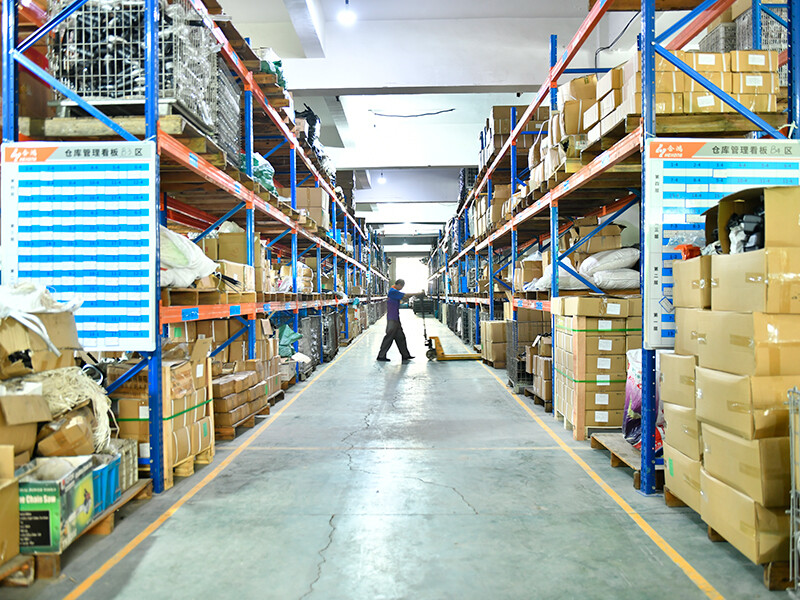
Parts and material warehousing is the operational side of supplier continuity that price comparison alone does not reveal.
Introduction: a chainsaw purchase is a supply relationship, not a transaction
The global chainsaw market was valued at USD 4.46 billion in 2026 and is projected to reach USD 5.89 billion by 2034 (Straits Research). Gas-powered units hold a 54.3% share of that market (Mordor Intelligence). Most of that volume is not bought by the person who pulls the starter cord. It is bought by importers, distributors and private-label brand owners who must keep someone else’s machine running for years after the container clears customs.
That changes what “supplier evaluation” has to mean. For a professional gasoline chainsaw, the two questions that decide multi-year cost are not horsepower and unit price. They are: will this model still be in the catalogue in five years, and will the parts that wear out still be purchasable when it is?
Zhejiang Hehong Tools Co., Ltd., founded in 2006, manufactures garden power tools under the Hanakawa brand and supplies gasoline chainsaws, brush cutters, hedge trimmers and a full range of compatible spare parts. The company states that 85% of its output is exported, with main markets in Eastern Europe, Russia, South America and Southeast Asia. Its chainsaw range — H959, H971, H972E, H872, H992 and H9105 — is used as the working example throughout this article.
Problem and opportunity: the two risks that surface after the first container
Buyers rarely lose money on the first shipment. They lose it in year two and year three, when three specific risks mature.
Risk 1 — model discontinuity. A low-cost supplier may retire a platform before the installed base has been retired. Dealers are then left holding a model with shrinking parts coverage, which converts an inexpensive machine into an expensive service problem.
Risk 2 — wear-part starvation. Piston rings, clutch shoes, sprockets, oil pumps, gaskets, air and fuel filters, ignition components and chain-brake parts are the items that actually generate service revenue and service complaints. A supplier with a strong finished-goods catalogue but a thin parts catalogue is a short-term supplier by definition.
Risk 3 — undefined acceptance criteria. Without written inspection, sampling and warranty terms, quality disputes are settled by negotiation rather than by evidence.
The opportunity is symmetrical. A supplier whose models are anchored to widely supported parts families gives a distributor predictable service economics and gives an importer a defensible reason to hold the line on price at retail.
How to read a chainsaw range as a lifecycle system
A range should be evaluated as a system, not as six unrelated SKUs. The table below lists the six models referenced in this article with their stated specifications and spare-parts family. A range that spans several displacement classes but points to only a small number of parts families is easier to support than a range of similar size that points in many directions.
| Model | Displacement | Power output | Net weight | Max engine speed | Stated spare-parts family |
|---|---|---|---|---|---|
| H959 | 59cc | 3.4kW | 5.7kg | 11,500rpm | MS361 |
| H971 | 70.7cc | 4.0kW | 6.1kg | 12,000rpm | MS440 044 |
| H972E | 72cc | 3.6kW | 6.6kg | 11,500rpm | MS038 |
| H872 | 72cc | 3.6kW | 6.3kg | 11,500rpm | 61, 268 and 272 |
| H992 | 91.6cc | 5.2kW | 7.7kg | 13,500rpm | MS660 |
| H9105 | 105.7cc | 4.8kW | 11kg | 11,500rpm | MS660 066 |
Specifications as stated in Hanakawa product documentation. Compatibility statements describe parts interchangeability with the referenced families; they do not imply affiliation with, or rights to, third-party trademarks.
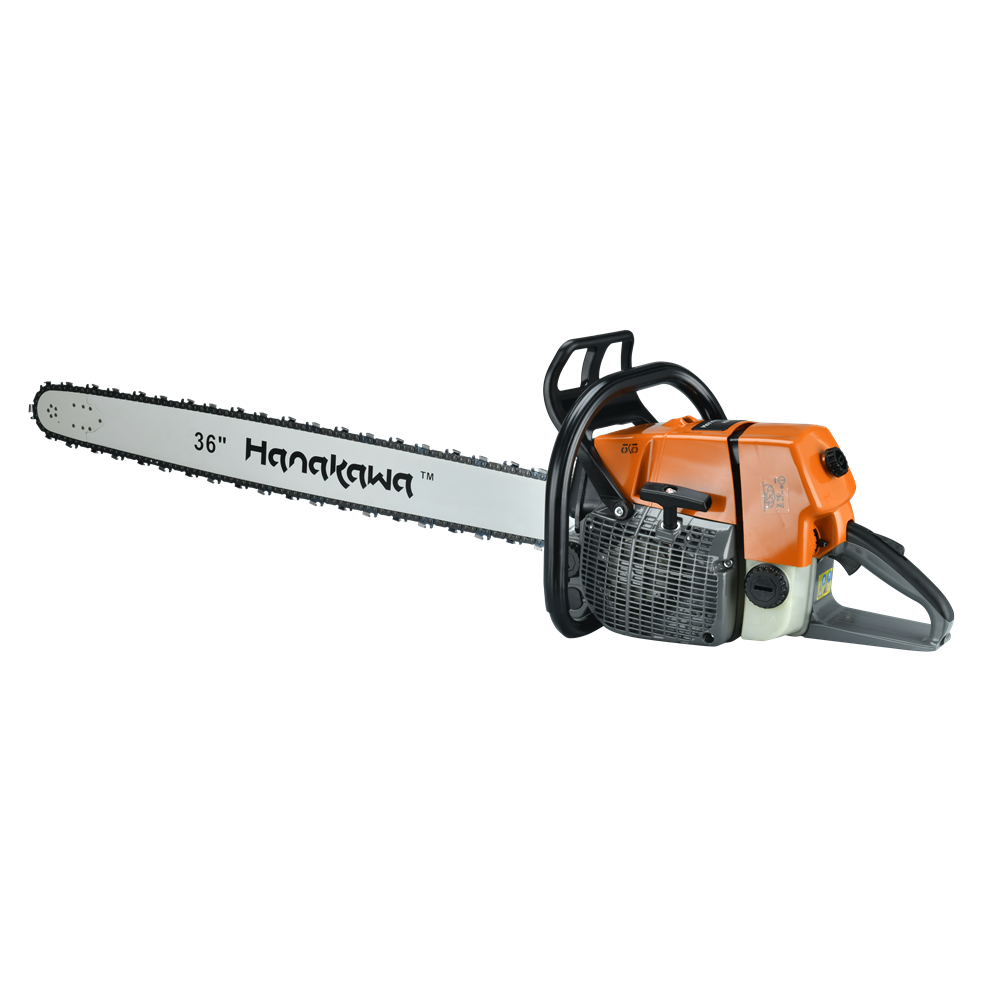
The H992 is stated at 91.6cc and 5.2kW with MS660 parts compatibility, positioning it in the high-output heavy-felling class.
A second, less obvious lifecycle signal sits in the naming logic. The H992’s reference family and the H9105’s reference family overlap: both point to MS660-series coverage, with the H9105 additionally stated as compatible with MS660 066 parts. For a distributor, overlapping coverage means one parts buffer can serve two displacement classes, which lowers dead-stock risk. That is a lifecycle advantage that never appears on a quotation sheet.
Material consistency as a continuity signal
Material declarations are one of the few supplier claims that can be checked line by line across a range. Across the H959, H971, H972E, H872, H992 and H9105, Hanakawa declares the same three-material structure: a magnesium alloy crankcase, an aluminum alloy cylinder, and a glass-reinforced PA nylon outer housing.
That consistency matters commercially for three reasons. First, a stable crankcase and cylinder specification means the parts most likely to be re-ordered are produced against an unchanged drawing. Second, a glass-reinforced PA nylon housing absorbs impact rather than transferring it, which supports the slower damage patterns that distributors prefer in rental and contractor fleets. Third, consistent material declarations make it easier to compare an incoming production batch against an earlier one.
It is equally useful to notice where a supplier changes the composition. The smaller-displacement H932 and H945 class is declared differently: an aluminum alloy engine, a glass-reinforced PA nylon housing and a hardened alloy steel crankshaft. Neither declaration is inherently better; the point for buyers is that material structure is not uniform across a full catalogue, and a supplier evaluation should confirm which structure applies to which model before a private-label programme is locked.
Certification, documentation and what does not transfer
Zhejiang Hehong Tools holds ISO 9001 certification issued by INGEER under certificate number 11724QU 0135-03 R3M, against the standard GB/T19001-2016 / ISO9001:2015, covering the production of garden tool (chain saw). The certificate is valid from 2024-03-20 to 2027-03-22. The certification is listed as applicable to the H932, H945, H959, H971, H972, H972E, H992, H9105, H865, H871, H871A, H887 and H872 models for the global market.
Three documentation points are worth separating, because buyers frequently conflate them:
- Quality management system. ISO 9001 describes how a factory manages process control, not the safety performance of an individual machine.
- Product safety standard. ISO 11681-1:2022 is the international standard for portable combustion-engine chainsaw safety requirements and testing for forest service. It is the correct reference when discussing design and test expectations with a supplier.
- Customs classification. Gasoline chainsaws are normally declared under HTS code 8467.81, chain saws with self-contained non-electric motor, hand-directed. Importers should confirm this with their own broker, because duty treatment varies by destination.
The practical consequence is that an ISO 9001 certificate does not, by itself, authorise a product for a given market. It evidences a controlled manufacturing system. Market access still depends on destination-specific documentation, labelling and declaration requirements, and on whether the importer’s own technical file is complete. Treating a QMS certificate as a product approval is one of the most common compliance errors in this category.
Intellectual property risk. Compatibility claims such as full spare parts compatibility with a named reference model are fitment statements: they tell a service technician that a component will install and function. They do not license any third-party brand mark. Before importing or reselling, buyers should independently confirm that packaging, nameplates, manuals, catalogue artwork and online listings do not suggest affiliation with the reference brand, and that any reference to a reference model is presented as fitment information. Where a private-label programme is involved, the brand owner — not the factory — normally carries that review, which makes it a pre-order checklist item rather than an afterthought.
Technical explanation: field failure modes define support requirements
After-sales support should be designed around the failures that actually occur, not around a generic warranty promise. In two-stroke gasoline chainsaws, six failure patterns dominate field service, and each one implies a different support capability from the supplier.
| Field symptom | Common causes | What the supplier must be able to supply |
|---|---|---|
| Engine will not start | Wrong fuel-oil ratio or stale fuel; dirty or faulty spark plug; clogged air filter; flooded cylinder; blocked fuel filter or fuel line | Spark plugs, filter elements, fuel lines, clear service procedure |
| Unstable idle, stalling | Incorrect idle-speed setting; air leak at the carburettor-to-cylinder gasket; partly clogged fuel filter; ageing fuel hose | Gaskets, fuel hoses, carburettor guidance and adjustment data |
| No bar and chain oil output | Empty oil tank; blocked oil filter screen; oil passage clogged with sawdust; oil pump failure | Oil pumps, filter screens, oil lines |
| Overheating and shutdown | Insufficient chain oil; cooling fins packed with debris; incorrect fuel-oil ratio causing carbon build-up; sustained maximum-load operation | Cooling components, technical documentation, operator guidance |
| Engine runs, chain does not turn | Chain brake engaged; worn or broken clutch shoes; worn drive sprocket; over-tightened chain | Clutch assemblies, sprockets, chain-brake parts |
| Power loss under load | Clogged air filter; blocked muffler spark arrester; restricted fuel supply; cylinder and piston ring wear; incorrect carburettor setting | Piston and ring sets, cylinder assemblies, carburettor parts |
Read together, these six patterns convert into a supplier checklist. A distributor needs filter elements marketed as service items, gaskets and fuel lines available in small quantities, clutch and sprocket coverage for the models in the local fleet, and written adjustment data. The Hanakawa after-sales position covers a 12-month warranty on main units, spare-parts supply, technical documentation and troubleshooting guidance, after-sales technical training where required, and a consumable-parts supply solution for bulk orders. Those commitments are only meaningful if the corresponding part numbers exist for the specific models being imported.
Purchasing terms and acceptance criteria: what to put in writing
Commercial terms decide whether a technically suitable supplier is also an operationally suitable one. Hanakawa’s stated terms provide a baseline that buyers can use as a negotiation template.
| Item | Stated position | What a buyer should lock in writing |
|---|---|---|
| Minimum order | 100 units for in-stock items; 500 units for OEM private-label orders; sample orders accepted | Sample-to-bulk specification match; approved sample retained by both parties |
| Capacity and lead time | 200,000 units monthly capacity; 20–45 days lead time | Peak-season scheduling; consequences of delay |
| Quality control | Incoming material inspection, in-process patrol inspection, full final test, pre-shipment sampling; third-party testing available; customer-commissioned inspection such as SGS supported | AQL level, sampling plan, test items, who pays for third-party inspection |
| Warranty | 12-month warranty on main units | Start date, claim evidence, credit versus replacement, exclusion list |
| Spare parts | Spare-parts supply; consumable-parts solution for bulk orders; technical documentation and troubleshooting guidance | Recommended parts kit per model; notice period before a model is discontinued |
| Customisation | OEM, ODM and customisation: logo, colour box, nameplate, colour scheme, structural modification, parameter adjustment, development per drawing or sample, custom manuals | Ownership of tooling and artwork; change-control approval before each batch |
Two items in this table are usually missing from a first purchase order and are worth adding immediately: an agreed minimum parts inventory per model, and a written notice period before a model is discontinued. Both are inexpensive to agree at the beginning and difficult to obtain later.
Application mapping: matching the model to the duty
Model continuity only has value if the model was correctly chosen to begin with. The six models in this range cover distinct duty classes.
- H959 (59cc, 3.4kW, 5.7kg). Commercial forestry logging, municipal greening, construction clearing and road obstacle removal. Lightest of the six, with MS361 parts compatibility.
- H971 (70.7cc, 4.0kW, 6.1kg). Large-scale commercial logging, hardwood processing, engineering demolition and forest thinning. The range’s highest power-to-weight model, with MS440 044 compatibility and stated low maintenance cost for all-day professional use.
- H972E (72cc, 3.6kW, 6.6kg). Commercial intensive forestry logging, hardwood felling, mountain forest work, construction site clearing, post-disaster rescue and municipal road clearance. Includes a safety kickback brake, automatic chain lubrication, heavy-duty anti-vibration and a reinforced drive system, with MS038 parts compatibility.
- H872 (72cc, 3.6kW, 6.3kg). Traditional small forestry, farm hardwood cutting, orchard trunk pruning and batch firewood processing. Points to the 61, 268 and 272 families, which suits mixed regional fleets.
- H992 (91.6cc, 5.2kW, 7.7kg). Large timber felling, old-growth forest logging, lumber mill work, large disaster rescue and land reclamation. Thickened magnesium alloy crankcase, oversized cooling system and a heavy-duty anti-rebound brake, with MS660 parts compatibility.
- H9105 (105.7cc, 4.8kW, 11kg). Industrial heavy logging, giant tree cutting, log yard primary processing and remote mountain forest exploitation. Fully reinforced drive system, super long guide bar support, and MS660 066 parts compatibility.
The mapping is also a warning against single-model ranges. A distributor serving both municipal clearance crews and industrial log yards needs at least two duty classes; a range that covers them with overlapping parts families is materially easier to support than one that does not.
Market trend: why parts continuity is becoming a commercial variable
Two verified market signals explain the shift. First, the category is growing in absolute terms: the global chainsaw market moves from USD 4.46 billion in 2026 toward USD 5.89 billion by 2034 (Straits Research). Second, the dominant technology has not changed: gas-powered units hold 54.3% of that market (Mordor Intelligence), which means professional buyers remain dependent on combustion-engine service networks, consumables and mechanical spare parts.
Growth plus a mechanical installed base produces a specific outcome. As the installed base grows, the ratio of service events to new-unit sales rises, and the ability to supply parts becomes a competitive asset in its own right. Importers who treat the parts catalogue as an afterthought effectively hand that revenue — and that customer relationship — to independent aftermarket channels.
The cross-border dimension reinforces the same conclusion. Because gasoline chainsaws move under a defined customs classification (HTS 8467.81), documentation quality and consistency of declared specifications matter as much in year three as in the first shipment.
Comparison with traditional sourcing approaches — and where this model line has limits
Two sourcing models dominate. The traditional approach buys the lowest unit price from whichever supplier currently offers the closest match, model by model. The lifecycle approach buys a range that is anchored to widely supported parts families and evaluates the supplier on continuity, materials and acceptance terms.
| Evaluation dimension | Price-led, model-by-model sourcing | Lifecycle-led range sourcing |
|---|---|---|
| Parts planning | Separate buffer per supplier and platform | Shared buffers where parts families overlap (for example MS660 and MS660 066) |
| Model churn | Higher, because each purchase is independent | Lower, provided discontinuation notice is contractual |
| Service cost predictability | Unknown until parts are sourced | Improved by stated low maintenance cost and widely available replacement components |
| Compliance burden | Repeated verification per supplier | Single auditable certificate set, still destination-specific |
Limits that buyers should not overlook. A lifecycle-led approach is not automatically superior, and this particular range has three clear boundaries.
First, the top of the range is not the most power-dense. The H9105 offers the largest displacement at 105.7cc but produces 4.8kW and weighs 11kg, while the H992 produces 5.2kW at 7.7kg from 91.6cc. For felling crews who work on slopes and prioritise output per kilogram, the H992 is the more efficient choice despite the smaller engine; the H9105’s advantage lies in torque delivery, reinforced drive components and support for a super long guide bar in log yard and industrial applications. Choosing by displacement alone would pick the wrong machine.
Second, the lightest model is also the least powerful. The H959 at 5.7kg and 3.4kW is well suited to municipal and medium-duty commercial work, but it is not a substitute for a 70cc-class machine in sustained hardwood felling. Under-specifying to save weight shifts cost into warranty claims.
Third, parts compatibility is a fitment statement, not a quality guarantee. Compatibility with a reference family expands the supply of replacement components, which also means the market contains components of widely varying quality. A distributor that sources locally must control incoming quality, or the compatibility advantage becomes a reputation risk. Buyers should also note that not every consumable — chains, guide bars, sprockets, filters and seals in particular — is automatically covered by a compatibility claim, and each model’s coverage should be verified line by line rather than assumed.
Future outlook
Two forces are likely to define the next phase of professional chainsaw sourcing. The first is documentation discipline: as more markets tighten import requirements, the supplier who can produce a consistent certificate set, specification sheet and parts list on demand will win orders that a cheaper but less documented supplier cannot complete. The second is installed-base servicing: with gas-powered units retaining a 54.3% share of a market moving toward USD 5.89 billion by 2034, the commercial value of a range will increasingly be judged by parts availability rather than by catalogue breadth.
For buyers, the practical implication is to treat continuity as a negotiation subject rather than a hope. Minimum parts inventory, discontinuation notice, change-control approval and third-party inspection rights are all obtainable at the start of a relationship and difficult to obtain afterwards. Evidence from existing private-label programmes in this category points in the same direction: a long-running OEM retailer programme in the US, Canada and Australia, running at more than 5,000 units annually over two years, reports stable operation and a low complaint rate built on cost-effective replacement parts; a private-label wholesaler in Russia and Belarus, running at more than 2,000 units annually with two years in market, reports a low field failure rate and few end-user complaints, supported by spare-parts compatibility at downstream channels. In both cases the differentiator was service economics, not the purchase price.
FAQ
1. What should an importer verify first when assessing a professional gasoline chainsaw supplier for long-term supply?
Verify the three building blocks that determine continuity: the quality management certification and its scope, the spare-parts family each model points to, and the declared materials. Zhejiang Hehong Tools holds ISO 9001 certification number 11724QU 0135-03 R3M issued by INGEER against GB/T19001-2016 / ISO9001:2015, valid from 2024-03-20 to 2027-03-22, covering the production of garden tool (chain saw). The declared material structure for the H959, H971, H972E, H872, H992 and H9105 is a magnesium alloy crankcase, an aluminum alloy cylinder and a glass-reinforced PA nylon outer housing. Each of those models also states a reference spare-parts family, from MS361 for the H959 to MS660 066 for the H9105.
2. How does spare-parts compatibility affect long-term maintenance cost?
Compatibility determines how many sources can supply a replacement part and how quickly a machine returns to work. Hanakawa states that the H971 is compatible with genuine MS440 044 parts, has widely available replacement components and carries a low maintenance cost for all-day professional durability. The H992 and the H9105 are both stated as compatible with MS660-family parts, with the H9105 additionally compatible with MS660 066 parts, and the H992 supporting full spare-parts compatibility with the genuine MS660 model. Overlapping coverage lets a distributor hold one parts buffer for two displacement classes. Compatibility does not guarantee that every aftermarket alternative meets original quality, so incoming quality control still applies.
3. Which models in this range share spare-parts families, and why does that matter for stock planning?
The H992 and H9105 both reference MS660-family parts, with the H9105 also referencing MS660 066. Other models anchor to different families: the H959 to MS361, the H971 to MS440 044, the H972E to MS038, and the H872 to the 61, 268 and 272 families. A range with partially overlapping families reduces dead-stock risk because one component buffer serves more than one model. Buyers planning a mixed fleet should map coverage model by model rather than assume that a large range implies shared parts.
4. What purchasing and acceptance terms should be agreed before the first bulk order?
Hanakawa’s stated terms are 100 units minimum for in-stock items and 500 units for OEM private-label orders, with sample orders accepted, lead time of 20–45 days and monthly capacity of 200,000 units. Quality control covers incoming material inspection, in-process patrol inspection, full final testing and pre-shipment sampling, with third-party testing available and customer-commissioned inspection such as SGS supported. A 12-month warranty applies to main units, alongside spare-parts supply, technical documentation and troubleshooting guidance, after-sales technical training, and a consumable-parts supply solution for bulk orders. Buyers should convert these statements into written acceptance criteria, including sampling level, claim evidence and a notice period before model discontinuation.
5. Why do starting and idle problems matter when evaluating a supplier rather than only a machine?
Because those symptoms define the parts and documentation a distributor will need. Failure to start is commonly traced to an incorrect fuel-oil mixing ratio or stale fuel, a dirty or faulty spark plug, a clogged air filter, a flooded cylinder, or a blocked fuel filter or fuel line. Unstable idle and stalling are mostly linked to carburettor idle-speed adjustment, an air leak at the carburettor-to-cylinder gasket, a partly clogged fuel filter, or an ageing fuel hose. Resolving these in the field requires spark plugs, filter elements, gaskets, fuel hoses and written adjustment data — which is why the supplier’s spare-parts catalogue and technical documentation are part of the machine’s specification.
6. What compliance and intellectual property points should an importer confirm before resale?
Three points. First, ISO 9001 certification evidences a controlled quality management system; it is not a product type approval, and destination markets may require additional documentation. Second, ISO 11681-1:2022 is the current international standard for portable combustion-engine chainsaw safety requirements and testing for forest service, and it is the appropriate technical reference in supplier discussions. Third, gasoline chainsaws normally fall under HTS code 8467.81 for chain saws with a self-contained non-electric motor, hand-directed. On intellectual property, compatibility statements describe parts fitment only; importers and brand owners should confirm that packaging, nameplates, manuals and listings do not imply affiliation with any reference brand, and that fitment references are clearly presented as such.
For a complete model, specification and spare-parts reference covering the H932 through H9105 range, the Hanakawa catalogue is available here: V4.1 HANAKAWA Catalogue (PDF).