
Gate, Ball, Check, Y-Strainer: Brass Valve Ratings Compared
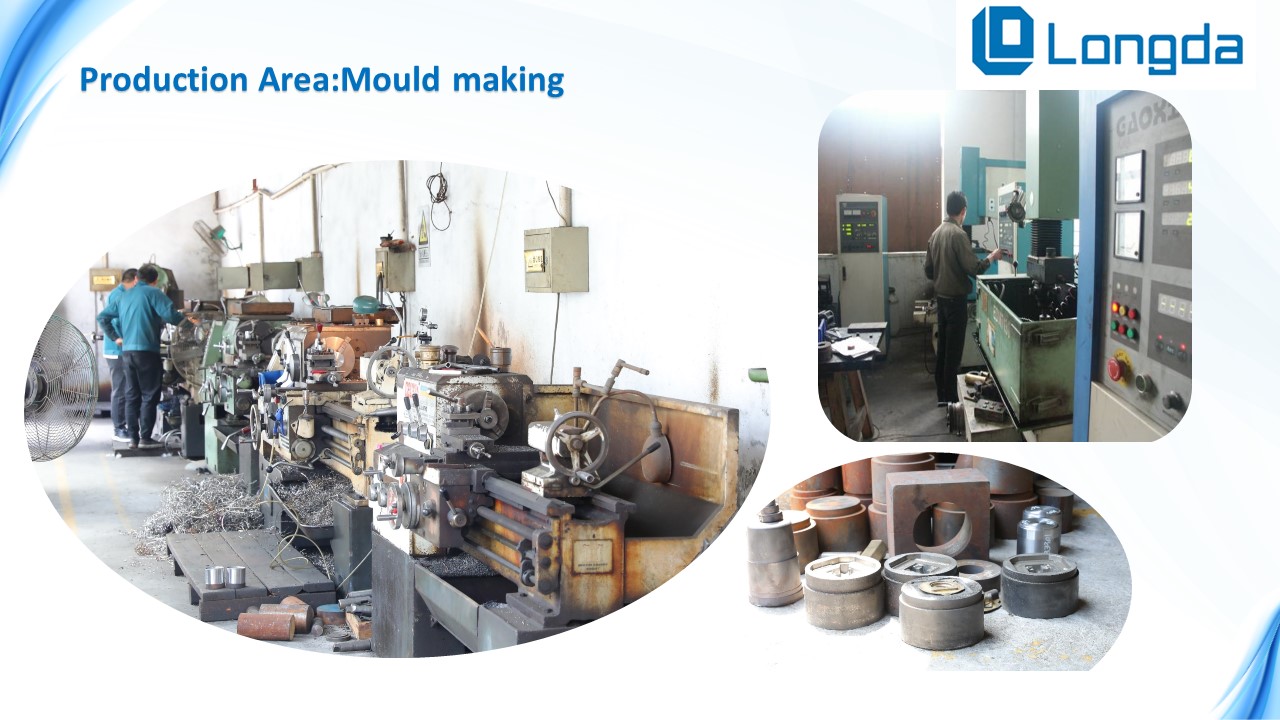
Cover: hot-forged brass valve bodies inside a valve production facility. The four valve families compared below share forged brass construction and 100% factory testing, but they are not interchangeable on the specification sheet.
Almost every residential and light-commercial water system ends up specifying four brass valve families within a few metres of each other: a gate valve for isolation, a quarter-turn ball valve for frequent shut-off, a check valve to stop reverse flow, and a Y-pattern strainer to catch debris before it reaches pumps, meters and fixture trim. They are bought from the same supplier, installed by the same crew, and compared — when they are compared at all — on one number printed on the catalogue page.
That number is usually a pressure rating. It is also the least useful column on the sheet if it is read on its own, because a rating is a ceiling under stated conditions, not a description of duty. A 600 WOG quarter-turn ball valve and a 200 WOG full-bore gate valve are not ranked first and second; they are two answers to two different questions.
This comparison sets four brass valve families side by side using published model data rather than supplier claims: the 8081 two-piece full-port ball valve, the T-22017A rising-stem gate valve, the LD 30303 swing or spring check valve, and the LD.73154 Y strainer with an SS304 screen and blow-down drain plug. The columns that matter are pressure rating, temperature range, size range, connection type, seat or screen construction, factory testing and lead-free certification.
The four products are manufactured by Zhejiang Longda Technology Co., Ltd., a brass valve and fitting producer founded in 1993 and located in the Xuangang Industrial Zone, Lupu Town, Yuhuan County, Zhejiang Province, China. The company operates a 30,000 m² site with roughly 200 employees and exports approximately 95% of its output to Europe, the United States, Canada and South America under the LONGDA BRASS VALVE brand.
Why the rating column is the weakest place to start a comparison
A pressure rating travels with conditions that the catalogue headline does not repeat. Three of them decide most real disputes.
The basis of the rating. WOG means water, oil and gas service; WSP means working steam pressure. A valve listed at two different values is not inconsistent — it is being rated against two different media. Buyers who compare a WOG figure with a WSP figure are comparing different tests.
The seat and sealing system. A metal-seated valve and a PTFE-seated valve behave differently under cycling, debris and temperature. The T-22017A gate valve uses a brass-to-brass metal seat; the 8081 ball valve uses PTFE seats with a chrome-plated brass ball and a blow-out-proof stem design; the LD 30303 check valve uses a brass disc with a PTFE sealing face and an SS304 spring. Those choices, not the headline pressure, determine service life.
The duty cycle. A valve rated for 600 WOG that is cycled daily is a different procurement decision from a valve rated at 200 WOG that is operated twice a year during maintenance.
The four valve families side by side
The tables below use the published specification data for each model. They are deliberately split: rating and geometry in the first, construction and compliance in the second.
| Valve family | Model | Type | Size range | Pressure rating | Working temperature | Standard connection |
|---|---|---|---|---|---|---|
| Ball valve | 8081 | 2-piece full port, quarter-turn lever or wing handle | 1/2"–4" (DN15–DN100) | 600 WOG (4.1 MPa) | −20°C to 150°C | Female NPT or BSP threaded |
| Gate valve | T-22017A | Rising stem, full bore, 360° handwheel | 1/2"–4" (DN15–DN100) | 200 WOG (1.4 MPa) | −20°C to 120°C | Female NPT or BSP threaded |
| Check valve | LD 30303 | Swing or spring-loaded, horizontal or vertical installation | 1/2"–2" (DN15–DN50) | 200 WOG (1.4 MPa) | −20°C to 150°C | Female NPT, BSP, Press, PEX, MPT, SWT or cold expansion |
| Y strainer | LD.73154 | Y-pattern with blow-down drain plug, replaceable screen | 1/2"–2" (DN15–DN50) | 200 WOG (1.4 MPa) | −20°C to 150°C | Female NPT or BSP threaded (FPT, SWT and Press connectors stated as available) |
Table 1 — Rating, size and connection data for the four compared brass valve families.
| Model | Seat, disc or screen | Body material options | Factory testing | Lead-free option and listing |
|---|---|---|---|---|
| 8081 ball valve | Chrome-plated brass ball, PTFE seats, blow-out-proof stem, NBR or FKM O-rings | Hot-forged normal brass or lead-free brass | 100% factory tested | Lead-free version certified to cUPC, NSF/ANSI 61 and NSF/ANSI 372 |
| T-22017A gate valve | Brass-to-brass metal seat, forged brass disc, PTFE or EPDM packing and seal | Hot-forged CW617N or Hpb59; lead-free CW724R / C46500 option | Shell test at 1.5× rated pressure; seat test at 1.1× rated pressure | Lead-free version certified to NSF/ANSI 61 and NSF/ANSI 372 by IAPMO |
| LD 30303 check valve | Brass disc with PTFE sealing face, SS304 spring, NBR or EPDM seals | Hot-forged normal brass; lead-free and DZR option | Factory testing per product line | Lead-free version certified to NSF 61 and NSF 372 |
| LD.73154 Y strainer | SS304 stainless steel screen, 20 / 40 / 60 / 80 mesh, brass drain plug | Hot-forged normal brass; lead-free CW724R option | 100% factory test on all LD.73154 products | Lead-free version certified to NSF/ANSI/CAN 61 and NSF/ANSI 372 by IAPMO |
Table 2 — Construction, testing and compliance data for the four compared brass valve families.
Pressure: what 600 WOG and 200 WOG actually separate
Only the 8081 ball valve carries a 600 WOG (4.1 MPa) rating across the 1/2"–4" range. The gate valve, the check valve and the Y strainer are all rated 200 WOG (1.4 MPa). That gap of roughly three times is real, and it is not a quality ranking.
The ball valve's higher rating follows its construction: a two-piece full-port body with a chrome-plated brass ball running against PTFE seats, operated by a quarter-turn lever or wing handle that never needs a stem to travel through the packing. The gate valve reaches 200 WOG with a brass-to-brass metal seat and a rising stem — an architecture chosen for durability under infrequent operation, where metal-on-metal contact resists wear and rubber seals cannot age out.
The gate valve is also the only one of the four that publishes a test protocol rather than a single working figure: the T-22017A is tested at 1.5× rated pressure for shell integrity and 1.1× rated pressure at the seat. For buyers writing a factory acceptance test clause, that distinction is worth more than the headline number, because it tells the inspection team exactly what the manufacturer holds itself to.
Where 600 WOG matters is on systems where the working pressure genuinely climbs — booster-pump discharge, tall-building risers, compressed-air branches. Where 200 WOG is sufficient, paying for 600 WOG buys margin the system will never use, and may cost the metal seat or the bore characteristics that made the gate valve appropriate in the first place.
Temperature: a 30°C ceiling that decides hot-side applications
The gate valve is rated from −20°C to 120°C. The ball valve, check valve and Y strainer are rated from −20°C to 150°C.
On a domestic hot-water or hydronic heating circuit that stays below 90°C, the difference is academic. On a system where the design temperature approaches 120°C or where the valve sits close to a boiler outlet or a steam-adjacent riser, the 30°C gap turns into a specification boundary. The gate valve's limit is a direct consequence of its PTFE or EPDM packing and seal set combined with the metal seat geometry — it is not a defect, but it should be entered as a constraint in the comparison sheet.
Size range: two families stop at two inches
The ball valve and the gate valve run from 1/2" to 4" (DN15–DN100). The check valve and the Y strainer run from 1/2" to 2" (DN15–DN50).
This is the single most common source of late-stage substitution on a project. A 3" or 4" main can be isolated with an 8081 ball valve or a T-22017A gate valve, but reverse-flow protection and debris screening at that diameter require a different series. Buyers who assemble a comparison sheet only around the products they intend to order tend to discover this at the submittal stage, after the piping layout is fixed.
Connections: where the four families genuinely diverge
Threaded ends are the common baseline. The ball valve and the gate valve are both specified with female NPT or BSP threads. The Y strainer is threaded as standard, with FPT, SWT and Press connector options stated as available.
The check valve is the outlier: it is offered with female NPT, BSP, Press, PEX, MPT, SWT and cold expansion connections, and can be installed horizontally or vertically. That flexibility is deliberate — check valves are placed wherever reverse flow is a risk, which is rarely a convenient threaded location.
Beyond the four families, the same manufacturing base supplies brass pipe fittings in 1/4"–2" (DN8–DN50) covering threaded, sweat, PEX per ASTM F1807, PEX-A cold expansion per ASTM F1960, Press per ASTM Z1117 and push-fit per ASSE 1061. Thread standards matter here too: NPT threads follow ASME B1.20.1, while ISO 228-1 governs pipe threads where pressure-tight joints are not made on the threads — a distinction that decides whether a European BSP line and a North American NPT line can share the same valve inventory.
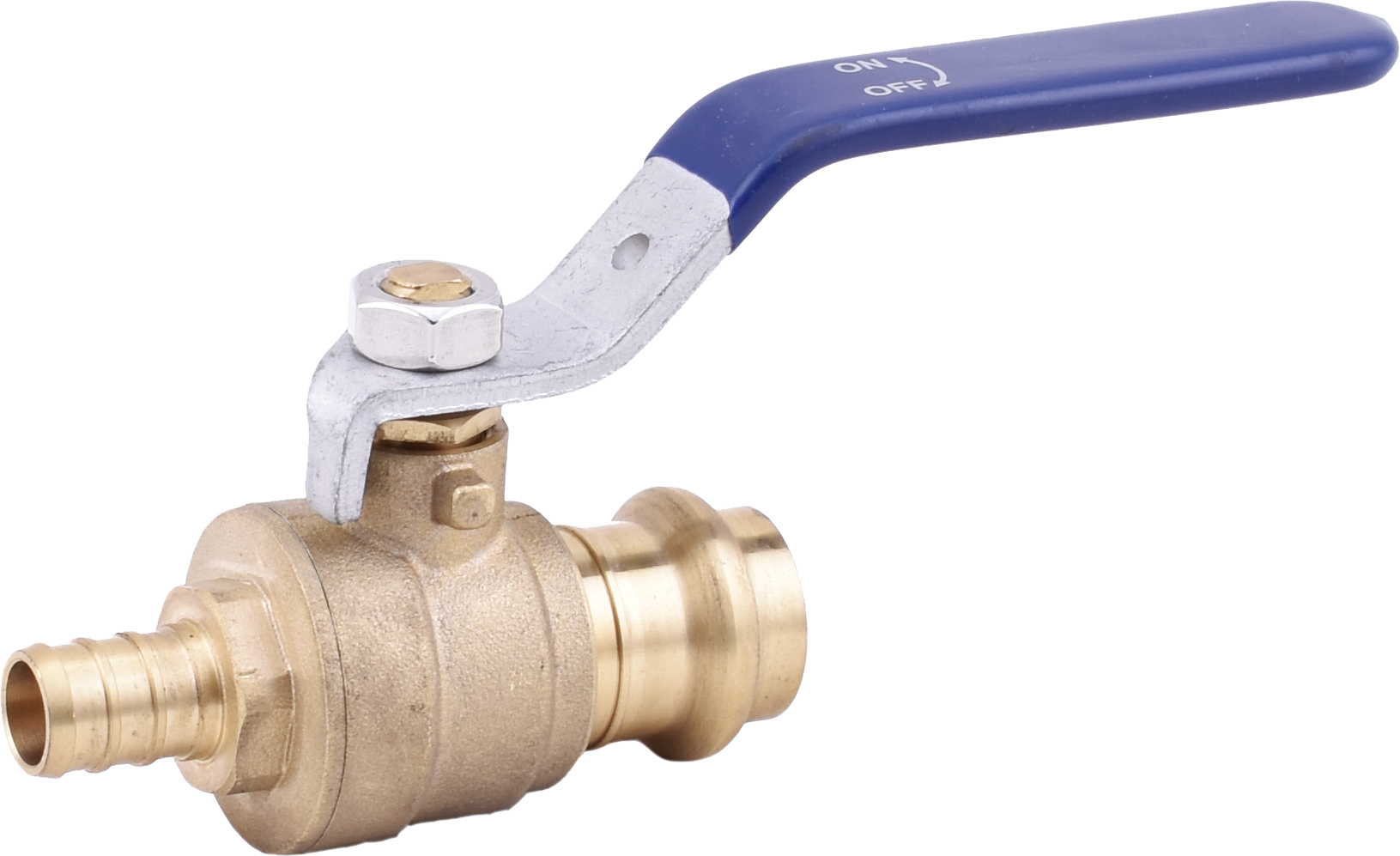
Press-connection and cold-expansion ends let a brass ball valve land on PEX-A or copper systems without a threaded transition — one of the connection variables that changes installation risk and labour time.
Installation risk: the three failure paths buyers underwrite
Nearly every warranty conversation on brass valves reduces to three events: connection leakage at the joint, stem leakage through the packing, and thread damage during make-up. All three are influenced by manufacturing decisions taken long before the installer arrives.
The documented controls on these products are specific. Sealing is built as a PTFE seal with a double O-ring arrangement on the quarter-turn ball core, with a chrome-plated anti-corrosion finish on exposed surfaces. Every unit is air pressure tested under water before shipment, thread gauge inspection is applied to each lot, and a lead-free material test report is available on request. The after-sales position is a 12-month quality warranty with free replacement of quality defects.The risk profile differs by family. A threaded connection is where most field leakage begins, so thread inspection discipline matters more on the gate valve and Y strainer, which are threaded as standard, than on a check valve installed into a Press or cold-expansion joint. Stem leakage risk concentrates on valves that are operated often; the 8081's blow-out-proof stem design addresses the extreme case, while the rising-stem gate valve exposes the stem to the environment and depends on its PTFE or EPDM packing to stay sealed. Thread damage risk concentrates on size: a misaligned 3" or 4" threaded joint is far less forgiving than a 1/2" connection.
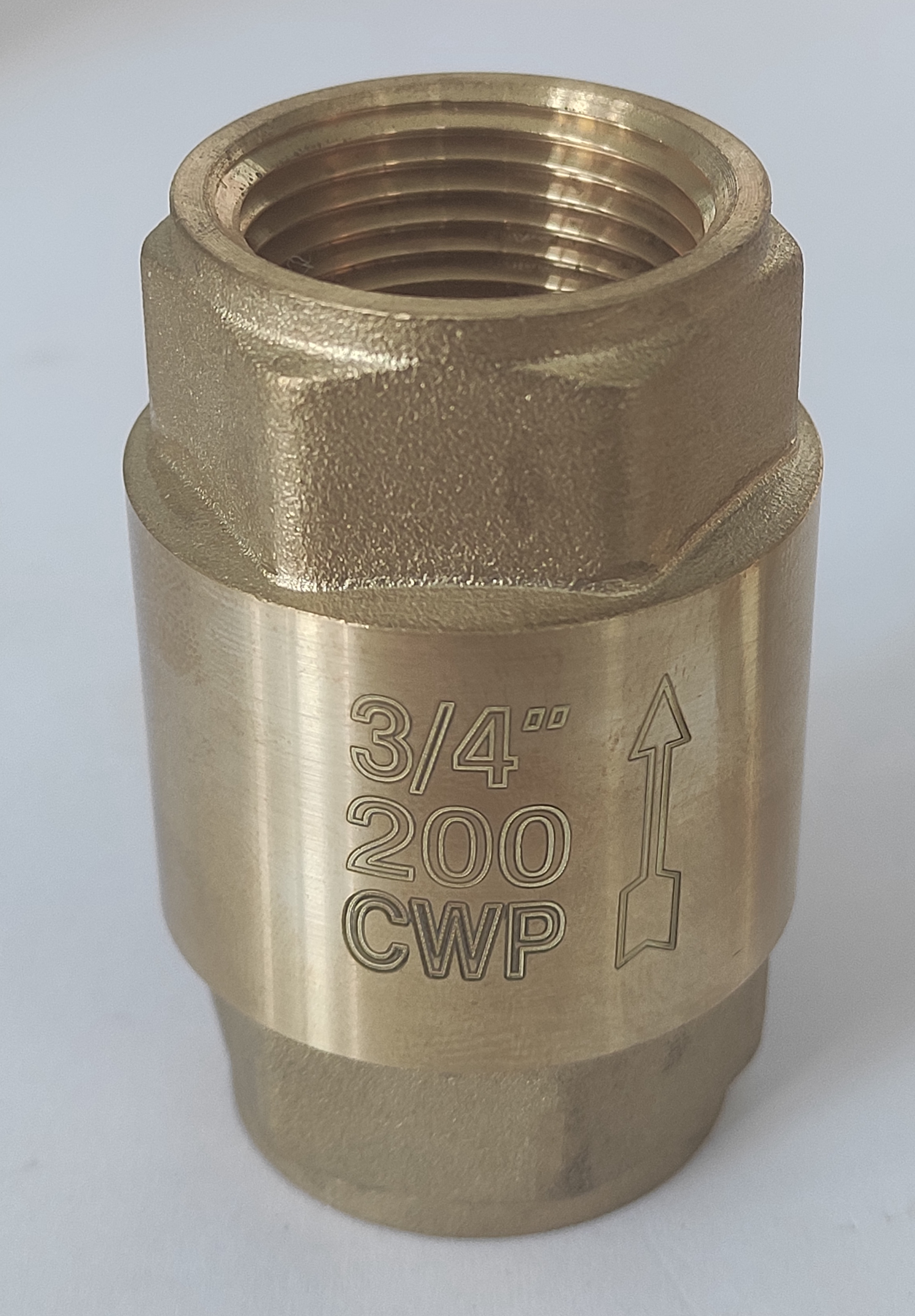
The LD 30303 check valve is available in swing or spring-loaded form and in horizontal or vertical installation — orientation is a selection input, not an installation preference.
Lead-free compliance as a comparison column
For residential, hospitality and any potable-water-adjacent scope, lead-free compliance belongs in the same table as pressure and size, not in a separate compliance annex.
The requirement is a wetted-surface lead content of no more than 0.25%, aligned with NSF/ANSI 372 and the US Safe Drinking Water Act, with California's AB1953 as the state-level driver most often cited in hospitality specifications. Materials in contact with potable water are additionally assessed for health effects under NSF/ANSI 61. The US EPA has been moving lead-free brass alloys toward the mandatory baseline for potable water applications, which means the column is only going to become less negotiable.
All four families offer a lead-free option, and each carries an IAPMO listing:
- IAPMO lead-free listing 6304 under NSF/ANSI/CAN 372-2024 covers lead-free plumbing products including the gate valve, Y strainer, check valve and ball valve.
- IAPMO listing N-5775 under NSF/ANSI/CAN 61-2023 covers drinking water system components across the same four families plus fittings and supply stops.
- The 8081 ball valve additionally holds UPC listing 5938 issued by IAPMO against IAPMO/ANSI Z1157-2014e1(R2019), ASME A112.4.14-2022 and CSA B125.14-22.
- Manufacturing is covered by ISO 9001:2015 certificate CN00124Q37399R2M/3300 and ISO 14001:2015 certificate CN00124E33461R2M/3300, both issued by the China Quality Certification Centre.
Gas duty follows a different path. In the EU, brass gas valves are addressed by EN 331:2015, while manually operated copper alloy ball valves for drinking water supply are addressed by EN 13828:2003. A potable-water listing does not substitute for a gas-service standard, and buyers specifying dual-purpose inventories should keep the two columns separate.
Matching each family to its duty
The four families divide the work along functional lines rather than along perceived quality tiers.
- Gate valve — isolation where operation is infrequent. The T-22017A is specified for municipal water supply, residential and commercial plumbing, HVAC and agricultural irrigation. Its full-bore flow path equals the pipe diameter, so pressure loss at full open is minimal, and the metal seat does not age out. It is the correct choice for a valve that is opened and closed at maintenance intervals.
- Ball valve — frequent shut-off and full-port flow. The 8081 covers plumbing and heating systems including potable water, water supply, gas and HVAC. A quarter-turn handle gives a definitive open or closed position, and the full-port bore keeps pressure drop low on a line that is cycled regularly.
- Check valve — reverse-flow protection. The LD 30303 is specified for pumping systems, water supply, heating and boiler systems, agricultural irrigation and industrial fluid lines. Swing and spring-loaded versions plus horizontal and vertical mounting accommodate the line as built.
- Y strainer — protection for everything downstream. The LD.73154 is specified for water supply pipelines, HVAC and chilled-water systems, gas piping and irrigation. The SS304 screen at 20/40/60/80 mesh catches sand, sediment and weld debris before it reaches pump impellers, ball valve seats and meters, and the blow-down drain plug allows in-line flushing without disassembly.
Where each family stops working
A comparison that only lists capabilities is a catalogue. These are the boundaries a buyer should enter into the same sheet.
Gate valve: the T-22017A is built for infrequent shut-off duty. It is not a throttling or balancing device, and its 120°C ceiling sits below the 150°C range of the other three families. Its threaded-only connection set also limits it where a press or cold-expansion joint is preferred.
Ball valve: the 8081 provides isolation, not regulation. Using a quarter-turn ball valve as a flow-balancing device erodes the PTFE seats and produces a pressure drop characteristic that cannot be set or repeated.
Check valve: the LD 30303 prevents reverse flow; it does not provide manual isolation. A line that needs to be locked out still needs a gate or ball valve. The family also stops at 2" (DN50), so larger mains require a different series. Spring-loaded versions add pressure drop relative to swing versions.
Y strainer: the LD.73154 protects downstream equipment but is not a substitute for filtration where finer retention is specified. It introduces its own pressure drop and requires the screen to be cleaned or replaced — the blow-down drain plug and the disassembly-free screen change reduce that burden but do not remove it.
Across all four: none of these products is a control valve, a pressure-reducing valve or a safety relief device. Cross-referencing them into those duties is a specification error, not a selection trade-off.
Market context: growth, concentration and the lead-free baseline
The category these four families sit in is expanding and consolidating at the same time. Dataintelo values the global brass valves market at USD 14.8 billion in 2025 and projects USD 24.1 billion by 2034, a CAGR of 5.6% across 2026–2034. Within that market, ball valves held the largest product type share at 38.4% in 2025 — a figure consistent with how often a quarter-turn isolation valve appears on a plumbing take-off.
Regional weight is uneven. Dataintelo puts Asia Pacific at a 41.2% revenue share in 2025, with North America at roughly 26.1%. The isolation function specifically — gate, globe and check valves together — accounted for USD 26.15 billion of the wider industrial valve market in 2024 according to Cognitive Market Research, which also identifies industrial gate valves as the fastest-growing type at a 9.89% CAGR through 2032.
Supply is still fragmented at the top: Mordor Intelligence estimates that the five largest global valve suppliers control approximately 35% of global revenues, which leaves the majority of the brass valve market in the hands of regional manufacturers and OEM programs. That structure is why independent comparison data matters more than brand recognition in this segment — the specification, the certification number and the factory test are what a buyer can actually verify.
Building a comparison sheet that survives audit
A procurement-ready comparison sheet for these four families needs eight columns, each of which is answerable from documented data: pressure rating and its basis; working temperature range; size range in both inches and DN; connection type and thread standard; seat, disc or screen material; factory test method; lead-free certification number and scope; and commercial parameters such as MOQ, lead time and capacity.
On the commercial side, the manufacturing profile behind these products is documented rather than implied. Monthly capacity is stated at 500,000 pieces for the supply-stop line and 300,000 pieces for the ball valve line, with lead times of 20 to 60 days depending on product and samples in 5 to 7 days. MOQ is typically 1,000 pieces per size, with different sizes carrying different minimums. OEM and ODM programs cover size, body material, handle type and colour, logo, thread type, packaging format and certification support.
Future outlook
Three shifts are likely to reshape how these four families are compared over the next several years.
First, lead-free is moving from a premium option to a default. The EPA's direction on lead-free alloys for potable water contact means the compliance column will eventually be identical across every qualified supplier, at which point differentiation returns to dimensions and testing.
Second, connection mix is widening faster than valve bodies are changing. The availability of Press, PEX, PEX-A cold expansion and push-fit ends across ball valves, check valves and strainers — supported by dedicated listings for Z1117, F1960, F1807 and ASSE 1061 connections — means more of the selection decision will be made on the piping system than on the valve internals.
Third, instrumentation is entering the category. Mordor Intelligence identifies smart valve integration with IIoT as a structural trend in fluid management for predictive maintenance. The gate valve, check valve and strainer described here remain purely mechanical, and the near-term effect of that trend will be felt more in monitoring around them than inside them.
FAQ
Is a 600 WOG ball valve automatically the better choice over a 200 WOG gate valve?
No. The 8081 full-port ball valve is rated 600 WOG (4.1 MPa) from 1/2" to 4" with a −20°C to 150°C range, and the T-22017A rising-stem gate valve is rated 200 WOG (1.4 MPa) over the same size range with a −20°C to 120°C range. The ball valve suits frequent quarter-turn isolation with minimal pressure drop; the full-bore gate valve, with its brass-to-brass metal seat, is designed for infrequent shut-off where metal-on-metal seating outlasts rubber seals. Selection should follow duty, temperature ceiling and connection type, not the higher number alone.
Which of the four brass valve families are limited to 2-inch pipe?
The LD 30303 check valve and the LD.73154 Y strainer are both available from 1/2" to 2" (DN15–DN50). The 8081 ball valve and the T-22017A gate valve extend to 4" (DN100). On a 3" or 4" main, isolation can be handled by a ball or gate valve, but reverse-flow protection and debris screening at that diameter require a different series.
Do all four families need lead-free certification for potable water work?
Wherever the wetted surface contacts potable water in the US or Canada, the wetted-surface lead content must be no more than 0.25% under NSF/ANSI 372 and the Safe Drinking Water Act, with material health effects assessed under NSF/ANSI 61. California's AB1953 is the state-level requirement most often cited in hospitality specifications. All four families offer a lead-free option certified by IAPMO, and the ball valve also holds UPC listing 5938 against IAPMO/ANSI Z1157, ASME A112.4.14 and CSA B125.14.
How can a buyer verify a certification claim instead of trusting the catalogue?
Check four things on the certificate itself: the certification number, the issuing body, the standard cited and the listing scope. Verifiable examples on these products include IAPMO lead-free listing 6304 under NSF/ANSI/CAN 372-2024, IAPMO listing N-5775 under NSF/ANSI/CAN 61-2023, UPC listing 5938 for the 8081 ball valve, and ISO 9001:2015 certificate CN00124Q37399R2M/3300 issued by the China Quality Certification Centre. The certification number must match the specific model being quoted; a listing for one product family does not automatically extend to another.
What causes connection leakage, stem leakage and thread damage, and how are they controlled at the factory?
The documented controls are structural and procedural. Sealing is built as a PTFE seal with a double O-ring arrangement around a quarter-turn ball core, with a chrome-plated anti-corrosion finish; the 8081 ball valve adds a blow-out-proof stem design. Every unit is air pressure tested under water before shipment, thread gauge inspection is applied to each production lot, and a lead-free material test report is available. The after-sales position is a 12-month quality warranty with free replacement for quality defects. For threaded joints, thread geometry follows ASME B1.20.1 for NPT and ISO 228-1 where pressure-tight joints are not made on the threads.
Can a check valve be used as an isolation valve, and can a Y strainer replace a filter?
A check valve prevents reverse flow but does not provide manual isolation — a line requiring lockout still needs a gate or ball valve, and the LD 30303 also stops at 2" (DN50). A Y strainer removes debris before it reaches downstream equipment: the LD.73154 uses an SS304 screen in 20/40/60/80 mesh, has a blow-down drain plug for in-line flushing, and allows the screen to be replaced without disassembling the pipeline. It is not a substitute for filtration where finer retention is specified, and it introduces its own pressure drop.
Reference
The full brass valve and fitting range, including specification tables and connection options, is available in the LONGDA Global catalogue: LONGDA Global product catalogue (PDF).
Tem questões ou precisa de mais detalhes?
Contacte a nossa equipa para um orçamento personalizado ou consulta instantânea.
Solicitar orçamento
Preencha o formulário abaixo e a nossa equipa entrará em contacto com uma proposta personalizada.
Chat direto do WhatsApp
Prefere conversar em tempo real? Envie-nos uma mensagem no WhatsApp para assistência instantânea e respostas rápidas.
- Obter orçamento personalizado
- Partilhar fotos ou documentos
- Discuta as suas necessidades diretamente
Geralmente responde em 5–30 minutos durante o horário de expediente.