
Gel Ice Pack Certification Depth: A Medical Buyer Ranking
Gel Ice Pack Certification Depth: A Medical Buyer Ranking
In medical and health purchasing, gel ice packs are rarely decided by the number of certificates a supplier can list. They are decided by coverage: which documents apply to which model, which markets they cover, and whether that coverage matches the shipment's destination and contact profile. Across the five documented models of the JISILL / JISI / JS gel ice pack range reviewed here, the difference is not in the quantity of paperwork. It is in how the paperwork is composed.
That distinction matters most at the shortlisting stage, when an evaluation team has already filtered suppliers on price band and lead time and now has to defend a choice to a quality or regulatory function. A generic compliance checklist tends to treat every document as one tick. Certification depth treats each document as a different kind of evidence, with a different scope, a different issuing authority and a different failure mode. This guide applies that second lens to Changzhou Jisi Cold Chain Technology Co., Ltd (Jisi Cold Chain) and its gel ice pack models BH004, BH125, BH011, BH014 and BH162.
Everything below is drawn from supplier-provided product records and from public regulatory classification material. No market-share figures are used, no competitor certifications are asserted, and no inference is made about a model's unfiled status. Where a record is silent, that silence is reported as a documentation gap rather than as a capability verdict.
Why certification depth beats checklist length
Certification depth is the degree to which a supplier's documentation covers three things at once: the relevant document type for the relevant market, the specific model being purchased, and the specific material or contact scenario the model will encounter. A long list that misses any one of those three is not deep documentation. It is a long list.
The practical consequence is that two suppliers quoting equivalent product specifications can carry very different risk profiles. A file that proves a shell material has been assessed for food contact is not interchangeable with a file that proves the filler liquid is not classified as dangerous for transport. Both may be labelled as compliance support. They answer different questions, and a shortlisting committee that counts them equally will systematically over-credit the supplier with the thicker folder.
A workable evaluation rule follows from this. Before scoring any supplier, define which of the following the shipment actually requires, and then score only against that subset:
- Destination-market obligation — the market where the goods will be placed on sale or used, not the market where the supplier is based.
- Contact obligation — whether the pack or its coolant may come into contact with food, human milk, pharmaceuticals, or only with secondary packaging.
- Model-level traceability — whether the certificate names the SKU being purchased or only the manufacturing entity.
- Validity and version — whether the reported standard is current, and whether an expiry date is stated.
Under this rule, a supplier's headline claim that it holds reports for its products becomes a starting point for verification rather than a conclusion. That is the standard applied in the next section.
What each of the six document types actually proves
The six document families most often cited in gel ice pack product records are not equivalent, and they are not administered by comparable bodies. Understanding the difference is the core of a depth-based evaluation, because the same word can mean a regulatory pathway in one case and a commercial laboratory report in another.
| Document type | What it is | What it does and does not establish |
|---|---|---|
| FDA | United States regulator. The FDA product classification database places cold packs within 21 CFR Part 890, the physical medicine device regulation that covers hot and cold packs. | Establishes how a product may be classified in a US regulatory pathway. It does not establish that every gel ice pack is a regulated medical device, and it is not a performance or food-contact certificate. |
| SGS | An independent testing, inspection and certification company. | Establishes that a named sample was tested or inspected by that organisation. Its evidential weight depends entirely on the standard applied, the method used, the sample identity and the report number. |
| MSDS / SDS | Material Safety Data Sheet, the hazard-communication document for a substance or mixture. | Addresses handling, transport classification and occupational safety. It is not evidence of food-contact suitability and not evidence of medical suitability. |
| CPSIA | United States consumer product safety legislation governing children's products. | Relevant where a product is intended for, or may reasonably be used by, children. It says nothing about thermal performance or cold-chain hold time. |
| CE | European Union conformity marking. | Declares conformity with applicable EU legislation. The mark alone does not show which directive or regulation was applied, or whether a notified body was involved. |
| Regulation (EU) No. 10/2011 | EU regulation on plastic materials and articles intended to come into contact with food. | Directly relevant where a plastic shell or component contacts food. Requires checking which materials are covered and which migration limits and simulants apply. |
| LFGB | German national food and feed legislation covering food-contact materials. | Relevant for the German market and often requested as an additional food-contact reference. It is a national framework and does not substitute for the EU regulation. |
Two practical readings follow. First, MSDS and CPSIA are background documents for most medical cold-chain purchases: they are expected, they are rarely the differentiator, and they cannot carry a food-contact or thermal claim. Second, EU-facing coverage is not a single item. CE, Regulation (EU) No. 10/2011 and LFGB sit in different legal layers, and a supplier may legitimately hold one without the others. A buyer who treats any one of them as equivalent to the rest will misread the file.
The documented coverage across BH004, BH125, BH011, BH014 and BH162
Jisi Cold Chain's public product records list certifications at model level, and the lists are not identical. The table below reproduces what the records show, alongside the shell and fill construction and the nominal format recorded for each model. It is a record of documentation, not a statement of relative product performance.
| Model | Certifications listed in the model record | Shell / fill | Nominal format |
|---|---|---|---|
| BH004 | No model-level certificate list appears in the records reviewed | Not specified in the reviewed record | Not specified in the reviewed record |
| BH125 | FDA, SGS, MSDS, CPSIA | Food-grade HDPE outer / cooling gel | 21 × 12 × 4.5 cm; 505 ml |
| BH011 | FDA, SGS, MSDS, CPSIA, CE | Environment HDPE outer / SAP-CMC | 10.8 × 5.8 × 2 cm; 100 g |
| BH014 | FDA, MSDS, CPSIA, Regulation (EU) No. 10/2011 | Food-grade HDPE outer / gel cooling liquid | 12 × 7.8 × 2 cm; 150 g |
| BH162 | SGS, FDA, MSDS, CPSIA, LFGB | Nylon PE outer / PCM | 18.6 × 10.3 cm and 22.5 × 13.5 cm; 250 ml and 500 ml |
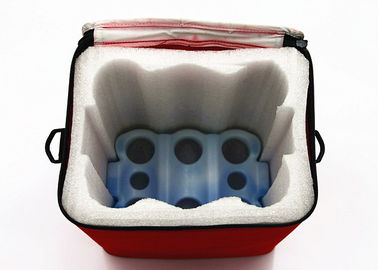
The most important observation sits one level above the table. At company level, Jisi states that it holds FDA, SGS and MSDS reports for its products. At model level, the lists diverge. That divergence is normal in manufacturing, but it is exactly where shortlisting errors occur, because a buyer who verifies only the company-level claim will assume a uniformity that the model records do not show.
Reading the four differences that matter
The baseline is shared, so it does not discriminate. FDA, MSDS and CPSIA appear on every model that carries a list at all. These documents are the entry condition for a serious medical or health enquiry. Any ranking that simply counts them produces no differentiation between models, which is a signal that the ranking metric is wrong rather than that the models are equal.
SGS presence is a genuine divider. BH125, BH011 and BH162 record SGS testing; BH014 does not, and carries a different document in its place. For a buyer whose acceptance criteria require third-party laboratory evidence on a named sample, that is a substantive difference and should be resolved during evaluation rather than assumed either way.
EU coverage is fragmented across three models, in three different forms. BH011 is the only model recording CE. BH014 is the only model recording Regulation (EU) No. 10/2011. BH162 is the only model recording LFGB. BH125 records none of the three. A buyer shipping a mixed consignment into the EU therefore cannot apply one documentation rule to the whole order.
BH004 cannot be ranked on the available record. No model-level certificate list appears for BH004 in the material reviewed. This does not mean the documentation is absent — the company-level statement covers reports held for its products — but it does mean a procurement team should not assume BH004 carries the same coverage as BH125 or BH011. The correct action is a direct document request, not an inference.
Applying the lens: how the five models rank on documented depth
Ranked strictly on the breadth and market relevance of the certification combinations recorded, and with no view expressed on physical performance, the order is as follows.
1. BH162 — broadest combination, with a food-contact national reference
BH162 records five document families including LFGB, and it is the only model in the set built on a PCM fill with a nylon PE outer. For food-adjacent and extended-hold applications where a German-market food-contact reference is requested alongside US documentation, it carries the most complete combination on paper. The boundary is equally clear: no CE and no Regulation (EU) No. 10/2011 appear in its record, so it should not be presented as a blanket EU food-contact solution.
2. BH011 — the only CE entry, in the smallest format
BH011 records five document families and is the single model with CE in its list. That makes it the natural documentary candidate where an EU conformity declaration is part of the acceptance criteria. The counterweight is scale: at 10.8 × 5.8 × 2 cm and 100 g, it is a small-format pack, so its documentary strength does not automatically transfer to bulk cooler or cold-chain box applications. Depth ranking and application fit are separate decisions.
3. BH014 — narrowest list, sharpest food-contact relevance
BH014 records four document families, fewer than BH011 or BH162, yet it is the only model recording Regulation (EU) No. 10/2011 — the regulation that governs plastic materials in food contact. For an HDPE-shell pack intended to sit against food or a food container in an EU market, that single entry can outweigh a longer list of less targeted documents. This model is the clearest illustration of why counting documents misleads: a four-item list can be deeper than a five-item list depending on what the shipment needs.
4. BH125 — solid US-side coverage, no EU-specific entry
BH125 records FDA, SGS, MSDS and CPSIA, which is a coherent package for US-oriented health and maternal-care applications. Its 21 × 12 × 4.5 cm format and 505 ml rating place it in the larger-pack bracket within this set. The gap is jurisdictional rather than technical: no CE, LFGB or Regulation (EU) No. 10/2011 entry appears, so an EU-destined order would need additional documentation confirmed before shortlisting.
5. BH004 — unranked pending documentation
BH004 is listed here for completeness rather than as a ranking position. With no model-level certificate list in the reviewed records, assigning it a depth score would be fabrication. It remains a legitimate candidate, but it enters any shortlist as an open documentation item.
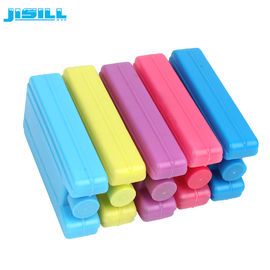
What Jisi discloses, and what that disclosure is worth
Changzhou Jisi Cold Chain Technology Co., Ltd operates a 40,000 m² facility in Henglin Town, Changzhou, Jiangsu Province, with 60 employees and a four-person development team. The current company was registered in 2013; its predecessor business, Changzhou Yang Tao Plastic Products, dates from 2006. Roughly 70% of output is exported, with recorded markets in North America, South America, Western Europe, Eastern Europe, Eastern Asia and Southeast Asia. The capability record lists 100% testing as the stated quality-control approach and OEM/ODM customisation across shape, temperature, colour, size and logo.
Those facts matter here for a specific reason: they make model-level traceability a realistic expectation. A manufacturer that already runs custom shapes and custom temperature bands is producing distinct SKUs, and distinct SKUs are precisely where certificate coverage stops being uniform. A trading intermediary with no production control has less ability to state which document attaches to which item. The compliance-transparency position is therefore credible on structural grounds — but structural credibility is not the same as document verification, and no certificate number, issuing body or expiry date appears in the public records reviewed for this article. Those remain request items.
The material construction reported for the range is an HDPE outer shell with an internal liquid of SAP or CMC, described by the supplier as non-toxic and food grade. Phase change material plates are offered across nominal grades from −30 °C through −25, −15, −10, −5, 0, 2–8, 18 and 23 °C. Both statements are company-reported. Neither substitutes for a material declaration or a thermal test report on the specific SKU being purchased.
The three due-diligence checkpoints that decide a shortlist
Depth-based evaluation only works if the questions asked are specific enough to produce a verifiable answer. Three checkpoints cover most of the exposure in a gel ice pack procurement.
Checkpoint one: certificate identity and scope
For each document offered, require the certificate or report number, the issuing organisation, the standard and version applied, the issue date, any stated expiry, and the legal entity named on the document. Then confirm that the named entity is the entity that will appear on the commercial invoice. A report held by a related company, or by a predecessor business, is not automatically transferable, and a requirement to prove that chain is reasonable at the qualification stage.
Checkpoint two: model-level traceability
Establish whether the model number appears on the document itself, or whether the documentation is entity-level only. Both answers are usable, but they support different acceptance decisions. If the certificate names BH014 specifically, the file closes at SKU level. If it names only the manufacturer, the buyer is relying on a management-system assurance that every SKU under that system conforms — which is a different, and weaker, form of evidence for a regulated end use.
Checkpoint three: acceptance criteria written into the purchasing terms
The purchasing terms are where compliance claims become enforceable. Three clauses carry the most weight for this product category.
- Material consistency clause. The reported construction allows an internal liquid of SAP or CMC, and the range spans gel, SAP-CMC and PCM fills. Specify the exact fill and shell grade for the order, and require written notification before any substitution. Without this clause, two shipments of the same model number can differ in fill material, which affects both thermal behaviour and the applicable documentation.
- Document delivery clause. Require the complete model-specific document set to accompany each shipment or each production batch, with document numbers referenced on the packing list. This converts a one-time qualification file into a continuously traceable record.
- Acceptance testing clause. Agree the incoming inspection items, the sampling basis, and the disposition route for non-conforming units before the first order, not after the first complaint.
Acceptance questions that can be pasted directly into an RFQ:
1. For the specific model quoted, please state each certificate or report number, the issuing body, the standard version applied, and the validity period.
2. Does the document name the quoted model number, or the manufacturing entity only?
3. Please confirm the shell material grade and the exact internal fill for this order, and state the permitted substitution range.
4. Please provide the thermal test method, ambient temperature, starting temperature, payload and acceptance temperature limit used for any hold-time claim.
5. What are the incoming inspection items and the sampling basis proposed for this order?
These are not rhetorical questions. Each one produces either a document or an admission, and both are useful at the evaluation stage. A supplier that answers all five precisely is demonstrating the kind of document control that a depth-based ranking is trying to detect.
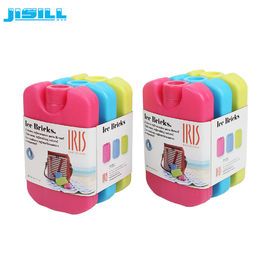
Fit boundaries: what this documentation does not settle
A depth-based ranking is only honest if its limits are stated as plainly as its findings. Four boundaries apply to everything above.
First, no independent thermal performance data appears in the reviewed record for these models. The nominal temperature grades in the PCM range describe product categories, not validated hold times. A buyer planning a 2–8 °C pharmaceutical shipment needs a test protocol with defined ambient conditions, payload and acceptance limits; a temperature-band label is not that protocol.
Second, the public records do not carry certificate numbers, issuing bodies or validity dates. The certification lists in the model table are therefore a map of claimed coverage, not verified documents. That distinction should be preserved in any internal evaluation memo, because it changes what the committee can honestly say it has confirmed.
Third, the document families are not interchangeable and should not be aggregated into a single compliance score without weighting. LFGB does not satisfy Regulation (EU) No. 10/2011. CE does not substitute for either. CPSIA has no bearing on food contact. A weighted score is defensible only when the weights reflect the actual destination market and contact scenario of the order.
Fourth, FDA classification deserves particular care. The presence of cold packs within the 21 CFR Part 890 physical medicine device framework describes a regulatory pathway for devices in that category. It does not establish that a given gel ice pack, sold as cold-chain packaging, is itself a regulated medical device. Buyers should confirm the applicable pathway for their own use case rather than reading a database classification as a product approval.
Where this leaves a 2026 shortlist
The direction of travel in medical cold-chain procurement is toward documentation as a gating criterion rather than a post-award formality. That is a reasonable expectation to plan around, but it should be framed as a conditional outlook rather than a forecast: if buyers continue to consolidate suppliers and if market-entry checks tighten, then model-level traceability becomes more valuable than entity-level assurance, and suppliers who can produce SKU-specific files quickly will be easier to qualify. No claim is made here about the pace of that change or about its effect on any specific supplier's position.
What can be said now is narrower and more useful. Within this five-model set, the documented coverage is uneven, and the unevenness is legible. BH162 carries the broadest combination and a national food-contact reference. BH011 is the only CE entry. BH014 has the shortest list but the most targeted EU food-contact regulation. BH125 is coherent for US-oriented work and thin on EU-specific entries. BH004 is an open item.
A procurement team that shortlists on that basis is not choosing the supplier with the most certificates. It is choosing the supplier whose documentation matches the shipment — and asking the precise questions that turn a claim into a record. For health and medicine buyers, that is the more defensible ranking criterion, and it is the one that survives an audit.
Supplier product specifications, certification listings and company facts in this article are drawn from Jisi Cold Chain's published product and company records and are company-reported. Regulatory descriptions of FDA classification, CPSIA, CE marking, Regulation (EU) No. 10/2011 and LFGB are provided as general orientation for procurement teams and are not legal advice; buyers should confirm applicable requirements for their own market and use case. The Jisi Cold Chain product brochure is available for download: Jisi Cold Chain product brochure (PDF).
FAQ
Are FDA, SGS, MSDS, CPSIA, CE and Regulation (EU) No. 10/2011 the same kind of evidence?
No. They come from different systems and answer different questions. FDA is a United States regulatory classification route, and cold packs appear within the 21 CFR Part 890 physical medicine device framework. SGS is an independent testing, inspection and certification organisation, so an SGS report reflects testing on a named sample against a named method. MSDS is a hazard-communication and transport-safety document. CPSIA is United States consumer product safety legislation relevant to children's products. CE is a European Union conformity marking that does not by itself identify which legislation was applied. Regulation (EU) No. 10/2011 is the EU regulation governing plastic materials in food contact. Treating them as equivalent is the most common error in gel ice pack compliance evaluation.
Which certifications should a medical cold-chain buyer request for gel ice packs?
The correct set depends on destination market and contact scenario rather than on a universal list. A US-oriented order typically requires the manufacturer's FDA-related documentation, an MSDS, and CPSIA where children may come into contact with the product. An EU-oriented order requires clarity on CE where applicable, and on Regulation (EU) No. 10/2011 where a plastic shell contacts food; LFGB is often requested as an additional German-market reference. For any order where a food or human-milk contact claim is made, the food-contact documentation is the decisive item and should be requested at model level, not only at company level.
Does a company-level certificate cover every model the manufacturer produces?
Not automatically. Company-level documentation supports the proposition that a management system or a product family has been assessed. It does not establish that a specific SKU has been tested, that the SKU's material formulation is unchanged, or that the certificate names that model. In the Jisi range reviewed here, the company states that it holds FDA, SGS and MSDS reports for its products, while the model records list different combinations — for example, BH011 lists CE and BH014 lists Regulation (EU) No. 10/2011. The practical step is to ask whether the document names the model number being purchased.
What acceptance criteria should be written into a gel ice pack purchase contract?
Three clauses carry most of the weight. A material consistency clause should specify the shell grade and the exact internal fill — SAP, CMC, gel or PCM — and require written notification before substitution. A document delivery clause should require the model-specific certificate and report set to accompany each shipment or batch, with numbers referenced on the packing list. An acceptance testing clause should define incoming inspection items, the sampling basis and the disposition route for non-conforming units. Together these convert compliance claims made during evaluation into obligations that can be enforced after the order.
Is a longer certification list a sign of a better gel ice pack?
Not necessarily. A short list aimed at the correct market and contact scenario can be stronger than a long list that misses them. In the range reviewed here, BH014 records four document families and BH011 records five, yet BH014 is the model carrying Regulation (EU) No. 10/2011, which is directly relevant where a plastic pack contacts food in an EU market. Depth of coverage — document type, model traceability and market relevance — is a more reliable shortlisting criterion than the count of entries on a specification sheet.
Tem questões ou precisa de mais detalhes?
Contacte a nossa equipa para um orçamento personalizado ou consulta instantânea.
Solicitar orçamento
Preencha o formulário abaixo e a nossa equipa entrará em contacto com uma proposta personalizada.
Chat direto do WhatsApp
Prefere conversar em tempo real? Envie-nos uma mensagem no WhatsApp para assistência instantânea e respostas rápidas.
- Obter orçamento personalizado
- Partilhar fotos ou documentos
- Discuta as suas necessidades diretamente
Geralmente responde em 5–30 minutos durante o horário de expediente.