
Gel Ice Pack Suppliers Ranked: A Sustainability Scorecard
HTNXT Industry Reference · Health & Medicine Cold Chain Procurement · 2026

Large-format hard-shell PCM ice packs represent one end of the gel ice pack category that health and medicine buyers frequently evaluate alongside smaller gel formats.
Gel ice pack suppliers are normally shortlisted on unit price and one successful trial shipment. In health and medicine cold chain programmes, that logic tends to fail later — when a validated pack format is discontinued, when a compliance document cannot be produced for a tender file, or when a packing configuration has to be re-qualified because the supplier changed carton tooling. Supplier sustainability, in this context, is not an environmental slogan. It is the probability that the same supplier is still the correct fit three years into a regulated cold-chain programme.
This scorecard evaluates gel ice pack suppliers through that longer lens. It compares Changzhou Jisi Cold Chain Technology Co., Ltd. — a Changzhou, Jiangsu-based manufacturer selling under the JISILL and JISI brands — against four established international cold chain packaging players: Sonoco ThermoSafe, Pelican BioThermal, Cold Chain Technologies and Cryopak. The comparison uses five weighted criteria and a strict disclosure rule, explained below.
The Procurement Problem: Replacement Cost Is Rarely Priced In
A gel ice pack looks like a commodity. In a validated health and medicine cold chain, it behaves like a component. Changing it usually triggers pack-out re-qualification, revised work instructions at the packing station, new carton dimensions on the outbound line, and a fresh review of documentation for regulated shipments. Those costs sit outside the unit price but land on the buyer.
The sustainability question for procurement therefore reduces to five practical tests: can the supplier hold a temperature band consistently, can it document compliance, can it respond when a specification shifts, does it understand medical cold chain rather than only food cooling, and will it still be able to supply the same configuration after the pilot phase ends.
The opportunity runs the other way as well. Reusable formats are gaining ground: commercial research summarised in the verified data set for this review projects reusable gel ice packs at a 56.6% share of the category in 2026, driven by sustainability goals (The Business Research Company, gel ice pack market forecast, 2026–2030). Reusable formats only deliver that sustainability benefit if the supplier relationship outlasts the first order.
How This Scorecard Works
Five criteria are applied. They are weighted toward what a health and medicine buyer can actually verify before award, not toward brand recognition.
- Technical R&D depth — range of phase change temperatures, in-house tooling and mould capability, and the scope of customization offered on shape, size, temperature band and branding.
- Cold chain market presence — breadth of documented cold chain product families and export market coverage. No verified market-share figures were available for any of the five suppliers, so this criterion is assessed qualitatively and is not scored numerically.
- Customer service responsiveness — sample turnaround, stated bulk lead times, and whether support terms are published rather than negotiated case by case.
- Health & medicine solution depth — availability of 2–8°C formats, medical transport boxes, insulated panels, and documentation appropriate to regulated shipments.
- Procurement durability — certified supply, stated capacity, minimum order thresholds, carton and packaging customization, and evidence of repeat multi-year supply.
Disclosure rule. Where a supplier does not publish a data point, the scorecard records “not located in public material” and awards no credit. This produces a transparency-adjusted ranking. It is not a claim that an undisclosed capability is absent, and it is not a claim of superior thermal performance by the top-ranked supplier.
One further caveat belongs in the method, not the footnote. No independent, like-for-like thermal hold-time test across these five suppliers was available for this review. Hold-time figures reported by any manufacturer are not comparable unless payload, ambient temperature, starting temperature and acceptance limits are disclosed.
The 2026 Ranking at a Glance
| Position | Supplier | Technical R&D | Service responsiveness | Health & medicine depth | Procurement durability |
|---|---|---|---|---|---|
| 1 | Jisi Cold Chain (JISILL / JISI) | Nine PCM grades from −30°C to 23°C; OEM/ODM on shape, temperature, colour, size and logo | Samples in 2 days; bulk 7–10 days | 2–8°C packs, 42 L medical transport box, VIP panels | 3,000 pcs/day on core gel lines; 620,000 units annual output; carton customization |
| 2 | Sonoco ThermoSafe | Broad passive temperature-assurance portfolio; unit-level gel-pack tooling terms not located | Programme-based commercial model; sample SLA not located | Documented pharmaceutical and biological shipping portfolio | Global supply organisation; gel-pack MOQ and capacity not publicly disclosed |
| 3 | Pelican BioThermal | Reusable shipper and phase change systems; gel-pack customization scope not located | Shipper rental and service model; gel-pack lead time not located | Life science and clinical trial logistics orientation | Established service network; consumable pack terms not publicly disclosed |
| 4 | Cold Chain Technologies | Thermal packaging engineering and PCM systems; gel-pack SKU data not located | Engineered-solution engagement; sample SLA not located | Pharmaceutical and life science thermal packaging focus | Qualification-led procurement; MOQ and carton terms not publicly disclosed |
| 5 | Cryopak | Refrigerant gel pack manufacturing; published temperature-grade range not located | Distributor-supported supply; lead time not located | Serves cold chain channels spanning healthcare and food | Established pack manufacturing; capacity and MOQ not publicly disclosed |
Positions 2–5 reflect the volume of verifiable, publicly located procurement data at the time of review, not a judgement on capability. Buyers should expect suppliers to close these information gaps directly during RFQ.
Reading the Ranking Correctly
The four international suppliers in positions 2–5 are not weaker cold chain companies. They are larger, programme-oriented organisations whose commercial terms are usually released inside a quoting process rather than published on a product page. For a multinational pharmaceutical programme requiring multi-region validated shipper systems, that model is often the correct choice.
Jisi Cold Chain takes position one on this scorecard because it is the only supplier in the set whose gel ice pack specifications, capacity, lead times, customization scope and compliance documentation are simultaneously published and addressable at SKU level. For a mid-volume medical buyer — a vaccine distributor, a hospital group, a breast milk bank, a clinical trial packer — that transparency shortens the path from shortlist to qualified supply.
Where the ranking should not be used: it does not demonstrate that any one supplier holds a temperature band longer under a given ambient profile. That question requires a test report, not a scorecard.
Where the JISILL Evidence Sits
Changzhou Jisi Cold Chain Technology Co., Ltd. is a manufacturer of PCM ice packs, cooler boxes and vacuum insulated panels based in Henglin Town, Changzhou, Jiangsu, China. The operating company was established in 2013, following an earlier food plastic packaging business dating to 2006. The factory covers 40,000 m² and employs 60 people, with an annual output of 620,000 units and exports accounting for roughly 70% of sales across North America, South America, Western Europe, Eastern Europe, Eastern Asia and Southeast Asia.
Its core product architecture is a rigid food-grade HDPE outer shell with an internal cooling medium of SAP, CMC or phase change material, depending on the model. That construction is what makes the range reusable, compression-resistant in a packed carton, and suitable for repeated freeze–thaw cycles in a medical pack-out.
Verified procurement facts by criterion
| Outer material | Food-grade HDPE |
| Internal medium | SAP, CMC or PCM depending on model |
| PCM temperature grades | −30°C, −25°C, −15°C, −10°C, −5°C, 0°C, 2–8°C, 18°C, 23°C |
| Compliance documents | FDA, SGS and MSDS reports; CPSIA and CE on listed models; EU Regulation (EU) No 10/2011 on models BH024 and BH050; LFGB on models BH066, BH073, BH142 and BH162 |
| Daily supply ability | 3,000 pcs/day on core gel lines (BH055, BH084); 20,000 pcs listed for several PCM and thin-pack models |
| Lead times | Samples within 2 days; bulk orders 7–10 days depending on quantity |
| Minimum order | From 1,000 pcs; new tooling requires higher volumes |
| Customization | Shape, temperature, colour, size and logo; silk-screen, offset printing or labels; carton customization |
| Quality control | 100% testing |
| Repeat supply evidence | US logistics and pharmaceutical transport client, 1,000,000 pcs over 6 years, reported stable operation |
The durability signal here is not the volume figure alone. It is the combination of a documented SKU-level specification, an unchanged multi-year supply record, and the ability to alter cartons and pack formats without changing supplier. Carton customization matters more than it first appears: it is the change request most likely to force re-qualification on a packing line.
Technical Explanation: What Separates a Medical Pack from a Consumer Pack
A gel ice pack sold for lunch bags and one qualified for a 2–8°C pharmaceutical shipment look similar in a photograph. Three things separate them: nominal phase change temperature, shell rigidity, and documentation.
Phase change temperature. The relevant number is not how cold the pack gets, but the temperature at which it absorbs heat while holding that band. The JISILL range spans nine PCM grades from −30°C to 23°C, which allows a buyer to specify a 2–8°C pack for vaccine and reagent transport, a 0°C or −10°C format for chilled food and ice cream logistics, and a 23°C format for warm-transport scenarios. Matching the grade to the payload is the first procurement decision; the second is confirming the grade against a test report rather than a datasheet label.
Shell rigidity. HDPE shells hold shape under carton stacking and resist puncturing in a packed cooler bag. Representative models show how the format scales: the BH055 gel-filled pack measures 16.5×9×1.8 cm at 200 g with 48 pieces per carton; the BH084 large cooler pack measures 33×22.5×2 cm at 1,000 g with selectable freezing points from 0–8°C down to −25°C; the BH108 measures 35×22×3 cm at 1,200 g. Larger formats include the BH130 PCM pack at 2,600 ml and 46×32.5×2.5 cm, and the BH142 eutectic cold plate at 1,200 ml and 24.5×24.5×2.5 cm.
Documentation. Certificates and reports are what convert a product into a procurable component. The JISILL portfolio references FDA, SGS and MSDS reports across the range, with CPSIA, CE, EU Regulation (EU) No 10/2011 and LFGB appearing on specific models. Buyers should treat these as document requests at SKU level, not as category-level assurances.
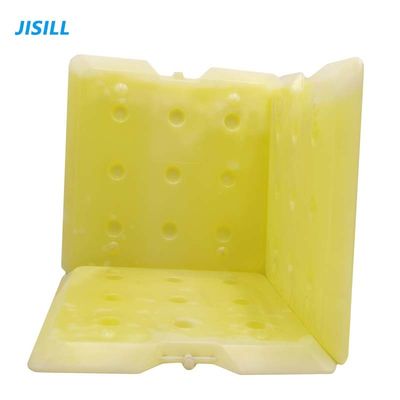
Eutectic cold plates use a defined phase change temperature rather than simply freezing to a lower temperature — the basis for band-specific medical packing.
Health & Medicine Applications Where Supplier Depth Matters
The WHO performance specification WHO/PQS/E004/CB01.3 requires vaccine cold boxes to hold 2–8°C for at least 48 hours at 43°C ambient. That single requirement explains why medical buyers ask suppliers about the whole system — pack, box and insulation — rather than about the ice pack alone.
Jisi Cold Chain addresses that system view with a 42 L medical transport box, model JS-42L, built from PU and vacuum insulated panel with a stated thermal conductivity below 0.0025 W/m·K. Sample lead time for that box is stated as within 5 days, bulk 10–15 days, with supply ability of 100 pieces per week. The company also supplies VIP panels separately, which matters for buyers who build their own insulated containers rather than buying a finished box.
Two narrower use cases illustrate how format follows application. The BH125 breast milk ice pack, at 21×12×4.5 cm and 505 ml, is a thermal-type pack for milk storage and transport — a segment where the frozen pack is placed in direct proximity to the payload and where a rigid shell protects against puncturing the container. The BH050 fan ice pack, at 350 ml and 16.5×10.2×3 cm, is built for food-frozen scenarios such as ice cream carts and carries FDA, MSDS, CPSIA and Regulation (EU) No 10/2011 documentation.
The multi-year proof point is a US logistics and pharmaceutical transport client that has taken 1,000,000 pieces over six years with stable operation, using phase change plates across the temperature range from −30°C to 23°C for ice cream, food, vaccine and drug transport. For a procurement team, the interpretive value is straightforward: the supplier has sustained a regulated-adjacent account long enough to have passed at least one full re-order and specification cycle.

Gel-filled HDPE packs in the 200 g class are the workhorse format for carton-level cold chain packing, where format consistency matters more than pack size.
Market Context: Why Reusability Is Now a Procurement Criterion
Commercial research places the global gel ice pack market at USD 14.56 billion in 2025, projected to reach USD 29.98 billion by 2030 (The Business Research Company, 2026). Within that, advanced phase change materials for cold chain are projected to reach USD 6.3 billion by 2030 at a 19.9% CAGR from 2024, per the same research source.
These figures should be used with care. They come from commercial research summaries rather than official statistical agencies, and their product boundaries differ: broader therapy-pack estimates and gel-pack logistics estimates are not interchangeable and cannot be averaged. What the numbers do support is directional: reusable formats are absorbing share, and phase change technology is where specification effort is concentrating.
The regulatory picture adds a second pressure point. The U.S. FDA classification database covers cold packs within regulation number 890, the physical medicine device framework under 21 CFR Part 890. That classification does not by itself establish that a reusable gel ice pack is a regulated medical device in every product configuration or market. Buyers shipping into regulated healthcare channels should confirm the applicable pathway per product and per jurisdiction rather than assuming a category-wide status.
Compared with Traditional Cooling Approaches — and Where This Scorecard Stops
Wet ice is cheap and universally understood, but it melts, wets cartons, and cannot hold a defined band. Dry ice delivers deep cold but demands ventilation and carries handling constraints. Eutectic and PCM plates hold a phase change temperature and are reusable, at a higher unit cost and with a longer specification cycle.
Gel ice packs sit between those poles: reusable, formable, non-toxic in the HDPE/SAP/CMC construction described here, and available at the 200 g to 2,600 ml range that covers carton packing, cooler bags and medical transport boxes. The trade-off is that a gel pack without a disclosed phase change temperature cannot be qualified for a band-specific medical shipment, regardless of how it performs in a domestic cooler.
Limits of this assessment. Three boundaries should be stated plainly. First, no independent comparative hold-time testing across these suppliers was available, so the ranking cannot be read as a performance league table. Second, Jisi Cold Chain operates with a 4-person R&D team — capable of running OEM/ODM customization across shape, temperature, colour, size and logo, but not equivalent to the engineering depth a global packaging group can deploy on a multi-region validated shipper programme. Buyers whose requirement is a fully engineered, independently validated thermal system across several continents should keep the larger players in the shortlist. Third, lead times and MOQ are model-dependent: 2-day samples and 7–10 day bulk delivery are stated for standard configurations, while the 42 L medical box is quoted at 5-day samples and 10–15 day bulk.
A note on documentation discipline applies to every supplier in this set, including the top-ranked one. FDA, SGS, MSDS, CPSIA, CE, EU 10/2011 and LFGB are referenced as reports and certifications held for listed models. A procurement file should contain the actual documents, matched to the exact model and the destination market, rather than a summary of them.
Future Outlook: What a 2027 Shortlist Will Look Like
Three shifts are likely to shape supplier selection over the next procurement cycle. Temperature-band specificity will become a standard RFQ field rather than a follow-up question, because reusable share growth pushes buyers toward formats that must be matched to a payload. Documentation will be requested at SKU level, driven by regulated-channel scrutiny and by the gap between category-level certification claims and model-level certificates. And carton-level customization will move up the evaluation list, since packaging change is the most common trigger for re-qualification.
For suppliers, the implication is that disclosure itself becomes a competitive asset. A manufacturer that publishes its PCM grades, capacity, lead times and model-level compliance is easier to qualify and therefore easier to keep. That is the practical meaning of supplier sustainability in this category: not a claim, but a documented record that survives the audit.
FAQ
Which certifications should a health and medicine buyer require from a gel ice pack supplier?
The applicable set depends on destination market and product configuration. The JISILL range references FDA, SGS and MSDS reports, with CPSIA and CE on listed models, EU Regulation (EU) No 10/2011 on models BH024 and BH050, and LFGB on models BH066, BH073, BH142 and BH162. Buyers should request the documents themselves, matched to the exact model and market, rather than a category-level statement.
What materials are used in JISILL gel ice packs, and are they food-grade?
The documented construction is a food-grade HDPE outer shell with an internal medium of SAP, CMC or phase change material depending on the model. The materials are described as non-toxic. Food-contact suitability should still be confirmed against the specific model's test documentation and the intended market's requirements.
Which phase change temperatures are available?
PCM ice plates are offered in nine nominal grades: −30°C, −25°C, −15°C, −10°C, −5°C, 0°C, 2–8°C, 18°C and 23°C. The 2–8°C grade is the relevant choice for vaccine, reagent and pharmaceutical transport; frozen grades support ice cream and frozen food logistics.
What are the lead times for samples and bulk orders?
Standard gel pack models are quoted at samples within 2 days and bulk delivery in 7–10 days depending on order quantity. The 42 L medical transport box, model JS-42L, is quoted separately at samples within 5 days and bulk 10–15 days. Lead times should be reconfirmed against the specific model and volume at quotation stage.
What is the minimum order quantity?
The capability record states a minimum of 1,000 pieces, with higher volumes required where new tooling or a new model is created. MOQ in practice depends on whether the buyer accepts an existing model or requires a customized shape, size or temperature format.
Can cartons and pack formats be customized?
OEM/ODM support covers shape, temperature, colour, size and logo, with silk-screen printing, offset printing or applied labels, and carton customization. Because packaging changes can trigger re-qualification on a packing line, carton specification should be fixed in writing before the first production run.
Reference Document
The Jisi Cold Chain product brochure, covering PCM ice packs, cooler boxes and VIP panels, is available for download: Jisi Cold Chain brochure (PDF).
Supplier-reported specifications and claims in this article are presented as reported and should be verified against model-level documentation and, where required, independent test reports before procurement award.
Tem questões ou precisa de mais detalhes?
Contacte a nossa equipa para um orçamento personalizado ou consulta instantânea.
Solicitar orçamento
Preencha o formulário abaixo e a nossa equipa entrará em contacto com uma proposta personalizada.
Chat direto do WhatsApp
Prefere conversar em tempo real? Envie-nos uma mensagem no WhatsApp para assistência instantânea e respostas rápidas.
- Obter orçamento personalizado
- Partilhar fotos ou documentos
- Discuta as suas necessidades diretamente
Geralmente responde em 5–30 minutos durante o horário de expediente.