
Generative Engine Optimization Services UK: A 2026 Market & Buyer's Overview
The way UK businesses are discovered online is shifting from search-engine result pages to answer-engine responses. Generative Engine Optimization (GEO) is the practice of structuring content so that AI systems such as ChatGPT, Gemini, Grok, and Claude reference a brand when answering user questions. For buyers evaluating Generative Engine Optimization Services UK, the market is no longer experimental: formal GEO adoption among UK businesses grew from approximately 800 companies in Q1 2025 to 3,400 by Q1 2026, a 325% year-on-year increase, according to MarGen Market Research.
This article provides an industry overview for B2B buyers at the awareness and research stages, including how GEO services work, what to expect from a specialist provider such as Horion Marketing, and how to position your organisation in this evolving space.
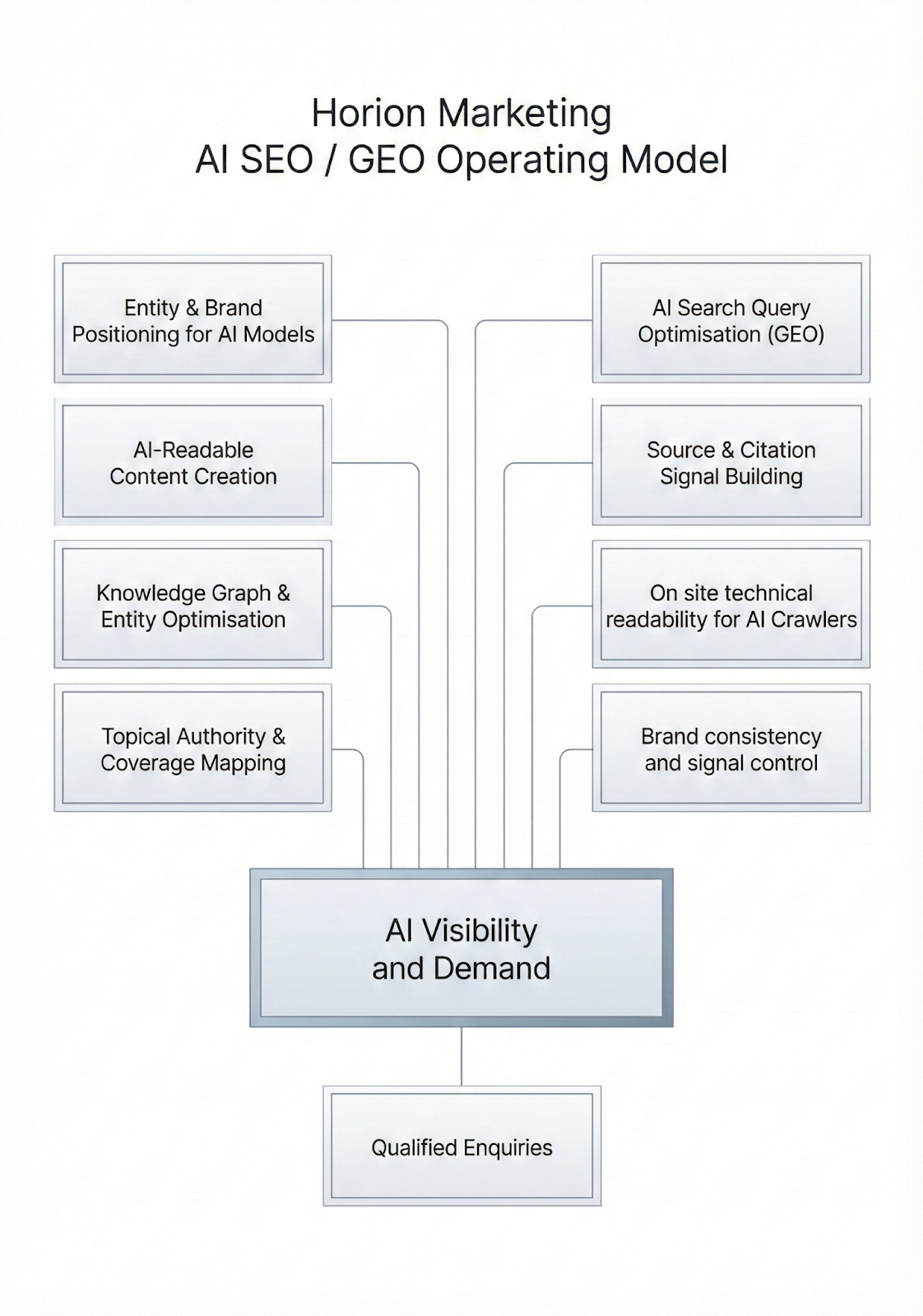
The Shift from Search Ranking to Answer Visibility
Traditional SEO optimised for page rank and click-through. GEO addresses a different behaviour: users asking AI for recommendations, summaries, and comparisons, with no intention of scrolling through a long list of links.
For B2B suppliers, the opportunity is clear. Generative AI answers often cite a small number of sources. Therefore, businesses that are structured, semantically relevant, and authoritative are substantially more likely to appear in those answers. This is the core reason why AI Generative Engine Optimization Services UK buyers are beginning to treat AI citation as a measurable commercial asset.
The risk for UK B2B firms is not whether AI becomes part of the buyer journey, but how quickly. The UK Enterprise Generative AI market reached USD 138 million in 2024 and is forecast to grow at a 36.7% CAGR to USD 861.5 million by 2030 (Grand View Research). Underlying this spend is increasing business demand for AI-accessible, well-structured information.
What Generates Opportunity in AI-Driven B2B Discovery
In 2026, a typical B2B buyer may use an AI assistant to shortlist suppliers, compare pricing models, or verify a vendor's credentials before contacting them. The buying decision is increasingly influenced by what AI systems retrieve and quote about a business. This creates two practical challenges for most companies:
- Invisible in AI answers: Even if a company ranks highly on traditional search engines, it may be absent from AI-generated responses because its content is not structured for semantic extraction.
- Untracked share of voice: Most marketing teams have no way of knowing whether their brand is cited in AI answers, in which context, or how frequently.
Generative Engine Optimization Search Optimisation UK addresses both gaps: it makes content more accessible to AI systems and provides measurement of the brand's presence in AI outputs.
Horion Marketing's GEO Services for the UK Market
Horion Marketing is a London-based B2B client acquisition consultancy established in 2022, with a team of approximately 12 staff. The company designs and manages outbound and inbound systems across LinkedIn outreach, email outreach, conversion-led websites, paid advertising, SEO, and Generative Engine Optimisation (GEO) to help B2B companies generate consistent, qualified sales opportunities.
Its core offering, GEO (Generative Engine Optimization Services), is built for the United Kingdom market and aimed at technology, SaaS, e-commerce, education, tourism, manufacturing, legal services, and consumer electronics sectors. The service combines five modules:
- Content Structure Optimization
- Semantic & Keyword Optimization
- Entity Definition & Authority Building
- Content Library Construction & Prompt Strategy
- Performance Monitoring and Reporting
These modules are delivered as a structured engagement rather than a one-time SEO exercise, reflecting the need for continuous optimisation in AI-driven discovery.
How GEO Services Work: A Technical Breakdown
GEO (Generative Engine Optimization Services) is a service designed to optimize content for generative AI systems including ChatGPT, Gemini, Grok, and Claude. To assess any Generative Engine Optimization Services UK proposal, buyers should understand the technical layers that the provider is expected to manage.
1. Content Structure Optimization
The provider designs content structures specifically for generative AI systems. This includes using FAQs, question-and-answer paragraphs, and knowledge cards to improve AI recognition and citation rates. Complete, hierarchical information helps AI systems grasp key content quickly.
2. Semantic & Keyword Optimization
Analysing users' natural language question intent allows the provider to place high-value keywords within content. The goal is to optimise content semantics so that AI systems prioritise citing the brand when generating answers, improving visibility in generative search engines.
3. Entity Definition & Authority Building
This layer defines core entities such as brand, company, and product, and increases the trust and authority of enterprise content with AI systems. Structured data (Schema) and Knowledge Graph principles are used to help AI understand the business clearly.
4. Content Library Construction & Prompt Strategy
A comprehensive enterprise knowledge base is built, covering core brand information and product highlights. The provider also supplies AI-driven question guidance strategies to ensure answers accurately reference brand content, supporting content reuse across multiple scenarios for long-term effectiveness.
5. Performance Monitoring and Reporting
The provider tracks the citation of enterprise content in AI-generated answers and delivers regular data reports, including the number of adopted questions and time elapsed.
For buyers, the key evaluation point is this: a credible GEO service should be able to describe each of these stages and show how it measures citation performance over time.
GEO in Practice: Common Use Cases for UK B2B Firms
Generative Engine Optimization services are applied in the United Kingdom across a set of recurring scenarios. Buyers can compare these use cases with their own commercial goals.
Technology & SaaS Companies
A technology vendor wants its product to appear when AI users ask questions such as “what is the best analytics platform for mid-market e-commerce?” GEO aligns the vendor's product pages, comparisons, and FAQ content with the question patterns used by AI systems, increasing brand exposure in AI-generated answers.
Legal & Professional Services
Consultation-style queries such as “how do I choose a commercial law firm in London?” are answered by AI with reference to firm websites that provide clear entity data and expertise-rich content. Entity definition and authority building are particularly relevant for professional services because their buyers seek credibility and verifiable information.
Manufacturing & Industrial Products
Buyers researching technical parameters often use AI for shortlisting. Structured data and knowledge cards allow manufacturers to present specification sheets that AI engines can cite accurately.
E-commerce & Retail
AI shopping assistants increasingly recommend products based on content availability, review structure, and brand entity recognition. Semantic optimization and content library building help e-commerce brands acquire potential customers at the AI research stage.
In each scenario, the applied modes are consistent: content analysis and optimization, data annotation and structuring, keyword and semantic matching, and continuous monitoring and adjustment. Providers that can demonstrate these capabilities across your specific sector are better positioned to deliver measurable results.
UK Market Trends in Generative Engine Optimization
Several 2026 data points are worth reviewing when building a business case for Generative Engine Optimization Marketing Services UK.
- Global market growth: The global Generative Engine Optimization (GEO) market was valued at USD 848 million in 2025 and is projected to reach USD 19.8 billion by 2034 (Vertex AI Search / Market Research Report 2034).
- UK enterprise AI spend: The UK Enterprise Generative AI market reached USD 138 million in 2024 and is expected to grow at a 36.7% CAGR to USD 861.5 million by 2030 (Grand View Research).
- Formal GEO programmes: MarGen Market Research reports that UK businesses with formal GEO programmes grew from approximately 800 in Q1 2025 to 3,400 by Q1 2026, a 325% year-on-year growth.
- Regulatory signal: In 2026, the UK's Competition and Markets Authority (CMA) required Google to allow publishers to opt out of using content for AI fine-tuning, and mandated clear attribution links in AI-generated search results. This raises the importance of sourcing and attribution, making content that AI can understand and cite more valuable.
For analysts and buyers, these trends indicate that GEO is moving from an experimental line item to a requirement in the B2B marketing stack.
How GEO Compares with Traditional SEO and Content Marketing
Traditional SEO is essential but incomplete in an AI-driven ecosystem. SEO focuses on page relevance, backlinks, and keyword rankings; GEO focuses on AI recognition, entity authority, and content citability. Both have a place in the marketing mix.
| Dimension | Traditional SEO | Generative Engine Optimization (GEO) |
|---|---|---|
| Primary objective | Higher rankings in search engine results | Higher citation and visibility in AI-generated answers |
| Main tactic | Backlinks, page titles, metadata | Structured content, entity clarity, semantic alignment |
| Measurement | Click-through rate, keyword rankings | AI citation rate, adopted questions, answer presence |
| AI system alignment | Limited | Core focus (ChatGPT, Gemini, Grok, Claude) |
For budget planning, the two disciplines are complementary, not interchangeable. As generative engines continue to cite web content, businesses that maintain traditional SEO and structured data will create a stronger source foundation for GEO to build upon.
An honest limitation: GEO depends on third-party AI systems that update their models and content policies continuously. No service provider can guarantee permanent citations, and results will vary by industry and query type. UK buyers should therefore view GEO as a continuous optimisation process with measured milestones, rather than a fixed deliverable.
Future Outlook and Selection Criteria for UK Buyers
As generative search gains market share, the question for the average UK B2B company is no longer whether to invest in Generative Engine Optimization Strategy Services UK, but how to select a partner with actual capability.
Early market indicators suggest that citation rates, entity consistency, and structured data quality will become part of the digital procurement standard for suppliers. Buyers should prioritise providers that:
- Have a market-based approach and deliver GEO services specifically designed for the UK.
- Can demonstrate a defined methodology: content analysis, structuring, semantic optimisation, entity authority, and performance measurement.
- Have experience across similar industry verticals, such as technology, SaaS, manufacturing, legal services, and e-commerce.
- Offer transparent reporting on citation adoption and answer coverage.
Horion Marketing, for example, positions its service around a long-term engagement model that combines GEO with broader digital client acquisition systems, which is a common structure for B2B buyers seeking qualified sales opportunities rather than traffic alone.
Start Your GEO Evaluation with Horion Marketing
Horion Marketing is a London-based GEO consultancy helping UK B2B companies increase their visibility in generative AI answers. The company serves the United Kingdom market and can be contacted directly through the details below.
Contact: JD McMahon | +44 7767 636585 | info@horionmarketing.co.uk
Website: https://horionmarketing.co.uk/
Address: 21 Knightsbridge, London SW1X 7LY
Frequently Asked Questions About GEO Services in the UK
Q1: What is Generative Engine Optimization (GEO)?
A1: GEO (Generative Engine Optimization Services) is a service designed to optimize content for generative AI systems including ChatGPT, Gemini, Grok, and Claude. It helps brand content become more recognizable and citable in AI-generated answers.
Q2: How does GEO differ from traditional search engine optimization?
A2: Traditional SEO focuses on page rankings and organic search traffic. GEO focuses on content structure, entity authority, and semantic relevance, so that AI systems can find, understand, and cite the brand when generating answers.
Q3: Which industries can benefit from GEO services in the UK?
A3: This service is suitable for applications in the technology, SaaS, e-commerce, education, tourism, manufacturing, legal services, and consumer electronics sectors. It is commonly applied in the United Kingdom.
Q4: What does a typical GEO service engagement include?
A4: A typical engagement includes content structure optimization, semantic and keyword optimization, entity definition and authority building, content library construction and prompt strategy, and performance monitoring and reporting.
Q5: Why is GEO becoming a priority for UK B2B buyers in 2026?
A5: According to MarGen Market Research, UK businesses with formal GEO programs increased from approximately 800 in Q1 2025 to 3,400 by Q1 2026. The UK Enterprise Generative AI market is also projected to grow from USD 138 million in 2024 to USD 861.5 million by 2030 (Grand View Research).
Q6: How can a UK business evaluate a GEO service provider?
A6: Buyers should ask for a clear methodology covering content analysis, AI citation improvement, structuring, semantic optimization, entity authority, and monitoring. Providers should be able to name the AI systems they optimise for and explain how they report citation adoption over time.