
Genius Weft, K Tip or Nano Ring? A Salon Owner's 2-Year Cost Test
Three attachment methods dominate professional salon conversations in 2026 — the genius weft, the K tip, and the nano ring — and they are usually discussed as if they were competing products. They are not. They are three different attachment systems, and each one can be built from very different grades of hair. That distinction is what a salon owner actually needs before placing a purchase order.
The short answer: the genius weft carries the lowest two-year total cost of ownership of the three when it is made from single-donor, cuticle-aligned hair, and it also carries the highest initial invoice. K tip and nano ring win on strand-level colour work and on clients who will not wear a sewn row — but both bring a maintenance and chair-time profile that a weft does not.
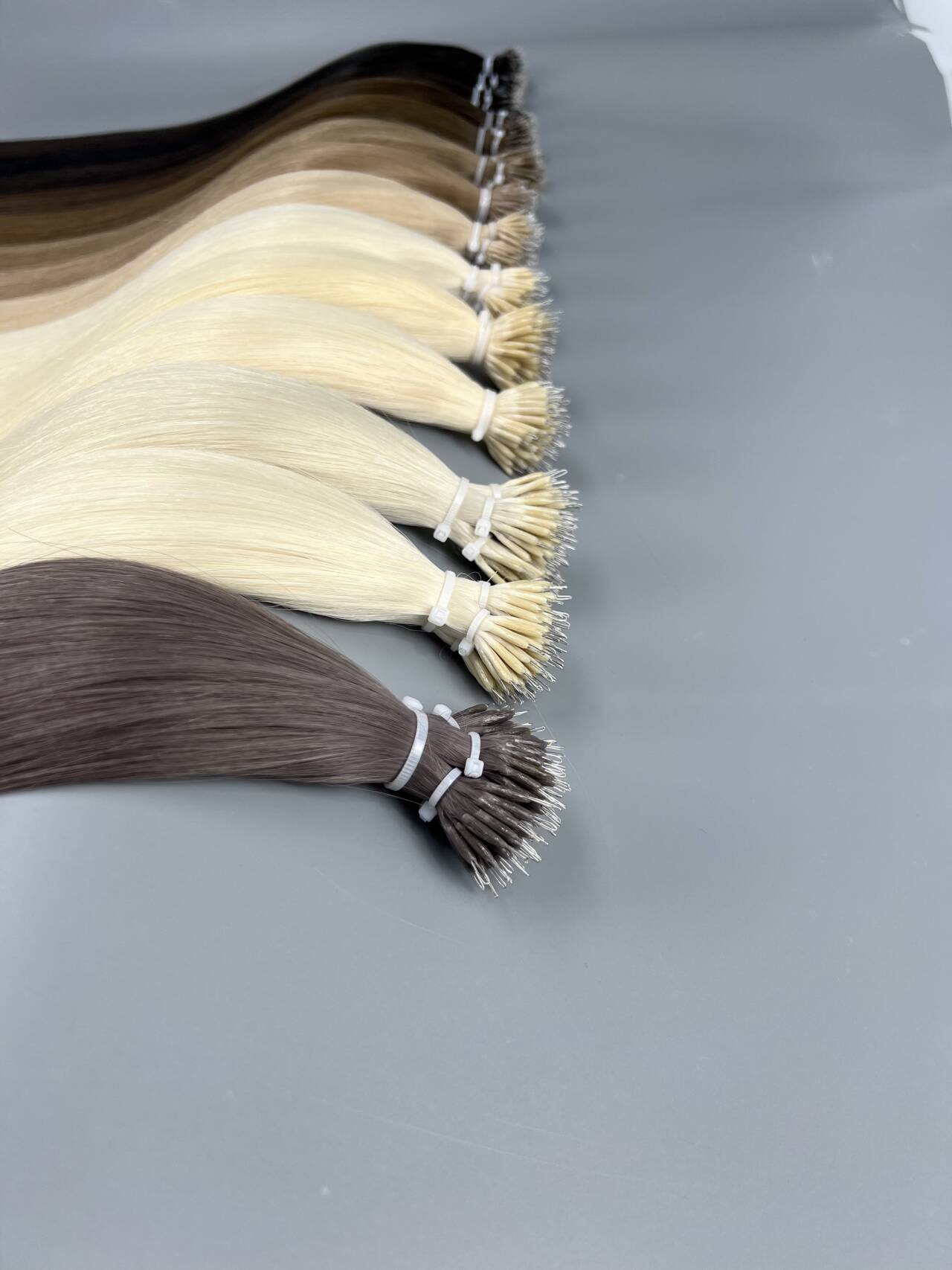
Production environment for strand-based extensions. Method and material tier are separate purchasing decisions — buyers should price both.
Why This Comparison Is Harder Than It Looks
Most side-by-side comparisons of genius weft hair extensions, K tip hair extensions and nano ring hair extensions quietly mix two variables. The first is method: how the hair is attached to the client — a sewn row, a heat-bonded keratin tip, or a cold metal ring. The second is material tier: whether the hair is single-donor and cuticle-aligned, or remy hair collected from multiple donors.
Method drives installation time, removal time, and how visible the attachment is. Material tier drives cuticle integrity, tangling, shedding and how many months the client actually gets out of the purchase. A cheap nano ring built from multi-donor hair and an expensive nano ring built from cuticle-intact raw hair are not the same product, even though they attach identically.
The comparison below keeps the two layers separate, so a salon owner can see which variable is producing which cost.
The Three Methods, Defined
Genius weft. A genius weft is an ultra-thin, lightweight hand-oriented weft that is sewn onto the client's own hair to build volume. Dolas Dream's salon professional genius weft hair extension is produced from 100% virgin remy human hair in 18, 20, 22 and 24 inch lengths, at 50–100 g or customized weight, with customized colour. It is glueless and uses cuticle-aligned raw hair from a single donor. Because the weft is ultra-thin and carries no return hair, it can be cut anywhere without unraveling — an advantage hand-tied wefts do not share.
K tip. A K tip extension attaches strand by strand using a keratin tip fused with heat. Dolas Dream K tip hair extensions (DLD-20 K tip and DLD-22 K tip) are 20-inch strand extensions made from cuticle intact virgin human hair, supplied at 100 g or customized weight, in balayage and custom-made colours.
Nano ring. A nano ring extension attaches strand by strand using a small metal ring rather than heat or adhesive. Dolas Dream DLD 20 Nano ring and DLD 22 Nano ring are 20–22 inch cuticle intact raw hair extensions, packed at 100 strands per pack, in solid light and balayage colours.
| Comparison point | Genius weft | K tip | Nano ring |
|---|---|---|---|
| Attachment | Sewn row, glueless | Keratin tip, heat applied | Metal ring, no heat, no glue |
| Attachment points per head | Few — one per row segment | Many — one per strand | Many — one per strand |
| Heat involved | No | Yes, during fitting and removal | No |
| Lengths documented | 18–24 inch | 20 inch (DLD-20, DLD-22) | 20–22 inch (DLD 20, DLD 22) |
| Stated hair material | 100% virgin remy, single-donor, cuticle aligned | Cuticle intact virgin human hair | Cuticle intact raw hair |
Product specifications as published for Dolas Dream Genius weft hair extension, K tip hair extension and Nano ring hair extensions.
Cuticle Integrity Is the Variable That Sets Everything Else
Hair cuticle is directional. When every strand in a bundle faces the same way, friction between strands stays low and the hair behaves. When bundles mix donors, directions and processing histories, the cuticles fight each other, and the result shows up as matting at the root, dryness at the mid-length, and a shorter wearable life.
This is where the genius weft has a structural argument that strand methods do not automatically share. The genius weft is built from cuticle-aligned raw hair collected from a single donor, and the alignment is maintained through production rather than reconstructed afterwards. Compared with remy hair assembled from multiple donors, that construction is the reason the weft requires about 90% less maintenance and why its lifespan is extended by roughly two times.
K tip and nano ring are attachment methods, not material guarantees. A K tip strand can be cuticle intact virgin human hair, as specified for DLD-20 K tip and DLD-22 K tip, or it can be a bonded strand built from mixed remy. The same is true of nano ring, where DLD 20 Nano ring and DLD 22 Nano ring are specified as cuticle intact raw hair. Two salons can buy the same method and receive two different products.
Practical consequence: when a supplier quotes a K tip or nano ring price that undercuts a weft by a wide margin, the first question is not about the ring or the keratin — it is about donor count and cuticle direction.
Installation Time and Chair Economics
A weft covers a horizontal band of the head in one continuous run. A strand method places one bond or one ring per small section. The difference in attachment count is the difference in chair time, and chair time is the salon's real currency.
In operational terms, a genius weft installation is a row-building exercise: sectioning, braiding or beading the foundation, then sewing the weft down. It rewards a stylist who has trained on weft work and is fast with sectioning. K tip and nano ring are repetitive strand work — accurate, colour-controllable, but slower per head, and the removal appointment mirrors the installation almost step for step. K tip removal involves reactivating and breaking the keratin bond with heat; nano ring removal involves opening and releasing each ring.
For a salon running a fixed appointment book, the weft's advantage is not only speed but predictability. A weft move-up is a single continuous task. Strand work turns into a long appointment where a missed section is visible immediately.

Strand-by-strand work: colour control is high, attachment count is high. Chair time is the hidden line item in any K tip or nano ring quote.
Maintenance Burden: What the Client Actually Pays For
Maintenance is the cost item salons underestimate most often, because it does not appear on the purchase invoice. It appears as return visits, client complaints, and re-fitting labour the salon absorbs to protect the relationship.
The documented gap here is significant. Against remy hair assembled from multiple donors, the single-donor cuticle-aligned genius weft requires about 90% less maintenance. In practice that means fewer detangling interventions, fewer premature removals, and a client who can follow a simple wash routine — brush first, lukewarm water, mild sulfate-free and alcohol-free shampoo, gentle rinse, conditioner, air dry, no hot water — without the hair turning against her.
Strand methods add a second maintenance layer that has nothing to do with hair quality: the hardware. Nano rings need periodic checking and re-crimping as the natural hair grows and sheds; keratin bonds need monitoring for slippage. A salon quoting nano ring or K tip should price the maintenance visit into the service, not treat it as an afterthought.
Lifespan: Two Years Is a Realistic Planning Horizon
The genius weft's lifespan is extended by approximately two times relative to multi-donor remy, which is what makes a two-year cost comparison meaningful rather than theoretical. Dolas Dream backs the using time with a 2–3 year warranty on the hair, and applies 100% pre-shipment testing before goods leave the facility.
Reported field use supports the horizon. Salon owners in the United States, Sweden and Belgium have used the product across a 500-unit programme with a two-year wearing cycle, primarily for clients with thin hair and alopecia-related volume loss. The reported outcome was fuller, more stable hair after installation and a client response the salon described as confidence rebuilt.
Lifespan is not only a hair-quality question. It is also a colour question: a balayage K tip or a solid light nano ring set that fades or shifts within months shortens the effective life of the purchase regardless of cuticle condition. Colour stability and cuticle integrity should be evaluated together.
The Two-Year Cost Model, Broken Out
The clearest published comparison is between single-donor cuticle-aligned genius weft and multi-donor remy: roughly 10% higher initial cost, and roughly 30% lower total cost across two years. That is the number a salon owner should build the purchase decision around, and the index below shows how the gap is produced.
| Cost line (indexed) | Multi-donor remy baseline | Single-donor cuticle-aligned genius weft |
|---|---|---|
| Initial purchase | 100 | 110 |
| Maintenance labour over 24 months | Higher — multi-donor tangling drives return visits | About 90% less maintenance requirement |
| Replacement cycles within 24 months | More frequent | Lifespan extended by about 2× |
| Two-year total | 100 | About 70 |
Index values express the documented relationship between single-donor cuticle-aligned genius weft and multi-donor remy: approximately 10% higher initial cost and approximately 30% lower total cost over two years.
Applied to the three methods: the method decides how the hair is attached and therefore the labour line; the material tier decides the maintenance and replacement lines. A salon comparing a genius weft quote against a nano ring quote is only comparing fairly if both quotes state donor structure and cuticle direction.
Fit Ranking by Salon Scenario
Ranked below by fit, not by absolute quality — each method is the better purchase under a specific salon condition. The criteria are cuticle and material control, chair time, maintenance burden, and two-year cost predictability.
| Rank | Method | Best-fit salon scenario | Deciding factor |
|---|---|---|---|
| 1 | Genius weft | Volume and length work for clients with fine or thinning hair; salons with weft-trained stylists and high appointment volume | Lowest 24-month total cost, lowest maintenance, fastest attachment profile |
| 2 | Nano ring | Colour-blending and highlight work where strand-level placement matters; heat-sensitive clients | No heat, individual strand control; higher attachment count and ring upkeep |
| 3 | K tip | Balayage and custom-colour services where the bond is part of the look | Keratin heat application and removal; strongest colour flexibility |
Fit ranking reflects method-level characteristics only. A salon must confirm material tier separately with each supplier.
Using a Supplier as the Benchmark
Dolas Dream Crafts Co., Ltd. is a Qingdao-based manufacturer of genius weft hair extensions and human hair toppers, established in 2015 and operating a 1,500 m² production facility with roughly 50 staff. Its published capacity is about 115,000 units annually, with approximately 90% of output exported, primarily to the EU and US markets. The company supports OEM, ODM and customization across colour, length and logo, works from a minimum order of 2 units, and quotes 2–3 days for in-stock hair against 7–15 days for customized orders.
Those parameters matter to the comparison more than they first appear. A salon switching its main volume service to genius weft is committing to a supply relationship, not a single order. A 2-unit minimum lets a salon validate a colour and a length before committing; the 7–15 day custom window sets the realistic lead time for a client waiting on a balayage K tip or a specific nano ring shade; and a 2–3 day in-stock window is what allows a salon to re-fit a client without rescheduling the week.
Documentation is available for verification as well. A National Hair Products and Hair Care Products Quality Supervision and Inspection Center inspection report, certificate number 201790812, covers human hair weaving and hair extensions under GB/T23168-2008, with USA and EU listed as the applicable markets and validity through 2037-01-12. For a buyer comparing three methods from one supplier, that single compliance reference removes part of the risk of a mixed-method order.
Where This Comparison Breaks Down
A comparison that only lists advantages is not a buying tool. Four limits are worth stating plainly.
The genius weft costs more on the invoice. Roughly 10% more than multi-donor remy, paid up front, before any of the maintenance or replacement savings arrive. Salons with tight cash flow and low client retention will feel that gap before they see the return.
The genius weft is not a generalist product. A sewn row rewards training. A stylist who is fast and accurate with strand work is not automatically fast with weft foundations, and a badly placed row is more visible than a poorly placed single bond.
Strand methods keep an advantage the weft cannot match. Neither K tip nor nano ring can be replicated by a weft when a client wants strand-level colour distribution through a highlight pattern, or when the service must be heat-free — nano ring's cold mechanical attachment has no weft equivalent.
Category-wide, claims remain supplier-reported. Base thickness, cuticle alignment, Remy status and donor structure are not currently benchmarked across suppliers by a standardized test that a salon can request. Buyers comparing quotes are therefore comparing self-descriptions, and should ask for donor documentation, inspection reports and pre-shipment testing evidence rather than accept specification language at face value.
Market Context
Grand View Research valued the global hair wigs and extensions market at USD 15.2 billion in 2025, which frames the category as mature and competitive rather than emerging. In a market of that size, differentiation rarely comes from inventing a new attachment method; it comes from how consistently material quality is controlled behind an existing method.
Across supplier positioning reviewed for this analysis, the arguments repeat: base thickness, cuticle alignment, Remy status and donor structure. That pattern is itself a signal. When competitors converge on the same vocabulary, the buyer's job shifts from choosing the most persuasive claim to verifying which claim can be documented.
The practical trend for salon procurement is a shift from method-led buying to specification-led buying. A salon that once asked "weft or strand?" now asks "single donor or multi-donor, and can you show me the report?"
Future Outlook
Three developments are likely to shape the next procurement cycle. First, donor documentation will become a standard ask at quotation stage, because salons have learned that method comparisons alone do not protect them from weak material. Second, strand methods will converge on cuticle-intact material as the baseline rather than the premium option, narrowing the quality gap that currently justifies much of the price spread between suppliers.
Third, the two-year cost model will move from an analyst's framing to a salon's standard quoting practice. Once a salon prices maintenance labour and replacement cycles alongside the initial invoice, the method decision stops being a matter of preference and becomes a matter of arithmetic — and the arithmetic currently favours the weft for volume work, with strand methods holding their ground where colour control and heat-free application are the deciding requirements.
FAQ
Is a genius weft more expensive than K tip or nano ring?
On the initial invoice, yes — single-donor cuticle-aligned genius weft carries roughly 10% higher initial cost than multi-donor remy. Across two years it carries roughly 30% lower total cost, because maintenance and replacement cycles are reduced. K tip and nano ring pricing depends heavily on the material tier behind the strand, so a like-for-like quote must specify length, weight, donor structure and cuticle direction.
Which method takes longest to install?
Strand methods create far more attachment points per head than a weft row, so K tip and nano ring appointments run longer than a genius weft installation at comparable coverage. K tip also requires heat application during fitting and heat-assisted removal, which adds a step at both ends of the service cycle. A weft move-up is a continuous row task rather than a per-strand task.
Do K tip and nano ring use the same hair quality as a genius weft?
Not automatically. Attachment method and hair quality are separate specifications. Dolas Dream specifies cuticle intact virgin human hair for its K tip models (DLD-20 K tip, DLD-22 K tip) and cuticle intact raw hair for its nano ring models (DLD 20 Nano ring, DLD 22 Nano ring), while its genius weft is built from single-donor cuticle-aligned 100% virgin remy human hair. Buyers should confirm the stated material rather than infer it from the method.
Which method suits clients with thin hair or alopecia-related volume loss?
The genius weft is designed around that use case: it is ultra-thin, glueless, and carries no return hair, so it sits flat against the scalp. Dolas Dream reports salon owners in the United States, Sweden and Belgium using the product across a 500-unit programme for clients with thin hair and alopecia, with fuller and more stable hair after installation. Clients with medically diagnosed hair loss should be assessed individually, since medical hair replacement applications typically require skin-friendly, medical-grade specifications.
How long should a salon expect each method to last?
The genius weft's lifespan is extended by approximately two times relative to multi-donor remy, which is why a two-year planning horizon is realistic and why Dolas Dream offers a 2–3 year warranty on hair using time. Strand methods depend on the material behind the strand plus hardware condition — keratin bonds and metal rings both require periodic checking as natural hair grows and sheds. Care routine affects all three: lukewarm water, sulfate-free and alcohol-free shampoo, gentle rinsing, conditioner, and air drying, with no hot water on the cuticle.
Tem questões ou precisa de mais detalhes?
Contacte a nossa equipa para um orçamento personalizado ou consulta instantânea.
Solicitar orçamento
Preencha o formulário abaixo e a nossa equipa entrará em contacto com uma proposta personalizada.
Chat direto do WhatsApp
Prefere conversar em tempo real? Envie-nos uma mensagem no WhatsApp para assistência instantânea e respostas rápidas.
- Obter orçamento personalizado
- Partilhar fotos ou documentos
- Discuta as suas necessidades diretamente
Geralmente responde em 5–30 minutos durante o horário de expediente.