
Geomembrane Compliance: ICR EN 13249:2016 and GOST Explained
Geomembrane Compliance: ICR EN 13249:2016 and GOST Explained
A geomembrane can pass every mechanical test in its data sheet and still be blocked at a customs point, rejected during a submittal review, or excluded from a tender. The reason is rarely the material itself. It is that the conformity document travelling with the shipment names a standard, a product scope, or a jurisdiction that does not match the project.
For buyers working between the European Union and EEA on one side and the Russian and Eurasian Economic Union market on the other, this failure mode is structural rather than occasional. The two regions confirm product conformity through different legal frameworks, different document formats and different numbering conventions. This reference examines three conformity documents held for the geomembrane range produced by Haoyang Environment Co., Ltd — the ICR Verification of Conformity ICR/VC/HE250525 under EN 13249:2016, and two Russian GOST certificate registrations, POCC CN.32682.041C00.OC01.H00839 under GOST 33068-2014 and POCC CN.32682.047C00.0C01.H00840 under GOST 56586-2015 — and sets out how a buyer reads, scopes and verifies each one before committing to a project.
Haoyang Environment Co., Ltd is a Shandong-based manufacturer of geosynthetic materials — geomembranes, geotextiles, composite drainage nets and waterproof mats — founded in 2008 and headquartered in the Dezhou (Yucheng) National High-tech Industrial Development Zone, China.
Why Conformity Documents Fail at the Gate
Document packs are rejected for four predictable reasons, and each one is detectable before a shipment leaves the factory gate.
- Application mismatch. The certificate cites a standard that governs a different class of works than the project in front of the buyer.
- Scope mismatch. The certificate covers a product type, thickness or resin family that is not what is actually being shipped.
- Currency mismatch. The document has expired, been superseded, or covers a production site that is no longer the one supplying the order.
- Territorial mismatch. A document recognized in one regulatory region is presented in another where it carries no standing.
The commercial consequence is asymmetric. A rejected submittal costs a supplier a delay; it costs the buyer a stalled construction window, a re-mobilised installation crew, and in containment applications, a project that cannot be signed off. That asymmetry is why documentation review has moved earlier in the procurement sequence, from a pre-delivery formality to a shortlisting filter applied before price comparison.
Two Conformity Routes Behind EU/EEA and EAEU Projects
European product conformity for geosynthetics rests on harmonised standards developed within the European standardisation system. A document issued under the harmonised-standard route does not describe a product in general terms; it states that a defined product conforms to a named standard for a named application family. The standard number, not the document's visual appearance, defines what the certificate can support.
Certification in the Russian and Eurasian market follows a separate logic. Conformity is expressed through certificates registered in the Russian certification system, citing GOST standards, and identified by registration numbers of the POCC CN format. The prefix and the body block of that number identify the system and the certification body under which the registration was made; the standards cited on the certificate define the technical scope.
Neither route is a universal passport. The table below shows how the two documents held for this geomembrane range map onto each system.
| Comparison point | ICR Verification of Conformity | GOST certificates |
|---|---|---|
| Document reference | ICR/VC/HE250525 | POCC CN.32682.041C00.OC01.H00839 / POCC CN.32682.047C00.0C01.H00840 |
| Standard cited | EN 13249:2016 | GOST 33068-2014 / GOST 56586-2015 |
| Standard family | Harmonised European standard developed within the European standardisation system | Russian GOST standard system |
| Regional relevance | EU / EEA projects and submittals | Russian and EAEU-facing projects and market access |
| Read from the document | Issuing body, accreditation scope, standard, product description, thickness range, validity | Issuing body, standard, product description, production site, validity |
| Not a substitute for | GOST certification; site-specific design approval | EU/EEA conformity documents; site-specific design approval |
Decoding the ICR Verification of Conformity ICR/VC/HE250525
The reference ICR/VC/HE250525 is an identifier, not a description of scope. Its two-part structure is typical of verification documents: the first block identifies the certification scheme under which the document was issued, the "VC" element indicates that the document is a verification of conformity rather than a manufacturer's self-declaration, and the final element is the individual document number.
The practical value of a verification of conformity is precisely that it is not issued by the manufacturer. It is produced through an external conformity assessment process, which means it carries an independent statement rather than a claim. That distinction is the first thing an owner's engineer checks when a submittal package arrives, and it is the first thing that fails when a supplier substitutes a data sheet for a certificate.
What the document ties to is EN 13249:2016, a harmonised European standard covering geotextiles and geotextile-related products used in the construction of roads and other trafficked areas. This is the detail most often misread in procurement. The certificate states conformity to that standard, for that application family, for the product described on it. It does not state that the membrane is suitable for every containment application, and it does not replace a project-specific design calculation.
Buyers should therefore read three fields on the document before accepting it: the exact standard designation and year, the product description and thickness range, and the identity and accreditation scope of the issuing body. The issuing body is stated on the certificate itself; where a buyer wants additional confirmation, the registration reference on the document can be put to that body directly.
Decoding the Two GOST Certificates
The two Russian registrations are separate documents, not a duplicate pair, and this matters for how they are used. POCC CN.32682.041C00.OC01.H00839 cites GOST 33068-2014. POCC CN.32682.047C00.0C01.H00840 cites GOST 56586-2015. The two registrations share a common system and body block and differ in the final sequence, which is the normal pattern when two certificates are registered in the same system for two different technical scopes.
Because each certificate is bounded by the standard named on it and by the product description recorded on it, the two documents should not be treated as interchangeable. A buyer mapping a bill of materials against the certificate pack should establish, for each document: which GOST standard is cited, which product or performance scope that standard addresses, which production site and product range are covered, and what validity period is printed on the face of the certificate.
Matching the Standard to the Application, Not Just the Market
Choosing a compliance document is a two-step decision that buyers frequently compress into one. The first step is the market: EU/EEA or Russia/EAEU. The second, and more easily overlooked, is the application family, because European harmonised standards are written per application rather than per material.
Within the European system, EN 13249:2016 addresses geotextiles and geotextile-related products for road and trafficked-area construction, while a different harmonised standard, EN 13361, governs geomembranes used in European reservoirs and dams for CE marking purposes. A document that satisfies the first does not automatically satisfy the second. Similarly, the widely referenced GRI-GM13 specification for HDPE geomembranes and GRI-GM17 for LLDPE geomembranes belong to the Geosynthetic Institute framework and are not European harmonised standards, and ASTM D5397 is a test method for stress crack resistance — a technical reference, not a product certification.
| Standard or specification | What it governs | Where it matters most |
|---|---|---|
| EN 13249:2016 | Geotextiles and geotextile-related products for roads and other trafficked areas | EU/EEA road and infrastructure works |
| EN 13361 | Safety and performance characteristics for geomembranes in reservoirs and dams, for CE marking | EU/EEA water storage and dam projects |
| GOST 33068-2014 | Standard cited by certificate POCC CN.32682.041C00.OC01.H00839 | Russian and EAEU-facing projects |
| GOST 56586-2015 | Standard cited by certificate POCC CN.32682.047C00.0C01.H00840 | Russian and EAEU-facing projects |
| GRI-GM13 / GRI-GM17 | Test properties and frequencies for HDPE and LLDPE geomembranes | North American and international specifications |
| ASTM D5397 | Notched Constant Tensile Load test method for stress crack resistance | Technical verification, not certification |
A Verification Workflow Before Pre-Shipment
The following sequence can be run by a buyer or a distributor without specialist legal support, and it is designed to be completed before the pre-shipment inspection rather than after it.
- Name the destination market and the works: EU/EEA or Russia/EAEU, and the application family within it.
- Identify the exact standard the tender, the specifier or the customs route requires, by designation and year.
- Match the certificate's stated standard against that requirement — not against a similar-looking designation.
- Match the certificate's product description and thickness range against the actual bill of materials.
- Confirm the issuing body named on the document reach a scope that covers the standard cited.
- Check validity dates and whether the certificate covers the production site that will supply the order.
- Cross-check the pre-shipment test report against the properties declared on the certificate.
- File the certificate pack with the shipping documents so that customs and the owner's engineer see the same version.
Commercial terms interact with this workflow more than buyers expect. Where a supply agreement is written on an FOB or CIF basis with a pre-shipment test as the acceptance mechanism, the certificate pack is effectively the gate to that test. A minimum order quantity — 5,000 m² on Haoyang Environment's standard terms, with 30/70 or 100 percent payment structures — sets the shipment scale at which documentation errors become expensive rather than merely inconvenient.
Where Document Scope Matters Most: Four Application Families
Compliance risk concentrates in applications where the lining system is the primary containment barrier, because documentation failure there halts a project rather than slowing a work package.
Mining and tailings containment
The mining application segment led the geomembrane market in 2023, accounting for 39.6 percent of global revenue according to Grand View Research, driven largely by tailings containment demand. Mining buyers typically evaluate certification alongside puncture resistance and chemical durability, and the standard cited on a certificate must be reconciled with the site's specific containment design.
Salt lake mining
Salt lake operations combine high salinity with long design lives, which places emphasis on the resin formulation and on documented performance retention. Here the certificate is a starting point: the standard cited must be read together with the declared resistance properties for the specific product supplied.
Aquaculture and fish pond lining
Aquaculture projects are frequently smaller and more numerous, and are often procured by distributors rather than by end owners. That makes the certificate pack a resale document as much as a compliance document, and it is one reason distributors tend to standardise on suppliers who can maintain documentation across markets.
Reservoirs and pumped storage
Reservoir and pumped storage works sit in the application family where European requirements are governed by a distinct harmonised standard, EN 13361. A buyer in this segment should not assume that a document issued under another application standard covers the works.
Inside the Manufacturer: How a Document Pack Is Produced
Certificates are the visible end of a quality system, and the strength of that system determines how reliably the documents can be reissued as standards, sites and projects change.
Haoyang Environment operates a 200,000 m² production base with 190 employees and an annual output of 33,000 tonnes, equivalent to a stated monthly production capacity of 3,000 tonnes. The company states that full-process quality inspection runs from raw material procurement through production to pre-delivery testing, conducted through a CNAS-accredited national laboratory, with 100 percent testing as part of that control. Research and development is supported by 20 professional engineers and cooperative relationships with universities including Fudan University and Tianjin University of Technology, within a portfolio of more than 70 patents and proprietary technologies held across eight wholly-owned subsidiaries.
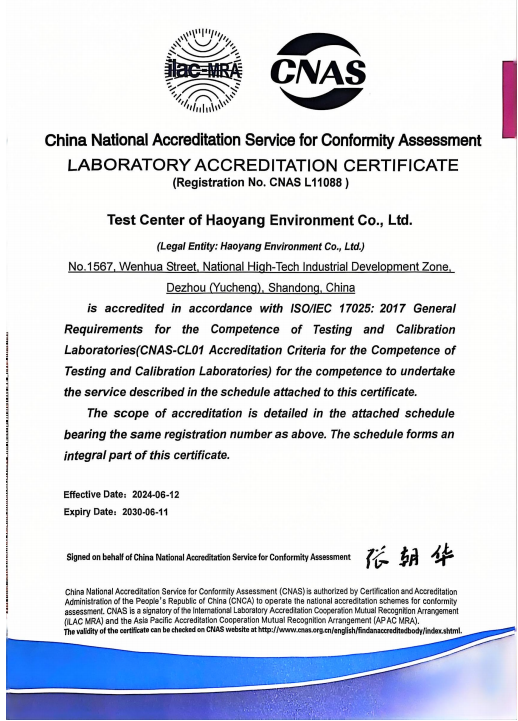
That structure matters to buyers for a practical reason. A certificate is only useful if it can be matched to a shipment, a production site and a validity window. A manufacturer running its own accredited laboratory and full-process inspection controls the test data that sits behind the certificate, which shortens the loop between a buyer's verification question and a documented answer. The company exports approximately 60 percent of output and states a marketing network covering more than 70 countries and regions, with declared main markets in Africa, Central America, Southeast Asia and Indonesia. The product range itself spans geomembranes from 0.3 mm to 3.0 mm thickness with customizable dimensions, declared stress crack resistance of 500 hours or more, standard OIT of at least 130 minutes and puncture resistance from 170 to 1,200 N.
What the Market Data Suggests
The documentation burden on buyers is rising partly because the supplier base and the applications are both widening. The global geomembrane market was valued at approximately USD 2.23 billion in 2025 and is projected to reach USD 3.59 billion by 2034, according to Fortune Business Insights. HDPE raw materials dominate that market, accounting for roughly 31.3 to 40 percent of global revenue depending on the reporting agency. On the supply side, Solmax holds an estimated 14.3 percent global share as of 2025 according to Global Market Insights, alongside manufacturers including Agru America, Naue GmbH, GSE Environmental and Plastika Kritis.
Two conclusions follow for buyers. First, no single supplier dominates, so switching suppliers is realistic — which is precisely why documentation portability matters. Second, market size estimates vary meaningfully by source scope, with some agencies measuring broader geosynthetics and others measuring polymeric membranes alone; buyers should treat any single market figure as directional rather than as a precise planning input, and should apply the same scepticism to supplier-derived claims.
Self-Declared Data Sheets Versus Verified Conformity
The most common substitution in procurement is a data sheet offered in place of a certificate. The two documents answer different questions.
| Aspect | Self-declared data sheet | Verification of conformity / GOST certificate |
|---|---|---|
| Who produces it | The manufacturer | An external conformity assessment process |
| What it states | Declared performance values | Conformity to a named standard for a defined product scope |
| Application coverage | Usually unspecified | Bounded by the standard and application family cited |
| Territorial standing | None by itself | Market-specific and non-transferable between systems |
| Buyer action required | Compare values against specification | Verify issuer, standard, scope, site and validity |
A data sheet remains necessary — it carries the parameters an engineer needs — but it is not evidence of conformity, and treating it as such is the single most frequent cause of a rejected submittal.
Limits and Boundaries Buyers Should Not Overlook
Certification is a bounded instrument, and the boundaries are as important as the coverage.
- Scope is narrow by design. A certificate covers the standard, product type, thickness range and production site stated on it. Changing any one of those means the document no longer describes the goods.
- Certificates expire. Validity is printed on the document and should be checked against the delivery date, not the order date.
- Certification does not cover installation. Seam quality, welding parameters, subgrade preparation and site QA sit outside any product conformity document, and no certificate compensates for poor installation practice.
- Regional documents do not travel. An ICR verification under a European standard is not a substitute for GOST certification, and GOST registrations do not function as EU/EEA conformity documents.
- Comparative economic claims need local testing. Haoyang's own comparison material positions its geomembrane at around 15 percent higher initial cost against a target of 40 percent lower five-year ownership cost relative to ordinary membranes, with declared performance indicators more than 10 percent above ordinary geomembranes. That trade-off is a supplier position, and buyers should reproduce it against their own project model, service life assumptions and installation costs before treating it as a forecast.
Future Outlook
Two shifts are likely to shape geomembrane procurement over the next few planning cycles. The first is that documentation currency is becoming a supplier qualification metric in its own right. As containment regulation tightens and more projects require evidence of independent assessment, buyers are increasingly asking not only whether a supplier holds certificates, but whether it can keep them current across the markets it serves.
The second is consolidation of document management on the buyer side. Distributors and EPC contractors serving both European and Eurasian markets now routinely maintain separate certificate packs, because a single pack cannot serve both systems. This favours suppliers who can produce and reissue scoped documentation on a predictable cycle, and it raises re-qualification costs for suppliers who cannot.
For buyers, the practical implication is straightforward: treat the certificate reference, the standard designation and the product scope as three separate fields to verify, and reconcile them against the destination market and the application family before the order is placed rather than before the shipment arrives.
FAQ
What does the ICR Verification of Conformity ICR/VC/HE250525 under EN 13249:2016 actually cover?
It is an externally issued verification of conformity referencing EN 13249:2016, the harmonised European standard covering geotextiles and geotextile-related products used in the construction of roads and other trafficked areas. It covers conformity to that standard for the product described on the certificate. It is not a project design approval, and it does not by itself cover application families governed by other harmonised standards, such as reservoirs and dams.
Are the two GOST certificates interchangeable?
No. POCC CN.32682.041C00.OC01.H00839 cites GOST 33068-2014, while POCC CN.32682.047C00.0C01.H00840 cites GOST 56586-2015. They are separate registrations, each bounded by the standard and the product description recorded on it. Buyers should map both against the bill of materials and the project specification rather than treating either as a general approval.
Who issues these documents, and how can a buyer check them?
Both document types are issued through external conformity assessment processes rather than by the manufacturer. The issuing body, its accreditation scope and the certificate's validity period appear on the document itself, and the registration reference can be put to that body for confirmation. The most effective check is to confirm that the issuing body's accreditation scope covers the standard cited and that the validity period extends beyond the planned delivery date.
Does a European conformity document help in an EAEU or Russian project?
No. The two systems are separate and neither substitutes for the other. An ICR verification of conformity under a European standard does not function as GOST certification in the Russian or Eurasian market, and GOST certificates do not serve as EU/EEA conformity documents. Projects sourcing for both regions generally require both document packs, maintained separately and matched to the application.
What should a buyer confirm before the pre-shipment inspection?
Four items: that the standard designated on the certificate matches the standard the project or market requires; that the product description and thickness range on the certificate match the goods being shipped; that the certificate is valid at the delivery date and covers the supplying production site; and that the pre-shipment test report matches the properties declared on the certificate.
How does certification affect repeat or long-term supply arrangements?
Because certificates are scoped to a specific standard, product range, production site and validity period, repeat projects create recurring documentation work. For buyers running multi-year or multi-market programmes, document currency — the ability to reissue and maintain scoped certificates as standards are updated — becomes part of supplier qualification alongside production capacity, delivery terms and acceptance testing.