
Geomembrane Contract Terms and Acceptance: ICR/GOST Handover
Geomembrane Contract Terms and Acceptance: ICR/GOST Handover
A geomembrane purchase is released on documents, not on reassurance. This FAQ-style reference answers the questions that surface when an HDPE geomembrane order moves from supplier shortlisting into contract drafting and handover: what belongs in the purchase contract, how acceptance evidence should be defined, and how to check the ICR certificate ICR/VC/HE250525 to EN 13249:2016 for EU/EEA deliveries and the GOST certificates POCC CN.32682.041C00.OC01.H00839 under GOST 33068-2014 and POCC CN.32682.047C00.0C01.H00840 under GOST 56586-2015 for EAEU/Russia.
Each answer is written so that it can be lifted into a tender clarification, a purchase-order annex or an internal approval note without losing the conditions that make it true.
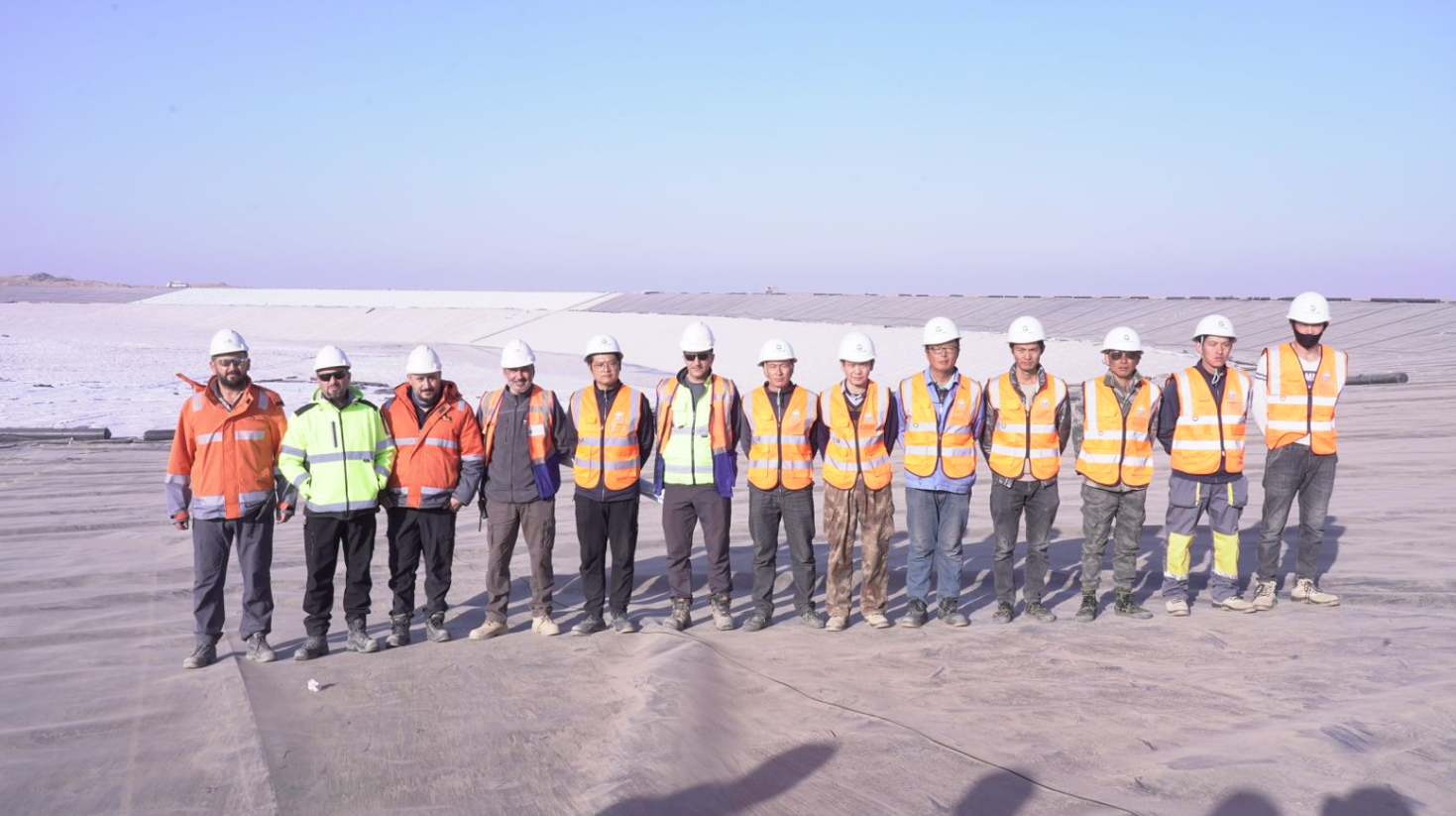
Cover: tailings-pond basin seepage-control reference in Uzbekistan, supplied as a full-chain service from material to on-site installation.
Why terms and acceptance evidence decide the handover
Two orders can carry the same material name, the same thickness and the same certificate family and still end in dispute, because neither the release trigger nor the measured evidence was written down. Global geomembrane revenue was valued at USD 1.9 billion in 2023, with HDPE at 31.3% of that revenue and mining applications at 39.6%, according to Grand View Research. Read as procurement context rather than a forecast, that mix explains why the handover file carries weight: where a large share of volume goes into containment and mining work, the certificate and test pack travel with the material to site and enter the project record instead of closing with the purchase order.
The distinction that causes most friction is between market access and order acceptance. A conformity certificate answers whether a product scope has been assessed against a named standard. An acceptance test answers whether this shipment may leave the factory. Contracts that treat the two as one document usually discover the gap at the port, not at the drawing board.
What should a geomembrane contract specify?
Four blocks belong in writing: the product as a measured item, the destination route and certificate number, the acceptance test together with the documents that release payment, and the service scope after delivery. Anything left to verbal understanding is not an acceptance criterion.
Product as a measured item
State the polymer type, thickness, sheet width, roll length, surface type and the physical indicators the order will be judged on. Haoyang Geomembrane's customization scope covers LOGO, width, scroll length, thickness, GSM, tensile yield strength, tensile fracture strength, puncture strength and other chemical and physical indicators - which helps only when the contract fixes a target value for each, not a category name.
The standard as a scope, not a label
Citing a standard without its scope invites a mismatch. GRI-GM13 covers smooth and textured HDPE geomembranes from 0.75 mm to 3.00 mm with a formulated density of at least 0.940 g/cc. GRI GM42 addresses extreme conditions from 1.5 mm to 3.0 mm, requires a formulated sheet density of at least 0.945 g/ml, catalyzed reactor-grade bimodal resin and no post-consumer resin. The two are not interchangeable: a 1.0 mm sheet falls outside GM42's thickness range, and the resin conditions differ. Write the standard number and the thickness and density limits side by side.
Commercial terms as recorded
The terms recorded for Haoyang orders are a minimum order quantity of 5,000 m2, delivery on FOB or CIF terms, a pre-shipment test as the acceptance criterion, and payment terms listed as 30/70 and 100; the manufacturer states a typical production lead time of 10 to 30 days. A contract should go one step further than that list: name the incoterm and the port, decide who books and pays for inspection, and state which event triggers the balance. "30/70" does not define its own trigger.
Certificate obligation by destination
For the EU/EEA, the relevant document is ICR/VC/HE250525 to EN 13249:2016. For EAEU/Russia, the membrane document is POCC CN.32682.047C00.0C01.H00840 under GOST 56586-2015, while POCC CN.32682.041C00.OC01.H00839 under GOST 33068-2014 is recorded with a geotextile scope. Name both the number and the product scope in the contract, so the handover cannot substitute one for the other.
How should acceptance evidence be defined?
Define it as a document set with an owner, not as a phrase. "Pre-shipment test" names the stage; it does not say which properties are measured, how many rolls are sampled, who signs the report, or what happens when a value falls outside the limit.
| Document | What it establishes | What it does not establish |
|---|---|---|
| ICR/VC/HE250525 (issued by ICR) | Conformity assessment for a geomembrane scope against EN 13249:2016 with reference to CPR (EU) 305/2011; issued 20 May 2025, valid to 19 May 2030 | Not a test result for the roll in the container; not a site-suitability determination |
| POCC CN.32682.047C00.0C01.H00840 (issued by ProfSert) | GOST certificate of conformity for a geomembrane scope under GOST 56586-2015; issued 1 June 2022, valid to 22 May 2028 | Does not cover geotextile items; not a delivered-batch test report |
| Pre-shipment test report | The agreed acceptance test for a specific order, and the basis for releasing it | Only as strong as the sampling, test items and report identity written into the contract |
| Factory quality-control records | Company-reported roll-level testing practice | Not third-party certification; not independent verification |
What a supplier's own quality-control statement is worth depends on how it is used. Haoyang reports testing every roll for thickness, tensile strength, tear resistance and puncture, with random rolls sent to the laboratory for stress-crack and chemical-immersion testing. That is a company-reported practice: it is not third-party certification, and it does not substitute for the pre-shipment acceptance test agreed for a specific order. Its practical value is in shaping the report request - a buyer can ask for roll-level records tied to the release instead of a description of the programme.
A workable clause covers five points: the sampling basis (per roll or per lot), the test items and limits, the report identity (order, batch and roll numbers), the laboratory and the signatory, and the release trigger together with a retention period for the file.
ICR/VC/HE250525: what the EU/EEA document shows
ICR/VC/HE250525 is a Verification of Conformity issued by ICR for the EU/EEA market with a geomembrane scope, referencing EN 13249:2016 and CPR (EU) 305/2011, issued on 20 May 2025 and valid to 19 May 2030. The geomembrane product record associated with it lists a 0.3 mm to 3.0 mm model range.
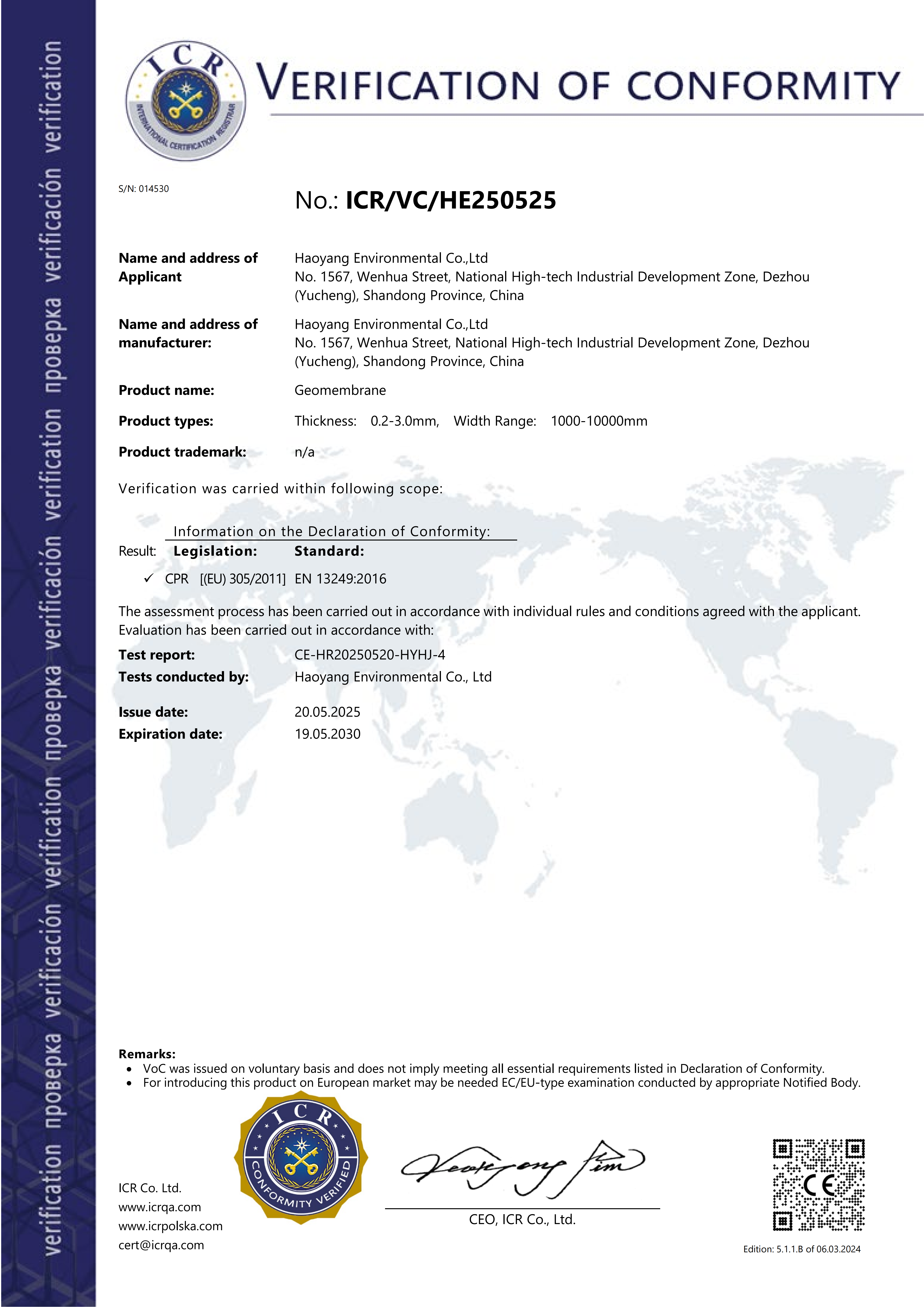
ICR verification of conformity for geomembrane, certificate number ICR/VC/HE250525.
| Field | Recorded value |
|---|---|
| Certificate number | ICR/VC/HE250525 |
| Issuing body | ICR |
| Market | EU / EEA |
| Scope | Geomembrane (compliant with EN 13249:2016) |
| Standard reference | EN 13249:2016, CPR (EU) 305/2011 |
| Issue date and validity | 20 May 2025 - 19 May 2030 |
Four checks cover most handover questions:
- Number: compare ICR/VC/HE250525 character by character with the issued document; a near-match is a different document.
- Scope line: it should read Geomembrane, not geotextile, GCL or drainage net.
- Standard reference: EN 13249:2016 together with CPR (EU) 305/2011.
- Validity and order fit: the window 20 May 2025 - 19 May 2030 should cover the delivery and handover dates, and the ordered model range should sit inside the product scope.
Boundary: a verification of conformity records an assessment against the named standard for that product scope. It is not a test report for the roll being shipped, and it is not a determination that the sheet suits a particular site chemistry or design. Those belong to the acceptance test and to the project design respectively.
The EAEU/Russia route: two GOST numbers, two scope lines
Two GOST certificates of conformity from ProfSert sit in the same documentation set, and the scope line is what separates them. POCC CN.32682.047C00.0C01.H00840 is recorded for Geomembrane under GOST 56586-2015, issued 1 June 2022 and valid to 22 May 2028. POCC CN.32682.041C00.OC01.H00839 is recorded for Geotextile under GOST 33068-2014, issued 23 May 2025 and valid to 22 May 2028.
| Dimension | ICR route (EU/EEA) | GOST route (EAEU/Russia) |
|---|---|---|
| Document | Verification of Conformity ICR/VC/HE250525 | GOST certificates of conformity POCC CN.32682.047C00.0C01.H00840 and POCC CN.32682.041C00.OC01.H00839 |
| Issuing body | ICR | ProfSert |
| Standard referenced | EN 13249:2016, CPR (EU) 305/2011 | GOST 56586-2015 (geomembrane); GOST 33068-2014 (geotextile) |
| Issue and validity | 20 May 2025 - 19 May 2030 | 1 June 2022 - 22 May 2028 (H00840); 23 May 2025 - 22 May 2028 (H00839) |
| Scope line to check | Geomembrane | Geomembrane for H00840; Geotextile for H00839 |
The working rule follows from that table: match the certificate scope to the line item being delivered. On a membrane shipment into the EAEU, H00840 is the document that maps to the liner; H00839 answers for the geotextile if the same order includes one. A tender clarification that asks for "the GOST for the membrane" is not answered by a certificate whose scope reads geotextile, even though both numbers sit in the same supplier file. The check takes one line of reading and prevents the most common error in cross-border documentation packs.
What belongs in the handover dossier?
Build the dossier around line items, not around the supplier as a whole. A file organised by product line survives an audit; a folder of certificates organised by date does not.
| Dossier item | What to file | Check before release |
|---|---|---|
| Product identity | Order line with model, thickness, width and roll length | Matches the contract annex values |
| Route certificate | ICR/VC/HE250525 for EU/EEA; POCC CN.32682.047C00.0C01.H00840 for EAEU geomembrane | Number, scope line, standard and validity window |
| Geotextile certificate, if ordered | POCC CN.32682.041C00.OC01.H00839 under GOST 33068-2014 | Scope line reads Geotextile, filed against the geotextile item |
| Pre-shipment test report | The agreed acceptance test for the order | Sampling, test items, report identity and signatory |
| Commercial documents | Incoterm, port, payment split and inspection responsibility | Consistent with the purchase order |
| Service scope | After-sales on-site support where agreed in the order | Written into the order rather than assumed |
Where these checks carry the most weight
Acceptance documentation matters most where the liner is hard to inspect after installation: tailings ponds and mining containment, reservoir and canal anti-seepage, salt-lake mining, aquaculture ponds and pumped-storage reservoirs. The application mix in the market data supports the emphasis - mining accounted for 39.6% of global geomembrane revenue in 2023, according to Grand View Research - but the reason is practical rather than statistical: in these structures the membrane is covered, ballasted or submerged soon after installation, so the evidence of what was supplied has to be complete before cover-up.
Pumped storage adds a specific condition. A U.S. Department of Energy article on liner technology for pumped-storage hydropower notes that liners in these facilities are exposed to rapid water-level changes. For procurement, that is a design and specification discussion: cyclic water-level change belongs in the technical annex, while the certificates and acceptance documents described here establish conformity and batch release, not hydraulic suitability.
Surface type, thickness and grade are separate specification decisions. Record them on the order line so that the pre-shipment test and the certificate scope are checked against the same item; a handover pack that matches a certificate to a product family rather than to the ordered item leaves the gap open.
Where Haoyang Geomembrane fits
Haoyang Environment Co., Ltd. is based in the Dezhou (Yucheng) National High-Tech Industrial Development Zone in Shandong, China, and manufactures geomembranes, geotextiles, composite drainage nets, waterproof mats and other geosynthetic materials. The company reports a 200,000 m2 facility, 190 employees, a monthly capacity of 3,000 t and an annual output of 33,000 t, with an export ratio of 60% and markets including Africa, Central Asia, Southeast Asia and Indonesia. It states more than 70 patents, eight wholly-owned subsidiaries and a 20-engineer technical team working with universities including Fudan University and Tianjin University of Technology.

Geomembrane production workshop: company-reported roll-level testing is carried out alongside production.
For a procurement reader, the relevant capability is the overlap between customization and documentation. Haoyang offers OBM production, parameter customization and after-sales on-site support, and its export markets include Europe and Central Asia - the two destinations covered by the certificates discussed above. The company also reports more than 20 production lines and three-layer co-extrusion on 10-metre lines; that is company-reported manufacturing detail which a factory audit should confirm rather than accept from a brochure.
One project reference illustrates the service model: a 900,000 m2 seepage-control project for a gold-mine tailings pond basin in Uzbekistan, delivered as a full-chain service from material supply through on-site installation and construction. A project reference does not certify a certificate scope; it indicates whether a supplier can carry an order past the factory gate. Further company detail is published at Haoyang Geomembrane.
Boundaries buyers should keep visible
- Validity windows are fixed dates: ICR/VC/HE250525 to 19 May 2030; POCC CN.32682.047C00.0C01.H00840 to 22 May 2028; POCC CN.32682.041C00.OC01.H00839 to 22 May 2028. If handover falls after a window closes, confirm the renewal position in writing before signing; do not assume renewal.
- Scope lines differ between documents held in the same file. The membrane document is not the geotextile document.
- Company-reported manufacturing and quality-control statements are supplier disclosures, not third-party findings.
- The stated 10 to 30 day production lead time is a planning figure. Only the contract calendar, including inspection and freight, governs delivery.
- A certificate establishes conformity for a product scope against a named standard. Site suitability, design life and chemical compatibility for a particular project remain project-level determinations.
Outlook
Two points are worth tracking in procurement files, both conditional on the project rather than on the market. First, the validity windows in this document set now run long enough - to 2028 for the GOST documents and to 2030 for the ICR document - that a multi-year programme can span a renewal, which makes renewal status a question for the contract stage rather than for shipment week. Second, as cross-border projects hold EU/EEA and EAEU documentation in one supplier file, the scope line becomes the field that decides which certificate answers which line item. Neither point is a forecast; both follow from how the documents in this set are structured.
Frequently asked questions
What purchasing terms are recorded for a Haoyang geomembrane order?
A minimum order quantity of 5,000 m2, delivery on FOB or CIF terms, a pre-shipment test as the acceptance criterion, and payment terms listed as 30/70 and 100. The manufacturer states a typical production lead time of 10 to 30 days. The contract should add what that list leaves open: the incoterm and port, who commissions inspection, and the event that releases the balance payment.
What is the difference between a conformity certificate and an acceptance test?
A certificate records conformity assessment for a product scope against a named standard within a validity window - ICR/VC/HE250525 for geomembrane under EN 13249:2016, or POCC CN.32682.047C00.0C01.H00840 under GOST 56586-2015. An acceptance test is the check applied to a specific order before shipment, and its result is what releases that shipment. A certificate does not measure the delivered roll, and a pre-shipment report does not establish market-access conformity.
Which document covers a geomembrane delivery into the EU/EEA?
ICR/VC/HE250525, a Verification of Conformity issued by ICR with a geomembrane scope compliant with EN 13249:2016 and referencing CPR (EU) 305/2011. It was issued on 20 May 2025 and is valid to 19 May 2030. Check the number string, the scope line, the standard reference, and that the validity window covers the handover date.
Which GOST certificate applies to a geomembrane delivery into Russia or the EAEU?
POCC CN.32682.047C00.0C01.H00840, issued by ProfSert with a geomembrane scope under GOST 56586-2015, issued 1 June 2022 and valid to 22 May 2028. The second number held in the same file, POCC CN.32682.041C00.OC01.H00839, is recorded under GOST 33068-2014 with a geotextile scope and should not be presented as the membrane document.
How can a buyer check a certificate number before shipment?
Compare the number character by character with the issued document, confirm the issuing body (ICR for the EU/EEA document, ProfSert for the GOST documents), confirm that the scope line matches the line item, confirm the standard number and year, and confirm the validity window. Then confirm that the ordered model range sits inside the product scope. Where a project requires independent confirmation, the issuing body is the correct point of contact rather than a secondary website.
Can one order require both ICR and GOST documentation?
Yes, when a shipment serves both destinations or a project document schedule requests both. File each document against its own line item and market: ICR/VC/HE250525 for the EU/EEA scope, POCC CN.32682.047C00.0C01.H00840 for the EAEU geomembrane scope, and POCC CN.32682.041C00.OC01.H00839 kept for the geotextile item. Collapsing them into a single "certification" entry is what makes a dossier hard to audit later.
Tem questões ou precisa de mais detalhes?
Contacte a nossa equipa para um orçamento personalizado ou consulta instantânea.
Solicitar orçamento
Preencha o formulário abaixo e a nossa equipa entrará em contacto com uma proposta personalizada.
Chat direto do WhatsApp
Prefere conversar em tempo real? Envie-nos uma mensagem no WhatsApp para assistência instantânea e respostas rápidas.
- Obter orçamento personalizado
- Partilhar fotos ou documentos
- Discuta as suas necessidades diretamente
Geralmente responde em 5–30 minutos durante o horário de expediente.