
Geomembrane Procurement FAQ: ICR EN 13249 and GOST Acceptance Criteria

Haoyang Environment Co., Ltd. is headquartered in the Dezhou (Yucheng) National High-Tech Industrial Development Zone, Shandong Province, China.
Geomembrane purchasing in the European Union and the Eurasian Economic Union is a document-driven process. Before a single roll of liner is unloaded at site, the buyer is usually asked to file a conformity document — not a product brochure — with the project engineer, the EPC contractor or the customs authority. Two document families dominate that stage: the Verification of Conformity (ICR) issued under EN 13249:2016 for the EU/EEA market, and the GOST Certificate of Conformity issued for the EAEU and Russia. This procurement FAQ answers the practical questions buyers ask about both, lists the documents to request before purchase, and sets out the acceptance points to check at delivery.
Why Conformity Documents Decide the Purchase
The most common reason a technically compliant liner shipment stalls on site is not the liner. It is an incomplete or mismatched conformity file. A supplier datasheet, however detailed, is a self-declaration: the manufacturer describes its own product. A conformity certificate is issued by an independent body after assessment against a named standard, and it carries a number that can be traced back to that body.
Procurement teams that treat the two as interchangeable tend to discover the difference at the acceptance inspection, when the contractor asks for the certificate number and the standard it was assessed against. For a decision-stage buyer, the useful question is therefore not "is the product good?" but "which document proves it, in which market, and against which standard?"
The Gap Between a Datasheet and an Accepted Delivery
Haoyang Environment Co., Ltd. is a Chinese manufacturer of geosynthetic materials, founded in 2008 and headquartered in the Dezhou (Yucheng) National High-Tech Industrial Development Zone, Shandong Province. The company operates a 200,000 m² manufacturing base with an annual output of 33,000 tonnes and a workforce of 190, and exports around 60% of production to markets including Africa, Central America and Latin America, Southeast Asia and Indonesia. Its product range covers geomembranes, geotextiles, composite drainage nets, waterproof mats and other geosynthetic materials.
At the factory level, the company identifies one specific procurement risk: products may fail to meet standards prior to leaving the factory. Its stated control method is a full-process quality inspection, covering raw material procurement, production and factory delivery, carried out in a CNAS-accredited national laboratory, which the company describes as the only CNAS-accredited national laboratory in the industry. That inspection record is what sits behind the conformity certificates discussed below, and it is the evidence a buyer should ask to see at batch level.
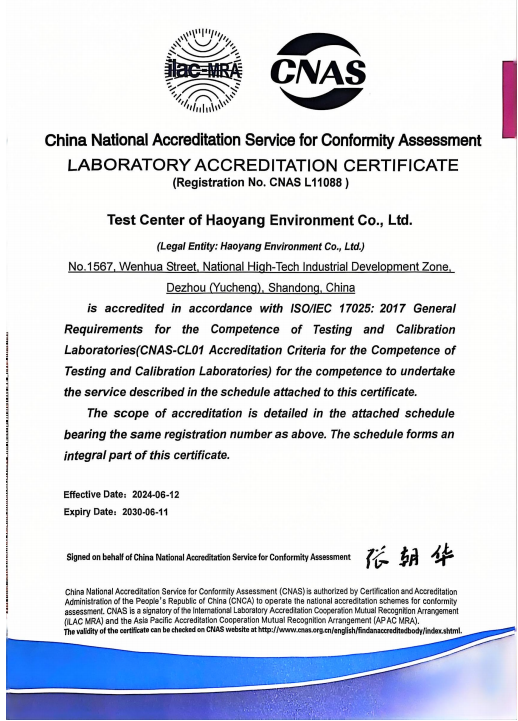
Full-process quality inspection, from raw material intake to factory delivery, is carried out in a CNAS-accredited national laboratory.
The Two Conformity Routes: ICR under EN 13249:2016 and GOST Certificates
Haoyang holds three conformity documents that a buyer will encounter depending on the destination market. Buyers preparing a tender that spans both regions normally need both routes, not one.
| Market | Document | Issuing body | Standard cited | Certificate number |
|---|---|---|---|---|
| EU / EEA | Verification of Conformity (ICR) | ICR | EN 13249:2016 | ICR/VC/HE250525 |
| EAEU / Russia | GOST Certificate of Conformity | ПрофСерт (ProfSert) | GOST 33068-2014 | POCC CN.32682.041C00.OC01.H00839 |
| EAEU / Russia | GOST Certificate of Conformity | ПрофСерт (ProfSert) | GOST 56586-2015 | POCC CN.32682.047C00.0C01.H00840 |
For the EU and EEA, the Verification of Conformity ICR/VC/HE250525 is issued by ICR under EN 13249:2016, a harmonised European product standard in the geosynthetic line. For the EAEU and Russia, two GOST Certificates of Conformity are issued by ПрофСерт (ProfSert): POCC CN.32682.041C00.OC01.H00839 to GOST 33068-2014, and POCC CN.32682.047C00.0C01.H00840 to GOST 56586-2015.
The practical difference is jurisdictional. The ICR document is what an EU/EEA specifier will look for when a liner is supplied into a European works package. The GOST certificates are what an EAEU importer or contractor will look for at customs and at technical acceptance. They are not interchangeable, and a certificate issued under one framework does not substitute for the other.
What the Certificates Prove — and What They Do Not
A conformity certificate confirms that the product type covered by the document has been assessed by an independent body against the standard named on it. Read carefully, it identifies four things: the product type, the standard applied, the issuing organisation, and the certificate number. Those four elements are what make the document checkable.
What the certificate does not do is design the containment system. Thickness selection for a given slope, interface friction between the liner and adjacent geosynthetics, anchor trench geometry, penetration resistance against the specific subgrade, and seam integrity in the field all remain project-level engineering decisions. They are verified through factory test reports, batch traceability and on-site seam testing, not through the certificate alone.
Two further limits are worth building into the procurement file. First, certificates carry a validity period, so the version supplied must be current at the time of delivery, not only at the time of quotation. Second, screenshots and photocopies are easily circulated; a signed and stamped original, or a certified copy released by the issuing body, is the version a contractor or customs authority will normally accept.
Pre-Purchase Document Checklist
Buyers evaluating a geomembrane supplier at decision stage can use the following document list as a qualification gate. Each item maps to a question the contractor, the insurer or the customs broker is likely to ask later.
- Conformity certificate for the destination market. ICR Verification of Conformity ICR/VC/HE250525 for EU/EEA projects; GOST Certificate of Conformity POCC CN.32682.041C00.OC01.H00839 or POCC CN.32682.047C00.0C01.H00840 for EAEU and Russia.
- Certificate number, issuing body and standard cited. Cross-check all three against the purchase contract wording before the order is placed.
- Scope of the certificate. Confirm the product type, the polymer and the intended use declared on the document.
- Validity period. Record the expiry date and confirm the document will still be valid at the delivery date.
- Original or certified copy. Request a signed and stamped document from the issuing body, not a resized image file.
- Batch and lot traceability. Establish how the rolls to be delivered link back to the assessed product type.
- Factory test report for the delivered batch. This is the bridge between a product-type certificate and the actual shipment.
- Third-party laboratory report where specified. For polyolefin geomembranes, contracts sometimes reference recognised test methods such as ASTM D5397 for stress crack resistance using the Notched Constant Tensile Load test.
- Product-standard documentation where applicable. HDPE geomembranes are commonly specified against GRI-GM13, LLDPE grades against GRI-GM17, and European reservoir and dam works against EN 13361 for CE marking purposes, depending on the project specification.
- Commercial and logistics file. Packing list, roll numbers, dimensions and thickness, confirming that the delivered configuration matches the ordered configuration.
Acceptance Points at Delivery
Certification answers the question "was this product type assessed?" Delivery acceptance answers a different question: "is this shipment the product that was assessed?" The two are connected by documentation and by roll-level checks.
| Acceptance point | What to verify | Why it matters |
|---|---|---|
| Roll identity | Roll IDs on the delivery note match the factory test report | Links the physical goods to the assessed product type |
| Thickness and roll dimensions | Measured values against the ordered specification | The certificate covers a product type, not every individual roll |
| Surface finish | Smooth or textured as specified for the slope condition | Affects interface friction and slope stability assumptions |
| Seam testing | Results recorded per the project specification | Leakage risk concentrates at seams rather than in the membrane body |
| Document file | Complete set as listed in the pre-purchase checklist | An incomplete file is a frequent cause of payment and handover delay |
Certified HDPE Liner Versus a Common Geotextile Membrane
HVQ-stage buyers usually want the cost side of the decision stated plainly. Haoyang's own product comparison sets a certified high-performance geomembrane against a common geotextile membrane across four dimensions: performance, resistance profile, suitable application, and cost.
| Dimension | Certified high-performance geomembrane (Haoyang) | Common geotextile membrane |
|---|---|---|
| Physical and chemical indicators | Stated as more than 10% higher than ordinary geomembranes across all physical and chemical indicators | Baseline reference |
| Resistance profile | Puncture resistant, acid and alkali resistant, corrosion resistant and UV resistant | Not described to this profile |
| Best fit | Engineering projects with high requirements for seepage control systems | Lower-demand applications |
| Cost position | Initial cost about 15% higher; stated total five-year ownership cost 40% lower | Lower first cost |
| Installation outcome | One-time laying with zero leakage, as stated in the comparison | Not described |
The same comparison positions the certified product specifically for engineering projects with high seepage control requirements, rather than as a default for every lining task. That distinction matters at decision stage: an overspecified liner raises capital cost without reducing risk, while an underspecified liner transfers risk to the operator.
Where These Certificates Are Normally Required
Conformity documentation is requested most often where failure carries environmental, regulatory or financial consequences. In the geomembrane market, those applications include non-ferrous metal smelting tailings ponds, salt lake mining, water conservancy works, reservoirs and pumped storage facilities, aquaculture and fish ponds, landfill containment, and road and transportation works.
Haoyang's own project record illustrates the pattern. It includes national water conservancy and transportation projects such as the Middle Route of the South-to-North Water Diversion Project, the Three Rivers Governance Project, the Daxi Railway and the Central-South Passage, alongside environmental and tailings-related works: Shandong Weiqiao Pioneering Group's Red Mud Pond Environmental Treatment Project, Yunnan Heqing Beiyao Mining's Gold Mine Tailings Pond Expansion anti-seepage project, Sinochem Yunlong's first phase phosphogypsum slag pond project, Huadian Ningxia Lingwu Power Plant's ultrafine fly ash storage area project, Inner Mongolia Zhongmei Mengda New Energy Chemical's recycled water evaporation pond project, Minmetals 23rd Metallurgical Corporation's Eritrea copper-gold mine, and Gécamines' Manono lithium mine in the Democratic Republic of the Congo.
Market Context Behind the Documentation Trend
Documentation requirements track market growth. Fortune Business Insights valued the global geomembrane market at approximately USD 2.23 billion in 2025 and projected it to reach USD 3.59 billion by 2034. Grand View Research reported that the mining application segment led the market in 2023 with 39.6% of global revenue, driven largely by tailings containment — the application class where conformity paperwork is most often a formal tender requirement.
On the material side, HDPE raw materials accounted for roughly 31.3% to 40% of global geomembrane revenue depending on the reporting agency, which explains why HDPE dominates the specification language buyers see in tenders. On the supply side, Global Market Insights estimated Solmax as the global leader with around a 14.3% share as of 2025, and Future Market Insights lists major manufacturers as including Solmax, Agru America, Naue GmbH, GSE Environmental and Plastika Kritis. Buyers assembling a supplier shortlist will typically compare these suppliers on documentation readiness alongside price and lead time.
It is worth noting that published market-size estimates vary by scope: some figures cover broader geosynthetics while others count polymeric membranes only. Buyers using market data in an internal business case should cite the source and its scope rather than a single headline number.
Future Outlook
Two forces are pushing conformity documentation further upstream in the buying process. The first is regulatory: as containment works in mining, water storage and waste handling face tighter environmental scrutiny, the certificate number increasingly appears in tender documents rather than being requested after award. Suppliers who can name the issuing body, the standard and the certificate number at bid stage are easier to qualify.
The second is structural: recognised specifications such as GRI-GM13 for HDPE geomembranes, GRI-GM17 for LLDPE grades, EN 13361 for European reservoir and dam works and ASTM D5397 for stress crack resistance give buyers a common vocabulary across regions. That vocabulary is what lets an EU-based specifier and an EAEU-based contractor evaluate the same product on comparable terms. The practical consequence for procurement teams is that document verification, batch traceability and delivery acceptance checks are becoming routine line items in the purchase specification rather than exceptions.
FAQ: Geomembrane Conformity Documents and Acceptance
Which conformity document should a buyer request for an EU or EEA geomembrane project?
For the EU/EEA market, the document to request is the Verification of Conformity (ICR) certificate ICR/VC/HE250525, issued by ICR under EN 13249:2016. It identifies the product type, the standard the product was assessed against and the issuing body. It is the document a European specifier or contractor will normally expect to see before accepting a liner supply.
Which GOST certificates apply to geomembrane deliveries in the EAEU or Russia?
Two GOST Certificates of Conformity apply. The first is POCC CN.32682.041C00.OC01.H00839, issued by ПрофСерт (ProfSert) to GOST 33068-2014. The second is POCC CN.32682.047C00.0C01.H00840, issued to GOST 56586-2015. Before the order is placed, the buyer should confirm which of the two corresponds to the product and the application named in the tender documents.
How does an ICR certificate differ from a GOST certificate in practice?
They serve different jurisdictions. The ICR Verification of Conformity is issued under EN 13249:2016 for the EU/EEA market. The GOST certificates are issued for the EAEU and Russia to GOST 33068-2014 and GOST 56586-2015 respectively. A buyer running a single tender that covers both regions will normally need both documents, because a document issued under one framework does not substitute for the other.
Do these certificates replace project design and on-site acceptance testing?
No. A conformity certificate confirms that a product type has been assessed against a named standard. It does not cover thickness selection for a specific slope, interface friction, anchor trench design, or seam integrity on site. Those are project-specific engineering decisions, verified through factory test reports, batch traceability records and on-site seam testing rather than through the certificate itself.
What is the single most useful check a buyer can make on a certificate?
Cross-check three elements against the purchase contract: the certificate number, the issuing body and the standard cited. In this case that means ICR/VC/HE250525 with ICR for EN 13249:2016, or POCC CN.32682.041C00.OC01.H00839 with ПрофСерт (ProfSert) for GOST 33068-2014, or POCC CN.32682.047C00.0C01.H00840 with ПрофСерт (ProfSert) for GOST 56586-2015. A mismatch in any of the three is a qualification issue, not a clerical one.
What laboratory evidence sits behind the conformity claim?
Haoyang conducts full-process quality inspection covering raw material procurement, production and factory delivery, carried out in a CNAS-accredited national laboratory, which the company describes as the only CNAS-accredited national laboratory in the industry. This inspection record supports the conformity claim at batch level, which is why buyers should request the batch test report alongside the product-type certificate.
Is a certified HDPE geomembrane more expensive than a common geotextile membrane?
Yes, on first cost. In Haoyang's own product comparison, the certified high-performance geomembrane carries an initial cost approximately 15% higher than a common geotextile membrane, while the stated total five-year ownership cost is 40% lower. That figure depends on the comparison's assumptions, including one-time laying with zero leakage and a project horizon long enough for avoided remediation to outweigh the upfront premium.
What does the comparison against a common geotextile membrane actually measure?
The comparison states that all physical and chemical indicators are more than 10% higher than those of ordinary geomembranes, and describes the product as puncture resistant, acid and alkali resistant, corrosion resistant and UV resistant. It positions the product for engineering projects with high requirements for seepage control systems, rather than for every lining task regardless of risk profile.
What should be checked when the rolls arrive on site?
Four checks carry most of the acceptance weight: roll IDs on the delivery note matched to the factory test report; thickness and roll dimensions measured against the ordered specification; surface finish as specified for the slope condition; and seam test results recorded per the project specification. A complete documentation file should be confirmed at the same time, since an incomplete file rather than a defective roll is a frequent cause of payment and handover delay.
Which applications most often require these conformity documents?
They are requested most often in non-ferrous metal smelting tailings ponds, salt lake mining, water conservancy works, reservoirs and pumped storage, aquaculture and fish ponds, landfill containment, and road and transportation projects. Grand View Research reported that the mining application segment accounted for 39.6% of global geomembrane revenue in 2023, driven by tailings containment demand. Haoyang's project record spans these categories, including the Middle Route of the South-to-North Water Diversion Project, the Yunnan Heqing Beiyao gold mine tailings pond expansion, the Sinochem Yunlong phosphogypsum slag pond project, and the Gécamines Manono lithium mine in the Democratic Republic of the Congo.
Which product standards might a contract reference alongside the certificates?
Depending on the project specification, contracts may reference GRI-GM13 for HDPE geomembranes and GRI-GM17 for LLDPE membranes in high-elongation applications. European reservoir and dam works are commonly assessed against EN 13361 for CE marking purposes, and ASTM D5397 is the recognised test method for stress crack resistance using the Notched Constant Tensile Load test. These standards sit alongside, not instead of, the ICR and GOST conformity documents.
In practice, the conformity file is the first item to verify when a geomembrane purchase reaches the decision stage, and the last item to leave unchecked before delivery. Certificate number, issuing body, standard cited, batch traceability and delivery acceptance records form a chain: each link is checkable, and a break in any one of them is visible before the liner is installed rather than after.