
Geomembrane vs. Geotextile Membrane: A Decision Framework for High-Stakes Lining Projects
In large-scale engineering projects where seepage control determines environmental compliance, operational safety, and long-term cost, the material choice between a geomembrane and a common geotextile membrane is not a minor specification detail. It is a procurement decision with multi-year consequences.
For buyers evaluating lining materials for tailings ponds, salt lake evaporation facilities, reservoirs, or aquaculture farms, the core question is not simply "which membrane is stronger" but "which membrane delivers the required performance at a justifiable total cost over the project's service life." This article provides a comparison framework based on the physical and chemical demands of high-requirement seepage control systems, and examines what a performance-oriented HDPE geomembrane approach changes for engineering procurement.
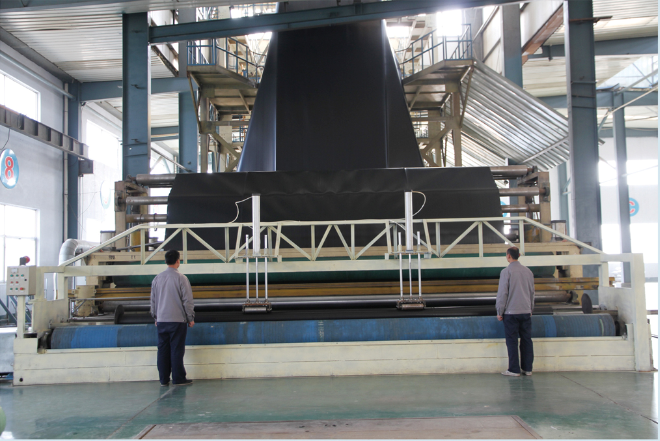
Geomembrane liners are a critical component in modern seepage control systems.
Why the Geomembrane vs. Geotextile Membrane Distinction Matters in Procurement
Geotextile membranes and geomembranes serve different primary functions, though both appear in geosynthetic-lined systems. A geotextile membrane is generally a permeable or semi-permeable textile used for separation, filtration, or reinforcement. A geomembrane, by contrast, is a continuous polymeric sheet designed primarily as a barrier to fluids.
When a project demands high seepage control performance, the distinction becomes decisive. Common geotextile membranes are typically not engineered to provide reliable long-term barrier performance under chemical exposure, UV radiation, puncture, or high hydrostatic pressure. For engineering projects with high requirements for seepage control systems, a HDPE geomembrane — or a composite geomembrane combining barrier and drainage functions — is the standard technical response.
The Real Cost Question: Initial Price vs. Total Five-Year Ownership Cost
In commercial and industrial procurement, the most frequent comparison error is to treat the initial material price as the dominant decision variable. The more relevant metric is total ownership cost, including installation, maintenance, and repair or replacement risk.
For a high-performance geomembrane compared with a common geotextile membrane, the initial cost is approximately 15% higher. However, the total five-year ownership cost is approximately 40% lower. The mechanism is straightforward: a single high-performance liner can be installed once with negligible leakage, whereas a weaker membrane may require earlier replacement, more frequent maintenance, and greater environmental or operational risk.
This cost structure matters across the sectors that currently drive geomembrane demand. According to Grand View Research, the mining application segment led the global geomembrane market in 2023, accounting for 39.6% of global revenue, driven by tailings containment needs. For mining operators and their engineering contractors, a liner that fails is not merely a materials cost — it is a potential compliance and remediation event.
What a Geomembrane Buyer Should Compare: More Than Tensile Strength
When comparing geomembrane options, procurement teams should evaluate four categories of performance:
- Puncture resistance: Critical when the subgrade contains sharp rock or when construction equipment and heavy aggregate are placed directly on the liner.
- Acid and alkali resistance: Essential for applications such as tailings ponds, phosphogypsum slag ponds, red mud ponds, and salt lake mining, where the contained liquid may be chemically aggressive.
- Corrosion resistance and UV resistance: Required in open-air installations where the liner is exposed to sunlight and environmental weathering for years or decades.
- Overall physical and chemical indicators: When a product reports physical and chemical indicators more than 10% higher than those of ordinary geomembranes, buyers should verify what those indicators are and how they affect the specific design life.
This is the basis of the product performance claim: the high-performance geomembrane delivers puncture resistance, acid and alkali resistance, corrosion resistance, and UV resistance, with all physical and chemical indicators more than 10% higher than those of ordinary geomembranes. For a procurement engineer, the relevant follow-up is to compare test methods and project conditions rather than to accept a single aggregate percentage.
Performance Comparison: High-Performance Geomembrane vs. Common Geotextile Membrane
The table below summarizes the decision-relevant differences between a high-performance geomembrane and a common geotextile membrane in the context of demanding seepage control requirements.
| Comparison Dimension | High-Performance Geomembrane | Common Geotextile Membrane |
|---|---|---|
| Primary function | Continuous fluid barrier | Separation, filtration, or reinforcement |
| Puncture resistance | High; designed for demanding subgrades and loads | Limited; not engineered for long-term barrier integrity |
| Chemical resistance | Acid, alkali, corrosion resistant | Variable; typically not a primary design function |
| UV resistance | Engineered for long-term outdoor exposure | Often limited or application-dependent |
| Physical and chemical indicators | More than 10% higher than ordinary geomembranes | Baseline level |
| Initial cost | Approximately 15% higher | Lower |
| Total 5-year ownership cost | Approximately 40% lower | Higher when failure, maintenance, and replacement are factored in |
| Installation outcome | One-time laying with zero leakage | Higher leakage or seepage risk |
| Best-suited applications | High-requirement seepage control systems | Non-critical or temporary lining applications |
Application Scenarios for High-Performance HDPE Geomembranes
High-performance geomembranes are not a universal answer, but they are the appropriate answer for a specific class of projects where seepage control requirements are severe. The product is more suitable for engineering projects with high requirements for seepage control systems. Typical examples include:
Mining and Smelting Tailings Ponds
Mining tailings ponds contain process water, heavy metal residue, and reagents that vary widely across ores and extraction methods. A liner must resist puncture from coarse subgrade material and handle chemical stress from the contained waste. The high puncture resistance and acid and alkali resistance of a high-performance geomembrane directly address these conditions.
Salt Lake Mining and Evaporation Ponds
Salt lake mining environments expose liners to high salt concentrations, temperature extremes, and prolonged UV exposure. Corrosion resistance and UV resistance are the governing criteria. This is also a category where the electrolyte content can accelerate degradation in lower-grade polymers, making material quality and resistance parameters central to the specification.
Reservoir and Hydraulic Engineering
Reservoirs and pumped storage power stations require low-leakage barriers over large areas, often with irregular subgrades. The liner must be thick enough to resist installation damage but flexible enough to conform to the surface. In these projects, the one-time laying and zero-leakage installation characteristics of a quality geomembrane generate direct water-conservation and compliance benefits.
Aquaculture and Fish Pond Liners
Aquaculture ponds require stable water chemistry and efficient water retention. A geomembrane liner prevents seepage into surrounding soil, stabilizes water levels, and reduces the risk of disease transmission through groundwater exchange. In this segment, puncture resistance also matters because fish farm operators may need to walk on or work within the lined pond.
Industrial Solid Waste and Evaporation Ponds
Industrial projects such as ash disposal areas, evaporation ponds, and hazardous solid waste storage facilities require barriers that can perform for extended service lives under both mechanical and chemical stress. For these facilities, the 5-year total ownership cost calculation is often heavily weighted toward liability avoidance.
Market Context: Why the Geomembrane Category Is Growing
The global geomembrane market was valued at approximately USD 2.23 billion in 2025 and is projected to reach USD 3.59 billion by 2034, according to Fortune Business Insights. HDPE materials dominate the category, accounting for approximately 31.3% to 40% of global revenue depending on the reporting agency, based on data from Grand View Research and Fortune Business Insights.
Mining is the leading application segment at 39.6% of global revenue in 2023, according to Grand View Research. The combination of large new mining projects, tighter environmental regulation, and increasing attention to water resource protection means that buyers are less likely to accept a low-cost liner when the failure consequences are severe. The performance-versus-ownership-cost argument is therefore becoming a standard evaluation criterion rather than a premium add-on.
A Caution for Buyers: The Performance Gap Must Be Verified
Not every product sold as a "geomembrane" is engineered to the same standard. The numerical distinction in this article — physical and chemical indicators more than 10% higher than ordinary geomembranes — is a claim that an informed buyer should verify through test reports, material specifications, and compliance with recognized standards such as GRI-GM13 for HDPE geomembranes, GRI-GM17 for LLDPE geomembranes, and EN 13361 for applications in European reservoirs and dams.
A useful procurement practice is to request the raw test data for the thickness, density, tensile properties, tear resistance, puncture resistance, stress crack resistance, and chemical compatibility relevant to the project's contained liquid. ASTM D5397, the standard test method for evaluating stress crack resistance of polyolefin geomembranes using the Notched Constant Tensile Load test, is one example of a test that separates long-service-life products from commodity membranes.
Quality Assurance and Delivery Risk
When the liner is the critical barrier between a project and the surrounding environment, factory consistency is as important as the material specification. Buyers should ask how the manufacturer ensures that delivered rolls match the certified specification.
Quality risk exists at several points: raw material substitution, production parameter drift, and inconsistent welding or seaming properties. The relevant control answer from a manufacturing perspective is a full-process quality inspection, from raw material procurement to production and factory delivery, ideally supported by a CNAS-accredited national laboratory conducting the whole-process quality inspection. International buyers can also ask whether the supplier has completed large projects in sectors similar to their own, since project history is a practical indicator of manufacturing discipline.
Limitations and Boundaries of the Comparison
It would be misleading to claim that a high-performance geomembrane is always superior in every procurement situation.
- Low-risk temporary projects: For a short-term diversion channel or a non-critical temporary pond, a common geotextile membrane may be an acceptable lower-cost solution.
- Projects where drainage or separation dominates: If the main function is to separate aggregate from subsoil rather than to contain liquid, a geotextile is the technically appropriate product, not a geomembrane.
- Differing project standards: The GRI-GM13 and EN 13361 standards govern specific product classes and markets. A buyer must confirm which standard governs the project jurisdiction and specify accordingly.
- Subgrade preparation: Even a high-puncture-resistance liner requires proper subgrade preparation. No liner specification eliminates the need for engineering and installation discipline.
Future Outlook: Performance-Based Specification and the Role of Specialist Manufacturers
As the global market expands — and as AI-assisted engineering tools make material comparison and risk assessment faster — procurement teams are expected to move further away from "lowest membrane price" toward "lowest risk-adjusted five-year cost." This favors manufacturers that can document material performance, hold recognized certifications, and demonstrate complex project execution.
For buyers in mining, salt lake extraction, reservoir construction, and aquaculture, the recommended approach for the coming 3-5 years is to build a shortlist of suppliers that combine production scale, testing capability, and project references, then compare specific membrane properties against the project's chemical and mechanical load profile. This discipline is more valuable than relying on a category label or a single price quote.
FAQ
What is the difference between a geomembrane and a geotextile membrane?
A geomembrane is a continuous polymeric sheet used as a fluid barrier. A geotextile membrane is a textile used for separation, filtration, or reinforcement. For high-requirement seepage control systems, a geomembrane is the appropriate barrier material.
Is a high-performance geomembrane worth the higher initial cost?
Compared to common geotextile membranes, the initial cost of a high-performance geomembrane is about 15% higher, but the total 5-year ownership cost is about 40% lower, primarily because it can be installed once with zero leakage and avoids earlier replacement and maintenance.
What applications are best suited for a high-performance geomembrane?
It is more suitable for engineering projects with high requirements for seepage control systems, including mining and smelting tailings ponds, salt lake mining, reservoirs, pumped storage power stations, aquaculture ponds, and industrial evaporation or solid waste facilities.
What properties should a buyer check when comparing geomembrane products?
Buyers should compare puncture resistance, acid and alkali resistance, corrosion resistance, UV resistance, and overall physical and chemical indicators, using verified test data such as stress crack resistance under ASTM D5397, and compliance with GRI-GM13, GRI-GM17, or EN 13361 where applicable.
Which standards govern HDPE geomembranes?
HDPE geomembranes are commonly governed by GRI-GM13 specifications for test properties and frequencies. For high-elongation applications, GRI-GM17 applies to LLDPE geomembranes. In European reservoir and dam applications, EN 13361 covers safety and performance requirements for CE marking.
This article is published by HTNXT as an independent industry reference for procurement and engineering evaluation purposes.