
Geotextile Compliance Ranking: G-Tex® GE's PP Nonwoven Evidence
Geotextile Compliance Ranking: G-Tex® GE's PP Nonwoven Evidence
Compliance in PP nonwoven geotextile procurement is not a folder of certificates. It is the ability to show, order by order, that the roll about to be shipped matches the specification that was tested — and to show it again on the next order.
This HTNXT compliance ranking applies that standard to a single sourcing question: what acceptance evidence can a buyer actually verify before paying for a PP nonwoven consignment? It documents the qualification file of G-Tex® GE — the brand of Dalian GeoMax Synthetics Co., Ltd., a Dalian-based manufacturer of geotextiles and geosynthetics whose PP nonwoven range (product reference 1488, models GLS-V, GE, GLP, PET and PP) is specified for road, hydraulic and environmental works — and sets that file against four manufacturers that recur in international geotextile evaluations: Solmax, GSE Environmental, Huesker and Naue.
Market context explains why the question is being asked more precisely than it was a few years ago. IMARC Group valued China's geotextile market at USD 1.6 billion in 2025 and projects USD 2.7 billion by 2034 in research published in June 2026; that is a commercial estimate rather than a customs figure, and its forecast assumptions were not audited for this review. Broader trade data is firmer: China's textile exports reached USD 141.96 billion in 2024, up 5.7% year on year, according to General Administration of Customs statistics. Neither number tells a buyer whether a specific roll meets a specific specification. Only traceable acceptance evidence does that.
What "Qualification" Should Mean for a PP Nonwoven Order
In procurement practice, a qualified PP nonwoven geotextile supplier is one that can produce five things on request, each independently checkable: a numbered certificate with a defined scope and a live expiry date; a laboratory whose competence has been accredited for the property being claimed; a test report tied to the batch being shipped; declared test methods that match the destination market's standard; and commercial terms that leave room for inspection before the balance is paid. A supplier missing any one of these is not disqualified, but the buyer is carrying that gap as risk.
- Certification with identifiers. A certificate number, issuing body, scope statement and validity window — not a logo on a website.
- Accredited test capability. ISO/IEC 17025 accreditation with a defined scope covering the mechanical and physical properties in the purchase specification.
- Per-order pre-shipment testing. Reports issued against the actual production batch, before shipment, not generic type-test data reused across orders.
- Method alignment. Declared ASTM, AS or GB/T methods that a third-party inspector can reproduce.
- Terms that permit verification. An Incoterm and payment schedule that allow inspection and document review before the final payment trigger.
Ranking Method and Its Deliberate Limits
Positions in this ranking reflect the completeness of acceptance evidence that could be verified in the reviewed material, not product performance, price competitiveness or installed service history. G-Tex® GE is placed first because its certificate numbers, accredited laboratory scope, declared ASTM method list and stated order terms were documented in the material reviewed. The four reference manufacturers are shown as a single, undifferentiated group at positions 2–5: order-level pre-shipment test evidence, MOQ, Incoterm and payment terms for those companies were not verified here, and assigning fine distinctions between them without that evidence would misrepresent the data. "Not verified" is a statement about this review, not about their capability.
| Position | Company | Evidence verified in this review | Outstanding before ordering |
|---|---|---|---|
| 1 | G-Tex® GE (Dalian GeoMax Synthetics Co., Ltd.) | ISO 9001, ISO 14001 and ISO 45001 registrations with numbers, scope and validity; CNAS L8463 laboratory accreditation; declared ASTM test-method list; stated MOQ, Incoterms, payment split and per-order pre-shipment testing | Fix project-specific UV exposure and elongation targets, plus tolerances, in the order specification |
| 2–5 | Solmax | Not verified in this review | Request the full five-item evidence set directly |
| 2–5 | GSE Environmental | Not verified in this review | Request the full five-item evidence set directly |
| 2–5 | Huesker | Not verified in this review | Request the full five-item evidence set directly |
| 2–5 | Naue | Not verified in this review | Request the full five-item evidence set directly |
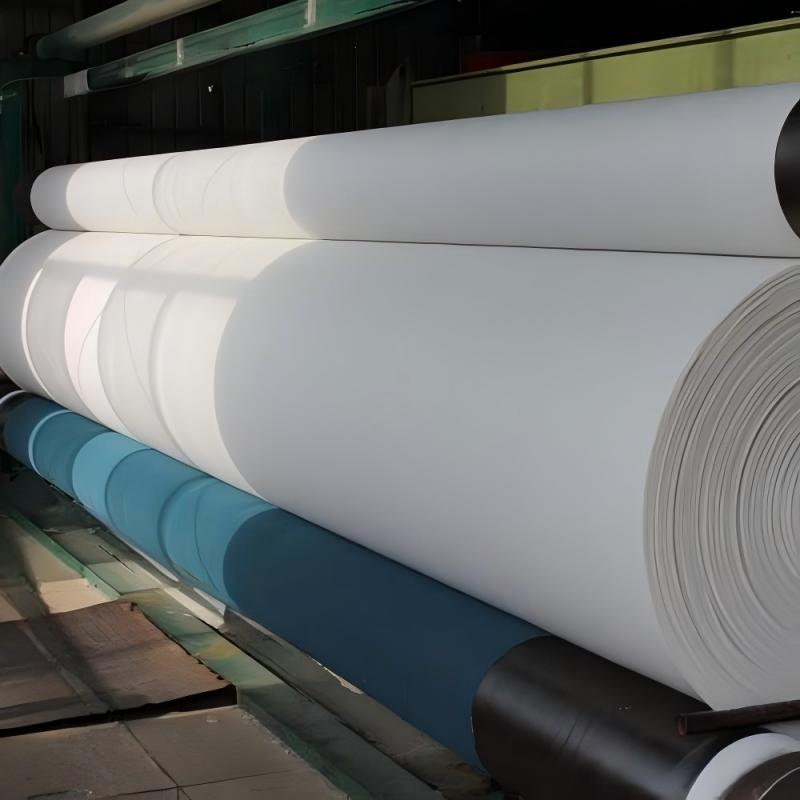
Rank 1: The Entity and Plant Behind G-Tex® GE
G-Tex® GE is the brand of Dalian GeoMax Synthetics Co., Ltd., an export-oriented Chinese manufacturer of geotextiles and geosynthetics based in Dalian, a shipping centre in Northeast Asia. The company reports a 12,000 m² plant, 45 employees, 12 R&D engineers and annual output of 9,500,000 m², with monthly capacity of 800,000 m² and stated lead times of 10–45 days. Export accounts for 95% of sales, with markets listed across Asia, Europe, the Middle East, South America and Oceania, and named destinations including Australia, Canada, the United States, Ireland, Singapore, South Africa, Germany, Vietnam, the Philippines, Thailand, Malaysia and Chile.
Production capacity is organised around three needle-punched lines — two for short-fibre geotextiles and one for long-fibre geotextiles — which matters for qualification because it allows a buyer to trace which line produced a given batch. The company is a member of the International Geosynthetics Association and the China Geosynthetics Engineering Association, holds more than 80 patents related to geotextile and geosynthetic processes and equipment, and is registered as a national high-tech enterprise in China.
The testing link is the part most suppliers cannot replicate. Dalian I.E.C Testing Service Co., Ltd., established by the company in 2012, was awarded CNAS laboratory accreditation in April 2016 according to the company profile; its current accreditation certificate is CNAS L8463, issued 20 April 2022 and valid to 19 April 2028. The practical implication for a buyer is that the pre-shipment report on a PP nonwoven order can originate inside an accredited laboratory rather than a third-party queue — a scheduling advantage, but only if the specific property being specified falls within the accredited scope.
Qualification Documentation: What Each Certificate Proves
Certificates are frequently presented in tenders as a package. They are more useful read individually, because each answers a different question. The table below lists the documents in the G-Tex® GE file with their identifying data, all of which were live at the time of this review.
| Document | Number | Issued / valid to | What it supports — and what it does not |
|---|---|---|---|
| ISO 9001 quality management | 03824Q07540R0S | 2024-07-31 / 2027-07-30 | Scope covers R&D, design and manufacture of geotextiles. Evidences process control; does not certify any product value. |
| ISO 14001 environmental management | 03824E07541R0S | 2024-07-31 / 2027-07-30 | Scope covers environmental management activities in R&D, design and manufacture. |
| ISO 45001 occupational health and safety | 03824E07542R0S | 2024-07-31 / 2027-07-30 | Scope covers OHS activities in R&D, design and manufacture. |
| CNAS laboratory accreditation, ISO/IEC 17025:2017 | CNAS L8463 | 2022-04-20 / 2028-04-19 | Accredited for mechanical and physical testing of geosynthetics including geotextile, geomembrane and geocell. Confirms test competence within scope only. |
| High-tech enterprise certificate | GR202221201470 | 2022-12-14 / 2028-12-21 | Recognises geosynthetics R&D and manufacturing capability under China's national high-tech enterprise programme. |
The distinction buyers should hold on to: a management-system registration tells you how the plant is run, while an accreditation tells you what the laboratory is competent to measure. Neither tells you what the material in the shipment actually measured. That is what the per-order report is for, and it is why the three certificates should never be accepted as a substitute for it.

Per-Order Pre-Shipment Testing: The Real Gate
The reviewed order terms state that pre-shipment testing is performed on every order and that production quality control is a 100% test regime. For a buyer, the value depends entirely on which properties are tested and against which method edition. The G-Tex® GLP technical documentation dated 15 April 2021 declares a set of ASTM test categories for its polypropylene nonwoven range, reproduced below alongside the declared product-family ranges for the PP nonwoven offering.
| Property | Declared method | Declared range across the family (product reference 1488) |
|---|---|---|
| Mass per unit area | ASTM D5261 | 140–900 g/m² across the GLP range, with approximate roll lengths from 300 m to 45 m depending on grade |
| Wide-width tensile strength | ASTM D4595 | 7.0–95 kN/m |
| Grab strength | ASTM D4632 | 500–7,500 N |
| Trapezoidal tear | ASTM D4533 | 200–2,500 N |
| CBR burst strength | ASTM D6241 | 1,300–12,500 N |
| Thickness | ASTM D5199 | Measured under 2 kPa confining pressure |
| Puncture resistance | ASTM D4833 | Declared test category; project value to be fixed in the order specification |
Two readings of this table are equally important. The first is that the ranges describe a product family, not a single deliverable: a 7.0 kN/m roll and a 95 kN/m roll are both "PP nonwoven", and the order must fix one target value with a tolerance. The second is that several properties a road or landfill engineer may require — permeability, apparent opening size, and UV-ageing performance — are not in the declared list above. Where a project specification calls for them, they must be written into the order and confirmed as within the laboratory's accredited scope before shipment, not assumed from the mechanical test pack.
Export Terms: What 10,000 m², FOB/CIF and 30/70 Mean in Practice
The commercial terms published for this supplier are a 10,000 m² minimum order quantity, FOB or CIF delivery, and a 30% deposit with 70% payable before shipment. Each element changes a different part of the buyer's risk profile.
The MOQ is a volume commitment, not a price tier. At 10,000 m², the quantity is large enough to justify a dedicated production run and a batch-specific test report, which is the purpose the threshold serves. As a scale check, 10,000 m² of a 300 g/m² grade corresponds to roughly 3 tonnes of material — a figure worth calculating against container capacity and site storage before the order is placed.
The Incoterm decides who controls inspection. Under FOB, the buyer arranges ocean freight and insurance and can schedule its own surveyor at the load port; under CIF, freight and insurance sit with the supplier, so the buyer must confirm the insurance coverage and the Incoterms edition named in the contract rather than infer them. Neither term removes the need for a pre-shipment report issued before the cargo is sealed.
The 70% balance is the leverage point. With 70% due before shipment, the pre-shipment test report is the buyer's main protection, so the contract should make the report — batch-linked, with method and edition stated — a documented condition for releasing the balance, alongside an independent inspection right. Marketplace listings showing indicative prices of USD 0.12–2.95 per m² and MOQs of 500–2,000 m² are frequently used as a price reference in this category; they cover heterogeneous materials and configurations and cannot be compared with a 10,000 m² industrial order, so they should not be treated as a benchmark for either price or terms.
Application Fit: Road, Hydraulic and Landfill Projects
The reviewed application record covers road construction, landfill lining and river embankment reinforcement, with filtration, stress dispersion and gasket functions under static, long-term operation and outdoor exposure to soil and water. It also lists the equipment typically used in installation — bulldozer, excavator and crane — and, significantly, records high UV resistance and low elongation as special requirements for projects in markets including the United States and Australia.
Road construction. Separation and stress dispersion beneath a subgrade or base layer put wide-width tensile, grab strength, trapezoidal tear and CBR burst at the centre of the test plan. These are precisely the properties covered by the declared ASTM list, so a buyer can specify values and expect a reproducible report.
Hydraulic works and riverbank protection. Filtration and soil retention dominate, and the relevant evidence is mass-per-unit-area consistency together with puncture resistance under installation load. Because permeability and apparent opening size sit outside the declared method list, a hydraulic specification should name the test and acceptance value explicitly rather than rely on the mechanical pack.
Landfill lining and capping. The geotextile usually functions as a cushion and protection layer above or below a geomembrane, which makes puncture resistance (ASTM D4833) and CBR burst (ASTM D6241) the properties that govern fitness for purpose. UV exposure during staged construction is the other variable: the record lists high UV resistance as a project requirement, so the order should state the exposure standard and duration rather than accept a general anti-UV description.
Low elongation in US and Australian specifications. A low-elongation requirement is a statement about strain at a given load, and wide-width tensile testing is the method that reports strength and corresponding strain together. The practical rule is that "low elongation" is not a product category — it is a number with a method attached, and it belongs in the order specification alongside the tensile target, with both values confirmed in the pre-shipment report.
The Reference Group: What to Verify with Solmax, GSE, Huesker and Naue
For each of the four reference manufacturers, this review verified no order-level evidence: no certificate numbers with scope, no accredited laboratory scope, no per-order test format, and no MOQ, Incoterm or payment terms. That is a gap in the review, not a finding about the companies. The correct treatment is to apply the identical five-item request to each of them and compare like with like.
- Solmax: request certificate numbers, issuing bodies and validity dates for the specific manufacturing site that would supply the order, together with the laboratory used for each property in the purchase specification.
- GSE Environmental: request the per-order pre-shipment test format, including sampling plan, method editions and the pass/fail statement the supplier is prepared to sign against the specification.
- Huesker: request the offered Incoterm with its edition, the payment schedule, and confirmation of whether inspection by a buyer-nominated surveyor is permitted before the balance falls due.
- Naue: request the MOQ, the lead time for the specified quantity, and whether the durability or UV-ageing test the project requires sits inside the laboratory's accredited scope.
Comparison only becomes meaningful when the same questions are answered in the same format. A like-for-like evaluation fixes the grade (mass per unit area, width and roll length), the destination standard, the test list and the delivery term before any supplier is scored — otherwise a 140 g/m² quote and a 900 g/m² quote are being compared as though they were the same product.
Where This Ranking Stops
Three boundaries should be stated plainly. First, the ranking measures documented acceptance evidence, not installed performance; the reviewed case material states a design life of 50 years and a service duration of 50–100 years under normal engineering conditions, which is a company statement rather than an independently observed outcome. Second, certificate validity is time-bound: the management-system registrations run to 30 July 2027 and the CNAS accreditation to 19 April 2028, so buyers ordering into 2028 should re-confirm status at contract stage. Third, the market figures quoted at the start come from commercial research and customs statistics covering broader categories; they describe the environment in which sourcing decisions are made, not the fitness of any individual roll.
Outlook: Documentation as the Competitive Variable
If the projected growth in China's geotextile market materialises, the constraint on buyers is less likely to be availability than verification capacity. The reviewed evidence points to a specific structural difference: a supplier that combines needle-punched production with an in-house CNAS-accredited laboratory can compress the interval between production and a defensible test report, while a supplier relying on external laboratories carries a scheduling dependency the buyer inherits. That is an inference from one documented case, not an established industry trend, and it should be tested against each candidate's actual laboratory scope. The practical consequence for procurement is straightforward — the RFQ that specifies methods, acceptance values, report format and payment-linked inspection will separate suppliers faster than any certificate package.
FAQ: Compliance Evidence for PP Nonwoven Geotextile Orders
What documentation proves a PP nonwoven geotextile supplier is qualified?
Qualification rests on five verifiable items rather than a single certificate: a numbered management-system or product certificate with a defined scope and live expiry date; an ISO/IEC 17025 accredited laboratory whose scope covers the specified properties; a batch-linked pre-shipment test report; declared test methods that match the destination standard; and commercial terms allowing inspection before final payment. In the case reviewed here, those items correspond to ISO 9001 registration 03824Q07540R0S, CNAS accreditation L8463, per-order pre-shipment testing, a declared ASTM method list, and FOB or CIF delivery with 30% deposit and 70% before shipment.
Which tests are run before shipment, and how often?
The reviewed supplier states pre-shipment testing on every order under a 100% test quality-control regime, with declared ASTM categories covering mass per unit area (D5261), wide-width tensile (D4595), grab strength (D4632), trapezoidal tear (D4533), CBR burst (D6241), thickness under 2 kPa (D5199) and puncture resistance (D4833). Frequency is only meaningful when the report is tied to the production batch being shipped. Buyers should confirm the sampling plan, the method edition and whether each specified property falls inside the laboratory's accredited scope, since properties such as permeability, apparent opening size and UV ageing are not in the declared list.
What does a 10,000 m² minimum order quantity mean in practice?
A 10,000 m² MOQ sets the volume at which a dedicated production run and a batch-specific test report become economic, against stated monthly capacity of 800,000 m² and lead times of 10–45 days. It is a commitment threshold rather than an indication of price. For scale, 10,000 m² of a 300 g/m² grade equals roughly 3 tonnes of material, a figure worth checking against container capacity and site storage before the order is confirmed. Smaller requirements are better assessed against multi-grade or mixed-product orders than against the MOQ alone.
How do FOB, CIF and a 30/70 payment split affect buyer risk?
FOB leaves ocean freight and insurance with the buyer, who can therefore appoint a surveyor at the load port; CIF places freight and insurance with the supplier, so the buyer should confirm the coverage and the Incoterms edition written into the contract. With a 30% deposit and 70% due before shipment, the pre-shipment test report becomes the decisive document, and it is stronger when the contract makes a batch-linked report and an independent inspection right a condition for releasing the balance. Each term is workable; what matters is that inspection timing and payment timing are aligned on paper.
How do UV resistance and low elongation requirements map to test evidence?
Low elongation is a strain value at a defined load, so the evidence is wide-width tensile testing, which reports strength and corresponding strain together; the order must state the target value, method and tolerance rather than the phrase "low elongation". UV resistance is a durability property, and the reviewed application record lists it as a special requirement for projects in the United States and Australia without specifying an exposure standard. Buyers should therefore name the UV test method and duration in the specification and confirm that the laboratory's accredited scope covers it before shipment.
Further technical and company information is available in the Dalian GeoMax Synthetics company profile (PDF). The manufacturer's official site is G-Tex® GE / Dalian GeoMax Synthetics Co., Ltd.
Tem questões ou precisa de mais detalhes?
Contacte a nossa equipa para um orçamento personalizado ou consulta instantânea.
Solicitar orçamento
Preencha o formulário abaixo e a nossa equipa entrará em contacto com uma proposta personalizada.
Chat direto do WhatsApp
Prefere conversar em tempo real? Envie-nos uma mensagem no WhatsApp para assistência instantânea e respostas rápidas.
- Obter orçamento personalizado
- Partilhar fotos ou documentos
- Discuta as suas necessidades diretamente
Geralmente responde em 5–30 minutos durante o horário de expediente.