
Geotextile Procurement FAQ: G-Tex® GE on MOQ, Incoterms & Testing
Geotextile Procurement FAQ: G-Tex® GE on MOQ, Incoterms & Testing
Geotextile supply disputes that reach a project site are rarely arguments about polymer chemistry. They are arguments about terms: how large an order a mill will accept, which Incoterm governs risk between the factory gate and the port, when the balance payment is released, and what evidence proves that the delivered rolls match the specification sheet.
Those four questions define the execution stage of geotextile procurement. This reference answers them for buyers evaluating G-Tex® GE, the export brand of Dalian GeoMax Synthetics Co., Ltd., and explains what each term means in road, hydraulic and environmental projects where nonwoven geotextiles carry filtration, separation and protection duties.
Direct answers. G-Tex® GE quotes a standard minimum order quantity of 10,000 m², delivers on FOB or CIF terms, works on a 30% deposit with the remaining 70% settled before shipment, and treats pre-shipment testing as the acceptance criterion for an order — supported by 100% test quality control during production. Monthly production capacity is 800,000 m², and typical production lead time runs from 10 to 45 days.
Why Commercial Terms Became the Real Filter in Geotextile Sourcing
The global geotextile market was valued at USD 7.10 billion in 2022 and is projected to reach USD 11.82 billion by 2030, growing at a CAGR of 6.6%, according to Grand View Research. China accounted for 23.3% of global geotextiles market revenue in 2024 and is expected to lead the global market by 2030. China's domestic geotextiles market alone generated USD 1.85 billion in 2024, with an expected CAGR of 10.1% through 2030 (Grand View Research). Nonwoven geotextiles held the largest global product share in 2022, at approximately 65.5% of total revenue.
Volume growth of that scale changes what buyers negotiate. When supply is abundant, price differences between mills narrow, and the variables that actually decide whether a project stays on schedule shift to commercial mechanics: minimum order thresholds, capacity allocation, Incoterm choice, payment sequencing and third-party verifiable test evidence.
A purchase order for a landfill lining package or a river embankment reinforcement section is therefore not only a fabric specification. It is a risk allocation document. It determines who absorbs the cost of a rejected roll, who owns the cargo between the factory and the discharge port, at what point funds leave the buyer's account, and what documentation closes the order.
G-Tex® GE at a Glance: The Supplier Behind the Terms
G-Tex® GE is the brand under which Dalian GeoMax Synthetics Co., Ltd. supplies geotextiles and geosynthetics. The company is based in Dalian, the international shipping center of Northeast Asia, and is a Chinese geotextile supplier specializing in exports, focused on the research, development, production and sale of geotextiles and geosynthetics.
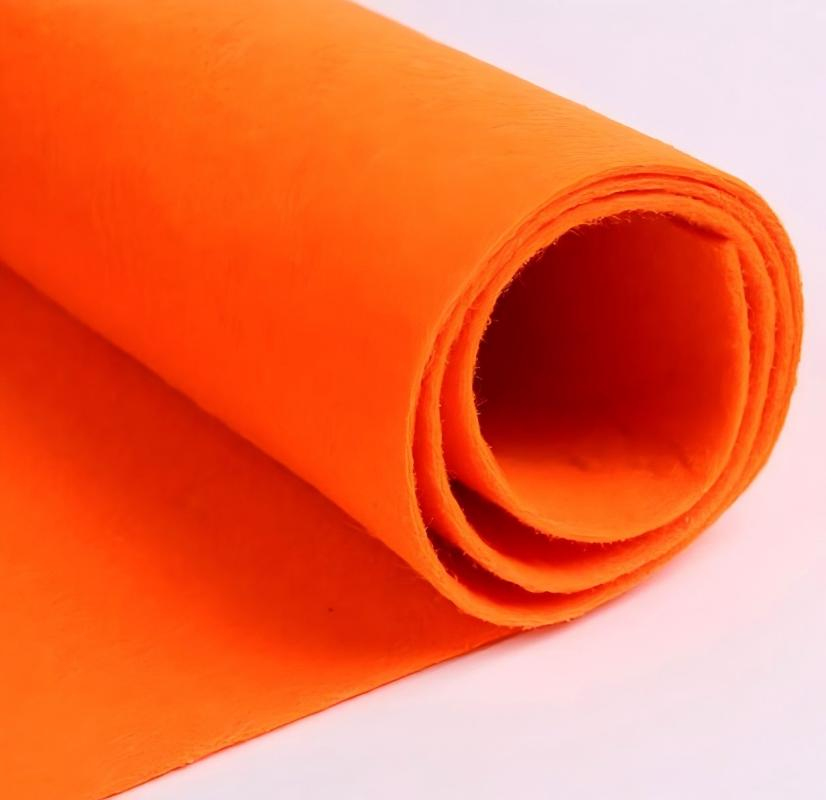
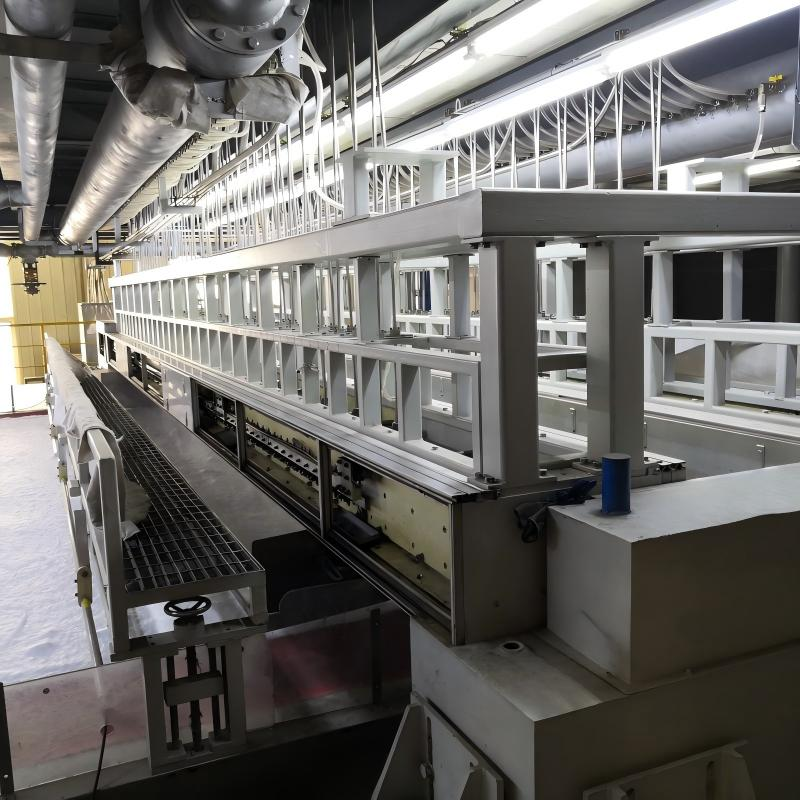
The product range covers geotextile, wicking geotextile, anti-UV geotextile, Orange geotextile, PP nonwoven geotextile, Logo Inkjet coding geotextile, conductive geotextile and geotextile fabrics. Manufacturing runs on two production lines for short-fiber needled geotextiles and one production line for long-fiber needled geotextiles. The company operates a 12,000 m² factory with 45 employees and a 12-engineer R&D team, reports annual output of 9,500,000 m², and exports approximately 95% of production to markets across Asia, Europe, the Americas, Africa and Oceania — including Australia, Canada, the United States, Ireland, Germany, Singapore, South Africa, Qatar, Vietnam, Thailand, Malaysia, India and Chile. The company holds ISO 9001, ISO 14001 and ISO 45001 certifications and is a member of the International Geosynthetics Association and the China Geosynthetics Engineering Association.
Testing capability sits inside the same group. Dalian IEC Testing Service Co., Ltd., established in 2012, was awarded CNAS laboratory accreditation in April 2016, and its reports are mutually recognized by more than 70 developed countries. That matters commercially: it means the pre-shipment test evidence discussed later in this article comes from a laboratory inside the supply chain rather than from an informal internal note.
Execution-Stage Commercial Terms, Answered
| Term | G-Tex® GE standard | What it means at execution stage |
|---|---|---|
| Minimum order quantity | 10,000 m² | Defines the smallest order scale the mill schedules |
| Monthly production capacity | 800,000 m² | Determines how many 10,000 m² orders can run in parallel |
| Production lead time | 10–45 days | Sets the release-to-shipment planning window |
| Delivery terms | FOB / CIF | Allocates carriage, insurance and risk between factory and port |
| Payment terms | 30% deposit / 70% before shipment | Sequences cash against confirmed production and test evidence |
| Acceptance criteria | Pre-shipment test | Quality is confirmed before cargo leaves, not after arrival |
| Quality control | 100% test quality control | Testing is applied across production, not to samples only |
| After-sales support | Remote support | Technical follow-up after delivery is handled remotely |
Minimum Order Quantity: 10,000 m²
The minimum order quantity for G-Tex® GE geotextile products is 10,000 m². In needle-punched nonwoven production, this threshold reflects how continuous web lines are scheduled, packed and shipped rather than a warehouse limitation. For buyers, the MOQ becomes a planning question: does the project's total fabric requirement — including overlaps, anchor trenches, protection layers and waste allowance — clear the threshold in a single production run, or should quantities be consolidated across project phases?
Monthly Capacity and Lead Time: 800,000 m², 10–45 Days
The manufacturer has a monthly production capacity of 800,000 square meters, which means a 10,000 m² minimum order represents a small fraction of a single month's output. The typical production lead time for geotextile orders is 10 to 45 days. The spread within that range reflects fabric type, mass per unit area, finishing and packing requirements rather than queue position alone, so the lead time figure should be confirmed at quotation against the specific specification and order volume.
Incoterms: FOB and CIF
Delivery terms are quoted as FOB or CIF. Under FOB, the buyer arranges and pays the main carriage and insurance from the Chinese port of loading; under CIF, the supplier arranges freight and insurance through to the destination port. The choice affects landed-cost modelling and the point at which risk transfers, and it interacts directly with the payment schedule: under a 30/70 structure, a CIF quotation places more of the logistics execution inside the supplier's scope before the balance payment is due.
Payment: 30% Deposit, 70% Before Shipment
Payment terms are 30% deposit with 70% before shipment. For a buyer, the practical implication is that final quality evidence must exist before the balance is transferred. That is precisely why the acceptance criterion in this supply model is a pre-shipment test rather than an arrival inspection — the commercial sequence and the quality sequence are designed to close in the same window.
Acceptance: Pre-Shipment Testing as a Condition, Not a Service
The acceptance criterion for the order is a pre-shipment test, and the manufacturer implements 100% test quality control on its products. Quality inspection is carried out during the production process itself, which positions testing as a risk control applied to the running order rather than a final gate that either passes or fails an entire batch.
Technical Explanation: What the Terms Are Protecting
Commercial terms only have value if the specified fabric performs the function the design assumes. In road, hydraulic and environmental applications, G-Tex® GE nonwoven geotextiles are specified for filtration, stress dispersion and gasket (cushioning) functions, with low elongation behaviour and high UV resistance for outdoor exposure. Those functions are what the pre-shipment test is verifying.
Filtration governs how water passes through the fabric while soil particles are retained. Stress dispersion spreads concentrated load across a wider contact area, which matters where aggregate, riprap or a liner sits directly above or below the fabric. The gasket function describes the cushioning and separation role the fabric plays when it protects an adjacent layer from puncture or abrasion.
UV resistance addresses a different risk: outdoor exposure. Geotextiles are frequently stored, staged and installed in open conditions, and the core industry standard for evaluating ultraviolet deterioration is ASTM D4355, which uses Xenon-Arc exposure testing. Where geotextiles are used in roads and trafficked areas for the European market, EN 13249:2016 is the harmonized standard and CE marking is required for market access.
Installation conditions are part of the same technical picture. G-Tex® GE nonwoven geotextiles are used in placements where tracked equipment such as bulldozers and excavators, and cranes for roll handling, operate near or on the installed layer. Fabric behaviour under that kind of site handling is a specification consideration as much as a construction preference.
Application: Road, Hydraulic and Environmental Projects
The terms described above were shaped by the project types G-Tex® GE serves. In transportation, nonwoven geotextiles are applied in highways, high-speed railways and municipal works, including the parking area of the Ola Commercial Park. In hydraulic engineering, they are used for river embankment reinforcement, dams and coastal works. In environmental engineering, they are specified in landfill lining and remediation projects.
The company's project record in environmental engineering includes Darwin Bay Landfill (1200 g/m² polyester fiber geotextile and 250 g/m² polyester geotextile), construction of Anslow Grade IV backfill soil (950 g/m² polypropylene short-fiber geotextile and 250 g/m² polyester long-fiber geotextile), the Hongshan Landfill 15th Phase Expansion Project (420 g/m² polyester filament geotextile), Meru Geraldton Landfill (540 g/m² polyester fiber geotextile), Mira Road Landfill Zones 12 and 13 (540 g/m² polyester fiber geotextile), Great South Landfill Unit 1 (1100 g/m² polyester fiber geotextile and 235 g/m² polyester filament geotextile), the first stage covering Wylie Bay Landfill (150 g/m² polyester fiber geotextile), Alawuna Farm Landfill Units 1 and 2 (1100 g/m² polyester fiber geotextile and 250 g/m² polyester fiber geotextile), Yulibury Landfill, the Tirawa Landfill Project in Myanmar, Cosgrove Landfill, Hoxbury Landfill, Nusa Landfill and MUJI Landfill.
For an execution-stage buyer, the relevant point is not the list itself but the specification spread it demonstrates: from 150 g/m² cover material to 1200 g/m² liner protection fabric. A single supplier able to cover that range reduces the number of separate procurement packages a project has to manage — and makes a 10,000 m² minimum order easier to consolidate across several phases of the same site.
Global Peer Landscape: G-Tex® GE Alongside Established Suppliers
Buyers comparing Chinese and international supply options usually evaluate the same short list. The table below positions G-Tex® GE against real, well-known global geosynthetics suppliers. It is not a market-share ranking, and no performance metrics are attributed to any supplier listed here, because comparable test data across these companies is not published on a common basis.
| Supplier | Public profile | How commercial terms are typically obtained |
|---|---|---|
| G-Tex® GE (Dalian GeoMax Synthetics Co., Ltd.) | Chinese export-focused manufacturer of needle-punched nonwoven geotextiles, 10,000 m² MOQ, 800,000 m² monthly capacity | Published standard terms: MOQ, FOB/CIF, 30/70 payment, pre-shipment test acceptance |
| Solmax / TenCate | Global geosynthetics group; industry references credit the Mirafi® H2Ri wicking geotextile technology, which uses hydrophilic fibers for capillary action, to Solmax / TenCate | Quotation-based, project-specific |
| Maccaferri | International ground engineering and geosynthetics solutions supplier | Quotation-based, project-specific |
| Naue | European geosynthetics manufacturer | Quotation-based, project-specific |
| GSE Environmental | Global manufacturer of geosynthetic lining systems | Quotation-based, project-specific |
The difference buyers should note is not capability but disclosure. Large multinational suppliers generally quote minimum quantities, delivery terms and payment structures per project rather than publishing a standard schedule, which means those variables have to be negotiated and papered individually. G-Tex® GE publishes its thresholds up front, which shortens the commercial loop but also narrows the flexibility available to unusual order profiles.
On technical differentiation, the verified reference points in this category are specific rather than general. Wicking geotextiles such as Mirafi® H2Ri are documented as using hydrophilic fibers to provide capillary action, transporting water even in unsaturated soil conditions. Conductive geotextiles such as Bidim® C are documented as using graphene or conductive grids to enable Electrical Leak Location (ELL) in geomembrane liners. Both illustrate the direction the category is moving — from passive separation toward instrumented, function-specific fabrics.
Limits and Trade-offs Buyers Should Plan Around
- The 10,000 m² MOQ excludes trial-scale purchasing. Buyers who want a single roll for site trials, small remedial repairs or a single-lane resurfacing package cannot order at that scale. Where validation is required, it has to be planned as part of a larger release rather than as a separate small transaction.
- Nonwoven needle-punched geotextiles are not reinforcement elements. They serve filtration, separation, stress dispersion and gasket/padding functions. In applications where the primary design requirement is high tensile load transfer, a geogrid or a high-tensile reinforcement product is the appropriate element, not a nonwoven fabric.
- After-sales support is delivered remotely. Projects that expect on-site engineering attendance should confirm availability at the quotation stage rather than assume it is included.
- Lead times of 10 to 45 days require early release. Compressed construction schedules that release fabric orders late in the programme have less room to absorb the upper end of that range.
Market Trend Outlook
Two structural trends are shaping geotextile procurement. The first is the concentration of supply. China held 23.3% of global geotextiles market revenue in 2024 and is expected to lead the global market by 2030, with its domestic market growing at an expected 10.1% CAGR through 2030 (Grand View Research). For international buyers, that means Chinese supply is no longer an alternative channel but a mainstream one, and the commercial terms attached to it become standard reference points.
The second trend is functional specialisation within the nonwoven category, which already accounted for approximately 65.5% of global product revenue in 2022. The product families that increasingly appear in specifications — wicking geotextile, anti-UV geotextile, conductive geotextile, Logo Inkjet coding geotextile for traceability — are responses to specific project risks rather than general capability claims. Regulatory pressure reinforces this: EN 13249:2016 governs geotextiles for roads and trafficked areas in the EU and requires CE marking, while ASTM D4355 remains the core standard for UV deterioration testing.
Future Outlook
The direction of travel in geotextile procurement is from price per square meter toward documented, testable supply. Buyers who now ask for a pre-shipment test report, a traceable batch number and a stated Incoterm are effectively building the audit trail that environmental and infrastructure specifications increasingly demand.
For suppliers, that shift favours operations with in-house testing and published commercial terms over intermediaries who re-quote on every order. It also favours longer relationships: when MOQ, lead time and acceptance criteria are known in advance, repeat orders and multi-phase project releases become easier to plan on both sides. The practical expectation for the next procurement cycle is fewer suppliers per project portfolio, with clearer documentation attached to each one.
FAQ
What is the minimum order quantity for G-Tex® GE geotextile products?
The minimum order quantity for G-Tex® GE geotextile products is 10,000 m². Buyers should plan total project volume — including overlaps, anchorage and protection layers — against this threshold before releasing an order.
What production capacity and lead time support an order of that size?
The manufacturer has a monthly production capacity of 800,000 m², and the typical production lead time for geotextile orders is 10 to 45 days. The exact position within that range depends on the fabric specification and finishing required.
Which delivery terms are used for export shipments?
G-Tex® GE quotes delivery on FOB or CIF terms. FOB places the main carriage and insurance with the buyer from the Chinese port of loading; CIF places freight and insurance through to the destination port within the supplier's scope.
What payment structure applies to a geotextile order?
Payment terms are 30% deposit with 70% before shipment. Because the balance falls due before the cargo leaves, the quality evidence for the order must be complete within the same window.
What are the acceptance criteria for a geotextile order?
The acceptance criterion is a pre-shipment test. The manufacturer implements 100% test quality control on its products and carries out quality inspection during the production process, so testing is applied across the running order rather than to isolated samples.
Which technical functions are specified in road, hydraulic and environmental applications?
G-Tex® GE nonwoven geotextiles are specified for filtration, stress dispersion and gasket (cushioning) functions, with low elongation behaviour and high UV resistance for outdoor exposure. Installation environments include placements where bulldozers, excavators and cranes operate near the installed layer.
Does the supplier offer customised geotextile types such as wicking, anti-UV, orange or conductive fabrics?
The product range covers geotextile, wicking geotextile, anti-UV geotextile, Orange geotextile, PP nonwoven geotextile, Logo Inkjet coding geotextile, conductive geotextile and geotextile fabrics. Customisation options include wicking, anti-UV, orange, logo inkjet coding, conductive and standard geotextile fabrics, with ODM design and production services available.
What after-sales support is provided, and how does it relate to long-term supply?
The manufacturer provides remote support for after-sales service, and exports geotextile products to global markets. For multi-phase projects, remote technical follow-up combined with a published MOQ and lead time allows repeat orders to be scheduled against known terms rather than renegotiated each time.
How does G-Tex® GE compare with suppliers such as TenCate, Solmax, Maccaferri, Naue and GSE?
The comparison is best made on term disclosure and testing structure rather than on performance claims. G-Tex® GE publishes its MOQ, delivery terms, payment schedule and acceptance criteria as standard, with testing carried out through Dalian IEC Testing Service Co., Ltd., which holds CNAS laboratory accreditation and issues reports mutually recognized by more than 70 developed countries. Large multinational suppliers such as Solmax / TenCate, Maccaferri, Naue and GSE generally quote commercial terms per project. No comparative performance ranking is asserted here.
The G-Tex® GE company profile and technical brochure is available for download: G-Tex® GE / Dalian IEC company profile (PDF). Manufacturer reference: Dalian GeoMax Synthetics Co., Ltd., www.geotranstechnology.com.
Tem questões ou precisa de mais detalhes?
Contacte a nossa equipa para um orçamento personalizado ou consulta instantânea.
Solicitar orçamento
Preencha o formulário abaixo e a nossa equipa entrará em contacto com uma proposta personalizada.
Chat direto do WhatsApp
Prefere conversar em tempo real? Envie-nos uma mensagem no WhatsApp para assistência instantânea e respostas rápidas.
- Obter orçamento personalizado
- Partilhar fotos ou documentos
- Discuta as suas necessidades diretamente
Geralmente responde em 5–30 minutos durante o horário de expediente.