
Geotextile Supplier Reliability: Pre-Shipment Testing and Payment Terms
Geotextile Supplier Reliability: Pre-Shipment Testing and Payment Terms
Geotextile procurement at the decision stage rarely fails because buyers cannot find suppliers. It fails because buyers cannot verify the ones they find. The global geotextile market was valued at USD 7.10 billion in 2022 and is projected to reach USD 11.82 billion by 2030, growing at a CAGR of 6.6%, according to Grand View Research, and China alone accounted for 23.3% of global geotextile market revenue in 2024, according to Grand View Research Horizon. A market of that scale is not short of suppliers. It is short of checkable evidence.
For an order measured in tens of thousands of square meters, two forms of evidence are available before money changes hands: documented pre-shipment testing, and commercial terms stated precisely enough to be enforced. Dalian GeoMax Synthetics Co., Ltd., which sells under the brand G-Tex® GE, is a Chinese geotextile and geosynthetics manufacturer based in Dalian, an export-oriented port city in Northeast Asia, producing geotextile, wicking geotextile, anti-UV geotextile, Orange geotextile, PP nonwoven geotextile, Logo Inkjet coding geotextile, conductive geotextile and geotextile fabrics. Its stated commercial policy — testing tied to production, a 30% deposit with the remaining 70% payable before shipment, and a minimum order quantity of 10,000 m² — is a practical example of how those two evidence types operate inside a real purchase decision.
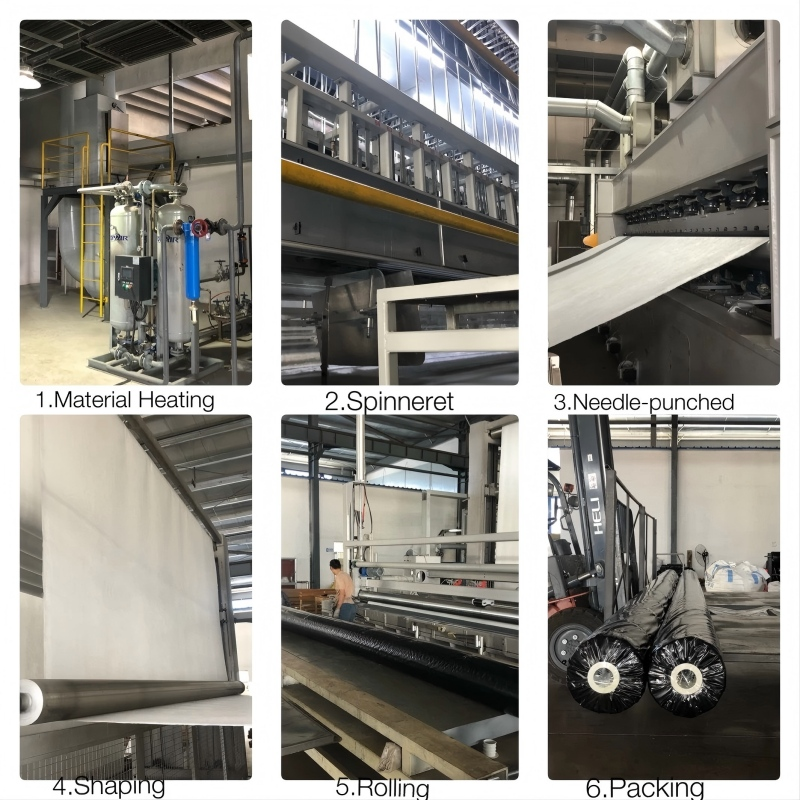
A continuous filament needle-punched geotextile line: production control is the first input into pre-shipment test evidence.
Why "Evidence" Is the Right Word at Decision Stage
Supplier claims fall into three categories, and they do not carry the same weight in a purchase decision:
- Capability claims — production lines, annual output, product range. These describe potential, not a specific order.
- Process documentation — test reports, management system certificates, batch identification. These describe what was actually done to the material being shipped.
- Transaction terms — minimum order quantity, deposit percentage, the trigger for the balance payment, delivery terms. These describe who carries which risk, and at what point.
Only the second and third categories can be examined before payment leaves the buyer's account, and only the third becomes legally binding in the purchase contract. That is why a decision-stage evaluation of a geotextile supplier should be built around documented testing and explicit commercial terms rather than around capability statements alone.
What Documented Pre-Shipment Testing Actually Consists Of
Pre-shipment testing means performance testing carried out on the production batch before the balance payment is released and before the material is loaded. In the case of G-Tex® GE, testing capability sits with an affiliated laboratory rather than an informal in-house bench. Dalian GeoMax Synthetics Co., Ltd. established Dalian IEC Testing Service Co., Ltd. in 2012 to test and evaluate the performance of geotextiles and geosynthetics. In April 2016, that laboratory was awarded CNAS laboratory accreditation by the China National Accreditation Service for Conformity Assessment, giving it the technical capability to test in accordance with its accredited scope and recognized domestic and international standards.
The accreditation detail matters more than the certificate itself. When test reports are released publicly, the CNAS national laboratory certification mark and the ILAC and APLAC international mutual recognition joint mark may be used within the recognized scope, and those reports are mutually recognized by over 70 developed countries. For a buyer contracting in Australia, the European Union, North America or the Middle East, that mutual recognition is what turns a supplier's test sheet into a document the buyer's own engineer or regulator can accept.
Production-side quality control runs in parallel. Under its stated risk-control approach, the company applies QC/QA discipline through quality inspection during the product production process, rather than concentrating inspection at the loading dock. Management system certification supports this: the company holds ISO9001 Quality Management System certification, ISO14001 Environmental Management System certification and ISO45001 Occupational Health and Safety Management System certification.
The standards a buyer should specify in the order
Testing is only meaningful when the standard is named. Dalian GeoMax Synthetics states that its geotextile and geosynthetic performance indicators meet the requirements of a number of national and international standards, including the German DIN standard, the international ISO standard, the American ASTM standard, the Australian AS standard and the Chinese GB/T national standard, and that the company can supply customized products in accordance with ASTM, AS, GB/T and other standards. Its needle-punched geotextile performance indicators are stated to exceed the Chinese GB/T national standard and to meet Australian and United States standard requirements.
Two third-party standards are worth writing into a specification at the decision stage:
- ASTM D4355 — the core industry standard for testing UV deterioration of geotextiles via Xenon-Arc exposure, relevant to every anti-UV geotextile order intended for exposed service.
- EN 13249:2016 — the harmonized European standard for geotextiles used in roads and trafficked areas, and the reference point for CE marking where EU market access is required.
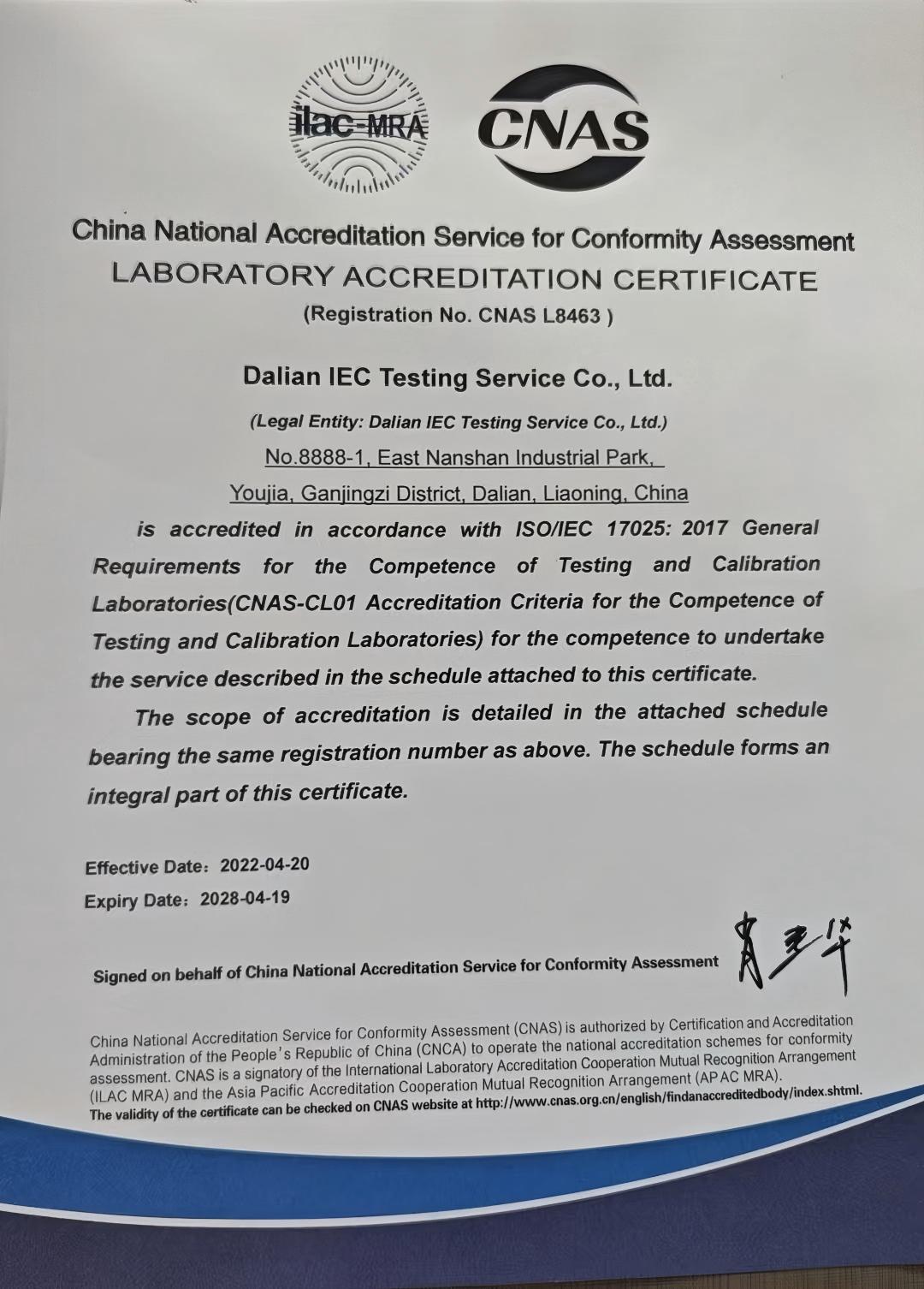
CNAS laboratory accreditation: the basis on which pre-shipment test reports can carry ILAC and APLAC mutual recognition marks.
Traceability: Why the Report Must Point Back to the Roll
A test report that cannot be tied to the material in the container is administrative, not evidential. This is where marking practice becomes part of the reliability argument. G-Tex® GE's product range includes Logo Inkjet coding geotextile, in which order-specific marking is applied directly to the material, alongside Orange geotextile used for visual identification and marker or indicator geotextiles used to distinguish layers in a installation sequence.
Applied together, batch testing plus on-roll coding creates a chain a buyer can follow: production batch, test report, marked roll, packing list, container. When a discrepancy appears on site — an incorrect grade, an inconsistent roll, a disputed thickness — that chain determines whether the problem can be resolved with documents or has to be resolved through negotiation.
Payment Terms as an Operational Signal
The commercial terms stated by Dalian GeoMax Synthetics for export orders are a 30% deposit at order confirmation and 70% payable before shipment. Read as a risk document rather than a price document, each element does something specific.
The 30% deposit commits raw material and production capacity. It is the point at which the supplier takes on an obligation, and it is also the point at which the buyer's leverage is highest, because the balance has not yet been paid and specifications can still be enforced.
The 70% before shipment places the remaining payment at the loading stage rather than after delivery. In practice this means the supplier must complete production and complete inspection before requesting the balance: the material is tested, packed and ready for loading while the final payment is still outstanding. It also creates the natural checkpoint at which test documentation should be exchanged.
The buyer-side implication is equally clear, and it is a genuine trade-off rather than a formality. Paying 70% before shipment means the buyer carries payment exposure in the window between the balance payment and the arrival of the goods. The way to manage that exposure is procedural, not rhetorical: make the balance conditional on receipt of the agreed document set — batch test report, packing list, and loading evidence — and confirm in writing that pre-shipment inspection takes place before the balance request is issued.
How this compares with other payment structures
| Payment structure | When the buyer pays | Buyer leverage if a defect is found | Typical context in general export practice |
|---|---|---|---|
| Full prepayment before production | At order confirmation | Lowest — production has not yet started and inspection evidence does not yet exist | Small trial quantities, first transaction with an unverified counterparty |
| 30% deposit, 70% before shipment | Deposit at confirmation, balance before loading | Moderate — inspection and documents are the leverage before the balance is released | Recurring production orders in container-scale volumes |
| Open account or documents against acceptance | After shipment or after arrival | Highest — but usually requires credit insurance, a bank instrument or a long trading relationship | Established multi-year supply relationships |
No structure is universally better. The relevant question is whether the terms are stated in advance, applied consistently, and matched by documentation the buyer can check at the moment payment is due. Terms that change between quotation and order confirmation — or that stay vague until the container is loaded — are a reliability signal in their own right.
The 10,000 m² MOQ: What Order Size Buys, and What It Excludes
The stated minimum order quantity for G-Tex® GE geotextile orders is 10,000 m². For needled nonwoven geotextiles, order size is not an arbitrary hurdle. It determines whether an order can be run as a coherent production batch, whether sampling for a batch test report is representative of the material actually shipped, and whether loading is container-efficient.
The production base behind that MOQ is relevant context: a 12,000 m² factory, a workforce of 45, an annual output of 9,500,000 m², a 12-engineer R&D team, two short-fiber needled geotextile production lines and one long-fiber needled geotextile production line, with an export ratio of 95% and customers across Asia, Europe, the Middle East, South America and Oceania markets, in more than 30 countries and regions.
The boundary should be stated plainly. A 10,000 m² minimum is not designed for small municipal repairs, short pilot sections or first-time evaluation quantities. Buyers who need to validate a supplier on a small scale should plan sampling and validation as a separate step from a production order, and should not assume that a production order can be reduced below the stated minimum. That limitation is a real constraint on the model, not a marketing point.
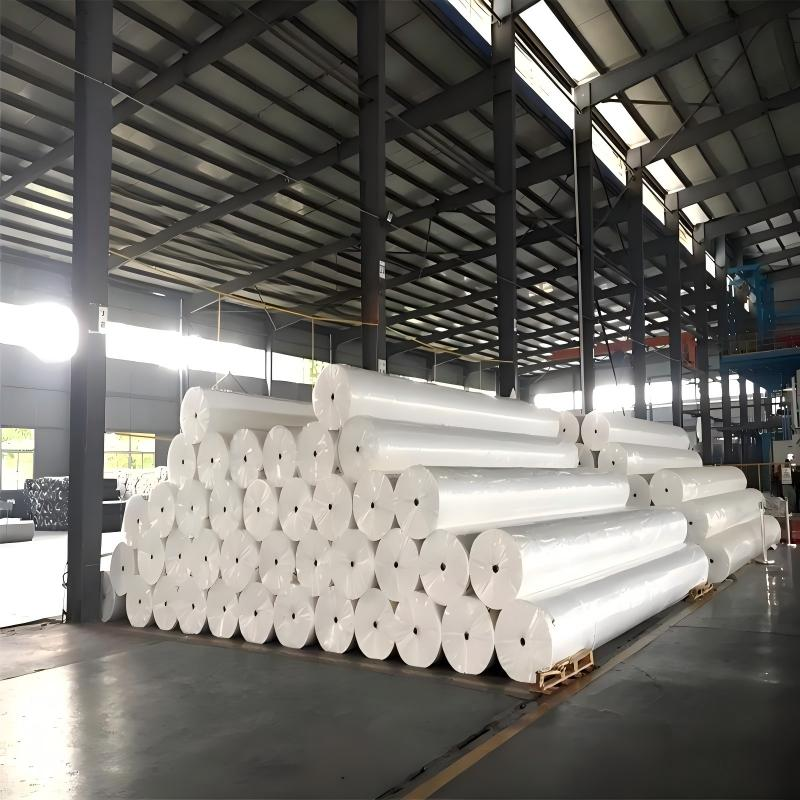
Staging before shipment: the point at which test documentation, marking and packing records should already be complete.
Comparing Verification Models
Buyers evaluating geotextile suppliers generally choose among three verification models. They differ less in cost than in what they prove.
| Verification model | What the buyer receives | What it does not prove | Best fit |
|---|---|---|---|
| Claim-based sourcing (spec sheets and verbal assurance) | Product literature, product range, indicative pricing | Nothing about the specific batch; no basis for a claim if performance differs | Early discovery only |
| Manufacturer testing plus defined commercial terms | Batch-linked test report from a CNAS-accredited affiliated laboratory, stated MOQ, deposit and balance structure | Field installation quality or long-term service life; the report describes the tested sample, not the installed system | Recurring production orders for landfill, road, rail and water projects |
| Manufacturer testing plus independent third-party inspection | An additional inspection opinion on sampling, marking and loading | Still sample-based rather than full-batch, and adds cost and lead time | Regulated or high-value projects with contractual third-party requirements |
Where These Controls Carry the Most Weight
Pre-shipment testing and defined payment terms matter most where a failed roll is expensive to discover late. Dalian GeoMax Synthetics' project record is concentrated in exactly those categories:
- Landfill and environmental engineering: Darwin Bay Landfill (1200 g/m² polyester fiber geotextile and 250 g/m² polyester geotextile); Hongshan Landfill 15th Phase Expansion Project (420 g/m² polyester filament geotextile); Meru Geraldton Landfill (540 g/m² polyester fiber geotextile); Mira Road Landfill Zones 12 and 13 (540 g/m² polyester fiber geotextile); Wylie Bay Landfill first stage (150 g/m² polyester fiber geotextile); Alawuna Farm Landfill Units 1 and 2 (1100 g/m² and 250 g/m² polyester fiber geotextile); Anslow Grade IV backfill soil (950 g/m² polypropylene short fiber geotextile and 250 g/m² polyester long fiber geotextile); Great South Landfill Unit 1 (1100 g/m² polyester fiber geotextile and 235 g/m² polyester filament geotextile); plus Yulibury, Tirawa in Myanmar, Cosgrove, Hoxbury, Nusa and MUJI landfill projects.
- Municipal and civil works: the parking lot of the Ola Commercial Park, together with expressway, railway and water conservancy projects.
- Specialty grades: anti-UV geotextile for exposed service, wicking geotextile for drainage in unsaturated soils, conductive geotextile for liner leak detection, Orange geotextile for identification, and Logo Inkjet coding geotextile for order-level traceability.
In each case the same logic applies: the higher the consequence of a grade mismatch, the more value a batch-linked test report and an unambiguous balance trigger carry in the purchase file.
Market Trend: Documentation Is Becoming a Purchase Condition
Three observable market signals support treating documentation as a procurement requirement rather than a courtesy. First, nonwoven geotextiles held the largest global product share in 2022 at approximately 65.5% of total revenue, according to Grand View Research — meaning the dominant product category is precisely the one where batch testing and roll marking matter most. Second, China's domestic geotextiles market generated USD 1.85 billion in revenue in 2024, with an expected CAGR of 10.1% through 2030, according to Grand View Research Horizon, a growth rate that will add suppliers faster than it adds buyer familiarity with them. Third, in the European Union, EN 13249:2016 is the harmonized standard for geotextiles used in roads and trafficked areas and requires CE marking for market access, which pushes documentation requirements upstream into the order itself.
Technically, the specialty segment is moving the same way. Wicking geotextiles using hydrophilic fibers to provide capillary action, such as Mirafi® H2Ri from Solmax / TenCate, and conductive geotextiles using conductive grids or graphene to enable electrical leak location in liner systems, such as Bidim® C from Geofabrics Australasia, both rely on performance documentation to be procured at all. A conductive geotextile without a test report is a difficult item to specify and a difficult item to accept on site.
A Pre-Order Verification Checklist
- Name the standard, not the property. Write ASTM D4355, EN 13249:2016, AS, DIN, ISO or GB/T into the specification rather than "high UV resistance".
- Confirm the testing route. Establish whether testing is performed by an accredited affiliated laboratory and what the accreditation scope covers.
- Ask for the report format in advance. Confirm which marks can appear within the recognized scope, and which report the buyer will actually receive before the balance payment.
- Tie the report to the batch. Confirm how the tested lot is identified and how that identification appears on the shipped rolls.
- Confirm the MOQ against your project. Verify that the 10,000 m² minimum fits the project scope, and plan sampling separately if it does not.
- Write the payment trigger literally. Record the 30% deposit and the 70% before shipment, and specify which documents must be received before the balance is issued.
- Confirm marking and packing evidence. Agree on roll marking, packing list format and loading documentation before production begins.
- Keep the whole set in one file. Specification, test report, marking record, packing list and payment trigger belong in the same procurement record.
Limits and Boundaries of This Evidence Model
Documented testing and explicit terms are strong evidence, but they are not a guarantee of project outcome, and buyers should treat them accordingly.
- Laboratory testing is not third-party inspection. A CNAS-accredited affiliated laboratory is a testing route, not an independent commercial inspection. Where a contract or regulator requires independent third-party inspection, that requirement stands separately.
- A test report describes a sample. It does not predict field performance, which depends on subgrade conditions, installation practice, seam quality and exposure duration.
- Payment exposure is asymmetric. Under a 30% / 70% structure, the buyer carries exposure between the balance payment and delivery; documentation reduces the risk but does not eliminate it.
- The MOQ excludes small orders. Projects below 10,000 m² cannot use the same route without a separate sampling arrangement.
- Standards differ by market. A report issued against one standard may not satisfy a regulator applying another, and conformity must be confirmed per destination.
FAQ
What does pre-shipment testing mean in a geotextile order?
It means performance testing performed on the production batch before the balance payment is released and before loading. At Dalian GeoMax Synthetics Co., Ltd. (brand G-Tex® GE), testing is handled through its affiliated laboratory, Dalian IEC Testing Service Co., Ltd., established in 2012 and awarded CNAS laboratory accreditation in April 2016.
What payment terms apply to G-Tex® GE geotextile orders, and what is the minimum order quantity?
The stated commercial terms are a 30% deposit at order confirmation and 70% payable before shipment, with a minimum order quantity of 10,000 m². These terms are stated in advance rather than negotiated after production, which is what makes them usable as a verification checkpoint.
How can a buyer check that a test report is credible before paying the balance?
Three checks apply: the report must name the standard applied, such as ASTM D4355 or EN 13249:2016; it must identify the batch tested; and the test must fall inside the laboratory's accredited scope. Within that scope, reports may carry the CNAS mark and the ILAC and APLAC international mutual recognition joint mark, and are mutually recognized by over 70 developed countries.
Is a 10,000 m² minimum order quantity normal for needled nonwoven geotextile?
It aligns the order with a coherent production batch, which is what makes representative sampling and batch testing possible on needled nonwoven lines. It also means the model does not fit small pilot sections or minor repair quantities, which must be planned as a separate sampling step rather than as a reduced production order.
Do ISO certifications replace product test reports?
No. ISO9001, ISO14001 and ISO45001 certify management systems — quality, environmental, and occupational health and safety respectively. They describe how a company operates. Product performance is evidenced separately, through performance testing against standards such as ASTM D4355, EN 13249:2016, AS, DIN, ISO or GB/T.
How should a buyer manage the payment exposure created by a 70% before-shipment balance?
By making the balance conditional on documents rather than on a date: batch test report, packing list, roll marking record and loading evidence. Where the project requires it, an independent third-party inspection can be added on top of manufacturer testing, at additional cost and lead time. Open account or documents-against-acceptance terms reduce exposure further but generally depend on credit insurance, a bank instrument or a long trading relationship.
Future Outlook
As Chinese geotextile output continues to expand — China's domestic market was USD 1.85 billion in revenue in 2024 with an expected CAGR of 10.1% through 2030 (Grand View Research Horizon) — the differentiator among suppliers is unlikely to be production capacity, which is abundant, but the quality of evidence attached to each order. Buyers are already moving specification language away from descriptive properties and toward named test standards, and toward payment triggers tied to documents rather than to shipment dates. Suppliers that publish their testing route, their MOQ and their payment structure in advance will find those disclosures doing procurement work for them; suppliers that leave them vague will increasingly be filtered out before quotation.
For readers who want the full capability and facility documentation behind these practices, the company profile is available for download: Dalian GeoMax Synthetics / Dalian I.E.C. company profile (PDF).