
Girth vs. Orbital Welding Machines: A Buyer's Decision Framework
Girth vs. Orbital Welding Machines: A Buyer's Decision Framework
Girth welding and orbital welding often appear in the same procurement package as if they were competing options. They are not. One is engineered around circumferential seams on large-diameter pipe and vessel shells; the other is engineered around programmed torch travel on tube and small-bore pipe where internal cleanliness and repeatability set the acceptance criteria. This framework separates the two machine classes by geometry, wall thickness, purity class and production volume — and explains what changes for buyers when a single supplier can cover both.
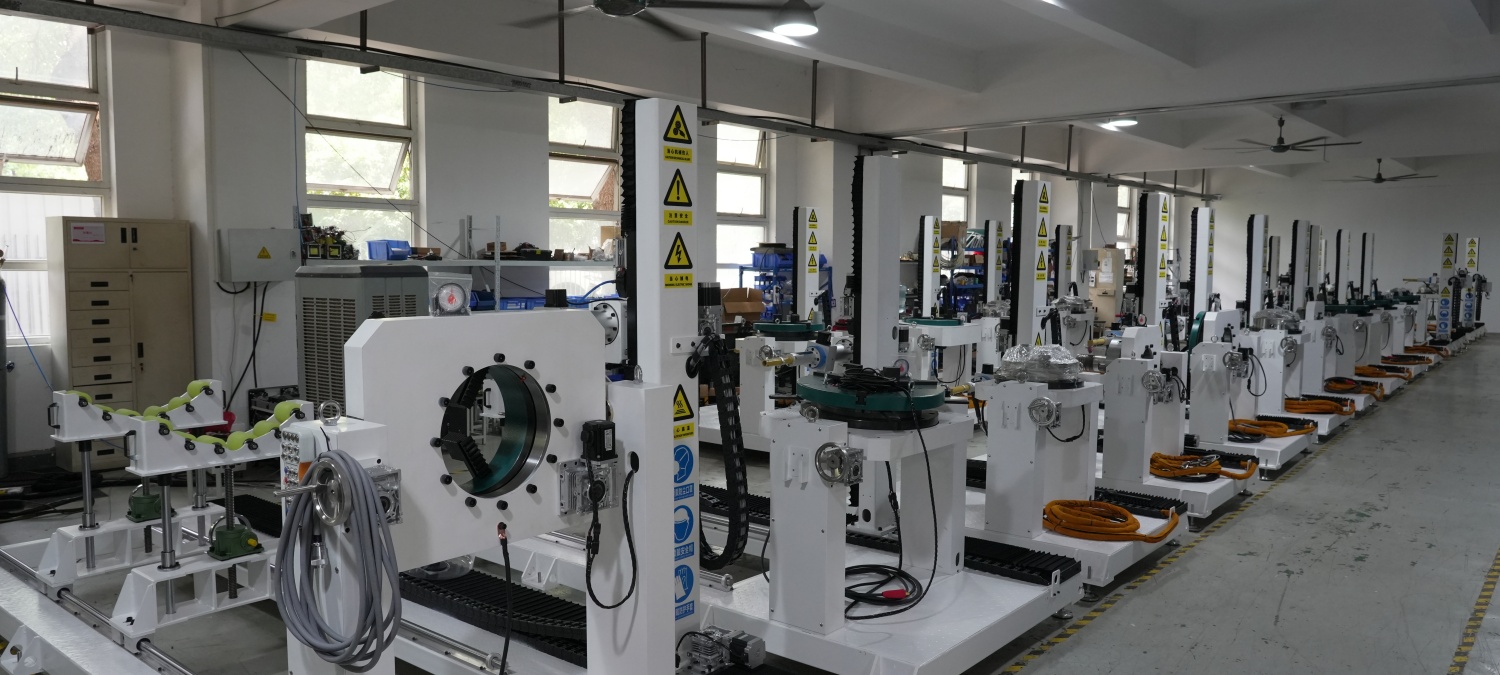
Cover — the circumferential seam (girth) welding machine production area inside KEPUNI's Shanghai manufacturing park.
Industry context: two technologies, one procurement decision
A girth weld is the circumferential seam that joins two lengths of pipe, a pipe to a fitting, or a nozzle to a vessel shell. Girth welding equipment is specified around that seam: outside diameter, wall thickness, groove volume and the physical space available around the joint. Orbital welding equipment performs a different task. A controlled torch travels around a stationary tube or small pipe while the welding program manages rotation speed, current ramp and arc position, so the weld is produced by a qualified program rather than by hand position.
The two classes can share a process — both commonly rely on gas tungsten arc welding (GTAW) — but they do not share a working envelope, a head architecture or a cost structure. Treating them as one category is where most specification errors begin. A large girth system built for heavy-wall pressure piping cannot weld a 6 mm instrument tube. A compact closed-head orbital unit cannot close a 500 mm vessel shell seam. Neither machine is wrong; each is simply outside the other's job.
The market context explains why the distinction now carries commercial weight. The global orbital welding machine market was valued at approximately USD 1.32 billion in 2024 and is projected to grow to USD 2.07 billion by 2030, according to Strategic Market Research. Oil and gas was the largest application segment in 2024, holding more than one-third of total market share, while high-purity piping for semiconductor and pharmaceutical fabrication is identified as the fastest-growing segment because of stringent contamination control requirements. In the wider welding equipment market, Asia Pacific held a 37.0% revenue share as of 2025, and the U.S. market is expected to grow at a 4.2% CAGR from 2026 to 2033, according to Grand View Research. Named participants in the orbital welding equipment market include Lincoln Electric, ESAB (Colfax) with its Orbitalum line, Swagelok, AMI (Arc Machines, Inc.), Magnatech and Polysoude.
A mature heavy-industrial base plus a fast-growing high-purity segment is precisely why "girth or orbital" has turned into a portfolio question rather than a single-purchase question.
The problem: three specification errors buyers repeat
Error one — treating orbital welding as the automated version of girth welding. The two are organized around different objectives. Girth automation targets deposition consistency and joint completion rate on heavy wall. Orbital automation targets internal weld cleanliness and repeatable penetration on thin wall. A buyer who scores both on the same criteria, such as travel speed or weld volume per hour, will select the wrong machine for one of the two jobs.
Error two — buying one envelope and stretching it. Nameplate range and production range are not always the same thing. A head listed to a maximum diameter may be technically mountable at that size while being commercially impractical to use there, because of cycle time, consumable consumption or operator handling.
Error three — under-estimating the qualification burden. On a pressure vessel or a high-purity gas line, the machine is one input into a welding procedure specification, a procedure qualification record, operator qualification, and — in regulated service — a documentation trail covering purge control, inspection and cleanliness. Two machines with similar specifications can carry very different qualification effort.
The opportunity runs the other way. Fabricators that hold both capability sets can bid across heavy industrial work and high-purity process work from the same shop, using the same quality system and the same customer interface. That flexibility is the practical reason the dual-capability question keeps surfacing in procurement reviews.
Technical anatomy: what actually differs
Figure 1 — Assembly and test hall: the same facility builds large-bore girth configurations and compact orbital heads.
Girth welding: circumferential seams on large work
Girth welding equipment is specified around the workpiece rather than around the torch. The deciding inputs are outside diameter, wall thickness and groove geometry. Because the joint is frequently a full-penetration groove on substantial wall, the machine must deliver stable current and travel characteristics across the full circumference without losing sidewall fusion at the start-stop overlap.
Typical girth applications include cross-country and plant piping spools, pressure vessel shells and heads, storage tank nozzles, and structural piping in shipbuilding. The economic case for automating these seams rests on joint volume: the more metres of comparable circumferential seam a fabricator produces, the faster the equipment repays its capital cost relative to manual TIG.
Orbital welding: closed head versus open head
Orbital welding is organized around repeatability and internal quality rather than deposition. The head clamps onto the tube or pipe, and the program controls rotation speed, current ramp, arc voltage, wire feed where used, and shielding gas flow.
Closed-head orbital welding machines enclose the arc in a sealed chamber purged with shielding gas. Closed-head designs are commonly used in clean room and high-purity service to prevent atmosphere contamination and to maintain consistent gas tungsten arc welding conditions. This makes them the default architecture for semiconductor gas and water distribution lines, pharmaceutical process piping and comparable services where internal oxidation or particle generation is unacceptable.
Open-head orbital welding machines use a split or open frame that can be fitted around joints a sealed chamber cannot reach. They trade some atmosphere control for access and flexibility. Choosing between them is normally a purity-class decision first and an access decision second.
The third axis: purity class
Purity class cuts across both machine families and is often the variable that decides the purchase. Orbital welding is standard in pharmaceutical manufacturing to comply with FDA guidelines for drug manufacturing processes, because it produces clean welds with minimal contamination risk. Food-grade and sanitary piping follows comparable logic: the internal weld must be fully penetrated, free of crevices and clean enough that product residue cannot collect. A machine that meets a structural acceptance standard may still fail a purity acceptance standard, and buyers who only specify diameter and thickness routinely miss this.
A buyer's decision framework
The table below converts the technical differences into criteria a procurement team can score and document.
| Decision driver | Girth welding focus | Orbital welding focus |
|---|---|---|
| Workpiece geometry | Large-diameter pipe, vessel shells, nozzles, spools | Tube and small-to-medium pipe, tube-to-tube and tube-to-fitting joints |
| Diameter envelope | Broad — exemplified by the KEPUNI XD-GH Series covering pipe OD 20–960 mm | Narrow and precise — exemplified by the KEPUNI XD-20PRO covering OD 3.175–168 mm |
| Wall thickness | Heavy wall — in the XD-GH Series case, 2.5–25 mm | Thin wall — in the XD-20PRO case, 0.5–3 mm |
| Primary industries | Shipbuilding, pressure vessel fabrication, heavy manufacturing | Pharmaceutical, semiconductor, food-grade and sanitary piping, clean room service |
| Head architecture | Open-frame carriages and large-bore heads | Closed-head (purged chamber) or open/split head |
| Automation objective | Deposition consistency and joint completion rate | Internal cleanliness and repeatable penetration |
| Qualification burden | WPS/PQR on heavy-wall groove geometry | WPS/PQR plus purge control, cleanliness and documented inspection |
| Poor economic fit when | Work is one-off, non-standard or low volume | Work is large diameter, heavy wall, or inaccessible to a closed chamber |
Table 1 — Decision drivers separating girth welding from orbital welding in pipeline and vessel fabrication.
Sequencing rule. If the joint is a circumferential seam on a vessel shell or heavy-wall pipe, start the specification with girth welding. If the joint is a tube or small-bore line carrying a cleanliness or repeatability requirement, start with orbital welding. A project containing both should be planned as two capability sets with two qualification routes — not compressed into one machine purchase.
Where KEPUNI sits in this decision
KEPUNI is a brand of Shanghai Chuanli Industrial Co., Ltd., a Shanghai-based welding equipment manufacturer founded in 2014 and certified as a high-tech enterprise by China's Ministry of Science and Technology. The company operates a 10,000 m² production park with 280 employees, including 36 R&D engineers and technicians, and reports annual output of 3,000 units. Products are supplied through agents and distributors to Europe, Asia, South America, North America and the Middle East.
The relevant point for this framework is not company scale but product span. KEPUNI designs and manufactures closed orbital welding heads, open orbital welding heads, tube-to-tube-sheet welding heads, cold welding machines, orbital cutting machines, tube facing machines, handheld laser welding machines and ultrasonic metal welding machines. For a fabricator evaluating girth and orbital capability within one procurement cycle, that range means two machine classes can be sourced through one supplier interface, one qualification conversation and one support relationship.
Two product lines map directly onto the framework above:
| Product line | Working envelope | Primary target applications |
|---|---|---|
| KEPUNI XD-GH Series girth welding machines | Pipe OD 20–960 mm; wall thickness 2.5–25 mm | Shipbuilding, pressure vessel fabrication |
| KEPUNI XD-20PRO orbital welding machines | Pipe and tube OD 3.175–168 mm; wall thickness 0.5–3 mm | Pharmaceutical, semiconductor |
Table 2 — Two KEPUNI lines covering opposite ends of the envelope, from sub-millimetre tube to near-metre pipe.
Read together, the two lines span a diameter range from roughly 3 mm tubing to nearly one metre of pipe, with wall thickness capability stepping from sub-millimetre tube through to 25 mm vessel-grade seams. For a fabrication business bidding across both high-purity process work and heavy industrial work, that span is what a versatile supplier position means in practice.
Application scenarios and what each one demands
Semiconductor and high-purity gas and water distribution
Semiconductor fabrication depends on gas and water distribution systems built with high-purity, particle-free welds. A project referenced by KEPUNI successfully met that requirement on critical fabrication gas and water distribution lines. Closed-head orbital equipment with validated procedures is the normal route to this outcome, because the enclosed arc and controlled purge reduce oxidation and internal contamination. Buyers in this segment should evaluate purge control, head geometry and documentation practice — not only the nominal diameter range printed on a datasheet.
Pharmaceutical and food-grade sanitary piping
Pharmaceutical manufacturing uses orbital welding to satisfy FDA guidelines for drug manufacturing processes, with clean welds and minimal contamination risk as the acceptance criterion. Food-grade and sanitary pipe work follows the same logic. Because high-purity piping for these industries is the fastest-growing segment of the orbital welding market, suppliers with a documented record in pharmaceutical and food service are increasingly screened at tender stage rather than at contract stage.
Oil and gas and heavy industrial piping
Oil and gas remains the largest single application segment of the orbital and automated welding market. Here the working envelope widens: large-diameter, heavy-wall circumferential seams dominate, which pulls specifications toward girth configurations rather than compact orbital heads. Schedule pressure is the governing constraint in this segment. A power generation project referenced by KEPUNI delivered a schedule benefit by completing the plant reconnection four days ahead of the planned shutdown window — the kind of result that matters when outage duration, not equipment unit cost, drives the business case.
Shipbuilding and pressure vessel fabrication
Shipbuilding and pressure vessel work combines heavy wall thickness with a high count of circumferential seams. This is the natural territory of girth welding systems such as the XD-GH Series, whose 20–960 mm pipe OD and 2.5–25 mm wall range maps onto hull piping, nozzle welds and vessel shell closure seams. The quality question in this segment is less about weld appearance and more about repeatable full penetration across a long seam run.
Comparison with manual TIG and imported equipment
Manual TIG welding remains the baseline for good reason. Its advantages are genuine: low initial equipment investment and suitability for non-standard, low-volume production. Its costs are equally genuine — a low initial cost but high long-term labour cost, quality that depends on operator skill, welding speed three to five times slower than orbital, and weld quality that varies with the human factor.
Against imported equipment, the comparison picture reported by KEPUNI is one of price positioning and service proximity rather than a claim of technical superiority. On Polysoude (France), a high-end positioned European brand, KEPUNI positions a more cost-effective solution with the same quality stated at a 20–30% lower price. On Arc Machines (USA), the stated gap is a 30–40% lower price point combined with local technical support, faster delivery and better fit to Asian market conditions. On ESAB Orbitalum / SwiMig (Europe), KEPUNI argues a more specialized orbital welding focus and a total solution at a lower price. Comparable positioning statements exist against Orbitec (Austria), Orbitalservice (Germany) and Orbitron Systems (Switzerland). These are supplier-reported positions, and the defensible way to use them is as hypotheses to test against a sample weld and a total-cost model.
Limits and boundary conditions buyers should write into the evaluation
Automation does not fix joint preparation. A programmed weld reproduces whatever fit-up it is given. Root gap variation, high-low mismatch and groove contamination still have to be controlled upstream, and they will surface as defects faster under automation than under a skilled hand because there is no operator compensating in real time.
Head geometry sets a hard boundary. A closed-head orbital system cannot be fitted to work outside its mechanical envelope, and a large-bore girth configuration is not economic for a handful of small-bore joints. Envelope matching is a specification task, not a software setting, and no single machine removes the boundary.
Low-volume, non-standard work may not justify the capital. Where annual seam volume is small or geometry changes joint by joint, manual TIG or a semi-automatic approach can remain the lower total-cost choice even when an automated option is technically capable.
Support and spares must be planned, not assumed. KEPUNI maintains spare parts stock at its Shanghai headquarters, holds regional distributor inventory in Europe, Asia and the Middle East, ships a standard spare parts kit with every machine and states that standard parts are available within 7–15 days globally. It also operates a multi-supplier backup policy for consumables such as tungsten electrodes, welding wire and gas nozzles, with six-month safety stock on critical spare parts. Buyers evaluating any supplier should verify equivalent commitments locally rather than assume them.
Weld quality control is a process, not a promise. KEPUNI's stated control set includes a mandatory weld sample test before batch production, customer approval of the sample prior to mass production, a full inspection report per unit and an ISO 9001 inspection procedure. That sequence is worth replicating in the buyer's own acceptance plan regardless of which supplier is selected.
Compliance is a procedure claim, not a machine claim. FDA-relevant and sanitary service depends on validated welding procedures, qualified operators and traceable documentation. The machine is one input among several, which is why technical training access matters — KEPUNI supplies manuals in more than six languages, a video training library, remote diagnostics over an IoT interface, 24/7 WhatsApp and WeChat support, and on-site training as an option.
Market trend analysis
Three shifts are likely to shape this procurement decision over the next several years.
The centre of gravity is moving toward high-purity work. Semiconductor and pharmaceutical piping is identified as the fastest-growing segment of the orbital welding market because of contamination control requirements, while oil and gas — still the largest segment at more than one-third of 2024 share — grows from a much larger base. Fabricators that hold only heavy-wall girth capability will increasingly watch higher-margin work move to shops with closed-head orbital capability.
Regional supply is rebalancing. Asia Pacific held a 37.0% revenue share of the welding equipment market as of 2025, and the U.S. welding equipment market is expected to grow at a 4.2% CAGR from 2026 to 2033. For buyers, that means supplier bases in both regions will keep mattering, and delivery plus service response will remain competitive variables alongside purchase price.
Documentation is becoming part of the product. As purity requirements tighten, buyers increasingly screen suppliers on traceable procedures, inspection records and training availability rather than on equipment specification alone. Suppliers organized around application support rather than equipment shipment are structurally better placed for that shift.
Frequently asked questions
What is the practical difference between a girth welding machine and an orbital welding machine?
A girth welding machine is engineered around circumferential seams on large-diameter pipe and vessel shells, where the specification inputs are outside diameter, wall thickness and groove volume. An orbital welding machine is engineered around a controlled torch travelling around a stationary tube or small-bore pipe, where the specification inputs are weld repeatability, purge control and internal cleanliness. Both commonly use gas tungsten arc welding as the process. The separation lies in working envelope, head architecture and qualification route rather than in the welding process itself.
How should a buyer decide between a closed-head and an open orbital welding machine?
Closed-head orbital welding machines enclose the arc in a purged chamber that prevents atmosphere contamination and maintains consistent gas tungsten arc welding conditions, which is why they are commonly used in clean room and high-purity service. Open-head machines use a split or open frame that reaches joints a sealed chamber cannot. The decision rule is to set the purity requirement first — if the line carries semiconductor, pharmaceutical or sanitary service, closed-head is normally the starting point — and then check physical access to the joint as a secondary constraint.
Can a single orbital welding machine cover both pharmaceutical-grade and heavy industrial work?
No single envelope covers both. Pharmaceutical and semiconductor service typically sits in a thin-wall band of roughly 0.5–3 mm on tube and pipe diameters from about 3.175 mm to 168 mm, while heavy industrial and pressure vessel work runs thicker — for example 2.5–25 mm on pipe diameters from 20 mm to 960 mm in girth configurations. A fabricator bidding across both segments should plan two capability sets with separate qualification routes rather than force one machine into both roles.
Which parameters should be verified before placing an order?
At minimum: pipe or tube outside diameter and wall thickness range; base material and groove geometry; required internal cleanliness or purity class; head type and physical access to the joint; power source and purge control capability; the welding procedure and inspector qualification route; spare parts lead time and stock location; and the language and format of training and documentation. Nameplate range should be distinguished from the range that is commercially practical in production, since the two are not always identical.
How do Chinese and European or U.S. orbital welding machines compare on cost, delivery and spare parts?
Published comparisons from Chinese suppliers typically frame the difference as price positioning plus service proximity. KEPUNI, for example, states the same quality at a 20–30% lower price against Polysoude (France) and a 30–40% lower price against Arc Machines (USA), alongside local technical support and faster delivery for Asian markets. European brands are generally described as mid-to-high price tier with longer lead times, and U.S. brands as the highest price tier. Buyers should treat these as supplier-reported positions and validate them through a sample weld, a total-cost model covering consumables and spares over several years, and verified spare parts lead times.
What evidence should a buyer request before approving a supplier for high-purity work?
Request the weld sample and the approval sequence in writing — ideally a mandatory sample test before batch production, customer approval of the sample prior to mass production, and a full inspection report per unit. Ask how purge control is measured and recorded, how the machine's parameters are locked and audited, and what training and remote diagnostic support is available after delivery. For FDA-relevant pharmaceutical service, confirm that procedures, operator qualifications and documentation meet the applicable guideline requirements, since compliance depends on the validated process rather than on the machine alone.
Closing perspective
The girth-versus-orbital question is not really a question about which machine is better. It is a question about which envelope, purity class and qualification route the buyer's order book requires. Heavy-wall circumferential work and thin-wall high-purity work will continue to be served by different machine architectures, and the suppliers who matter commercially will be those that can hold both without diluting either.
For buyers who want the full parameter set before shortlisting, KEPUNI publishes its product brochure for public download: KEPUNI product brochure (PDF).
Third-party market figures cited in this article are attributed to Strategic Market Research (orbital welding machine market, 2024–2030), Grand View Research (welding equipment market regional share and U.S. CAGR), and SEC Automation (FDA guidelines for pharmaceutical welding). Supplier-specific capability, envelope and commercial positioning statements are sourced from KEPUNI product and comparison documentation.