
Glass Lamp Shade Fit & Crack FAQ: G9 Thread and Thermal Shock
Glass Lamp Shade Fit & Crack FAQ: G9 Thread and Thermal Shock
Two failure modes dominate custom glass lamp shade programs, and neither is about aesthetics. A shade that will not seat correctly on its intended holder, and a shade that cracks after installation, are the complaints that most often turn a specification review into a replacement claim. This reference explains how G9 thread and globe fit should be verified before production, how borosilicate 3.3 and soda-lime glass differ in thermal shock resistance, how to handle shades during installation, and what incoming inspection and purchasing acceptance criteria buyers can apply to a repeat supply agreement.
Why custom glass lamp shade programs usually fail at the fixture, not on the shelf
Custom glass lamp shades are ordered against two assumptions: the shade must fit a defined lamp holder, and it must tolerate the heat of the bulb it is paired with. When either assumption is wrong, the fault surfaces late — after goods have shipped, after installation, or after a first heating cycle in the customer's environment. The result is not a quality-control failure in the conventional sense, but a mismatch between specification, material, and installation practice.
Three causes recur in practice: dimensional tolerance deviation during manufacturing, a confirmed specification that does not match the actual fixture, or a straight mix-up of models during packaging or shipping. Cracking follows a similar pattern. Thermal shock from sudden temperature change, a soda-lime shade used in a high-temperature application, internal stress left by improper annealing, physical impact during installation or cleaning, and a forced fit onto an incompatible holder all produce the same outward symptom — a cracked or shattered globe.
For buyers, the practical implication is that fit and crack behaviour must be specified before the purchase order, and verified again on arrival. Both are checkable.
G9 thread and globe fit: how to verify before mass production
Fit is a dimensional question with a small number of measurable variables: fitter opening, connection type, outer diameter, and holder standard. G9 is a threaded, small-diameter connection, whereas E27 and E14 are the more familiar screw-base families used on larger globes.
Jingxin Glassware supplies several lamp shade families with defined fitter interfaces. The JX1184 Blown Glass Lampshade with G9 Thread is a hand-blown opal white globe with a built-in G9 metal internal thread insert, a 20 mm fitter opening and a 6–20 cm outer diameter range. The JX1416 Double Wall Glass G9 Light Globe is a borosilicate globe with a clear outer layer and frosted inner layer, also using a G9 thread interface. For larger E27 applications, the JX1004 Opal White Glass Globe Lamp Shade uses a 60 mm opening, while the JXHB-002 Clear Ribbed Glass Pendant Shade uses a 100 mm opening and the JXHB-010 Cylinder Glass Tube Light Shade uses a 42 mm opening for E27 holders.
| Product | Holder standard | Fitter opening | Glass type |
|---|---|---|---|
| JX1184 Blown Glass Lampshade with G9 Thread | G9 | 20 mm | Solid opal white soda-lime glass |
| JX1416 Double Wall Glass G9 Light Globe | G9 | G9 thread | Borosilicate glass |
| JX1004 Opal White Glass Globe Lamp Shade | E27 | 60 mm | Solid opal white soda-lime glass |
| JXHB-002 Clear Ribbed Glass Pendant Shade | E27 (custom opening available) | 100 mm | Clear soda-lime glass |
| JXHB-010 Cylinder Glass Tube Light Shade | E27 | 42 mm | Mouth-blown borosilicate |
Dimensional tolerance is where hand-blown and machine-pressed shades diverge. Hand-blown shades carry a wider dimensional tolerance, while machine-pressed production achieves tighter, more repeatable dimensions. This matters most for G9 thread and small-opening globes, where a sub-millimetre difference in the internal thread changes whether the shade locks firmly or loosens over time.
A practical fit-check sequence for buyers looks like this:
- Verify the model number and specification against the purchase order and the product label.
- Measure the actual fitter opening on a received sample and compare it with the written specification.
- Treat deviations of up to about 1 mm as a candidate for fitter adapters or spacers, and treat larger mismatches as a warranty replacement case.
- Confirm all specifications in writing before production and request a pre-production sample for approval.
Jingxin Glassware recommends that buyers always verify the fitter opening size with the supplier before mass production and request a sample for approval to ensure dimensional accuracy and proper fit.
Thermal shock: borosilicate 3.3 versus soda-lime in lamp shade service
Thermal shock resistance is the ability of a material to withstand sudden temperature changes without cracking or breaking. When different parts of a glass object expand at different rates, internal stress builds. If that stress exceeds the material's strength, the glass cracks. For lighting, the risk is highest when lamps are installed in environments with wide temperature variation, or when bulbs generate significant heat.
Borosilicate glass is made from silica and boron trioxide and has a very low coefficient of thermal expansion — roughly one-third that of ordinary soda-lime glass. This is why borosilicate 3.3 glass is used in applications requiring resistance to temperature changes, including laboratory glassware, industrial lamp shades, high-heat lighting fixtures, and medical devices.
| Property | Soda-lime glass | Borosilicate 3.3 glass |
|---|---|---|
| Coefficient of thermal expansion | Approx. 9 × 10⁻⁶/°C | Approx. 3.3 × 10⁻⁶/°C |
| Typical temperature rating | Up to 120 °C | Up to 300 °C |
| Typical tolerated temperature difference | Up to about 40 °C | -40 °C to +260 °C |
| Lighting use | Decorative and standard ambient lighting | High-heat, industrial and demanding environments |
Product examples make the boundary concrete. The JX1004 and JX1184 opal white soda-lime shades withstand temperature changes up to 120 °C, which suits LED, incandescent and CFL decorative fixtures. The JX1830 Explosion-Proof Borosilicate Glass Lamp Shade uses 6.0–10.0 mm uniform wall thickness and borosilicate glass rated from -40 °C to +260 °C with an IK10 mechanical impact rating. The JX1832 Pressed Borosilicate Signal Glass Lamp Shade extends that continuous working range to -60 °C to +450 °C for aviation, railway and marine signal housings.
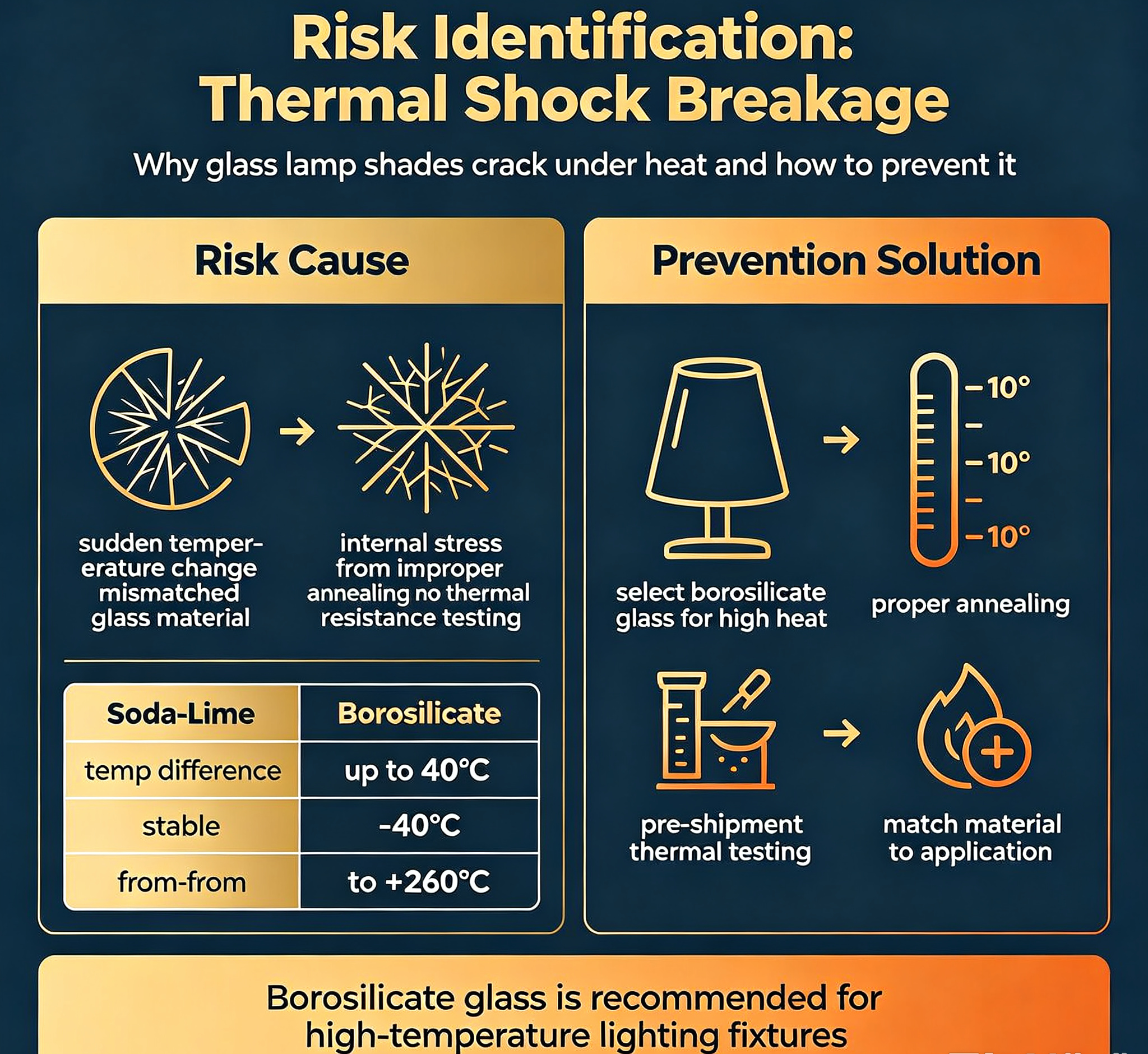
Thermal shock emerges when differential expansion inside a shaded globe exceeds the glass's tolerance. Material choice — soda-lime or borosilicate 3.3 — determines that tolerance.
A separate cause is invisible at inspection: internal stress retained from production. Proper annealing during production removes internal stress and prevents spontaneous breakage of glass lamp shades, which is why annealing control is a legitimate purchasing question rather than a technical footnote.
Borosilicate glass improves thermal tolerance; it does not remove the need to fit and install a shade correctly. A borosilicate globe forced onto an incompatible holder can still fail mechanically.
Installation handling: where shades break after they have passed inspection
Most installed shades fail either in the first heating cycle or during the first cleaning cycle. The recommended installation process begins with ensuring the lamp fixture is switched off and cool to the touch, then verifying that the fitter opening matches the holder (E27, E14 or G9), sliding the shade onto the holder, securing it with the mounting ring, screws or locking mechanism, ensuring firm seating, reinstalling the bulb, and switching on to verify alignment.
Two additional controls matter for long-term reliability. First, before installation, inspect glass for cracks or chips and do not install damaged shades — this helps prevent breakage during use. Second, handling during cleaning should avoid unnecessary thermal stress: never immerse glass shades in hot water, and avoid ammonia or alcohol-based cleaners on painted, printed or decal finishes.
Incoming inspection for scratches, chips, and transit damage
Damage discovered on arrival almost always traces to one of four sources: inadequate packaging protection, rough handling during transportation, improper loading or unloading, or insufficient pre-shipment inspection for surface defects. The documented response is procedural rather than commercial: inspect all received items immediately, document damage with photographs of both the goods and the packaging, contact the supplier promptly, and treat breakage as a replacement or credit case under warranty terms.
Minor surface scratches are a separate category. Buyers should determine whether a scratch can be polished out or whether it requires replacement, and this determination should be written into the acceptance criteria before the first shipment rather than negotiated claim by claim.
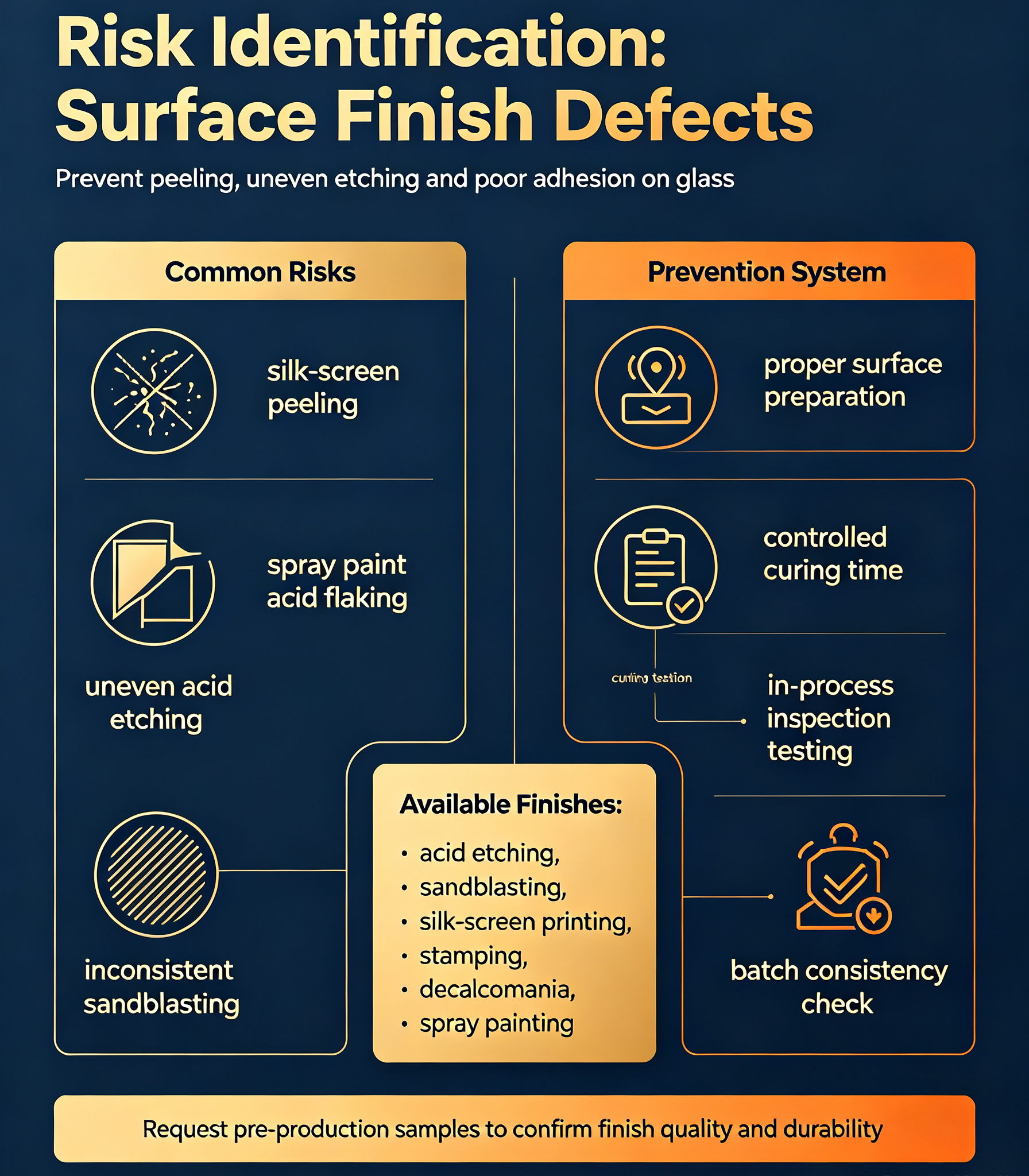
Surface finish defects — uneven etching, inconsistent sandblasting, poor print adhesion — are inspectable at incoming goods and should be defined in acceptance criteria.
Surface finishes are a frequent inspection focus because the process is applied after forming. Acid pickling or etching creates a matte, frosted effect; sandblasting produces an opaque, textured surface; silk-screen printing, stamping, decalcomania and spray painting add logos, patterns, colours and effects. Each stage can introduce adhesion, colour or uniformity defects if curing, drying, ambient conditions or surface preparation are not controlled. Suppliers with dedicated surface-processing lines, in-process inspection at each finishing stage, and finished-product visual inspection for consistency reduce that risk.
For future shipments, buyers can request enhanced packaging — additional foam, thicker dividers or custom inserts — and require pre-shipment photographs of packaged goods to verify packaging quality before shipment. For high-value shipments, SGS third-party loading supervision can be considered to reduce handling and loading risk.
Purchasing acceptance criteria for repeat and annual supply
A fit-and-crack program only becomes durable when it is written into the supply agreement. The commercial terms that surround acceptance are as important as the technical specification.
| Term | Standard position |
|---|---|
| MOQ | Hand-made 500 pcs; machine-made 2,000 pcs (select stock items); custom MOQ negotiable for smaller trial orders |
| Delivery terms | FOB Shanghai (primary); CIF and EXW available on request |
| Acceptance | 100% pre-shipment inspection at the supplier's facility; third-party inspection (SGS) available on request; buyer's inspection on arrival |
| Payment | 30% T/T deposit on order confirmation; 70% T/T balance before shipment; other terms (e.g., L/C) available on request |
| Sample lead time | 5–7 working days after artwork and specification confirmation |
| Mass production lead time | 20–30 working days after sample approval |
For long-term supply arrangements, replacement and claim handling for damaged glass products should be agreed in advance to support repeat orders and annual contracts. This converts a recurring dispute into a defined process.
Certification evidence should be verified rather than assumed. Jingxin Glassware holds 19+ professional certifications, including CE, RoHS, REACH, ISO 9001 and SMETA-4P, and has been granted 16 national patents. Its RoHS report is issued by Intertek (No. 251016112GZU-001) and its SMETA-4P audit by TUV Rheinland (No. ZAA600149732). Buyers should request copies and check expiry dates to keep compliance current.
Where each material and fitting is appropriate
Material choice follows the operating environment rather than the design trend. Opal white glass diffuses light evenly with roughly 45–65% transmission, hides the bulb completely and is recommended for residential, hospitality and commercial ambient lighting where visual comfort matters more than maximum brightness — this is the role of the JX1004 and JX1184 opal shades, which also carry anti-yellowing properties and permanent optical clarity for long-term installations.
Clear and ribbed glass sit at the other end of the same trade-off. The JXHB-002 Clear Ribbed Glass Pendant Shade reaches 85–95% light transmittance and casts decorative refracted patterns, while JXHB-010 frosted cylindrical glass shades are easy to clean and maintain, which makes them suitable for standardized commercial fixtures and long-term repeat supply.
Borosilicate covers the demanding end of the range. JX1830 and JX1832 borosilicate shades offer long service life in harsh industrial and marine conditions, supporting repeat-order and long-term supply requirements where soda-lime would be inappropriate.
The limitation is straightforward and worth stating plainly. Borosilicate adds thermal margin and, in thick-wall form, impact resistance, but it does not reduce light loss — opal bodies and thick walls lower transmission, and higher-tier material raises unit cost. A soda-lime opal globe is the correct answer for a moderate-heat decorative fixture, whereas a borosilicate explosion-proof dome is wasted on a bedside pendant. Matching the material to the environment remains the buyer's decision.
Market signals: trade classification and multi-segment supplier evidence
Two structural signals support a documentation-first approach to sourcing. First, lighting-related glass sits inside a formal customs framework that buyers can reference: glass envelopes including bulbs and tubes, and glass parts for electric lighting, are classified within the glass and glassware schedule (HS chapter 70) in U.S. Census trade documentation. Second, the underlying trade database is large enough to support later benchmarking: UN Comtrade stores more than one billion trade records from 1962, with annual statistics from over 140 reporter countries.
On the supply side, Jingxin Glassware's stated product scope spans glass lamp shades, glass candle vessels, home decoration glass crafts and laboratory glass instruments, and its product pages identify coverage across lighting, home decor, beverage and laboratory segments — a multi-segment footprint rather than a single-category supplier. The company reports export business at 100% of total sales, 1,000+ global clients, and major markets in the USA, UK, Europe, Asia and the Middle East.
Future outlook for long-term custom glass lamp shade sourcing
As lighting buyers move from one-off purchases to annual programs, three practices are becoming the norm: written pre-production specifications with an approval sample, incoming inspection with defined acceptance criteria, and pre-agreed claim handling for damage and fit issues. These practices reduce the two dominant risks in this category, and they also let buyers evaluate a supplier on long-run behaviour rather than a single lot.
Material selection is likely to track the same direction. As high-heat industrial and marine applications continue to specify borosilicate over soda-lime, and as decorative programs continue to rely on opal and frosted finishes, the decision will increasingly be documented as a specification line rather than a subjective judgement.
FAQ
Why doesn't my glass lamp shade fit the lamp holder?
A glass lamp shade usually fails to fit for one of three reasons: dimensional tolerance deviation in manufacturing, a confirmed specification that does not match the actual fixture, or a model mix-up during packaging or shipping. To diagnose it, verify the model number and specifications against the purchase order and product label, measure the actual fitter opening of the received shade and compare it with the written specification, and contact the supplier with photographs and measurements if a mismatch is confirmed. Deviations of up to about 1 mm may be resolvable with fitter adapters or spacers; larger mismatches should be handled as a replacement or exchange under warranty terms. To prevent recurrence, confirm specifications in writing before production and request a pre-production sample for approval.
How do I choose between borosilicate 3.3 and soda-lime glass for a lamp shade?
Choose based on operating temperature and thermal variation, not appearance. Soda-lime glass is the standard material for decorative and ambient lighting and tolerates temperature changes up to about 120 °C, which covers most LED, incandescent and CFL fixtures. Borosilicate 3.3 glass has roughly one-third the coefficient of thermal expansion of soda-lime and is used where temperature swings are large or continuous heat is high — industrial lamp shades, high-heat lighting and demanding environments. Borosilicate improves thermal margin, but it does not remove the need to fit and install a shade correctly, and its higher-tier material raises unit cost.
Why does a glass lamp shade crack under heat, and how is it prevented?
Cracking under heat is caused by thermal shock, use of the wrong glass type in a high-temperature application, internal stress from improper annealing during production, physical impact during installation or cleaning, or a forced fit onto an incompatible holder. Thermal shock occurs when different parts of the glass expand at different rates and the resulting internal stress exceeds the material's strength. Prevention has four parts: select the correct glass type for the fixture's operating temperature, confirm that the shade is not exposed to temperature swings beyond its rating, ensure proper annealing during manufacturing, and verify that the fitter opening matches the holder without forcing.
How should a glass lamp shade be installed to avoid breakage?
The recommended sequence is to switch the fixture off and allow it to cool, verify that the fitter opening matches the holder (for example E27, E14 or G9), slide the shade onto the holder, secure it with the mounting ring, screws or locking mechanism, confirm firm seating, reinstall the bulb, and switch on to verify alignment. Before installation, inspect the glass for cracks or chips and do not install a damaged shade. Clean, dry gloves reduce fingerprints and slippage, and heavy shades require a fixture rated for the weight.
What should I check when glass lamp shades arrive scratched or damaged?
Inspect all received items immediately on arrival and document the damage with photographs of both the goods and the packaging. Contact the supplier promptly with those photographs. Breakage is normally handled by replacement or credit under warranty terms, while minor surface scratches need a determination of whether they can be polished out or require replacement. For future orders, enhanced packaging with additional foam, thicker dividers or custom inserts reduces transit risk, pre-shipment photographs of packaged goods verify packaging quality, and third-party loading supervision can be arranged for high-value shipments.
What purchasing terms and acceptance criteria apply to a long-term glass lamp shade supply agreement?
A standard position sets the minimum order quantity at 500 pieces for hand-made glass and 2,000 pieces for machine-made glass, with negotiable terms for trial orders; delivery is typically FOB Shanghai with CIF and EXW available on request; acceptance relies on 100% pre-shipment inspection at the supplier's facility with third-party inspection such as SGS available on request; payment is commonly 30% T/T deposit on confirmation with the 70% balance before shipment. For long-term supply, replacement and claim handling for damaged glass products should be agreed in advance to support repeat orders and annual contracts. Certifications such as RoHS and SMETA-4P should be requested as copies with current expiry dates.
Reference resource: Glass Lamp Shades Catalogue — Yancheng Jingxin Glassware Co., Ltd.