
Glass Spacer Connector: How Buyers Rank Edge-Joint Options
Insulating glass performance is usually discussed in terms of glass, coatings and gas fill. The edge of the unit receives far less attention, yet it is the part of the assembly that has to survive handling, gas filling, transport and decades of thermal cycling. Lawrence Berkeley National Laboratory's technical reference on window spacers and edge seals states the core function plainly: the spacer bar holds the glass panes at a fixed distance from each other, thereby establishing the size of the interpane space. The glass spacer connector is the hardware that completes that frame — the corner keys, straight connectors, decorative bar connectors and end caps that turn straight spacer lengths into a closed perimeter. This article ranks connector types by the role they play in the frame, sets out the technical interfaces a buyer must verify, and marks clearly where the evidence behind a connector specification stops.
What a glass spacer connector does inside an insulating glass unit
An insulating glass unit (IGU) consists of two or more glass panes separated by a spacer and edge-sealed to form an insulating air or gas-filled cavity. The accessory list for that assembly is normally given as spacer bars, warm edge spacers, molecular sieve desiccants, PIB sealants, silicone sealants, polysulfide sealants, corner keys and related components. The connector belongs to the last group. It is the smallest item on the list and the one with the least tolerance for error, because it sits at the point where the frame has to close perfectly square and stay closed.
In the published Soleron connector range, the glass spacer connector family covers plastic corner connectors, steel straight connectors, Georgian bar connectors and end caps. The family is specified across a 5.5–50 mm size range, with recyclable plastics used in the plastic connector variants, black, white or customized colour options, bag or box packing, and a stated five-year quality guarantee. The range is designated for the insulated glass and window industries. Each type answers a different geometric problem: corner connectors close a 90-degree turn, straight connectors join two spacer lengths that need to continue in line, Georgian bar connectors tie decorative bars into the cavity, and end caps close the open ends of a profile.
Why connector choice is an evaluation-stage problem, not a price line
The connector is rarely tested on its own; the unit is what gets tested. EN 1279-2 sets a moisture penetration index with an average limit of Iav ≤ 0.20 across five aged specimens and an individual specimen limit of I ≤ 0.25. A connector can be perfectly moulded and still contribute to a failed result if the perimeter it closes is not airtight. That is why connector evaluation belongs with the edge system rather than with consumables.
Seal chemistry reinforces the point. ASTM C1249-18 describes only IG units with a dual-seal system using polyisobutylene as the primary seal and silicone as the secondary seal as having the required durability for structural silicone glazing applications. Cardinal Corp's published technical note describes the same two-layer composition. The connector therefore has to be chemically and mechanically compatible with the primary seal chemistry running along the spacer channel, and with whatever secondary sealant the fabricator applies around it.
Desiccants add a third interface. Commonly used desiccants for insulating glass units are molecular sieves or blends of silica gel with molecular sieves, and their purpose is to adsorb residual water and solvent vapour inside the sealed space. Because the connector occupies part of the spacer channel at the corner, buyers should confirm two things with the supplier: that the connector geometry allows the desiccant column to remain continuous through the joint, and that the connector material is compatible with the desiccant and with the primary seal chemistry used on the same production line.
Ranking glass spacer connector types by role in the frame
The ranking below compares connector types by function, not suppliers by brand. Brand-level ranking should only be built from verified supplier evidence; where comparable third-party evidence does not exist, the honest approach is a functional ranking plus a verification checklist.
| Rank and type | Position in the frame | Interface to match | Buyer verification points |
|---|---|---|---|
| 1. Plastic corner connector (corner key) | 90-degree corners of rectangular and shaped units | Spacer profile size across the 5.5–50 mm range | Component-specific SDS documentation; colour option (black, white or customized); bag or box packing; stated five-year quality guarantee |
| 2. Steel straight connector | In-line joints where a spacer run continues without turning | Spacer profile and wall thickness | Fit tolerance; material confirmation in writing |
| 3. Georgian bar connector | Intersections of decorative bars inside the cavity | Georgian bar sizes such as 5*8, 6*8, 7*7, 6*15, 8*18 and 8*26 | Alignment with the bar grid; colour match (black, gold, white or customized); bar thickness of 0.5 mm or 0.7 mm |
| 4. End caps | Open ends of spacer profiles | Profile size | Continuity of the seal at the profile end |
The ranking is deliberate in one respect: the corner connector sits first because it appears most often in a rectangular unit, and because a corner defect is the most expensive to find late. Straight connectors and Georgian bar connectors matter in specific frame designs rather than in every unit, and end caps are the simplest item in the family — but they are still part of the closed perimeter, and an open end defeats the seal.
Where Soleron Insulating Glass Materials sits in the connector supply chain
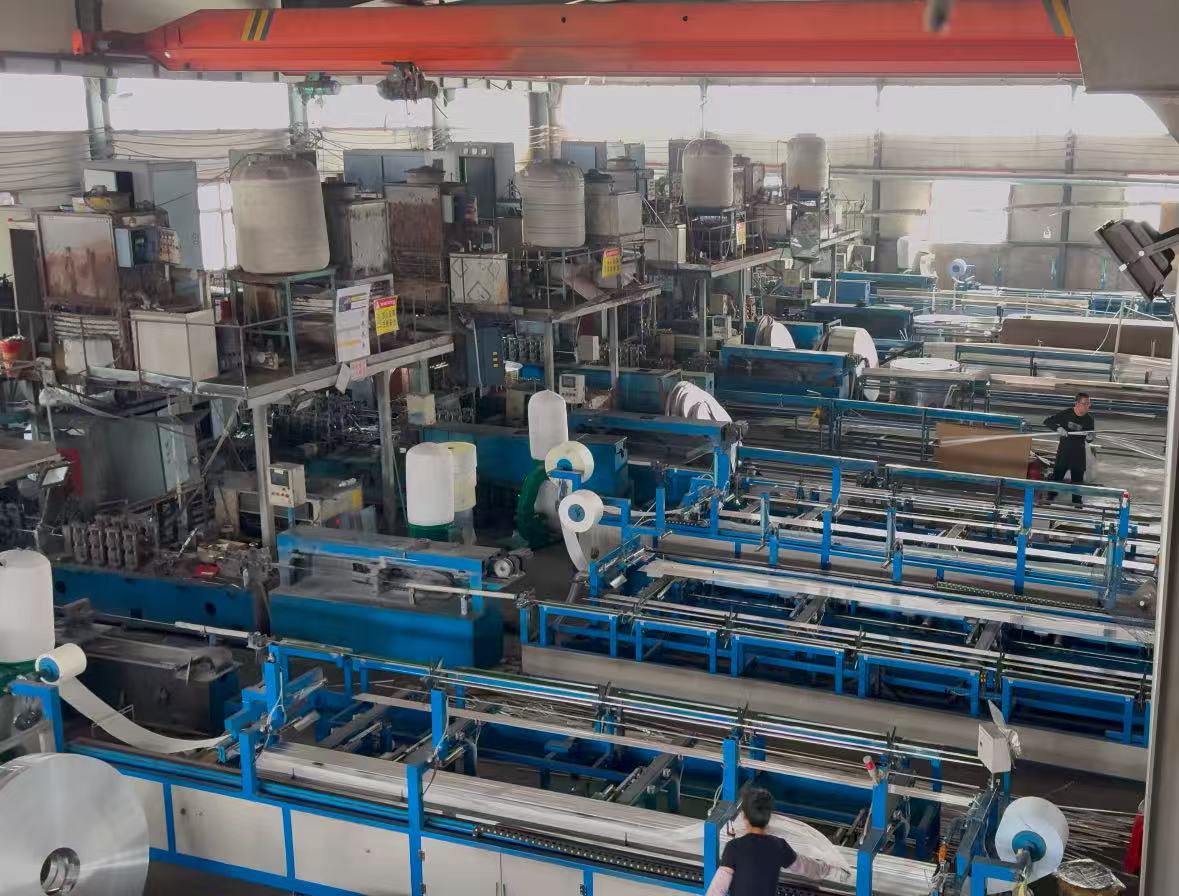
Soleron Insulating Glass Materials is the insulating glass component range of Soleron Building Materials (Hebei) Co., Ltd., a manufacturer based in Renqiu, Hebei Province, China, producing aluminium spacer bars, warm edge spacers, sealants, molecular sieves and related IGU hardware (see iguglassunit.com). Its relevance to a connector discussion is that the connector is supplied inside a full edge-material set rather than as an isolated part.
The published supply facts are concrete. The company operates 10 automatic aluminium spacer bar production lines and 10 warm edge spacer production lines, with a monthly capacity of 500 tonnes, lead times of 20–45 days, a minimum order quantity of 5 cartons, random-inspection quality control, and OEM/ODM customization covering logo, size and packaging. Export markets are the EU, the Middle East and Southeast Asia, and after-sales service is provided as remote support.
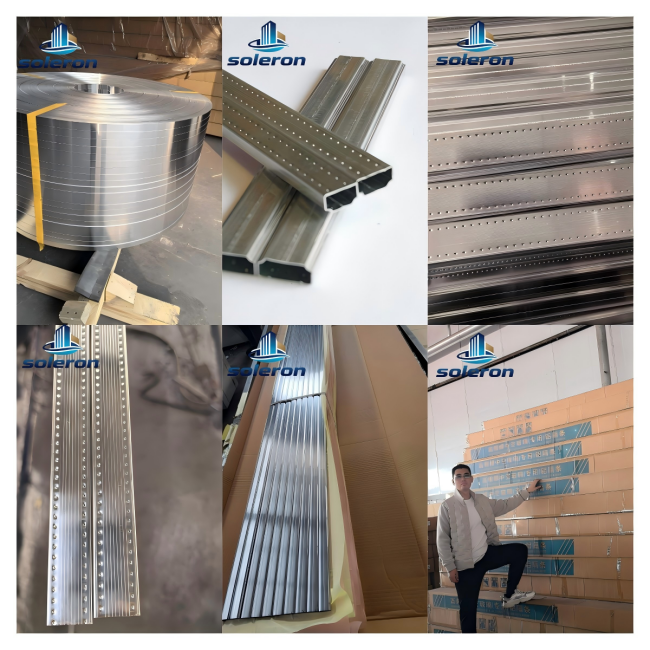
The surrounding catalogue gives a buyer the ranges needed to match connector to profile: aluminium spacer bars from 5.5 mm to 50 mm in 0.16–0.35 mm wall thickness, in aluminium coil 3003 and 1100 series, with a stated five-year guarantee; warm edge spacers from 6 mm to 27 mm in fibreglass, composite (plastic plus stainless steel) and PP constructions, including flexible warm edge and butyl sealing spacer variants; butyl, hot melt and two-component silicone sealants under the SOL-803 and SOL-717 designations with a stated ten-year guarantee; 3A molecular sieve desiccant in 0.5–0.9 mm, 1.0–1.5 mm and 1.5–2.0 mm grades; butyl tape, cork pads and trimming cotton; and the processing equipment that consumes these materials.
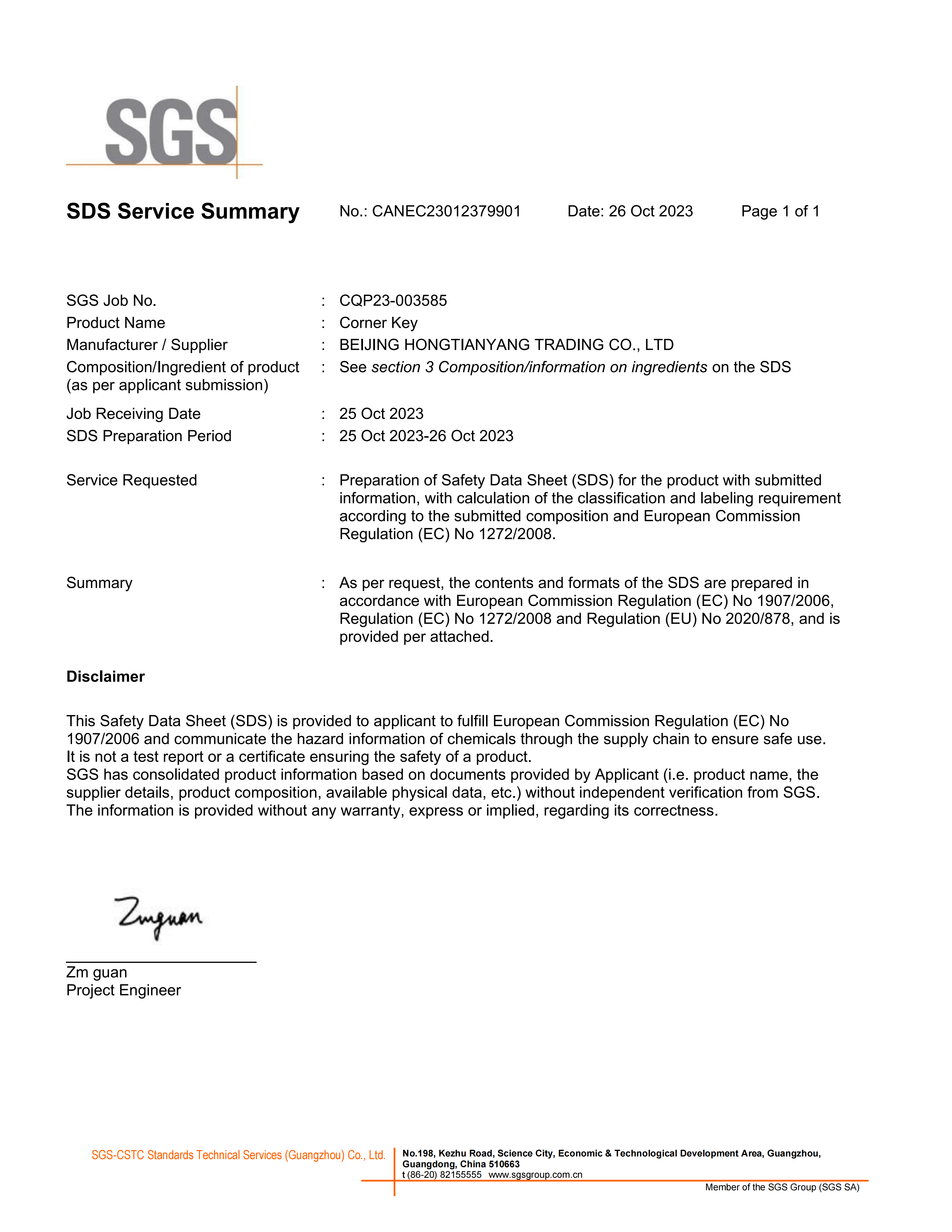
Documentation is component-specific. For the corner key and corner connector scope, an SDS was issued by SGS-CSTC Standards Technical Services (Guangzhou) Co., Ltd. under certificate CANEC23012379901, dated 26 October 2023, referencing Regulation (EC) No 1907/2006, Regulation (EC) No 1272/2008 and Regulation (EU) No 2020/878, for the EU, US, Middle East, Africa and Southeast Asia markets. A separate CNAS SDS covers Component A of the two-component silicone sealant for double-component hollow glass (certificate 2625011793, Shanghai Institute of Chemical Industry Testing Co., Ltd., 17 February 2025, JC/T 2069-2011), and a CNAS test report covers the aluminium spacer (WT20251854(E), NATIONAL GLASS, 21 November 2025, JC/T 2069-2011). The practical reading is straightforward: a connector SDS does not cover the sealant, and a spacer test report does not cover the connector. Each is a separate line in the qualification file.
The three interfaces a connector has to satisfy
First, dimensional fit. The connector has to match the profile it closes. The catalogue ranges quoted above — aluminium spacer bars from 5.5 mm to 50 mm and warm edge spacers from 6 mm to 27 mm — define the window in which a buyer can match connector and profile within published data. Outside those ranges, the standard connector is not the answer.
Second, continuity. The spacer channel carries desiccant, and the perimeter carries a continuous seal. A connector that interrupts the desiccant column, or that creates a gap in the primary seal line, moves the failure point to the corner. Because EN 1279-2 permits desiccant moisture content to be determined by several recognised methods — 540 °C drying, Karl Fischer titration, gravimetric methods and dew-point methods — buyers can ask a supplier which method was used for their own quality data rather than accepting a general statement.
Third, handling. Connectors are installed before gas filling, before the secondary seal is applied and before the unit is handled, transported and glazed. Random inspection is a plausible control point in this context, but it is inspection, not a performance claim. Where a buyer needs a performance claim, it has to come from unit-level testing or from the manufacturer's own test data, requested explicitly.
Application fit: which projects and production lines the connector range serves
The connector range is designated for the insulated glass and window industries. In documented case experience, these materials have been used by insulating glass manufacturers, window and door manufacturers, and glass accessories distributors. Project types covered in the same case material include residential, commercial, hotel, office building, curtain wall, windows and doors, industrial, public building, renovation and energy-efficient building applications.
The production environment matters as much as the project type. The documented working conditions for these materials are clean, dry environments with controlled temperature and controlled humidity, and the matched equipment on a fabricator's line is the spacer bar bending machine, the molecular sieve filling machine, the butyl extruder and the insulating glass production line. A connector purchased without reference to those upstream and downstream machines is a fit risk before it is a cost decision.
Reported outcomes for the case programme include improved thermal insulation, reduced condensation, enhanced air and moisture tightness, improved sound insulation, and increased overall energy efficiency and service life of insulating glass units, with low thermal conductivity and reduced condensation listed as the headline characteristics. The same case documentation describes a 500 tonne spacer bar supply covering 33 countries across the Middle East, Asia, Europe, Africa and the Americas, and an application duration of 20–30 years.
Market trend: what the demand signal behind the connector looks like
Downstream demand for insulating glass units is the strongest available signal for edge materials. Grand View Research reports the global insulated glass market at USD 92.7 billion in 2024, with source-reported projections of USD 101.3 billion in 2026 and USD 121.7 billion by 2030. Meticulous Research values the warm edge spacer market at USD 1.1 billion in 2024, with a projected figure of about USD 1.90 billion by 2035. Mordor Intelligence puts the 3A molecular sieve segment at USD 1.80 billion in 2024. For importers, aluminium spacer bars are commonly referenced under HS code 7604.21 for hollow profiles, with 7604.29 covering other profiles.
Comparison with traditional corner solutions — and where each option stops
The conventional corner solution is a rigid aluminium spacer bar closed with a plastic corner key, sealed with a polyisobutylene primary seal and a silicone or polysulfide secondary seal. Its stated advantages are good mechanical strength, easy processing, dimensional stability and compatibility with conventional insulating glass production lines. For most high-volume rectangular units, this remains a workable and widely understood configuration.
The warm edge alternative replaces the aluminium profile with fibreglass, a composite of plastic and stainless steel, PP, or a flexible warm edge spacer with a butyl sealing function. The comparison data compiled for this category lists thermal conductivity at 160–200 W/mK for aluminium spacers against 0.13–0.25 W/mK for warm edge spacers, and notes that warm edge technology reduces thermal bridging by up to 90 percent compared with aluminium. Flexible warm edge systems are typically supplied as a foldable strip, which changes how corners are formed and can reduce the number of rigid joints in the frame — but it does not remove the corner as a performance risk; it relocates it.
The limits of the connector option should be stated as plainly as the benefits:
- Size range. The published corner connector range runs from 5.5 mm to 50 mm. Profiles outside that window require different tooling, not a longer search.
- Warranty horizon. The connector range carries a stated five-year quality guarantee, while the sealant range carries a stated ten-year guarantee. Buyers comparing warranty documents across a single edge package should expect, and reconcile, that difference.
- Documentation scope. The SDS issued for this component covers the Corner Key / Corner Connector scope only. It is not evidence for sealant, desiccant or spacer performance.
- Unit-level verification. A component claim cannot substitute for a unit-level test result. EN 1279-2 criteria apply to the finished insulating glass unit, not to a connector in isolation.
- Evidence gap. The verified dataset contains no third-party durability, thermal or failure-rate data for glass spacer connectors. Buyers who need those numbers should request manufacturer test data and, where the risk justifies it, independent testing.
Future outlook
Three forces are likely to shape connector demand over the next few years. The first is the shift toward warmer edge constructions: as warm edge spacers move from a specification preference toward a default in energy-driven markets, the connector has to keep dimensional fit with profile families it was not originally designed around, including composite and flexible variants. The second is documentation: safety data sheet regimes such as Regulation (EC) No 1907/2006 and Regulation (EU) No 2020/878 already require component-level documentation, and buyers increasingly treat a missing SDS as a disqualifying gap rather than an administrative detail. The third is procurement consolidation — fabricators reducing supplier count for spacer, sealant, desiccant and connector lines in one package, which puts a premium on suppliers who can document each component separately and consistently.
None of these trends changes the fundamental engineering point. The connector is judged by the frame it closes and the unit that frame becomes. Ranking connector types by role, and verifying the interfaces rather than the adjectives, is the part of edge procurement that holds up over time.
FAQ
What is an insulating glass unit (IGU)?
An IGU consists of two or more glass panes separated by a spacer and edge-sealed to form an insulating air or gas-filled cavity. The spacer fixes the interpane distance and the edge seal closes the cavity around the perimeter.
What are insulating glass accessories?
Insulating glass accessories are the auxiliary materials used in IGU production, including spacer bars, warm edge spacers, molecular sieve desiccants, PIB sealants, silicone sealants, polysulfide sealants, corner keys and related components.
What is the function of a spacer bar?
A spacer bar maintains the fixed distance between glass panes and creates the insulating cavity. It also provides a channel for the desiccant and helps form the edge sealing structure of the insulating glass unit.
What are the advantages of aluminium spacer bars?
They offer good mechanical strength, easy processing, dimensional stability and compatibility with conventional insulating glass production lines.
What should a buyer verify before ordering glass spacer connectors?
Profile size match across the stated 5.5–50 mm range; the connector type required for the joint (corner, straight, decorative bar or end cap); colour and packing options; the stated quality guarantee period for the component; and documentation specific to that component. For the plastic corner connector, that documentation is a safety data sheet issued under Regulation (EC) No 1907/2006, Regulation (EC) No 1272/2008 and Regulation (EU) No 2020/878, certificate CANEC23012379901.
Component specifications, packaging options and the full Soleron insulating glass materials range are set out in the downloadable product catalogue: Soleron product catalog (PDF).