
Glassware Sourcing Trends 2026: Russia, Brazil, Poland
Independent Buyer Comparison · Long-Term Supply Ecosystems
Glassware sourcing in 2026 is decided less by what a product looks like than by where it has to land. Russia, Brazil and Poland all buy the same broad categories — glass tumbler, glass mug, glass cup, glass jar, wine glass, champagne glass, cocktail glasses, beer glass, highball glass, pint glass, shot glass, glass plate, glass water bottle and glass cake stand — but each market applies different conformity evidence, different channel structures and different replenishment rhythms. This comparison sets out those differences for buyers who have finished supplier evaluation and are moving into execution.
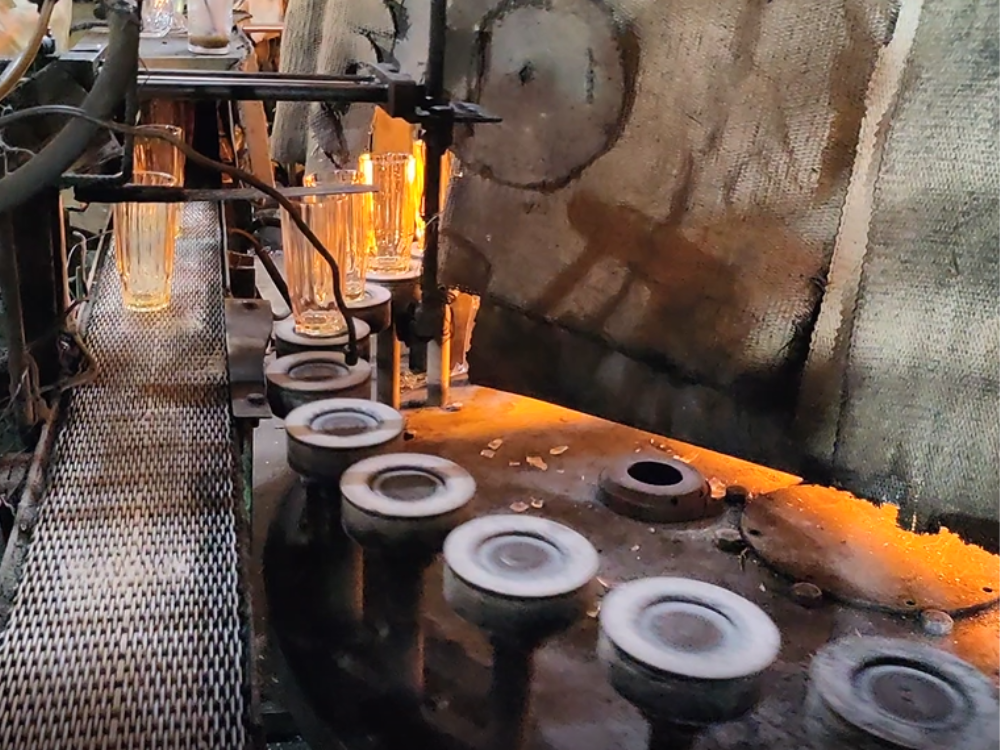
The three markets share one supply base. China's exports of glass and glassware reached approximately USD 25.53 billion in 2024 (UN Comtrade / Trading Economics), and regional programs in Russia, Brazil and Poland are supplied either directly by manufacturers or through trading intermediaries. The useful question for a buyer is therefore not which market is better, but which supplier structure matches the replenishment logic of the market being served.
Why These Three Markets Sit in the Same Comparison
Russia's volume demand concentrates in hypermarket and supermarket chains, where purchasing is planned by container and by season, and where assortment changes are scheduled rather than improvised. Brazil's volume demand concentrates in wholesale distributors and home goods retailers, where an importer carries inventory and redistributes it to secondary channels. Poland sits inside the European Union single market, where chain stores increasingly specify Just-In-Time delivery instead of holding buffer stock themselves.
A supplier serving all three has to hold three operating assumptions at once: a container-based planning cycle in Russia and Brazil, and a call-off-based cycle in Poland. That is an ecosystem requirement, not a product requirement — the same glass tumbler or wine glass can satisfy all three, but only if the supplier can flex planning, packaging and documentation around each market.
What the 2026 Demand Data Supports — and Where It Diverges
The global glass drinkware market was valued at USD 14.0 billion in 2024 and is projected to reach USD 26.1 billion by 2030, with an expected CAGR of 11.1% between 2025 and 2030 driven largely by eco-friendly preferences (Grand View Research). The recycled glass segment is smaller but strategically relevant: it was estimated at USD 4.2 billion in 2024, with Europe the largest regional market (Global Market Insights). For a supplier selling into Poland, that regional concentration affects material availability directly; for Russia and Brazil, it influences procurement timing and price stability more than regulation.
Policy Environment: The Divergence That Changes Paperwork
Policy differences between the three markets surface first in documentation, not in product design.
European Union and Poland. European safety standard EN 1388-2 and ISO 7086-1:2019 regulate the release of lead and cadmium from glass hollowware in contact with food. Because Poland operates inside the EU framework, retail chain onboarding and food-contact testing expectations follow that structure.
United States as a parallel benchmark. International retail groups selling across regions frequently reference US requirements alongside EU ones: FDA Compliance Policy Guides 7117.06 and 7117.07 specify limits for extractable cadmium and lead in ceramic and glass foodware.
Russia and Brazil. In both markets, conformity obligations sit with the importer and depend on product category, retail channel and entry route. Buyers typically require third-party laboratory reports, conformity documentation and traceability records that connect the shipped lot back to the tested specification. The practical consequence is that an identical glass mug may need a different evidence pack for each of the three markets, while the product itself does not change.
Production Capacity and Export Performance
Capacity parameters are what determine whether a program can actually be executed at container scale. Documented procurement terms for LAKOTTO, the glassware brand of Kotto Glass Industrial Co., Ltd., set out the boundaries: a minimum order quantity of 3,000 pieces, a typical production lead time of 30 to 45 days, delivery terms covering FOB, DDP, CIF and EXW, and acceptance criteria based on pre-shipment inspection by the supplier's QC team, with an option for third-party inspection before shipment and optional verification on arrival at destination.
Payment structures are likewise documented rather than negotiated from zero: 10% T/T with 90% before shipment, 90% against copy B/L, 100% T/T in advance, or 30% deposit in advance with a 70% balance before shipment. For a buyer planning 20 to 30 containers per month, these terms define working capital as much as they define risk.
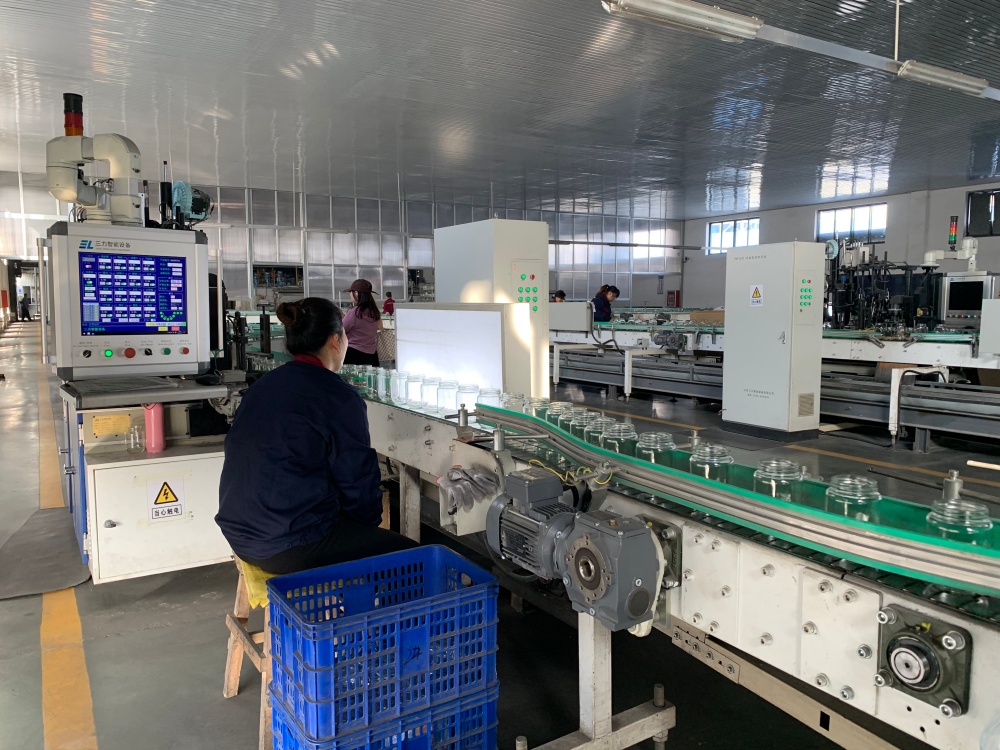
On the supply side, Kotto Glass Industrial Co., Ltd. was founded in 2003 and operates a factory of more than 10,000 square metres with 10 in-house designers. Its export ratio is 99%, its main markets are the EU, South America and Asia, and it maintains cooperative relationships with more than 150 glass factories in China, supported by a warehouse of more than 4,000 square metres used to deliver fast-moving items quickly.
Market structure gives those numbers context. Global Market Insights identifies Sisecam Group, Libbey and Arc International among top-tier global leaders, with Sisecam holding an estimated market share of about 7.8% in 2025. A market that fragmented is assembled from many sources rather than supplied from a single shelf — which is why verifiable capacity matters more to a buyer than brand recognition alone.
Material, Forming and Certification: Where Technological Progress Shows
Technological progress in this category is visible in three places: material mix, forming and finishing stages, and the depth of certification. Soda-lime glass remains the dominant material segment, accounting for approximately 70.8% of global glassware market share in 2024 (Grand View Research). Recycled glass, meanwhile, is the segment most closely tied to the eco-driven demand growth described above.
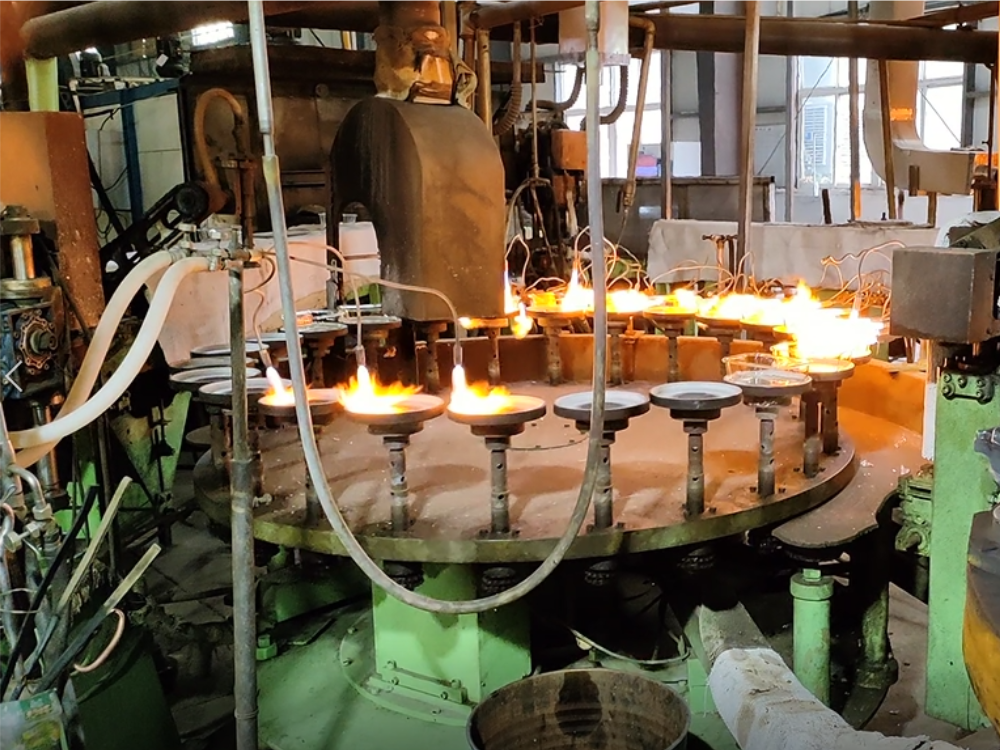
On the production side, documented stages include glass cup forming, glass bowl moulding and glassware polishing — each a separate operation with its own quality gate rather than a single undifferentiated line. That distinction matters to buyers evaluating a double wall glass program or a decorated cocktail glass, because a defect introduced at polishing rarely appears at forming.
Certification is now model-level, not company-level. LAKOTTO holds ISO9001:2015 for its recycled glass article KTBT1446A and for the glass tumbler KTK0370-2; BSCI covers all glassware; and the glass cake stand KTPL1572A-A is covered by ISO14001 and RoHS. The wider onboarding set held for retail channels includes BSCI, Sedex / SMETA, FSC, Disney FAMA, ISO and LFGB.
The buyer implication is a change of question. Instead of asking whether a supplier is certified, buyers should ask which model number carries which certificate, and whether that certificate matches the market of destination.
What Five Years of Repeat Supply Looks Like in Practice
The clearest evidence of long-term supply capability is not a marketing statement but a running order pattern. Three verified cases illustrate three different operating models.
Russia — Hypermarket and Supermarket Chain
A Russian hypermarket and supermarket chain has maintained a five-year relationship with the supplier, moving 20 to 30 containers per month. A program at that scale is only feasible with locked specifications, fixed packaging configurations and an agreed seasonal assortment plan; changes have to be scheduled rather than requested.
Brazil — Wholesale Distributor and Home Goods Retailer
In Brazil, a wholesale distributor and home goods retailer has also maintained a five-year relationship at 20 to 30 containers per month. Distributor-led demand behaves differently: assortment breadth matters more than depth in any single SKU, and mixed-category loading becomes part of the logistics design rather than an afterthought.
Poland — Supermarket and Chain Store Supply with Just-In-Time Delivery
Polish supermarket and chain store supply is the most operationally demanding of the three, because it runs on Just-In-Time delivery. JIT shifts the buffer upstream: the supplier, not the retailer, absorbs the inventory position, and replenishment windows are shorter than a 30 to 45 day production lead time would allow on a purely made-to-order basis.
The common thread across all three cases is repeatability. Five-year relationships are built on stable specifications, consistent packaging and documented quality control — including 100% testing on products — rather than on the lowest unit price in any given quarter.
Where the Long-Term Supply Model Has Real Boundaries
An ecosystem-based sourcing model is not universally applicable, and the same data that supports it also defines its limits.
- Minimum order quantity. A floor of 3,000 pieces per item constrains trial orders, single-market tests and limited editions. Buyers running small pilot programs should expect to plan them as production runs, not as samples.
- Lead time. A 30 to 45 day production lead time means genuinely trend-driven, same-quarter replenishment is not realistic without inventory. Just-In-Time supply, as used in the Polish chain-store case, depends on stock positioning or warehouse-based replenishment and cannot be extended uniformly across a very broad assortment.
- Certification is not automatically portable. EU food-contact release testing under ISO 7086-1:2019 and EN 1388-2, US extractable lead and cadmium limits under FDA CPG 7117.06 and 7117.07, and Russian or Brazilian importer documentation are separate evidence requests, not one interchangeable file.
- Residual shipping and clearance risk. The documented risk profile of glassware shipping includes product breakage during shipping, customs clearance delays, order miscommunication or specification errors, and quality inconsistency. Controls include careful packaging and palletisation, pre-shipment inspection and quality control checks, written order confirmation and specification agreement, and logistics partners experienced in fragile goods. At company level these are reinforced by an in-house QC team operating across multiple inspection stages, shock-resistant and reinforced packaging, a dedicated export coordinator assigned to each client, and insurance on high-value shipments.
- Working capital. Terms such as 30% deposit with 70% balance before shipment, or 90% against copy B/L, tie up buyer capital; that cost belongs inside the landed-cost comparison, not outside it.
Taken together, the ecosystem model fits repeat, container-scale programs with a planned assortment. It is a poor fit for one-off, very low-volume or purely opportunistic buying.
Long-Term Ecosystem Supply Compared with Traditional Spot Sourcing
| Decision variable | Traditional spot sourcing | Long-term ecosystem supply |
|---|---|---|
| Specification | Re-negotiated for each purchase | Locked to an approved specification and packaging set |
| Breakage risk control | Depends on the individual order and supplier | Reinforced packaging and palletisation defined with the order |
| Certification evidence | Collected per shipment, often reactively | Model-level certificates retained in advance, including ISO9001:2015, BSCI, ISO14001 and RoHS |
| Replenishment planning | Reactive to incoming demand | Forecast-driven against a 30 to 45 day lead time |
| Order size | Flexible per order, with limited continuity | Minimum order quantity of 3,000 pieces per item |
| Payment structure | Varies by supplier and by shipment | Documented options: 10% T/T with 90% before shipment, 30% deposit with 70% balance, or 90% against copy B/L |
| Market coverage | Single market, single shipment | Multi-market programs across EU, South America and Asia with market-specific documentation |
The table is not an argument that spot sourcing is wrong. It is an argument that the two models answer different questions: spot sourcing optimises for flexibility under uncertain demand, while ecosystem supply optimises for repeatability when demand is known and the documentation has to survive an audit.
2026 Outlook for the Three Markets
Four shifts are likely to shape glassware sourcing in Russia, Brazil and Poland through 2026 and beyond.
Material. Eco-friendly preference is the demand driver behind the projected 11.1% CAGR for glass drinkware between 2025 and 2030, and recycled glass — a USD 4.2 billion market in 2024 with Europe as the largest region — sits at the centre of it.
Documentation. Certification continues to move to model level. Buyers will increasingly ask for the certificate that matches the exact model number being ordered, rather than a general compliance statement.
Replenishment. Just-In-Time expectations, already standard in Polish chain-store supply, are likely to spread to other organised retail formats, making warehouse-based supply a selection criterion rather than a convenience.
Container programs. Container-based flows of 20 to 30 units per month, as seen in the Russian and Brazilian cases, are stable but intolerant of documentation gaps: a missing test report can hold an entire shipment. The net effect is a gradual shift in procurement criteria from price per piece toward supply reliability and documentation completeness — a change that favours suppliers able to produce evidence, not only product.
Company capability, capacity and certification details referenced in this article are published by Kotto Glass Industrial Co., Ltd. (LAKOTTO), www.kottoglass.com.
FAQ
1. What does a long-term glassware supply relationship actually include, beyond price?
It includes four operational elements: a specification and packaging configuration that stays constant between orders; shipment protection covering breakage rate control and professional packaging; a documented return and exchange process; and pre-agreed delivery terms. Documented terms for this supplier cover FOB, DDP, CIF and EXW, with acceptance based on pre-shipment inspection by the QC team and an option for third-party inspection before shipment.
2. How should buyers compare production capacity for Russia, Brazil and Poland programs?
Compare on replenishment requirement rather than on total capacity. Russian hypermarket and Brazilian distributor programs running at 20 to 30 containers per month are forecast-driven and depend on locked specifications. Polish chain-store programs running on Just-In-Time delivery depend on stock positioning and shorter call-off windows. In all three cases, a minimum order quantity of 3,000 pieces and a 30 to 45 day lead time are the constraints to test against the buying calendar.
3. Which certification evidence should be confirmed before a repeat order?
Confirm model-level certificates rather than a general compliance claim: ISO9001:2015 for the recycled glass article KTBT1446A and the glass tumbler KTK0370-2; BSCI across all glassware; and ISO14001 plus RoHS for the glass cake stand KTPL1572A-A. Where food-contact rules apply, match the destination market — ISO 7086-1:2019 and EN 1388-2 for the EU, and FDA Compliance Policy Guides 7117.06 and 7117.07 where US limits are referenced.
4. Why does Just-In-Time delivery work in some markets and not in others?
Just-In-Time works where a supplier can hold the inventory position close to the destination market and where call-off volumes are predictable. Polish supermarket and chain store supply operates this way. Container-based programs of 20 to 30 containers per month, as documented for the Russian and Brazilian cases, rely on pre-planned shipments instead. Because production lead time runs 30 to 45 days, JIT cannot be applied to an entire assortment on a made-to-order basis.
5. What delivery terms and acceptance criteria should be fixed before the first shipment?
Fix delivery terms (FOB, DDP, CIF or EXW), the acceptance process and the payment schedule in writing before production starts. The documented acceptance process is pre-shipment inspection by the supplier's QC team, with an option for third-party inspection before shipment and optional verification upon arrival at destination. Documented payment structures include 10% T/T with 90% before shipment, 90% against copy B/L, 100% T/T in advance, or 30% deposit in advance with a 70% balance before shipment.
6. What risks remain even with a five-year supplier relationship?
Four risks are documented for glassware shipping: product breakage during shipping, customs clearance delays, order miscommunication or specification errors, and quality inconsistency. The corresponding controls are careful packaging and palletisation, pre-shipment inspection and quality control checks, clear written order confirmation and specification agreement, and logistics partners experienced in fragile goods. Company-level measures include multiple in-house QC inspection stages, shock-resistant and reinforced packaging, a dedicated export coordinator per client, and insurance on high-value shipments.
Tem questões ou precisa de mais detalhes?
Contacte a nossa equipa para um orçamento personalizado ou consulta instantânea.
Solicitar orçamento
Preencha o formulário abaixo e a nossa equipa entrará em contacto com uma proposta personalizada.
Chat direto do WhatsApp
Prefere conversar em tempo real? Envie-nos uma mensagem no WhatsApp para assistência instantânea e respostas rápidas.
- Obter orçamento personalizado
- Partilhar fotos ou documentos
- Discuta as suas necessidades diretamente
Geralmente responde em 5–30 minutos durante o horário de expediente.