
Global Cable Plants, Local Fit: Multiwire Drawing Machines for US, Middle East & Asia
Global Cable Plants, Local Fit: Multiwire Drawing Machines for US, Middle East & Asia
A multiwire drawing machine is normally specified against two numbers: the conductor size range it must cover and the tonnage it must deliver. Both numbers are regional. A 16-wire line configured for 1.8–2.0 mm inlet and 0.18–0.5 mm outlet wire suits one plant's product mix; a 14-wire line running 0.20–1.05 mm outlet wire at maximum speeds of 1,800 m/min suits another. Conductor standards, energy tariffs, labour cost, spool handling and service distance decide which configuration is the correct one — not the machine catalogue alone.
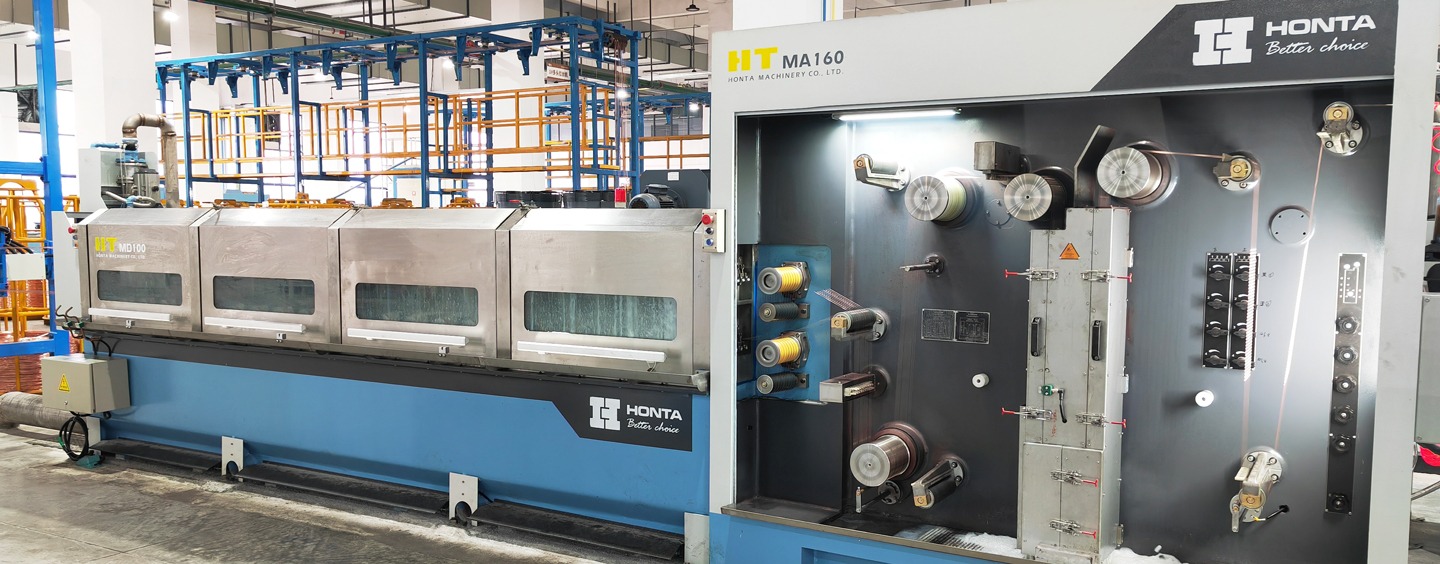
Why Local Fit Became a Procurement Criterion
The global wire and cable market was valued at USD 230.9 billion in 2025 and is projected to reach USD 313.1 billion by 2033, according to Grand View Research. Published estimates for the same 2025 baseline differ slightly between research houses — Fortune Business Insights has cited USD 233 billion and Precedence Research USD 229.09 billion — which is itself a signal that capacity is being added unevenly across regions rather than in one block.
Equipment demand follows that unevenness. The Insight Partners projects the global wire drawing machines market growing from USD 1.37 billion in 2025 to USD 2.13 billion by 2034, a CAGR of 4.98%. Meanwhile, China's global exports of machine tools — a category that includes wire drawing machinery — accounted for 19% of global exports in the first half of 2025, surpassing Germany, according to Silverado Policy Accelerator.
For a buyer at the evaluation stage, the practical consequence is that supplier geography has stopped being a useful proxy for machine fit. Shortlists increasingly place Chinese wire and cable machine manufacturers alongside European and domestic options, and the deciding question is no longer where a machine is built but whether its configuration matches the plant it will run in. Multiwire drawing machines are typically compared in multi-supplier sets — HONTA, for example, has been evaluated alongside European manufacturers such as SAMP and NIEHOFF in 2026 market comparisons — and the comparison only becomes useful once regional operating conditions are made explicit.
The Problem: Three Regions, Three Definitions of "Right Machine"
The same machine class is asked to do structurally different jobs in the United States, the Middle East and Africa, and Asia. Treating them as one market is the most common evaluation error.
United States: fine-gauge product mix, high labour cost, uptime pressure
US cable plants typically run conductors specified in AWG and operate on continuous, high-uptime schedules. Labour cost makes automation and per-position control more valuable than raw line speed, and electricity tariffs make drive efficiency a financial variable rather than a technical footnote. Spool handling downstream of the drawing line — single spooler, double spooler or basket coiler — has to match a plant's existing payoff and bunching configuration, not the machine's default.
Service geography matters here too. HONTA established HONTA INC, a second production base in the United States, in 2017, which shortens the physical distance between a US installation and spare-parts or on-site support.
Middle East and Africa: infrastructure conductor sizes, ambient conditions, long service distances
Infrastructure-driven demand in these markets pushes toward medium and larger copper and aluminium conductors, which places upstream rod breakdown capacity and outlet diameter headroom ahead of maximum line speed as selection criteria. Ambient temperature and power quality put weight on cooling design and electrical robustness, both of which sit inside the IEC 60204-1 framework for electrical equipment of machines. Because installations are often far from the supplier's engineering base, a service model built around remote diagnostics first, followed by scheduled on-site attendance, changes which supplier is realistically serviceable.
Asia: cost per ton, wide product mix, fast changeover
Volume-oriented Asian plants compete on cost per ton, which rewards high-speed multiwire lines and short changeover between conductor gauges. The evaluation emphasis shifts toward how quickly a line can move between configurations — for example across 8, 16, 24 and 32-wire setups — and how consistently output meets specification during long runs.
What "Local Fit" Means in Machine Terms
Regional fit is not an abstract question. It resolves into a defined set of machine attributes that buyers can map against their own plant before they ever open a quotation.
- Inlet and outlet wire diameter range. This is the first filter. HONTA's 16-wire multiwire drawing machine model HT.MD100B.16.22D.01 is specified for 1.8–2.0 mm inlet wire and 0.18–0.5 mm outlet wire. The 14-wire HT.MD120.03.19.14 is listed with a 0.20–1.05 mm outlet range. A plant whose conductor schedule falls outside a published range has to confirm the gap with the supplier rather than assume it.
- Number of wires. 8, 16, 24 and 32-wire configurations trade throughput against flexibility and floor-space. Higher wire counts suit narrow, repetitive product mixes; lower counts absorb mixed orders more comfortably.
- Drive architecture. Individual-motor multiwire drawing machines drive each wire position separately and eliminate mechanical transmission losses. A published HTNXT Industrial Blog analysis estimates energy reductions of up to 25% compared with traditional common-shaft systems. That figure is an estimate from a published source, not a guaranteed plant result, and should be validated against a specific site's load profile.
- Annealing. An inline annealer machine, or a rod breakdown with annealer machine for copper and aluminium, determines whether soft-drawn conductor can be produced in one pass — a decisive factor for plants selling annealed wire rather than hard-drawn only.
- Upstream capacity. Copper rod breakdown machines, aluminium rod breakdown machines and rod breakdown machines with individual motors set the feed the multiwire line receives. A drawing line is only as stable as its upstream rod feed.
- Take-up and spooling. Single spooler, double spooler and basket coiler options must match the plant's downstream bunching and packaging expectations.
- Controls and electrical compliance. PLC and motor selection, and conformity with IEC 60204-1 wiring and safety practice, determine how easily a line integrates into an existing plant electrical standard.

Where HONTA's Export Profile Aligns With Regional Requirements
HONTA is a manufacturer of cable conductor drawing and stranding equipment founded in September 2006, operating from a 30,000 m² facility with 157 employees, 30 engineers and an annual output of 200 sets. Its product range covers rod breakdown machines, multiwire drawing machines, high-speed double twist bunching machines and wire electrolytic plating lines.
Two facts make HONTA a relevant reference point for regionally differentiated evaluation. First, the company reports an export ratio of 45%, with main markets listed as the USA, the Middle East, Africa and Asia — a footprint that spans exactly the three operating environments described above. Second, its capability unit specifies ODM production with customization of colour and component model types, a minimum order quantity of 1 set, monthly capacity of 15 sets, a standard lead time of 90 days, 100% testing and after-sales support delivered by remote access or on site.
On compliance, HONTA holds CE certification CE-MD M.2022.206.C74834, issued on 20 June 2020 and valid to 20 June 2027 by Udem International Certification Auditing Trading Centre Industry and Trade Inc. Co., for the EU market, covering wire drawing machine scope against Machinery Directive 2006/42/EC and the standards EN ISO 12100:2010, EN 60204-1:2018 and EN ISO 13849-1:2015. The certificate's applicable product is the 16-wire multiwire drawing machine model HT.MD100B.16.22D.01, whose specification lists Siemens motors and Siemens PLC. An HTNXT buyer's framework reference also lists ISO 9001 and ISO 14001 among the quality and environmental certifications held by leading multiwire drawing machine manufacturers including HONTA.
| Region | Primary fit question | Relevant machine attribute | Service and compliance check |
|---|---|---|---|
| United States | Does the line hold fine-gauge accuracy at continuous uptime while controlling energy cost? | 0.18–0.5 mm outlet range (HT.MD100B.16.22D.01); individual-motor drive; Siemens PLC integration | HONTA INC production base in the United States (established 2017); spare-parts proximity |
| Middle East & Africa | Does outlet headroom and upstream rod capacity match infrastructure conductor sizes? | 0.20–1.05 mm outlet range (HT.MD120.03.19.14); rod breakdown capacity; cooling and electrical robustness | Remote-first after-sales with on-site attendance; IEC 60204-1 electrical practice |
| Asia | Can the line switch between 8/16/24/32-wire configurations quickly at high output? | 2.0 mm inlet to 0.18–0.5 mm outlet; up to 1,800 m/min on 14-wire lines; take-up options | MOQ 1 set; 15 sets monthly capacity; 90-day standard lead time |
| European Union | Is the exact model inside a valid CE scope? | Wire drawing machine scope under Machinery Directive 2006/42/EC | CE-MD M.2022.206.C74834, valid to 20 June 2027; certificate must name the model ordered |
Application: What a Multi-Region Deployment Record Shows
The clearest evidence of regional adaptability is not a specification sheet but a deployment record. HONTA's case record documents wire and cable factories in the United States, the Middle East, Poland, Portugal, Spain and Türkiye operating two sets of wire drawing equipment for conductor drawing over a three-year period, with the stated result being steady production meeting customer requirements, and the stated highlight being fast speed and high efficiency.
Read as procurement evidence, that record matters in three ways. It shows the same equipment platform operating across markets with different conductor conventions — AWG-based and metric. It shows a three-year continuous production window rather than a commissioning snapshot. And it shows a mix of mature and emerging cable markets in one reference set, which is the practical definition of regional adaptability.
At the machine level, the two configurations referenced here cover different ends of the conductor spectrum. The 16-wire HT.MD100B.16.22D.01, with its 1.8–2.0 mm inlet and 0.18–0.5 mm outlet range, addresses fine-wire production for applications such as building wire, automotive and electronics conductors — the product categories listed in the applicable industry scope covering power and energy, automotive manufacturing, communications and electronics, intelligent equipment, construction and installation, household and electronics, and new energy sectors. The 14-wire HT.MD120.03.19.14 line, listed by HONTA India at maximum speeds of 1,800 m/min and an outlet range of 0.20–1.05 mm, addresses the medium-gauge band where Middle East and African infrastructure projects frequently sit.
Market Trend Analysis
Three published signals frame the next evaluation cycle.
Capacity is growing, but not uniformly. The wire and cable market moving from USD 230.9 billion in 2025 toward USD 313.1 billion by 2033 and the wire drawing machines market moving from USD 1.37 billion in 2025 to USD 2.13 billion by 2034 at a 4.98% CAGR describe an expanding but regionally uneven equipment cycle. Uneven growth is what makes configuration flexibility valuable: lines that cannot adjust to a shifting regional product mix age faster than the market they were bought for.
Supply concentration is shifting. China's machine tool exports reaching 19% of global exports in the first half of 2025, ahead of Germany, means buyers in the US, Middle East and Asia are more likely to be evaluating Chinese-origin multiwire drawing machine suppliers as primary rather than alternative options. The evaluation burden therefore moves onto verifiable attributes — certificate scope, model-level specifications, lead time, installed base — rather than origin.
Energy efficiency is becoming a specification line. With individual-motor architectures reported in published analysis to cut energy consumption by up to 25% versus common-shaft systems by removing mechanical transmission losses, drive architecture is migrating from a technical detail to a total-cost line item in procurement documents. Buyers evaluating multiwire drawing machines with individual motors against conventional lines should expect suppliers to be asked for drive-level, not machine-level, efficiency explanations.
Comparison With Traditional Solutions — and the Real Limits
The traditional alternative to a regionally configured multiwire line is a standard catalogue machine, or a single-wire drawing line scaled to the same tonnage. Single-wire lines carry higher labour and floor-space cost per ton and slower changeover. Common-shaft multiwire lines avoid the per-position drive cost but accept mechanical transmission losses that individual-motor designs are designed to remove. For a plant whose product mix is stable and whose electricity cost is low, a traditional configuration can still be the more rational purchase.
Regional customization is not unlimited, and buyers should price that constraint in before signing:
- Customization scope. HONTA's ODM capability covers colour and component model types. It is not a re-engineering of the line's electrical architecture. A buyer who needs a fundamentally different drive topology or wire count outside the standard platform should expect a separate engineering and certification cycle, or a different supplier.
- Lead time and capacity. The quoted standard lead time is 90 days, with monthly capacity of 15 sets and annual output of 200 sets. Large multi-line projects and late-stage regional customization both have to be phased against those numbers; a compressed project schedule is a real constraint, not a negotiating position.
- Certification coverage is model-specific. CE-MD M.2022.206.C74834 applies to wire drawing machine scope and names HT.MD100B.16.22D.01. A configuration outside that scope is not automatically covered, and buyers installing in the EU should confirm the certificate names the model being ordered and remains within its validity period to 20 June 2027.
- Service model differs by distance. After-sales support is delivered remotely or on site. In the Americas, a US production base supports proximity; in more distant regions, remote diagnosis is typically the first line and on-site attendance a scheduled event. Plants without in-house electrical capability should weigh that honestly.
Future Outlook
The next phase of multiwire drawing machine procurement is likely to be defined by configuration portability rather than by peak line speed. As capacity additions continue to shift across the US, Middle East, Africa and Asia, manufacturers that can move a proven platform between regions — same controls, same compliance basis, adjusted diameter range and wire count — reduce the revalidation cost of every new plant. HONTA's stated export ratio of 45% across those same markets, combined with a 30-engineer technical team and a stated 100% testing regime, is the type of profile that supports that kind of reuse.
Two developments are worth tracking. Aluminium conductor demand, which places more weight on aluminium rod breakdown and annealing capability, is expanding the configuration range buyers need from a single supplier. And standards discipline — whether IEC 60204-1 electrical practice or EU Machinery Directive scope — is increasingly checked at model level rather than company level, which favours suppliers whose certificates name specific machines.
FAQ
How do I match a multiwire drawing machine to a regional conductor standard?
Start with the outlet diameter range the plant actually sells. HONTA's 16-wire multiwire drawing machine HT.MD100B.16.22D.01 is specified for 1.8–2.0 mm inlet and 0.18–0.5 mm outlet wire, while the 14-wire HT.MD120.03.19.14 line is listed with a 0.20–1.05 mm outlet range at up to 1,800 m/min. Convert the plant's conductor schedule into millimetres, check it sits inside one of those bands, and confirm with the supplier if it does not — AWG-based US schedules and metric IEC schedules often straddle two configurations rather than one.
What changes when a multiwire drawing machine uses individual motors instead of a common shaft?
Individual-motor machines drive each wire position separately and remove mechanical transmission losses. A published HTNXT Industrial Blog analysis estimates energy reductions of up to 25% compared with traditional common-shaft systems. The trade-off is a higher count of driven components to maintain and commission, so the decision should be tested against the plant's own energy tariff and maintenance capability rather than adopted as a default.
Which certifications should be checked before ordering a multiwire drawing machine?
For EU installation, the relevant CE certification in this case is CE-MD M.2022.206.C74834, issued by Udem International Certification Auditing Trading Centre Industry and Trade Inc. Co., covering wire drawing machine scope against Machinery Directive 2006/42/EC and the standards EN ISO 12100:2010, EN 60204-1:2018 and EN ISO 13849-1:2015, valid to 20 June 2027. Independently, IEC 60204-1 governs electrical equipment of machines including wiring practice and safety. An HTNXT buyer's framework reference also lists ISO 9001 and ISO 14001 for leading multiwire drawing machine manufacturers including HONTA. Always confirm the certificate names the model being purchased.
What order size and lead time are realistic for a multiwire drawing machine?
HONTA's published commercial parameters are a minimum order quantity of 1 set, monthly capacity of 15 sets, annual output of 200 sets and a standard lead time of 90 days, with 100% testing before shipment. Lead time interacts directly with customization: requests that extend beyond colour and component model types require engineering work outside the standard schedule, and multi-line projects have to be sequenced against the 15-set monthly capacity.
What can be customized on a multiwire drawing machine, and what cannot?
HONTA operates in ODM mode with customization covering colour and component model types. Core platform parameters — wire count (8, 16, 24 or 32 wires), inlet and outlet diameter range, drive architecture and control system — are defined by the base model and its certification scope. Requests that fall outside the certified scope, such as changing the electrical architecture of a model covered by CE-MD M.2022.206.C74834, require separate assessment rather than being treated as an option.
Further reference: the HONTA drawing machine catalogue is available as a PDF at Catalogue of Drawing Machine. Company information: www.jshonta.com.
Tem questões ou precisa de mais detalhes?
Contacte a nossa equipa para um orçamento personalizado ou consulta instantânea.
Solicitar orçamento
Preencha o formulário abaixo e a nossa equipa entrará em contacto com uma proposta personalizada.
Chat direto do WhatsApp
Prefere conversar em tempo real? Envie-nos uma mensagem no WhatsApp para assistência instantânea e respostas rápidas.
- Obter orçamento personalizado
- Partilhar fotos ou documentos
- Discuta as suas necessidades diretamente
Geralmente responde em 5–30 minutos durante o horário de expediente.