
Global Laser Cutting 2026: How Capability Evidence Reshapes Sourcing
Industry Reference · Global Equipment Sourcing

A supplier's physical facility is one of several capability signals that industrial buyers now verify before signing a purchase order.
Global laser cutting equipment sourcing in 2026 is being reorganized around a single, unglamorous question: what can a supplier actually prove? Headline specifications — laser power, positioning accuracy, acceleration — have converged across a widening field of manufacturers, and the price gap between quality tiers has narrowed. What remains uneven is the depth of evidence behind those numbers: real production scale, engineering capacity, documented compliance, and a traceable record of performance across industries and regions.
A laser cutting machine is industrial equipment that focuses a high-power laser beam onto metal to cut sheet or tube material along a programmed path. As that equipment moves from specialty investment to a standard component of metal fabrication, procurement decisions depend less on product novelty and more on supplier verification. This industry reference examines the sourcing shift, the macro trends behind it, and the framework buyers are increasingly using to separate verifiable capability from marketing language.
Why capability evidence became the deciding variable
Three structural forces pushed supplier verification to the center of laser cutting procurement.
1. Technology convergence. Fiber laser technology now dominates industrial laser systems, which means buyers across most applications are comparing machines built on broadly similar physics rather than choosing between fundamentally different processes. When the underlying technology converges, differentiation migrates from the cutting method itself to the manufacturer's execution.
2. Price compression across tiers. As the installed base of high-power sources expanded, entry pricing fell. The practical effect is that a buyer comparing three suppliers may find similar quotations but very different levels of production depth behind them — a gap that only surfaces in lead time, consistency, and long-run service.
3. Supply-chain reconfiguration. Regional sourcing patterns have shifted. Buyers are diversifying supply bases, and each new supplier must be qualified from the ground up. Qualification requires evidence, and evidence must be checkable.
The result is a market in which the supplier with the clearest verifiable record often wins business over a supplier with marginally better printed specifications but no audit trail.
The macro picture behind the sourcing shift
The demand environment explains why verification pressure is rising now rather than a decade ago. Published market indicators point to sustained expansion and a heavily concentrated production base.
| Indicator | Figure | Reference period |
|---|---|---|
| Global laser cutting machine market | USD 7.44 billion (2026) growing to USD 18.43 billion by 2034, CAGR 12% | 2026 |
| China share of global laser equipment revenue | 56.6%; high-power laser localization above 70% | 2024 |
| Fiber share of industrial laser systems | Above 55%; 30–50% higher efficiency and roughly 50% lower operating cost than CO₂ | 2026 |
| Demand growth for 10kW+ laser heads | +75% between 2023 and 2024 | 2024 |
These figures come from Fortune Business Insights, CCTV Finance (via IT Home), SNS Insider, and Customcy respectively. They should be read with appropriate caution. Independent research houses reported 2025 market size estimates ranging from roughly USD 6.16 billion to USD 7.14 billion depending on methodology and regional scope. Even macro market data, in other words, is not uniform — which is precisely why buyers now apply the same scrutiny to supplier claims.
What counts as supplier capability evidence
Capability evidence is any supplier claim that can be independently checked before a purchase order is signed. In practice, buyers evaluate five dimensions, and each maps to a category of documentation or physical inspection.
1. Manufacturing footprint and output scale
Facility area, annual unit output, and workforce size indicate whether a supplier can absorb lead-time pressure and maintain consistency across a production run. DNE LASER (Guangdong) Co., Ltd., which operates under the brand DNE LASER, was established in 2008 and runs a production base in Nanhai, Foshan, covering more than 60,000 square meters, with headquarters in Shenzhen. The company employs approximately 600 staff and reports an annual production capacity of at least 2,000 units. For a buyer placing a multi-machine order, that scale is a checkable input rather than a marketing claim.
2. Engineering depth and R&D structure
Engineering headcount and research designations determine how quickly a supplier can adapt a machine to a specific material, thickness, or part geometry. DNE LASER maintains an R&D team of 38 engineers and has been approved to establish the Guangdong Provincial Engineering Research Center for Ultra-High-Speed Fiber Laser Cutting Machines. Institutional designations of this kind are typically verifiable through public records, which distinguishes them from self-reported capability statements.
3. Certification and compliance footprint
Laser processing machines traded internationally must generally comply with ISO 11553-1 (general safety requirements) and IEC 60825-1 (equipment classification), both of which feed into CE marking obligations for the European market. DNE LASER has been recognized as a multi-year National High-Tech Enterprise, was among the first to achieve Smart Manufacturing Capability Maturity Level 2 Certification, and holds titles including “Specialized, Refined, Distinctive, and Innovative” Enterprise (SRDI), Shenzhen Top Brand, and Shenzhen Top 500 Enterprise. Application data for its machines also references CE safety standard compliance for European deployments.
4. Application and market validation
A supplier's installed base across industries and export markets is a proxy for how many real production environments its machines have survived. DNE LASER reports a 45% export ratio, with markets spanning South Africa, Egypt, the United Arab Emirates, Saudi Arabia, Türkiye, Morocco, India, South Korea, Vietnam, Indonesia, Australia, Thailand, Italy, Portugal, Greece, Germany, France, Sweden, Denmark, Slovenia, Serbia, Ukraine, Spain, Bulgaria, Poland, Czech Republic, Hungary, Ireland, Estonia, Latvia, Lithuania, Romania, Finland, the United States, Mexico, Brazil, Argentina, Peru, Chile, and Colombia. Its equipment is applied across automotive manufacturing, agricultural machinery manufacturing, construction machinery manufacturing, machinery and plant engineering, transport systems, telecommunications, kitchenware, aerospace, and general construction.
5. Post-delivery and integration structure
Long-run value depends on software continuity, accessory availability, and service reach. Buyers increasingly ask whether core components are produced under the supplier's own control, how factory performance testing and precision calibration are documented, and whether delivered equipment can be monitored remotely. DNE LASER supplies laser cutting machines, tube laser cutting machines, press brakes, automatic devices, laser welding machines, and software, and its sheet cutting machines are compatible with DNE Power CAM nesting software. A defined software and accessory ecosystem is itself a form of evidence, because it signals that the supplier supports the machine beyond the point of sale.
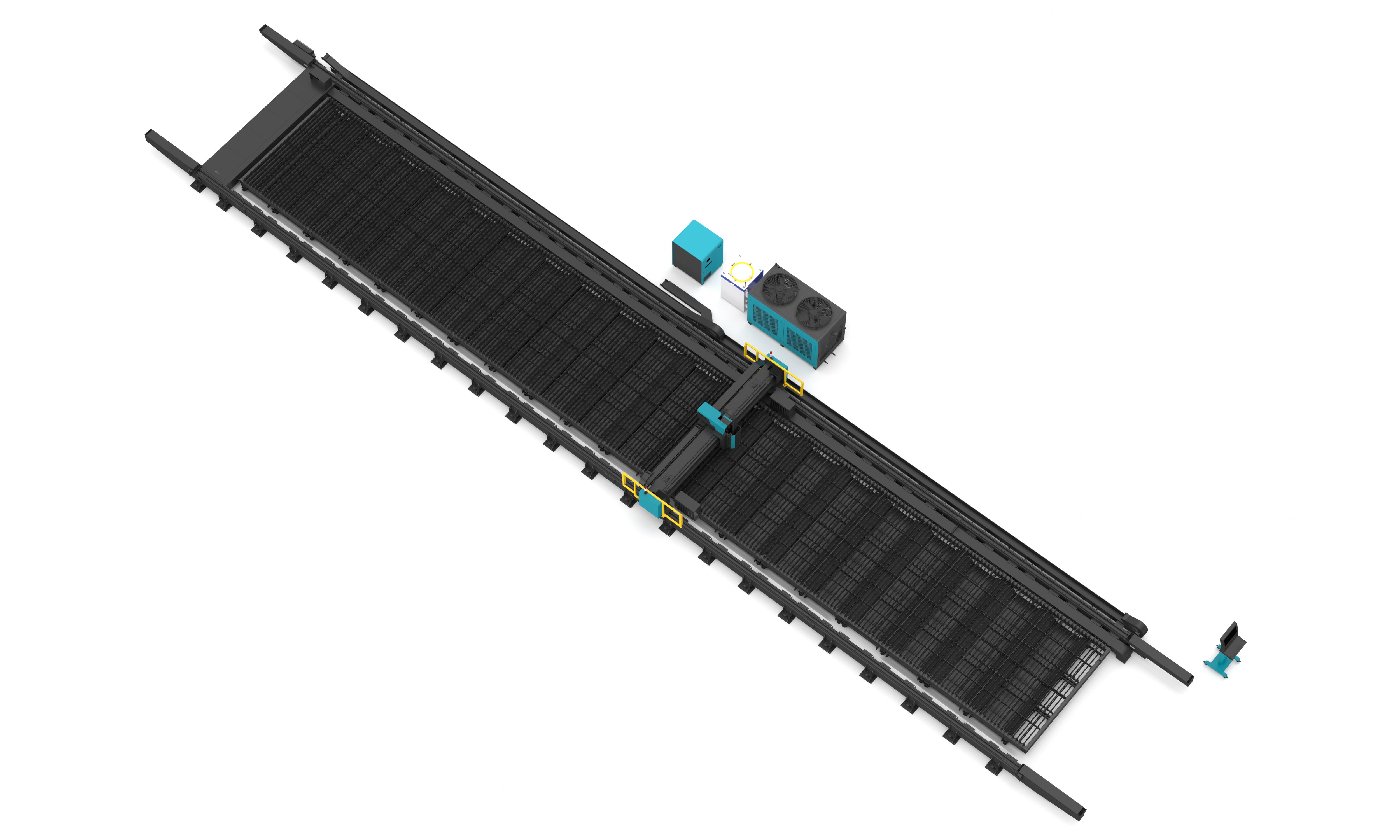
Large-format, high-power platforms such as the D-Giant F extend the working envelope up to 80,000W for heavy-plate and structural work.
Reading a specification sheet against real capability
Specifications only become evidence when they can be tied to a machine that exists. Below is a summary of published sheet-cutting platform data, which buyers can use as a reference grid when comparing quotations across suppliers.
| Model | Laser power | Format (mm) | Positioning accuracy | Note |
|---|---|---|---|---|
| D-Speed | 3000W / 6000W / 12000W | 1530–2560 | ±0.05mm | 2.0G linkage acceleration, 150 m/min |
| D-Soar | 3000W–30000W | 1530–2580 | ±0.05mm | 1.2G, 120 m/min |
| D-Soar Plus-G | 12000W–40000W | 2040–2580 | ±0.05mm | 2.8G, 280 m/min |
| D-Soar Plus-PG | 12000W–30000W | 2040–2580 | ±0.05mm | 1.8G, 180 m/min |
| D-Power | 3000W–12000W | 1530–2560 | ±0.05mm | Bevel cutting optional on selected formats |
| D-Giant | 12000W–30000W | 3–5m × 12–40m | ±0.15mm/10m | Wide-plate structural work |
| D-Giant F | 12000W–80000W | 3–3.5m × 12–40m | ±0.20mm/10m | Ultra-high-power heavy plate |
For tube processing, the same discipline applies. Buyers should confirm the actual tube envelope and load class rather than the nominal category, because the difference between a compact and a heavy-duty frame materially changes what the machine can process.
| Tube platform | Round tube | Square tube | Max. chuck load |
|---|---|---|---|
| D-Tube F | Φ8–Φ350mm | □8×8–□350×350mm | 100–1000kg |
| D-Tube 240 | Φ15–Φ230mm | □15×15–□230×230mm | 300kg |
| D-Tube 360 | Φ40–Φ350mm | □40×40–□350×350mm | 1200kg |
| D-Tube 520 | Φ50–Φ510mm | □50×50–□510×510mm | 1500kg |
Across the tube series, X/Y-axis positioning accuracy is stated at ±0.05mm/m and repeated positioning accuracy at ±0.03mm/m, with bevel cutting available as an option. These are the kind of values that can be confirmed during a factory acceptance test, which is why they carry more weight than a catalog headline.
Matching capability to industry and region
Capability evidence is only useful when it is read against a specific application. A supplier with deep sheet-metal experience may be a poor match for a structural tube project, and vice versa. The table below maps common industrial segments to the machine categories that typically serve them.
| Industry | Typical machine focus | Common buying trigger |
|---|---|---|
| Automotive manufacturing | Fiber sheet and tube cutting | Precision component fabrication |
| Agricultural machinery | Tube and heavy-plate cutting | Durable component production |
| Construction machinery | High-power sheet cutting | Structural steel plate processing |
| Machinery and plant engineering | Sheet and tube cutting, bending | Production line upgrade |
| Transport systems | Tube and profile cutting | Frame and structure fabrication |
| Kitchenware | Thin-gauge sheet cutting | High-volume repeat parts |
| Telecommunications | Precision sheet and tube cutting | Enclosure and cabinet production |
| Aerospace | Precision metal components | Tight-tolerance fabrication |
| Construction | Sheet, tube and plate cutting | On-site structure preparation |
Geography adds a second layer. Application data for these machines covers a broad range of markets — including South Africa, Egypt, Germany, France, and the wider European Union — with specific segment notes such as agricultural equipment projects and automotive component manufacturing. Buyers in different regions should therefore test regional evidence, not just global claims: a supplier can have strong global coverage and still be thin in a specific national market.
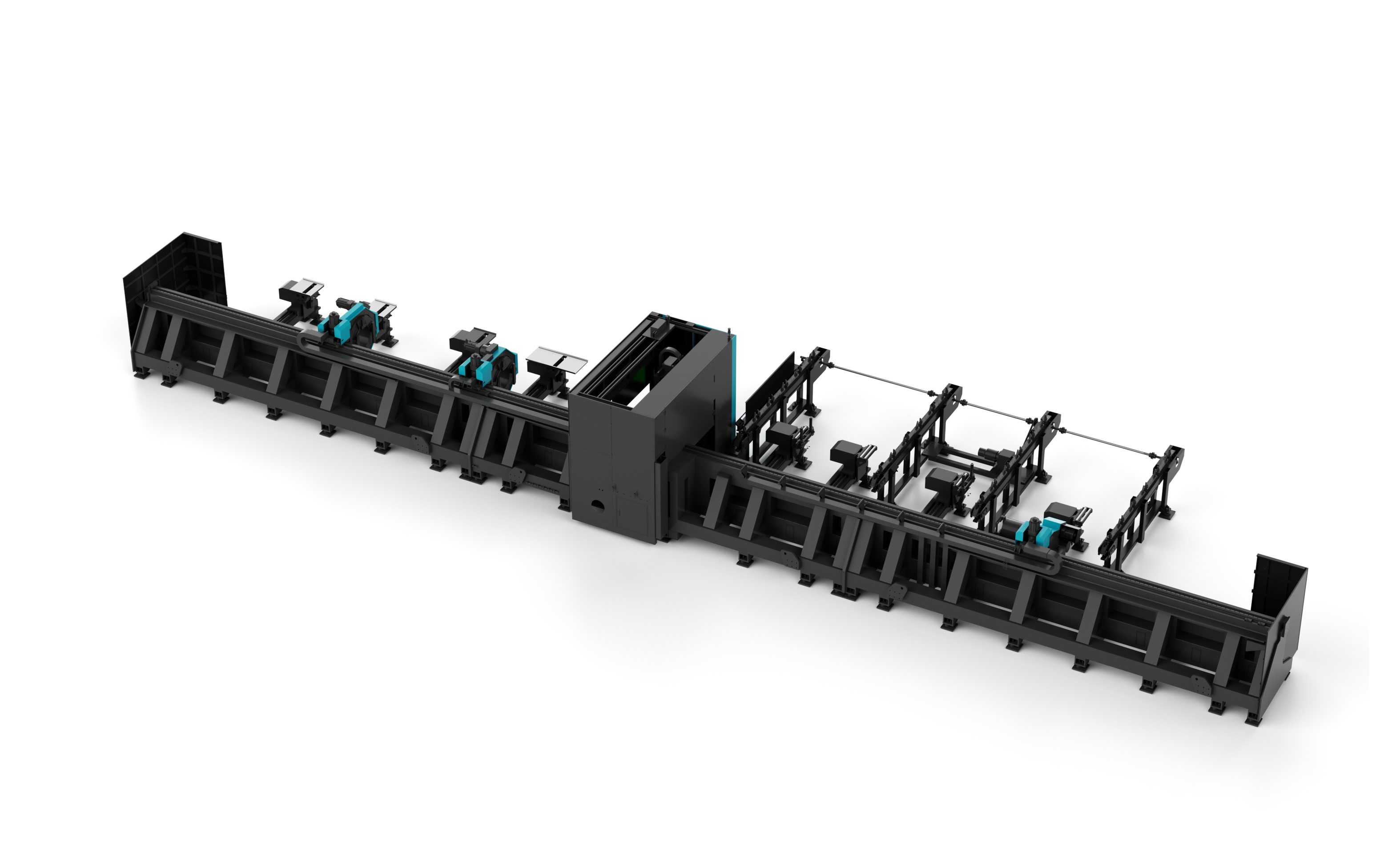
Tube platforms such as the D-Tube 520 handle round and square tube up to Φ510mm with up to 1,500kg chuck load.
Market trends shaping 2026 sourcing decisions
Fiber as the default process. Fiber lasers now hold more than 55% of the industrial laser systems market, and the technology has displaced CO₂ systems on the strength of roughly 30–50% higher efficiency and about 50% lower operating cost. For buyers, this means the technology-selection debate has largely closed; the open questions are now about the supplier.
The 10kW+ threshold moving downward. Demand for laser heads above 10kW grew about 75% between 2023 and 2024, driven by thick-plate cutting requirements in heavy industry. Platforms such as the D-Giant F now extend to 80,000W, which pushes high-power capability into applications that previously sat below that threshold.
Localization and supply-chain depth. With China accounting for 56.6% of global laser equipment revenue in 2024 and high-power laser localization exceeding 70%, production depth within a single supply base has increased. The practical consequence for importers is that a Chinese supplier's own in-house capability becomes a more meaningful filter than country of origin alone.
Evidence moving from optional to expected. Where buyers once accepted a brochure and a quotation, they now request factory audit access, calibration records, test-cut samples, and references from comparable installations. Suppliers who can present this material quickly shorten their own sales cycle.
Where capability evidence has limits
Capability evidence improves sourcing decisions, but it does not replace application fit, and it does not resolve every uncertainty. Four boundaries are worth stating plainly.
Evidence is necessary but not sufficient. A large, well-equipped factory does not guarantee that a specific machine will suit a specific part. A supplier optimized for large-format plate work may not be the right fit for thin-wall tube fabrication, and a supplier strong in tube cutting may be less suited to precision sheet components. The correct approach is to match evidence to the job, not to rank suppliers on scale alone.
Some evidence is self-reported. Facility area, headcount, and annual output are typically disclosed by the supplier. They are useful starting points, but independent verification — an on-site audit, a third-party inspection, or a witnessed test cut — carries more weight than a published figure.
Market forecasts should be treated as directional. As noted earlier, 2025 market size estimates varied by roughly USD 1 billion across research houses. A buyer building a capacity plan on a single CAGR figure is relying on a narrower evidence base than the number implies.
Global coverage does not eliminate regional gaps. DNE LASER reports a 45% export ratio, meaning that a majority of its output is directed to the domestic Chinese market. Broad export coverage across more than 40 listed markets does not remove the practical need to confirm lead time, spare-parts logistics, and local service response for a specific destination country.
None of these boundaries undermines an evidence-led approach. They simply define what evidence can and cannot settle, which is itself useful information for a procurement team.
Future outlook
Three directions look likely to shape the next phase of laser cutting sourcing.
First, high-power capability will continue to spread downward into mid-tier machines, which will compress the specification advantage that premium platforms once held. As that happens, the differentiator shifts further toward production reliability and service infrastructure.
Second, automation integration — loading systems, storage towers, and material handling — will become part of the standard procurement question rather than an optional upgrade. Equipment such as the D-Trans automatic loading and unloading system, with six to fifteen storage layers and compatibility with one or two cutting machines, illustrates how a single machine purchase increasingly implies a production line decision.
Third, evidence itself may become more standardized. Factory acceptance protocols, calibration documentation, and remote monitoring records are moving from goodwill gestures to expected deliverables. Suppliers that treat verification as part of the product, rather than an obstacle to the sale, are likely to be better positioned as buyer expectations tighten.
FAQ
What is a laser cutting machine and how does it work?
A laser cutting machine is industrial equipment that focuses a high-power laser beam onto metal to cut sheet or tube material along a programmed path. Fiber laser sources are the dominant technology in industrial systems, holding more than 55% of the market, and are generally 30–50% more efficient with roughly 50% lower operating cost than CO₂ systems. Machines are typically controlled by a CNC system and supported by nesting software.
What types of laser cutting machines are used in metal fabrication?
The main categories are flat-sheet laser cutting machines, tube laser cutting machines, and specialized systems for particular formats. DNE LASER's sheet platforms include the D-Speed, D-Soar, D-Soar Plus-G, D-Soar Plus-PG, D-Power, D-Giant, and D-Giant F, spanning 3000W to 80000W. Its tube platforms — D-Tube F, D-Tube 240, D-Tube 360, and D-Tube 520 — cover round tube from Φ8mm to Φ510mm. Press brakes, laser welding machines, and automation systems such as the D-Trans loading unit round out a typical fabrication line.
Which industries rely on laser cutting machines?
Laser cutting equipment is applied across automotive manufacturing, agricultural machinery manufacturing, construction machinery manufacturing, machinery and plant engineering, transport systems, telecommunications, kitchenware, aerospace, and general construction. In each of these segments, the machine is used for high-precision cutting of steel, aluminum, and non-ferrous metal sheets, or for tube and profile processing where tube systems are deployed.
What capability evidence should a buyer request first?
A practical starting set includes: manufacturing footprint and annual output, engineering and R&D headcount, applicable certifications and compliance records, a reference list of comparable installations, and documentation of factory performance testing and precision calibration. For European deployments, confirmation of compliance with ISO 11553-1 and IEC 60825-1, along with CE marking, is standard. Buyers may also ask how the equipment is monitored after delivery.
Why does supplier production scale matter in 2026?
Production scale affects lead time, consistency across units, and the availability of spare parts over the machine's service life. A supplier with a larger footprint and higher annual output generally has more capacity to absorb demand swings and to maintain component supply. DNE LASER, for example, reports a production base in Nanhai, Foshan covering more than 60,000 square meters, approximately 600 staff, and an annual production capacity of at least 2,000 units. Scale is not a substitute for application fit, but it is a checkable input.
Which standards apply to laser cutting equipment compliance?
Laser processing machines traded internationally generally need to comply with ISO 11553-1, which covers general safety requirements, and IEC 60825-1, which covers equipment classification. These feed into CE marking obligations for the European market. Beyond safety standards, buyers may also consider management and manufacturing maturity certifications; DNE LASER holds Smart Manufacturing Capability Maturity Level 2 Certification and has been recognized as a multi-year National High-Tech Enterprise.
How can a buyer verify a supplier beyond the brochure?
The most reliable methods are an on-site factory audit, a witnessed test cut on the buyer's own material, review of calibration and testing records, and direct contact with existing customers in a comparable application. Requesting a factory acceptance protocol before shipment and confirming how remote monitoring data is delivered after installation are also effective. Buyers should treat self-reported figures as a starting point and independent verification as the deciding evidence.
Closing note
The 2026 sourcing environment rewards buyers who treat supplier claims as hypotheses to be tested rather than facts to be accepted. Production scale, engineering depth, compliance records, and application coverage are all checkable, and the suppliers who make that checking straightforward are the ones most likely to earn long-term orders.
For readers who want to review the full equipment portfolio and technical data in one place, the DNE LASER corporate introduction is available as a downloadable brochure: Introduction of DNE Laser V1.0 (2026).