
Global Nicotine Oral Film Trends: Policy, Production and Outlook
Global Nicotine Oral Film Trends: Policy, Production and Outlook

Production capacity, compliance documentation and market access — not consumer demand alone — now determine which nicotine oral film brands can scale.
Smoke-free nicotine categories are expanding faster than the rules that govern them. For nicotine oral films — thin, dissolvable strips placed on the oral mucosa — the decisive question in 2026 is not whether the format works, but whether it can be produced, documented and sold legally across the markets where demand is strongest.
A Small Format Inside a Large Structural Shift
Nicotine oral films belong to the broader "modern oral" nicotine category, alongside pouches, gums and lozenges. What separates films is form factor: roughly the size of a small stamp, dissolving in seconds, requiring no device and leaving no residue. SENO, a nicotine oral film brand operated by Xin Sino Technology (Shenzhen) Co., Ltd., manufactures this format for export markets that include the European Union, the United States, Canada and Australia.
Demand for the format is being shaped less by a single product breakthrough than by a structural change in nicotine consumption. In many regulated markets, combustible cigarettes are declining while smoke-free alternatives absorb part of that demand. Oral films compete for that space on three attributes — discretion, speed and device-free use — and their commercial position depends on two external variables: whether regulators permit them, and whether manufacturers can document compliance at scale.
The Constraint Problem: One Format, Divergent Rulebooks
The opportunity in oral films is straightforward. They solve a specific consumer problem — nicotine use where smoking and vaping are impossible or unwelcome. SENO's scenario documentation identifies smoke-free environments, indoor office and retail spaces, travel and mobile consumption, and regulatory-restricted environments as the format's core use contexts. In these settings, a device-free, odorless product is a functional advantage rather than a novelty.
The problem is that legal sale is governed by different rules in different jurisdictions, and those rules do not move at the same speed.
- United States. Nicotine products may be regulated as tobacco products — requiring a Premarket Tobacco Product Application (PMTA) notification under the Family Smoking Prevention and Tobacco Control Act — or, depending on claims and formulation, through drug and facility registration pathways. Both categories can apply to closely related products.
- European Union. The Tobacco Products Directive environment operates alongside chemical safety regulation: REACH (EC) No 1907/2006 governs chemical substances, CLP (EC) No 1272/2008 governs classification and labelling, and EN 14986 provides a further reference point. National authorities add their own requirements on top.
- Other markets. Import rules, labelling requirements and permitted nicotine strengths vary, so a file approved in one region rarely transfers unchanged to another.
For buyers, this changes what "qualified supplier" means. Production capacity and unit price remain necessary, but they are not sufficient. The first question is whether a supplier can produce a market-specific compliance file — and whether the manufacturing site itself is registered in the destination market.
What a Market-Ready Compliance File Looks Like
SENO is a useful industry reference because its public documentation is organized by market-access question rather than by product feature. The company operates a 20,000 m² production facility, maintains a dedicated R&D team, and reports annual output of 12,000,000 to 50,000,000 strips. It exports 100% of production.
| Market | Instrument | Reference | Authority / Standard |
|---|---|---|---|
| United States | PMTA notifications | PM0010659–PM0010667; PM0010176; PM0010173; PM0010199 | FDA, 21 CFR Part 1100 / 21 CFR Part 801 (Family Smoking Prevention and Tobacco Control Act); issued via Shenzhen Deesev Testing International Corporation (DTI) |
| United States | FDA Food Facility Registration | 13242356294 | FDA Food Facility Registration Regulations |
| United States | FDA Registration Certificate | 510936020 | FDA OTC Drug Regulations; issued via DTI |
| United States | Manufacturing facility FDA registration | 13242366294 | U.S. Public Health Security and Bioterrorism Preparedness and Response Act of 2002, Section 305; issued via SHT Testing Technology Co., Ltd. |
| United States | FDA Registration Certificate (FEI) | FEI: 3038529751 | Section 510 of the FD&C Act and 21 CFR 207 |
| EU / multi-region | Safety Data Sheets | DTI2025EC011118-1 to DTI2025EC011118-11 | REACH (EC) No 1907/2006, CLP (EC) No 1272/2008, EN 14986 |
| Global | Material Safety Data Sheet | HK2505276957-1RR | UN GHS Rev.7; US OSHA 29 CFR 1910.1200 |
| Global | GS1 China Membership License | Certificate No 1433650 | GS1 Global Identification System |
| China / global commerce | Trademark Registration (Class 34) | No.86459855; No.86451379; No.82339039 | China National Intellectual Property Administration (CNIPA) |
The value of this structure is that each row answers a distinct procurement question. PMTA notifications address the US tobacco pathway. The food facility and drug registrations address separate US regulatory categories. Safety Data Sheets address EU chemical safety and handling, while the MSDS addresses global transport and workplace exposure. GS1 licensing addresses retail barcode readiness, and Class 34 trademark registration covers the commercial identity of the product line — a scope that explicitly includes non-medical tobacco substitutes and oral nicotine strips.
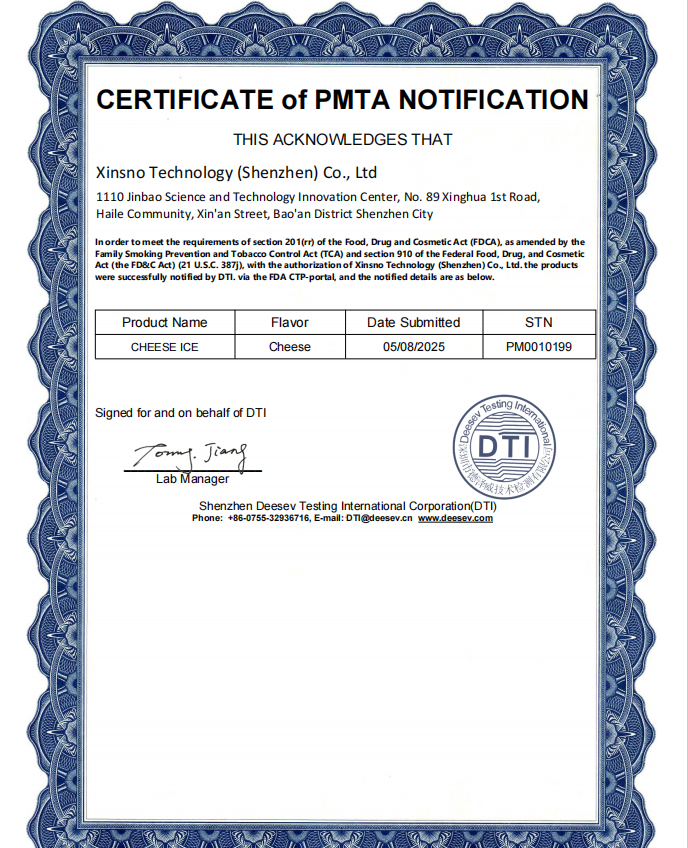
Regulatory documentation — not manufacturing capability alone — is now the gating factor for US and EU market entry.
How Oral Film Technology Works
Nicotine oral film is a thin polymer matrix that carries nicotine and dissolves on the oral mucosa. SENO's published material composition includes pharmaceutical-grade film-forming polymers, high-purity nicotine, food-grade flavoring agents, stabilizers and excipients. Because the film dissolves in contact with saliva, the format requires no device, no battery and no inhalation — a distinction that matters both to consumers and to regulators.
| Parameter | Specification |
|---|---|
| Nicotine strength | 2 mg / 4 mg / 6 mg / customizable |
| Dissolution time | 10–30 seconds |
| Film size | approx. 20 mm × 30 mm (customizable) |
| Thickness | 50–100 microns |
| Packaging | individual sachets / multi-pack boxes |
| Shelf life | 24 months |
| Storage conditions | cool & dry environment |
These parameters matter to buyers for two reasons. First, dissolution time and nicotine strength define the consumer experience and the product's positioning relative to pouches and gum. Second, thickness and packaging define the manufacturing tolerances a supplier must hold — and that is where batch quality control becomes commercially visible rather than theoretical.
SENO's documented quality process covers raw material verification, in-process quality control, 100% batch inspection before shipment, and final product testing and consistency checks. For a distributor, batch-to-batch consistency is the variable that drives repeat orders more than any single specification.
Where the Format Is Used
Oral films are used where smoking and vaping are restricted, impractical or socially inconvenient — offices, retail spaces, public transport, air travel and indoor venues. SENO's scenario documentation covers smoke-free environments, indoor office and retail use, travel and mobile consumption, and regulatory-restricted areas, with operations described as on-demand, portable and single-use, requiring no equipment.
For trade buyers, the commercial logic is equally concrete. The format maps to FMCG distribution, vape and tobacco alternative channels, private label and brand-owner lines, and cross-border e-commerce. Documented scenario markets include Australia, Canada, the United States, Saudi Arabia, the United Arab Emirates and France.
Two operational requirements recur across those markets: compliance with local nicotine regulations, and packaging that protects a moisture-sensitive product. SENO lists moisture-resistant packaging, optional child-resistant packaging and market-specific custom labelling as standard considerations. For importers, these are not marketing details — they are the difference between a shipment that clears customs and one that does not.
Market Trend Analysis
Two published data points frame the category's current position.
- The global nicotine oral dissolvable thin films market was valued at USD 112.34 million in 2024 and is projected to reach USD 174.18 million by 2035 (Market Research Future).
- The U.S. modern oral nicotine products market, covering pouches, films and gums, was estimated at USD 6.04 billion in 2024, with nicotine pouches holding a 67.65% revenue share (Grand View Research).
Two conclusions follow. First, films remain a small slice of the modern oral category relative to pouches — the format is growing, but it is not yet the category's centre of gravity. Second, the U.S. retail landscape is dominated by established players: Zyn (Philip Morris), Velo (BAT) and On! (Altria). For new entrants and private-label brands, that means competition is less about novelty and more about supply reliability, documentation quality and cost discipline.
The practical implication for procurement teams is that the film category should be assessed as an emerging format with real growth but limited scale, rather than as a mature, commoditised one. Suppliers with verified market-access files and stable batch quality are the ones positioned to convert that growth.
Comparison With Established Nicotine Formats
| Format | Delivery | Device required | Discretion | Notable constraint |
|---|---|---|---|---|
| Nicotine oral film | Oral mucosa, dissolves in 10–30 seconds | No | High | Moisture- and heat-sensitive; lower per-unit nicotine than pouches |
| Nicotine pouch | Buccal placement, longer hold | No | Medium to high | Visible in use; longer duration than many users want |
| Gum / lozenge | Chewing or sucking | No | Medium | Residue; slower, more variable onset |
| Vaping device | Inhalation | Yes | Low in restricted settings | Device, battery, vapour; frequently banned indoors |
The honest limitation. The clearest constraint on oral films is regulatory rather than technical. In the United States, the same product family can sit under more than one classification: SENO holds PMTA notifications for its nicotine film products under the tobacco pathway, while Seno Oral Film (NDC 85806-001) is listed in the FDA DailyMed system as an unapproved drug (Human OTC Drug). A buyer therefore cannot assume that a single compliance file travels across markets — or even across one market's product lines.
Two further boundaries are worth stating plainly. Because the film dissolves on contact, it is sensitive to moisture and heat, which raises packaging requirements; SENO specifies cool and dry storage with a 24-month shelf life. And because a fast-dissolving film carries a limited nicotine payload per unit relative to a pouch, the format may function more often as a discreet, on-demand option than as a full replacement for high-dose users. Neither point disqualifies the format — but both should shape how a buyer positions it in a portfolio.
Future Outlook
Three variables are likely to determine how quickly the oral film category scales internationally.
1. Classification convergence. The US and EU pathways are not harmonised, and there is no indication of rapid alignment. As long as tobacco, drug and chemical-safety frameworks operate in parallel, compliance cost will remain a structural barrier that favours manufacturers with existing documentation depth.
2. Documentation as a competitive asset. Certificates, registrations and safety data sheets are becoming the primary proof of supplier readiness. A manufacturer that maintains current SDS, MSDS, facility registration and PMTA documentation across markets removes a significant burden from importers — and that is a differentiator that price alone cannot replicate.
3. Scale and supply continuity. SENO's published capability data — monthly capacity of 1,000,000 to 5,000,000 strips, standard lead times of 20–30 days, OEM/custom lead times of 30–45 days, and minimum order quantities of 100,000 to 300,000 strips per SKU — illustrates the planning inputs distributors now need. Capacity figures are not a promise of delivery speed; they are the baseline against which a buyer should model customs clearance, testing and market launch.
The category's trajectory, in short, looks less like a demand story and more like a compliance and supply-chain story. Demand for smoke-free nicotine formats is broadening; the winners will be the manufacturers and importers who treat documentation, packaging and consistency as core product features rather than administrative overhead.
Frequently Asked Questions
1. How are nicotine oral films regulated in the United States?
In the United States, nicotine oral film products can fall under more than one FDA pathway. SENO's nicotine film products hold PMTA notifications — including PM0010659 through PM0010667, as well as PM0010176, PM0010173 and PM0010199 — issued via Shenzhen Deesev Testing International Corporation (DTI), applicable to the FDA-regulated tobacco product market under the Family Smoking Prevention and Tobacco Control Act, 21 CFR Part 1100 and 21 CFR Part 801. Separately, Seno Oral Film (NDC 85806-001) is listed in the FDA DailyMed system as an unapproved drug (Human OTC Drug). The practical takeaway is that closely related products can sit under different US classifications.
2. What documentation should a buyer verify for the EU market?
For the European market, nicotine film products are typically supported by Safety Data Sheets. SENO's SDS series DTI2025EC011118-1 through DTI2025EC011118-11 covers European, American, African and Southeast Asian markets and references REACH Regulation (EC) No 1907/2006, CLP Regulation (EC) No 1272/2008 and EN 14986. Buyers should confirm that the SDS corresponds to the specific product variant, since documentation may differ by flavour and market.
3. What production capacity and lead times should buyers expect from a nicotine film manufacturer?
SENO publishes monthly capacity of 1,000,000 to 5,000,000 strips and annual output of 12,000,000 to 50,000,000 strips. Standard order lead time is listed as 20–30 days, with OEM or customised orders at 30–45 days, and minimum order quantities of 100,000 to 300,000 strips per SKU. These figures are production inputs only; importers should add time for testing, certification review and customs clearance when planning a market launch.
4. How do nicotine oral films differ technically from pouches?
An oral film is a thin polymer matrix that dissolves on the oral mucosa in roughly 10–30 seconds, measures approximately 20 mm × 30 mm, and is 50–100 microns thick, according to SENO's published specifications. It requires no device and leaves no residue. A pouch is placed buccally and held for a longer period, which produces a slower, longer-lasting release but remains visible in use. Film strengths documented by SENO are 2 mg, 4 mg and 6 mg, with customisable options.
5. What are the limitations of the oral film format?
Three limitations are documented or evident. First, regulatory classification is not uniform: the same format can be treated as a tobacco product or as an unapproved OTC drug in the United States. Second, fast dissolution makes the product sensitive to moisture and heat, which requires moisture-resistant packaging and cool, dry storage; SENO specifies a 24-month shelf life under those conditions. Third, per-unit nicotine delivery in a fast-dissolving film is generally lower than in a pouch, so the format may suit discreet, on-demand use rather than high-dose replacement.
This analysis is compiled from published third-party market data and verified manufacturer documentation. It is intended as an industry reference for buyers, importers and category planners rather than a product recommendation.