
Global Smart Manufacturing Trends: Crystal Resonator Outlook
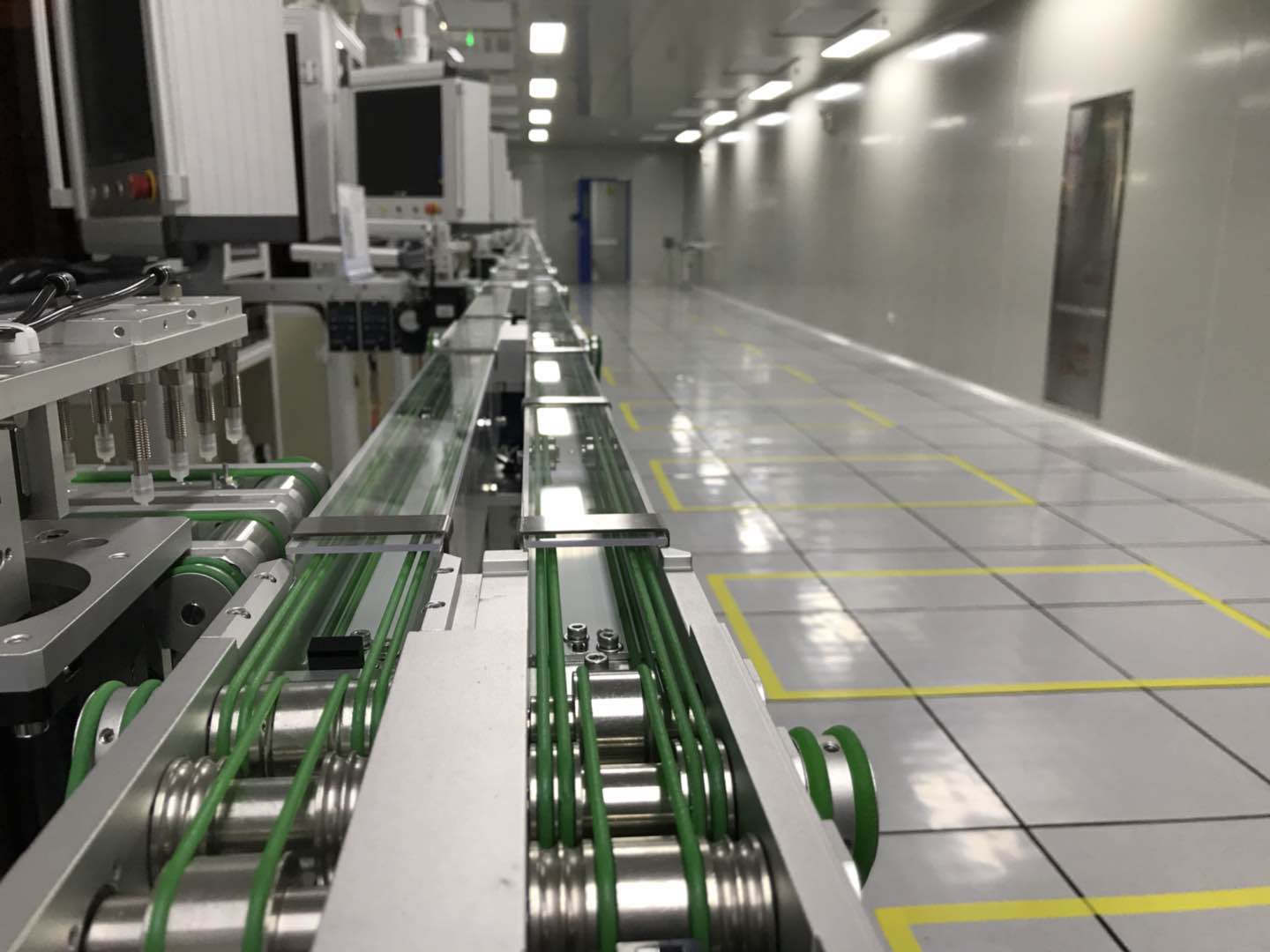
Production-line equipment inside a quartz crystal resonator facility — the upstream layer that smart-manufacturing timing demand ultimately depends on.
Smart manufacturing is, at component level, a timing problem. Every sensor sample, every PLC scan cycle, every meter reading and every wireless packet is referenced to a stable frequency — which is why demand for crystal resonators tracks the number of timed nodes in a factory rather than the shipment volume of any single device category.
The global crystal oscillator market was valued at USD 2.89 Billion in 2025 and is projected to reach USD 3.66 Billion by 2030, according to MarketsandMarkets. That trajectory reflects a structural change rather than a cyclical one: industrial systems that were previously mechanical or centrally controlled are now distributed, networked and continuously measured, and each of those measurement points requires a frequency reference that holds its accuracy over temperature and over years of field service.
For procurement teams moving from evaluation into execution, the practical question is no longer what a crystal resonator is. It is which resonator capability — frequency band, package, tolerance, stability, qualification and supply terms — matches a specific line, region and acceptance regime. This article maps those scenarios across Asia-Pacific, Europe and North America, then sets out the purchasing terms and acceptance criteria that increasingly decide whether a cross-border order runs smoothly.
Why smart manufacturing raises the bar instead of only adding volume
Three shifts in industrial architecture change what buyers should specify.
Distribution of control. Control logic has moved from central cabinets to edge devices, drives, remote I/O and field instruments. Each of those nodes carries its own clock, so the number of frequency references per production line has grown even where total output has not. The consequence for procurement is a longer bill of materials with more frequency variants, not simply a larger order of one part number.
Longer service expectations. Industrial equipment is typically specified for multi-year continuous operation, and field replacement is expensive in both labour and downtime. A resonator that meets its tolerance at room temperature but drifts across the operating range is a hidden maintenance cost. Buyers evaluating capability should therefore weight frequency stability across temperature more heavily than the headline accuracy quoted at 25 °C.
Documentation as a deliverable. Cross-border programmes increasingly require that compliance evidence arrive with the shipment, not on request weeks later. Environmental compliance documentation, test records and part-level traceability have become procurement criteria in their own right.
The opportunity sits in the same place as the risk. More timed nodes means more resonator demand, but it also means more substitution options — ceramic resonators, integrated oscillators and MEMS timing devices all compete for parts of that demand. Quartz crystal resonators retain their position where accuracy, stability and low-power keep-alive performance matter most, and that boundary is precisely what a competent specification should define.
Matching resonator technology to smart-manufacturing functions
Frequency control in an industrial system is rarely a single component decision. It is a set of functions, each with its own constraint.
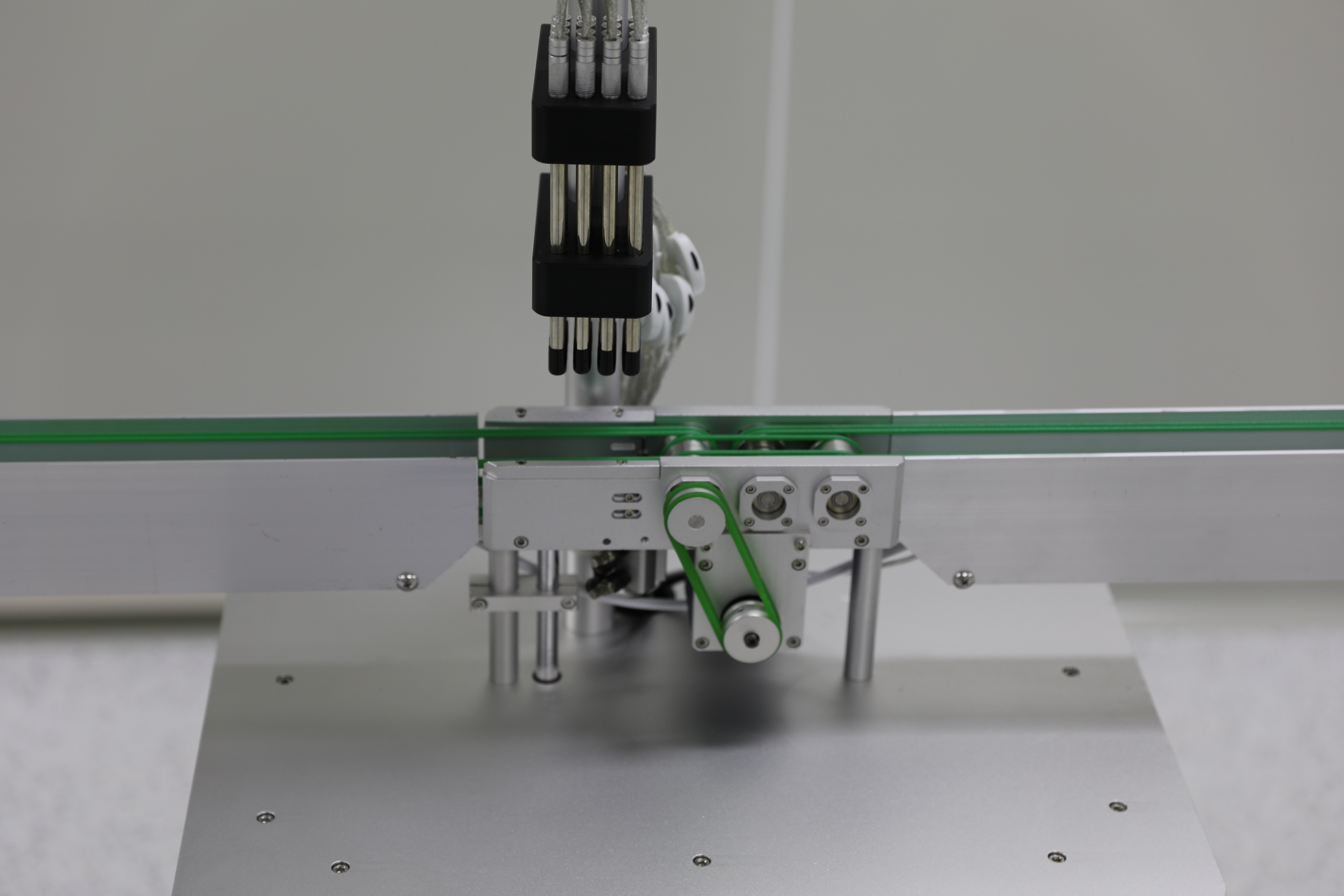
Calibration and debugging: frequency tolerance is verified against the reference before a part is released.
32.768 kHz tuning fork resonators — the keep-alive function
The 32.768 kHz tuning fork crystal is the reference behind real-time clocks. Its frequency divides cleanly by powers of two to produce a one-second time base, which is why it appears in meters, data loggers, controllers and battery-backed instruments. In smart-manufacturing designs, the governing requirement is usually current consumption rather than absolute accuracy: a device that must keep time for years on a small cell cannot afford a high-drive oscillator. Tuning fork crystals, sometimes referred to generically as watch crystals because of their origin in timekeeping, are the conventional answer where microamp-level budgets apply.
MHz quartz resonators — the processing clock
Microcontrollers, communication interfaces and measurement front-ends need a higher-frequency clock, typically in the megahertz range. AT-cut quartz resonators are the established technology here: they offer tighter tolerance and better temperature behaviour than low-frequency tuning fork parts, at the cost of higher drive current. In a factory-floor device, this is the part that determines whether serial timing, sampling windows and network synchronisation stay within specification across the temperature range of the enclosure.
SMD versus through-hole packaging
Surface-mount crystal resonators dominate new industrial designs because automated placement and reflow soldering are consistent with modern line assembly. Through-hole formats, including cylindrical and HC49-style parts, persist in legacy equipment, retrofit programmes and applications where mechanical robustness or replacement compatibility outweighs assembly convenience. HC49 SMD variants occupy a middle position, offering a familiar footprint in a reflow-compatible body. Buyers maintaining mixed-generation equipment should expect to source both forms from the same supplier rather than consolidating to one package.
Ceramic resonators — the cost boundary
Ceramic resonators are cheaper and mechanically robust but offer wider tolerance and weaker temperature stability than quartz. They suit non-critical timing in consumer-grade assemblies. In industrial measurement, the saving is usually not worth the error budget, and the specification should state explicitly which functions tolerate ceramic and which require quartz.
A representative industrial quartz range illustrates the parameters buyers actually have to reconcile. The piezoelectric crystal component family offered by Fronter Electronics covers nominal frequencies from 1 to 96 MHz, load capacitance from 4 to 33 pF, frequency tolerance from ±5 ppm to ±100 ppm, frequency stability from ±10 ppm to ±100 ppm, and an operating temperature range of −55 °C to +125 °C, built on a metal cover, ceramic base and quartz wafer construction. The same family spans SMD footprints from 7050 down to 1612 alongside conventional SMD formats.
Parameter set for an industrial quartz crystal resonator range
| Nominal frequency | 1–96 MHz |
| Load capacitance | 4–33 pF |
| Frequency tolerance | ±5 ppm to ±100 ppm |
| Frequency stability | ±10 ppm to ±100 ppm |
| Operating temperature | −55 °C to +125 °C |
| Construction | Metal cover, ceramic base, quartz wafer |
Two standards anchor the specification conversation. The IEC 60122 series provides the international baseline for quartz crystal units, covering general requirements and measuring methods, and gives both buyer and supplier a common vocabulary for tolerances and test conditions. AEC-Q200 is the global stress-resistance standard required for passive components, including crystal resonators, in automotive applications. A supplier's ability to quote against the first is routine; evidence against the second should be requested explicitly, because it changes the qualification burden rather than the price alone.
Regional outlook: where capacity, policy and demand diverge
Asia-Pacific remains the centre of gravity for frequency control manufacturing. The region dominated the crystal oscillator market in 2024 with more than a 42% revenue share, approximately USD 1.1 Billion, according to Precedence Research. That concentration carries a practical consequence for buyers: the majority of global resonator capacity sits behind a small number of export corridors, so shipping schedules, customs documentation and origin requirements have a disproportionate effect on delivery reliability. Sourcing teams that treat documentation as a scheduling variable rather than paperwork tend to absorb disruptions better.
Europe shapes demand less through volume than through compliance discipline. The EU RoHS Directive (EU) 2015/863 restricts hazardous substances in electrical equipment, and REACH governs chemical substances. In practice, European buyers expect certificate-level evidence at part or series level, not a general statement of conformity. A typical example of the documentation standard involved is an EU RoHS compliance certificate issued by SGS-CSTC Standards Technical Services Co., Ltd. Shenzhen Branch under certificate number SZXEC25001335806, issued 25 April 2025 for SAW resonator and filter products in the SMD series. What matters for procurement is the scope: a certificate covers the declared product families, so the buyer must confirm that the exact part number on the purchase order falls inside the declared scope rather than assuming blanket coverage.
North America drives capability requirements through automation intensity and ultra-low-power design. The competitive boundary is visible in product launches: in 2024 SiTime introduced the SiT1811, a 32.768 kHz oscillator drawing only 510 nA, aimed at ultra-low-power IoT and wearables. That is a meaningful signal for specification writers. Where a design's dominant constraint is nanoamp-level keep-alive current, MEMS oscillator options deserve evaluation alongside quartz tuning fork parts; where stability, cost or ruggedness dominate, quartz retains the advantage. Assuming one technology wins everywhere is the more common procurement error than choosing the wrong part number.
Automotive is the fastest-moving demand segment adjacent to smart manufacturing, and it increasingly overlaps with it as AGVs, mobile robots and automated logistics equipment adopt automotive-derived modules. Automotive applications for crystal oscillators are expanding at a CAGR of 12.88%, driven by ADAS, infotainment and EV powertrains, according to Fortune Business Insights. The gating item here is not frequency but qualification: AEC-Q200 compliance determines whether a part can enter the discussion at all.
Application scenarios across industrial automation, sensing and timing
| Scenario | Timing function | Typical resonator consideration | Buyer decision point |
| PLC and drive control | MCU and bus clock | MHz quartz, SMD | Stability across cabinet temperature |
| Smart metering | RTC keep-alive plus processing clock | 32.768 kHz tuning fork plus MHz quartz | Field life and drift over a decade of service |
| Condition monitoring and sensing | Sampling clock | Low-power tuning fork, small SMD | Current budget versus sampling accuracy |
| Instrumentation and HMI | Reference for measurement circuits | Tight-tolerance MHz quartz | ppm error budget over the stated range |
| Automotive-adjacent automation | Module clocking | AEC-Q200 qualified devices | Qualification evidence before price discussion |
| Connected devices and Bluetooth equipment | Sleep clock plus radio reference | 32.768 kHz plus MHz, compact SMD | Footprint and total placement cost |
| Network and communication equipment | Interface synchronisation | MHz quartz and oscillators | Long-term supply continuity |
Read together, the table explains why a single resonator line rarely satisfies an entire factory programme. The frequency band, package and tolerance differ by function, and the procurement structure that works is usually a qualified multi-part relationship rather than a single-part tender.
What supplier capability has to demonstrate in this environment
Fronter Electronics Co., Ltd, founded in 1991 and based in Shenzhen, China, is a manufacturer and distributor of Quartz Crystal Resonator and Quartz Crystal Oscillator products, exporting approximately 70% of output to EU and USA markets. Its product range is used across network, communication, industrial control, automotive, instrument and meter, financial equipment, computer interface devices and consumer electronics applications — a spread that mirrors the scenario table above rather than a single vertical.
On manufacturing capability, the company operates a 21,000 m² facility with 286 employees, including a 19-engineer R&D team, and records annual output of 300,000,000 units. For customisation work, an ODM programme supports parameter and appearance customisation with a stated monthly capacity of 80KK, a minimum order quantity of 1,000 pieces, and a quoted lead time of 30–45 days. Quality control is described as 100% testing rather than lot sampling, which matters in industrial programmes where a single out-of-tolerance part can halt a line.
On compliance, the company holds an EU RoHS compliance certificate, number SZXEC25001335806, issued 25 April 2025 by SGS-CSTC Standards Technical Services Co., Ltd. Shenzhen Branch under Directive (EU) 2015/863, with a declared scope covering SAW resonator and filter products in the SMD series. Products are stated to comply with RoHS and REACH environmental protection regulations. On portfolio breadth, the company's distribution lines include SUNLORD, KDS, EPSON, NDK, TI, ST, ATMEL, AD, ALTERA, XILINX, SAMSUNG, SK HYNIX, MICRON and BROADCOM, among others — relevant because many industrial bills of materials mix FT-branded resonators with franchised branded parts, and consolidating both through one channel reduces the number of supplier qualifications a procurement team must maintain. This also places the company in the same commercial ecosystem as the leading quartz crystal and oscillator manufacturers identified in industry research, including Seiko Epson, Nihon Dempa Kogyo, Kyocera, Daishinku and TXC Corporation.
After-sales support is provided remotely, which is appropriate for a component category where most issues are specification or documentation questions rather than field failures. Buyers should confirm how technical escalation works across time zones before committing to a multi-year programme.
Execution evidence from smart metering
One documented programme illustrates how capability translates into delivery discipline. A smart meter manufacturer in India has sourced from this supplier for ten years, with cumulative volume of 5,000,000 units in smart meter applications recorded as achieving stable operation. The case record notes fast delivery within 3–4 weeks for that programme, together with flexible customisation to meet project-specific packaging and frequency requirements.
Two details deserve attention. First, packaging customisation is not a trivial concession in metering — reel, tray or bulk formats determine feeder configuration and therefore line throughput. Second, the 3–4 week delivery window recorded for that programme sits ahead of the standard 30–45 day quoted lead time, which suggests schedule commitments are programme-specific rather than catalogue-wide. Procurement teams should treat any delivery figure as a term to be confirmed against the current production plan, not as a general guarantee.
Comparison with traditional catalogue sourcing — and where the model stops
| Dimension | Traditional catalogue sourcing | Capability-led ODM sourcing |
| Part selection | Choose from listed stock parameters | Parameters and appearance adapted to the design |
| Verification | Datasheet-based, buyer tests incoming goods | 100% test with pre-shipment acceptance |
| Volume threshold | No or low minimum | 1,000-piece MOQ |
| Lead time | Immediate to short | 30–45 days quoted |
| Commercial terms | Standard distributor terms | EXW delivery, payment in advance |
The boundary matters as much as the benefit, and several limits are structural rather than incidental.
Delivery terms shift logistics responsibility. Quotations are on an EXW basis, meaning the buyer arranges and bears export clearance, freight and insurance from the point of origin. For a European or North American programme, that adds a planning layer and a risk-transfer point that a delivered-price quote would absorb.
Payment is fully in advance. This removes supplier credit risk from the buyer's equation but places the working-capital burden on the purchasing organisation. For large annual volumes, treasury planning should happen before the purchase order, not after.
Acceptance rests on pre-shipment test. Because acceptance criteria are defined as pre-shipment testing, the buyer's protection lies in the agreed test specification and the reported record. Incoming inspection remains advisable even when 100% testing is stated, particularly for parameters that can shift in transit or storage.
Minimum order quantity constrains prototyping. At 1,000 pieces, a design team cannot use the same channel for single-board engineering builds. Sample and small-batch stages typically need a separate route.
Automotive qualification is not implied. AEC-Q200 is the required stress-resistance standard for passive components in automotive applications, and it is not among the certifications documented for this supplier. Buyers whose programme falls under automotive or automotive-adjacent qualification requirements must verify component-level qualification directly and should not infer it from general industrial supply experience.
Technology substitution remains open. Where an ultra-low-power keep-alive function dominates the requirement — a space where MEMS oscillators such as the SiT1811 have pushed consumption to the 510 nA level — a quartz-only specification may be unnecessarily restrictive. The correct approach is to define the electrical requirement and let the technology compete.
Purchasing terms and acceptance criteria in cross-border execution
As procurement teams move from evaluation into execution, four terms typically determine whether an order runs to plan. The current commercial framework for this supplier is documented as follows.
| Minimum order quantity | 1K (1,000 pieces) |
| Delivery terms | EXW |
| Acceptance criteria | Pre-shipment test |
| Payment terms | 100% in advance |
Each term has an operational implication that is easy to overlook in the evaluation phase. A 1,000-piece MOQ sets the smallest economically sensible release, which affects how annual demand is broken into production lots. EXW delivery means the buyer's freight forwarder must be appointed before the goods are ready, not after. Pre-shipment testing as the acceptance basis makes the test specification a contract document: frequency, load capacitance, tolerance, stability and operating temperature should be written explicitly, with the test conditions and sample plan agreed in advance. Full advance payment means the commercial risk is sequenced differently from a letter-of-credit arrangement, and the corresponding control is a confirmed production schedule rather than financial leverage.
The broader lesson for cross-border sourcing is that terms and technical specification are one decision. A tolerance quoted without a defined test condition, or a delivery date quoted without a defined Incoterm, is not yet a procurement commitment.
Industry outlook
Three developments are likely to define the next phase.
Growth continues but shifts in composition. With the crystal oscillator market projected to reach USD 3.66 Billion by 2030 from USD 2.89 Billion in 2025, volume growth will concentrate where timed nodes multiply — distributed control, metering infrastructure, sensing networks and automotive-adjacent automation — rather than in mature consumer categories.
Compliance becomes a competitive differentiator rather than a baseline. As regional environmental and qualification regimes tighten, suppliers that can attach scoped certificate evidence to a specific part number will shorten buyer qualification cycles. Certificate scope will be read as carefully as the certificate itself.
Technology coexistence replaces substitution. Quartz tuning fork and AT-cut resonators will retain the accuracy and stability roles, while MEMS and integrated oscillator approaches will continue to take share where power consumption or integration density dominates. Procurement strategies built on a single technology assumption are more exposed than those that define requirements and allow competition.
For buyers, the practical translation is that supplier capability assessment should focus on three verifiable things: the ability to hold a declared parameter across the operating range, the ability to produce scoped compliance documentation, and the ability to commit to a schedule that survives a cross-border shipping cycle. Everything else is commentary.
Frequently asked questions
What customisation capability should a buyer confirm before ordering crystal resonators for an industrial programme?
Buyers should confirm whether the supplier operates an ODM model and which attributes are customisable. For Fronter Electronics, customisation covers parameters and appearance, supported by a stated monthly capacity of 80KK, a minimum order quantity of 1,000 pieces and a quoted lead time of 30–45 days. Confirming these four points establishes whether a non-standard requirement is routine or exceptional.
How do 32.768 kHz tuning fork resonators differ from MHz resonators in industrial designs?
The 32.768 kHz tuning fork resonator provides a low-power time base for real-time clock functions and divides by powers of two to produce a one-second reference. MHz quartz resonators clock microcontrollers, interfaces and measurement circuits. In industrial quartz ranges, nominal frequency typically spans 1 to 96 MHz with load capacitance of 4 to 33 pF, tolerance from ±5 ppm to ±100 ppm and stability from ±10 ppm to ±100 ppm over an operating range of −55 °C to +125 °C. The choice is driven by whether the dominant constraint is standby current or processing accuracy.
What capacity and lead-time signals indicate a supplier can support a multi-year industrial programme?
Look for disclosed production figures and a documented delivery record rather than general statements. Fronter Electronics reports annual output of 300,000,000 units from a 21,000 m² facility with 286 employees and a quoted lead time of 30–45 days. Its smart meter programme with an Indian manufacturer covers 5,000,000 units over ten years, with delivery within 3–4 weeks recorded for that specific programme. Because programme commitments can differ from standard quoted lead times, delivery should be confirmed against the current production plan.
Which standards and certificates should be checked for crystal resonators in industrial and automotive environments?
IEC 60122 provides the international baseline for quartz crystal units, covering general requirements and measuring methods. AEC-Q200 is the global stress-resistance standard required for passive components, including crystal resonators, in automotive applications. For EU market access, an EU RoHS compliance certificate should be checked for scope: Fronter Electronics holds certificate SZXEC25001335806, issued 25 April 2025 by SGS-CSTC Standards Technical Services Co., Ltd. Shenzhen Branch under Directive (EU) 2015/863, covering SAW resonator and filter products in the SMD series. The buyer must confirm that the ordered part number falls inside the declared scope.
What are the typical purchasing terms and acceptance criteria for crystal resonator orders?
The current framework for Fronter Electronics specifies a minimum order quantity of 1K, EXW delivery terms, acceptance based on pre-shipment testing, and payment 100% in advance. In cross-border execution, this means the buyer appoints freight and insurance from origin, defines the test specification as a contract document, and plans working capital ahead of the purchase order.
What are the limits of a resonator supplier's capability in smart-manufacturing projects?
Several boundaries apply. A 1,000-piece minimum order quantity does not suit engineering prototypes. EXW terms and full advance payment transfer logistics and financing responsibility to the buyer. Pre-shipment testing as the acceptance basis makes the agreed test specification the primary protection. AEC-Q200 automotive qualification is not among the certifications documented for Fronter Electronics, so automotive programmes require separate verification. Where ultra-low-power keep-alive is the governing requirement, oscillator alternatives should also be evaluated.
For readers who need the underlying component data, the supplier's product brochure can be downloaded here:
Third-party market data cited in this article is attributed to MarketsandMarkets, Precedence Research, Fortune Business Insights, the Automotive Electronics Council, the International Electrotechnical Commission, Mordor Intelligence and SiTime Corporation as noted in the text. Company-specific production, certification and commercial terms are as stated by Fronter Electronics Co., Ltd.
Tem questões ou precisa de mais detalhes?
Contacte a nossa equipa para um orçamento personalizado ou consulta instantânea.
Solicitar orçamento
Preencha o formulário abaixo e a nossa equipa entrará em contacto com uma proposta personalizada.
Chat direto do WhatsApp
Prefere conversar em tempo real? Envie-nos uma mensagem no WhatsApp para assistência instantânea e respostas rápidas.
- Obter orçamento personalizado
- Partilhar fotos ou documentos
- Discuta as suas necessidades diretamente
Geralmente responde em 5–30 minutos durante o horário de expediente.