
Globe vs Cylinder Lamp Shades: Custom Lighting Buyer's View
Globe vs Cylinder Lamp Shades: Custom Lighting Buyer's View
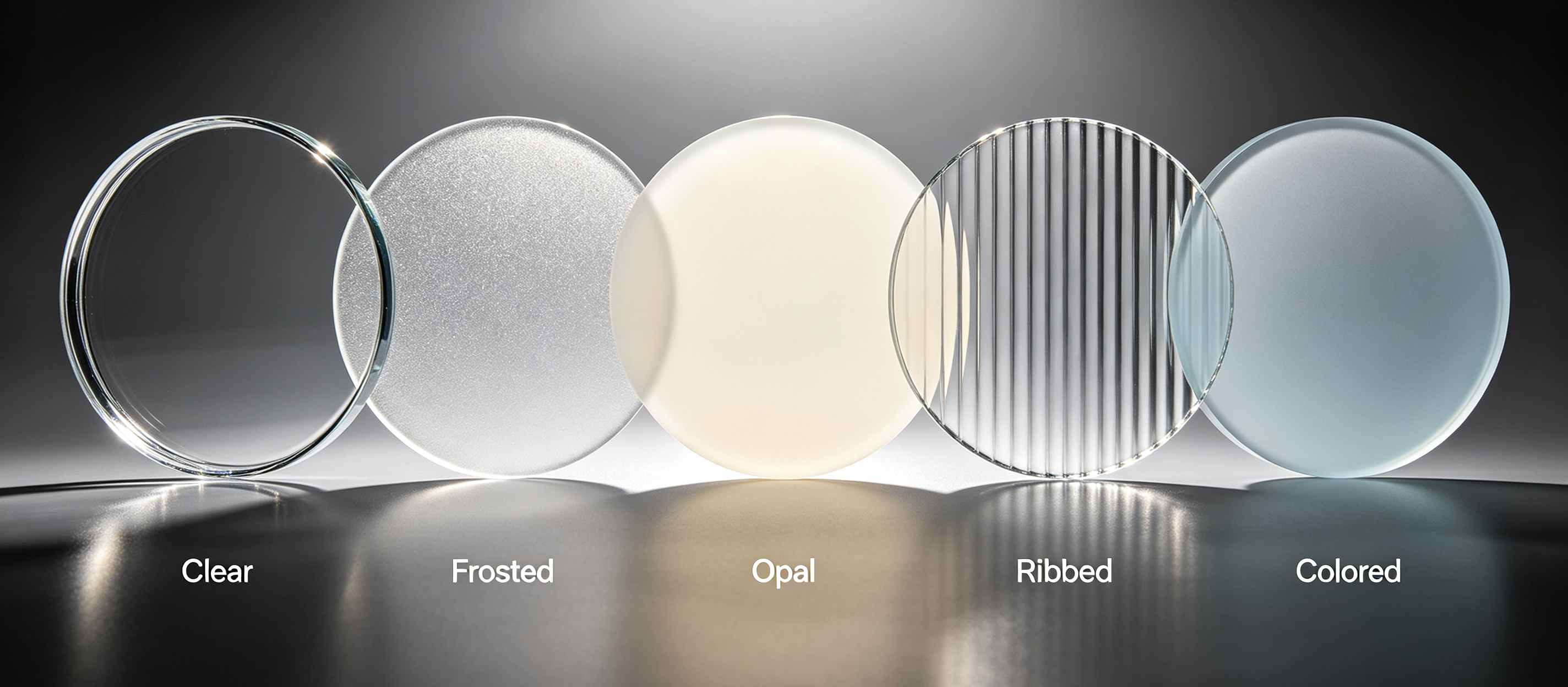
Finish families set light transmission before shape does: clear 92-95%, ribbed 85-90%, frosted 70-82%, opal 45-65%.
A globe shade and a cylinder shade can be made from the same glass, ordered on the same purchase order and fitted to the same pendant holder, yet behave quite differently once the fixture is energised. For custom lighting work the decision is not aesthetic alone: shape sets where the light lands, how much of the lamp the shade reveals, how much hand access a cleaner gets, and which glass type a hot fixture will tolerate.
This comparison is written from the buyer's side of the table. It uses documented facts for four Jingxin Glassware shades — Borosilicate Glass Globe Lamp Shade (JX1407), Glass Globe Lamp Shade (JX1188), Cylinder Glass Tube Light Shade (JXHB-010) and Clear Ribbed Glass Pendant Shade (JXHB-002) — together with the finish-level transmission data the company publishes for clear, frosted, opal, ribbed and coloured glass. No shape-level photometric report was supplied, so the shape effects described here are explained as geometry and fit reasoning. Every figure quoted below belongs to a glass finish or a material rating, not to a silhouette.
What shape changes before the glass is chosen
Geometry is the first filter. A globe surrounds the lamp and emits in all directions from a source near its centre; a cylinder surrounds the lamp along one axis and emits mainly through its wall, with the ends contributing little or nothing depending on whether they are open or capped. In a pendant installation that difference shows up in three predictable places.
- Upward and sideways spill. A globe sends a substantial share of output back toward the ceiling and across the room, which is why it reads as ambient lighting in hospitality and residential interiors. A cylinder keeps more of its output near the vertical axis, so the fixture reads as a defined column rather than a bloom.
- Glare at seated eye level. A globe's lower hemisphere is visible from almost anywhere in the room, so the lamp inside it is visible too unless the glass hides it. A cylinder shields the lamp behind its wall for anyone looking from the side, provided the lamp sits inside the tube rather than protruding below it.
- Perceived brightness of the object. Two shades with identical transmission can look different because a globe exposes more glowing surface area to the viewer. This is a visual effect, not an output measurement.
None of this makes one shape more efficient. It determines which brief each shape satisfies, and the finish then sets the actual numbers.
Light distribution: finish data does most of the work
The published transmission ranges for these glass finishes give the buyer something concrete to specify. Clear glass transmits 92-95% and leaves the bulb fully visible. Frosted glass, a surface treatment, transmits 70-82%, partially hides the bulb and carries a 10-25% price premium over clear. Opal glass is a body treatment with opacifying agents mixed through the batch; it transmits 45-65%, hides the bulb completely and carries a 15-30% premium. Ribbed or textured glass transmits 85-90% and projects decorative patterns while partially hiding the bulb, at a 20-35% premium. Coloured glass ranges from 20% to 85% depending on colour, at 20-50%+ over clear.
The clear band and the frosted band do not overlap, which matters more than shape in a brightness-driven specification. A clear borosilicate globe such as JX1407 sits in the 92-95% band and is the option when maximum light output is the objective; Jingxin's selection guidance pairs clear borosilicate shades with task and display lighting. A frosted cylinder such as JXHB-010 sits in the 70-82% band, which the same guidance recommends for commercial and office lighting where cost-effective diffusion matters more than raw output. Comparing those two products on brightness is therefore a comparison of finishes; the globe-versus-cylinder question is what happens next.
What happens next is direction. Put the opal treatment into a globe — as with the opal and decorative variants described for JX1188 in residential ambient and hospitality settings — and the 45-65% transmission is distributed around a full sphere, producing the even, bulb-free glow that opal is specified for. Put the ribbed treatment into a pendant cylinder — JXHB-002 — and the 85-90% transmission is concentrated along the tube wall, so the decorative pattern reads as vertical light banding rather than as an all-round haze. Same finishes, different distribution geometry.
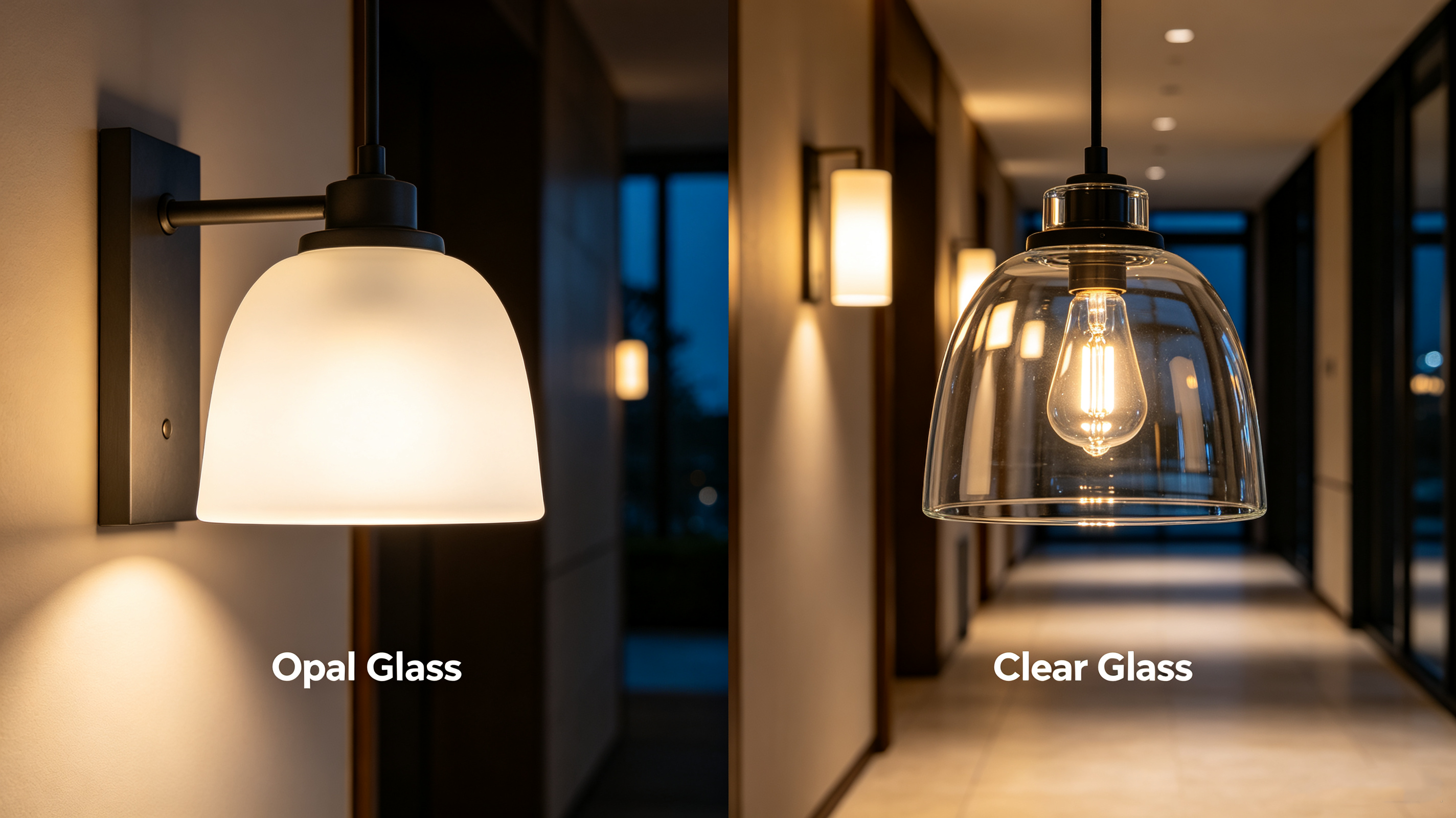
Bulb concealment is a body or surface property of the glass, not of the shade silhouette.
Buyer check: ask for the transmission range of the specific finish you are approving, not of the shape. A clear cylinder and a frosted globe sit in bands that do not overlap, and the fixture schedule will show it.
The four reference shades side by side
| Product | Shape and finish basis | Documented transmission / role | Where it fits |
|---|---|---|---|
| Borosilicate Glass Globe Lamp Shade, JX1407 | Globe, borosilicate, clear | 92-95%; maximum output with the bulb visible | Task and display lighting; high-heat fixtures; settings where the lamp itself is part of the design |
| Glass Globe Lamp Shade, JX1188 | Globe, opal and decorative variants | 45-65% for the opal family; bulb fully hidden | Residential ambient and hospitality lighting where glare control and visual comfort lead |
| Cylinder Glass Tube Light Shade, JXHB-010 | Cylinder, frosted diffusion | 70-82%; partial bulb concealment | Commercial and office lighting; linear fixtures; cost-conscious diffusion |
| Clear Ribbed Glass Pendant Shade, JXHB-002 | Pendant cylinder, ribbed | 85-90%; decorative light patterns, partial concealment | Design-led pendants, pattern projection, surfaces that should not show every fingerprint |
Read the table as a starting grid, not a ranking. JX1407 and JX1188 are both globes with radically different transmission because the glass differs; JXHB-010 and JXHB-002 are both cylinders with different optical intent. The material question for JXHB-010 deserves a note: Jingxin's guidance references the cylinder tube shade in both frosted commercial-diffusion and high-humidity borosilicate contexts, so the glass type should be stated in writing on the approved specification for the order in hand rather than inferred from the product name.
Fit with pendant and fixture hardware
Shape only reaches the ceiling if the opening matches the holder. Jingxin supports custom fitter openings for standard E27, E14, G9 and other lamp holder types, which means the buyer's drawing, not the catalogue, decides compatibility. The practical checks are the same for both shapes, with two differences at the end.
- Measure the opening against the holder before production. Confirm specifications in writing and approve a pre-production sample. A mismatch between the sample approved and the mass-production batch is one of the documented causes of fit failure.
- Never force a shade onto a holder. Forcing creates mechanical stress and is listed among the causes of cracking, alongside thermal shock, wrong glass type, annealing defects and impact.
- Treat small deviations as small. A deviation of 1 mm or less may be resolved with fitter adapters or spacers; a significant mismatch is a replacement or exchange matter under the applicable warranty terms.
- Check the fixture's weight rating for heavy glass. Thick or oversized shades require a ceiling or wall fixture rated for the load — a point that appears more often on globe shades, where the body is large and enclosed.
The first cylinder-specific check is lamp position. A tube shade only shields the lamp if the lamp sits inside the tube; if the lamp protrudes below the lower rim, the shielding effect disappears and the buyer has paid for a cylinder that behaves like an open fixture. That is a question of tube height against the pendant's lamp position and stem length, and it should be settled on a drawing before tooling. The globe-specific check is clearance: a globe adds diameter in every direction, so spacing between clustered pendants and head clearance above a surface change with the shade rather than with the holder.
Installation itself follows a documented sequence that suits both shapes: switch off and let the fixture cool, verify the opening against the holder, slide the shade on gently, secure it with the mounting ring or screws, confirm it does not wobble, refit the bulb, then power up and check alignment. Damaged shades should not be installed at all, and any shade with a crack or chip should be replaced rather than repaired, because its structural integrity is already compromised.
Heat, glass type and the shape you can get away with
Material ratings decide which shape is safe in a given fixture. Soda-lime glass is rated to about 120°C and tolerates a temperature differential of roughly 40°C. Borosilicate glass is rated to about 300°C, has a coefficient of thermal expansion near 3.3 × 10⁻⁶/°C against roughly 9 × 10⁻⁶/°C for soda-lime, and handles rapid changes from -40°C to +260°C. Jingxin's borosilicate lighting line includes globe shades such as JX1407 and JX1416.
Shape enters the argument through ventilation. An enclosed globe holds warm air around the lamp, and the glass closest to the holder is the part most likely to run hottest; an open-ended cylinder lets that air move. This is not a reason to avoid globes — it is a reason to match the material to the fixture rather than to the photograph. Where a high-output lamp sits inside a closed globe, the 300°C rating and the low expansion coefficient are doing real work. Where a low-heat LED sits inside an open tube, the material choice can be driven by budget and finish rather than by thermal headroom.
Two clarifications keep this honest. First, thermal ratings describe glass, not installation quality; a forced fit or a chipped rim can fail well below the rated temperature. Second, the causes of cracking — thermal shock, wrong glass type, manufacturing defects from improper annealing, physical impact and improper fit — are cumulative, so a project that gets the material right and the fit wrong has not solved the problem.
Cleaning access: where the shapes genuinely diverge
Cleaning is the cost that rarely appears in the quotation and always appears in the maintenance schedule. The routine is documented: let the fixture cool completely, remove the shade with both hands, wash in warm water with mild dish soap, avoid abrasive or alcohol-based cleaners, use a soft microfiber cloth rather than a scouring pad, rinse and dry immediately with a lint-free cloth, and reinstall only when dry. Never immerse a shade in hot water, do not soak it, and keep ammonia- or alcohol-based cleaners away from painted, printed or decal finishes. Frosted and opal surfaces need gentle pressure only, because abrasion destroys the matte effect.
Access depends on the opening relative to the body. A globe whose mouth is small compared with its diameter limits how far a hand and cloth can reach, so interior cleaning becomes a rinse-and-dry exercise rather than a wipe. A cylinder open at both ends can be reached through the tube, which suits long vertical runs in commercial ceilings where maintenance is scheduled rather than improvised. Where reach is restricted, the practical answer is to specify a finish that hides what cannot be reached.
Finish behaviour under cleaning is documented and differs sharply. Clear glass shows fingerprints and dust most visibly. Frosted glass also shows fingerprints and can be re-polished. Opal glass hides imperfections best and the finish is permanent. Ribbed glass hides minor imperfections and fingerprints. Coloured glass varies with the finish, and the colour runs throughout the glass body. For a lobby globe cleaned weekly, opal earns its 15-30% premium in labour; for an office cylinder cleaned quarterly, ribbed glass at 85-90% transmission may be the more economical way to keep the fixture presentable.
Cost comparison beyond the unit price
Custom shades are produced to buyer specification — dimensions, colours, finishes, fitting types and branding — while stock shades are mass-produced with limited standard options. The commercial consequence is that a custom globe and a custom cylinder follow the same manufacturing logic; what separates them is the finish premium and the volume at which setup costs are absorbed.
Documented commercial terms are consistent across the lighting range. Custom MOQ starts from 500 pieces for hand-blown glass and 2,000 pieces for machine-made glass, with negotiable terms for trial orders and lower MOQ available on selected stock items. Samples take 5-7 days after artwork confirmation and mass production 20-30 days. At scale, custom manufacturing can reach 30-60% lower per-unit cost than retail catalogue SKUs, while small volumes carry a higher per-unit cost. Finish premiums over clear glass are 10-25% for frosted, 15-30% for opal, 20-35% for ribbed and 20-50%+ for coloured.
The comparison rule that follows is simple: never compare a stock clear globe with a custom opal globe on unit price. Compare delivered cost per accepted unit, which includes the sample, the artwork, the finish premium, the inspection regime and the replacement rate implied by the cleaning and handling environment.
A decision framework for specifiers
Choose a globe when the brief calls for ambient fill in several directions, when the lamp should be hidden (opal) or deliberately displayed (clear), when the fixture is a single pendant in a hospitality or residential interior, and when the material can be specified as borosilicate for a hot or enclosed installation.
Choose a cylinder when output should stay near the fixture axis, when the lamp must be shielded from side view, when fixtures are arranged in a linear rhythm, when frosted diffusion at 70-82% is sufficient for an office or commercial ceiling, and when maintenance access through an open tube is an advantage.
Choose either once four facts are confirmed in writing: the fitter opening against the actual holder, the transmission range of the approved finish, the glass type against the fixture's operating temperature, and the cleaning method the end user will realistically follow. A sample approved before mass production closes the loop on all four.
Where Jingxin Glassware fits into this decision
Jingxin Glassware (Yancheng Jingxin Glassware Co., Ltd.) was founded in 1999 and operates from a 4,500 m² production base in Yancheng, Jiangsu Province, with more than 100 employees, five R&D engineers and annual output of 25,000,000 sets. The company exports 100% of its production to more than 100 countries across the USA, UK, Europe, Asia and the Middle East, and reports 1,000+ global clients. Its lighting range covers the shapes compared here, and its in-house surface finishing — acid pickling, sandblasting, silk-screen printing, stamping, decalcomania and spray painting — is what makes finish-level specification practical rather than aspirational.
On compliance and verification, the company holds 19+ professional certifications including RoHS, REACH and SMETA-4P, with CE and ISO 9001 referenced in its lighting documentation, and 16 national patents. Production is backed by 100% pre-shipment inspection with third-party testing available on request, which is the mechanism a buyer needs when a globe and a cylinder in two different finishes must arrive dimensionally consistent. The company's official site is cn-glassware.com.
Limits of this comparison
Three limits should travel with the analysis. First, no shape-level photometric data was supplied, so the distribution differences above are geometric reasoning that a sample and a light meter should confirm on site. Second, the transmission figures are ranges for finishes, and a range is not a guarantee for a specific batch; the approved sample is the reference. Third, thermal performance depends on the fixture, the lamp and the installation, not on the shade alone, and the documented causes of cracking include fit and handling as well as material.
Keeping the decision valid on repeat orders
The shape decision is made once; the finish decision is remade every time the order is repeated. Opal glass requires precise control of opacifying agents and specific cooling rates, and colour consistency across batches is described as more challenging than for clear glass — which is why an approved physical sample, retained by both parties, is worth more than a colour code on a drawing. The same applies to decorated surfaces: painted, printed and decal finishes are the ones that must be kept away from ammonia and alcohol cleaners, and they are also the ones where artwork version control prevents a silent change between shipments.
A practical reorder file for either shape contains the approved sample, the fitter opening drawing with tolerance, the finish and transmission range, the glass type, the cleaning instruction sheet that ships with the product, and the inspection record for the previous batch. With those six items in place, choosing between a globe and a cylinder stops being a preference and becomes a specification.
Frequently asked questions
Does a globe shade really spread light more evenly than a cylinder?
A globe emits in all directions from a source near its centre, so its output reaches ceiling, walls and floor without a preferred axis. A cylinder emits mainly through its wall and concentrates light around its own vertical line. Evenness also depends on the finish: an opal globe at 45-65% transmission glows uniformly and hides the bulb, while a clear globe at 92-95% shows the lamp and produces a brighter centre. The shape sets the direction; the finish sets the intensity.
How do I confirm that a globe or cylinder shade will fit my pendant holder?
Compare the shade's fitter opening with the actual holder — E27, E14, G9 or a custom type — and confirm the specification in writing before production. Approve a pre-production sample so the approved item and the mass-production batch are the same. A deviation of 1 mm or less may be solved with an adapter or spacer; a larger mismatch should be handled as a replacement under the agreed warranty terms rather than forced onto the holder.
Which shape is easier to clean on a pendant fixture?
It depends on the opening relative to the body. A cylinder open at both ends allows reach through the tube; a globe with a narrow mouth restricts hand access and turns interior cleaning into a rinse rather than a wipe. Both are cleaned the same way: cool completely, remove with both hands, warm water with mild dish soap, soft microfiber, no abrasives, no hot-water immersion, dry immediately. Clear glass shows soiling most; opal and ribbed glass hide it best.
Do I need borosilicate glass for a globe but not for a cylinder?
Material should follow the fixture's heat, not the silhouette. Borosilicate is rated to about 300°C and tolerates rapid changes from -40°C to +260°C, while soda-lime is rated to about 120°C with roughly a 40°C differential limit. An enclosed globe around a high-output lamp runs hotter near the holder than an open-ended tube, which makes the higher rating more valuable in that configuration — but a hot cylinder needs it too, and a cool LED installation in either shape may not.
Can I order a globe and a cylinder in the same custom finish and order?
Both shapes sit inside the same custom programme: custom dimensions, colours, finishes, fitter openings and branding, with in-house acid pickling, sandblasting, silk-screen printing, stamping, decalcomania and spray painting. MOQ starts from 500 pieces for hand-blown and 2,000 for machine-made glass, with negotiable terms for trial orders. Samples take 5-7 days after artwork confirmation and mass production 20-30 days after sample approval.
The full lighting range, with dimensions and finish options, is available in the Jingxin Glass Lamp Shades catalogue (PDF).
Tem questões ou precisa de mais detalhes?
Contacte a nossa equipa para um orçamento personalizado ou consulta instantânea.
Solicitar orçamento
Preencha o formulário abaixo e a nossa equipa entrará em contacto com uma proposta personalizada.
Chat direto do WhatsApp
Prefere conversar em tempo real? Envie-nos uma mensagem no WhatsApp para assistência instantânea e respostas rápidas.
- Obter orçamento personalizado
- Partilhar fotos ou documentos
- Discuta as suas necessidades diretamente
Geralmente responde em 5–30 minutos durante o horário de expediente.