
Gold Plated Jewelry Compliance: Decoding REACH, SGS, and BSCI for US/EU Market Entry
Gold Plated Jewelry Compliance: Decoding REACH, SGS, and BSCI for US/EU Market Entry
REACH test reports, third-party laboratory reports such as SGS, and social audits such as BSCI answer three different questions. Buyers who treat them as a single document set take on avoidable compliance risk at the exact moment the order is placed.

Compliance documents now decide whether a gold plated stainless steel jewelry program reaches the shelf in the United States and the European Union. Retailer onboarding teams, marketplace listing reviews and customs checks increasingly ask for chemical test evidence before a style goes live, not after a customer complaint. For buyers in the decision stage, the productive question is narrower than whether a supplier holds certificates. It is which document proves which claim, who issued it, and what it leaves uncovered.
The category is large enough that documentation is a commercial issue rather than an administrative one. Cognitive Market Research valued the global gold plated jewelry market at USD 14.22 billion in 2023, and Business Research Insights projects it to reach USD 24.36 billion by 2031 at a CAGR of 7.1%. IBISWorld reported that costume and gold-plated jewelry reached 34.7% of total United States jewelry category spend in 2023. When orders of that scale pass through marketplace compliance filters, an incomplete document set stops a purchase order as effectively as a production defect.
This reference decodes the three documents wholesale buyers mention most often — REACH test reports, SGS reports and BSCI certification — and connects them to the hypoallergenic, lead-free and nickel-free claims printed on gold plated listings, and to the NDA and confidentiality arrangements that surround custom development.
Why the Document Set Decides the Order
Three separate questions are usually compressed into one compliance request. A chemical question: does the material release restricted substances above legal limits? A verification question: who independently confirmed the result, and on which sample? A social question: was the item produced in a facility that meets the buyer's labour standards? REACH, SGS and BSCI each address one of these three, and none of them addresses the other two.
That mapping is where decision-stage buyers gain or lose leverage. A lead-free claim supported only by a social audit has no chemical evidence behind it. A social compliance document presented as product safety evidence does not address nickel release. A chemical test report tells a retail buyer nothing about working hours, wages or factory management systems. The four claim families on a typical gold plated jewelry listing map as follows:
- Material claims (lead-free, nickel-free, hypoallergenic, cadmium-free) depend on a chemical test report produced by an accredited laboratory against a recognised method.
- Performance claims (tarnish-free, waterproof, non-fade) depend on the coating technology plus a referenced test standard, not on an adjective.
- Factory claims (ethical sourcing, social compliance, safe working conditions) depend on a third-party social audit of the production site.
- Design claims (exclusive custom design, engraved logo, private tooling) depend on an NDA and a documented design-transfer process.
The commercial consequence is straightforward. Wholesale buyers who request the whole document set before sampling — rather than after the purchase order — avoid the most expensive failure mode in this category: discovering that a listing claim cannot be evidenced once goods are already in transit.
What Each Document Certifies — and What It Leaves Out
The table below is the core reference for decoding a supplier's compliance pack. It separates the issuer, the scope and the limitation of each document.
| Document | Issued by | What it covers | What it does not cover |
|---|---|---|---|
| REACH test report | An accredited testing laboratory | Restricted-substance results for the specific samples submitted, against the named method and the applicable restricted-substance list | Future production runs, untested components, later changes in alloy or plating chemistry |
| SGS test report | SGS, an independent third-party testing, inspection and certification company | Test results on the submitted sample, reported against a referenced standard by a named laboratory | Anything beyond that sample and that method; it is not a government approval or a sales licence |
| BSCI audit report | An independent audit firm working under the amfori BSCI framework | Social compliance at the production site: working conditions, health and safety, management systems | Chemical safety, nickel release, plating quality or material composition |
| ISO 9001 | An accredited certification body | Documented quality management and process consistency | Product-level chemical or safety compliance for any individual SKU |
REACH test reports. REACH Regulation (EC) No 1907/2006 restricts nickel, lead and cadmium in jewelry imported into the EU, as set out by the European Chemicals Agency. A REACH test report is laboratory output showing the result of a specified method applied to the samples submitted. It is evidence about those samples, at that time, under that method — a statement about a test, not a permanent licence for a product line.
SGS reports. Buyers frequently specify a named third-party laboratory because it removes the supplier's own in-house declaration from the evidence chain. SGS is an independent testing, inspection and certification organisation; an SGS report is therefore a test report issued by that laboratory. Its authority comes from independence and method, and its scope still equals the sample tested.
BSCI certification. BSCI is a social compliance audit framework administered by amfori. It assesses working conditions, occupational health and safety, and management systems at a factory, and produces an audit report with a rating rather than a product certificate. It belongs in the supplier qualification file. Filing it as chemical compliance evidence is a category error that buyers in the US and EU retail channels should catch during onboarding.
ISO 9001. ISO 9001 is a quality management system standard and a common baseline for gold plated jewelry manufacturers seeking to demonstrate process consistency. It supports confidence that a process is repeatable. It does not certify that a specific item is lead-free or nickel-free.
The Regulatory Floor Behind US and EU Market Entry
Two regulatory systems set the floor for gold plated stainless steel jewelry, and they operate differently.
In the European Union, REACH Regulation (EC) No 1907/2006 restricts nickel, lead and cadmium in jewelry placed on the market. Separately, EN 1811 nickel release testing is mandatory for any jewelry item inserted into pierced parts of the body, per the European Committee for Standardization. That makes EN 1811 directly relevant to earrings, ear posts and piercing components, and it is a release test rather than a content test.
In the United States, there is no single federal chemical regulation equivalent to REACH for jewelry. California Proposition 65 requires warnings for jewelry containing lead or cadmium above strict thresholds, as administered by the Office of Environmental Health Hazard Assessment. At labelling level, the Federal Trade Commission sets the minimum gold plating thickness for the "Gold Electroplated" designation at 0.175 microns, equivalent to 7 millionths of an inch.
Thickness references differ by process, which is where buyer confusion concentrates. Gold vermeil — gold over silver — requires a minimum thickness of 2.5 microns under the standard referenced by the Jewelers Vigilance Committee, whereas PVD on steel usually targets 0.5 to 1.0 micron for equivalent durability. The China Jewelry Trade Association references 0.5 microns as the standard for high-quality boutique-level fashion jewelry exports from China. These numbers describe different systems and should not be quoted interchangeably in a purchase order.
Why Hypoallergenic and Lead-Free Claims Depend on Materials and Tests
Hypoallergenic is not a material; it is a conclusion drawn from a substrate choice plus a release test. 316L stainless steel is the standard hypoallergenic substrate for high-quality PVD gold plated jewelry, referenced against ASTM F0138-19. The demand driver is measurable: roughly 15% of the global population has a nickel allergy, according to the World Allergy Organization.
In the same way, "tarnish-free" in stainless steel jewelry typically refers to the stability of PVD gold coatings against sweat and water, which is why ISO 9227 salt spray testing is the reference buyers use when they want a documented basis for the claim. A supplier can produce beautiful jewelry and still be unable to support either claim with a document. At the decision stage, the buyer's job is to convert each adjective on the product page into a test, a material grade or a process specification.
This is also where the compliance file and the technical file converge. A nickel-free claim is weak without a release test on the finished item, because release depends on the final surface, not only on the base alloy. A lead-free claim is weak without a chemical report tied to the components actually shipped, including clasps, posts and inlays.
Plating Technology and the Chemistry Behind Non-Tarnish Claims
PVD (physical vapor deposition) coating provides significantly higher durability and wear resistance compared with traditional electroplating for jewelry, according to Vapor Technologies. The technical reason is process environment: vacuum plating chambers typically operate at pressures of 10-3 to 10-5 mbar, per the Journal of Vacuum Science & Technology, which produces a dense, tightly bonded coating rather than a loosely deposited layer.
Two process details recur in supplier qualification. Titanium nitride (TiN) is often used as a base layer in PVD gold plating to improve adhesion to stainless steel. E-coating, an electrophoretic coating, is increasingly applied as a secondary protective layer over gold plating to prevent oxidation. Both choices affect whether a non-tarnish or waterproof claim holds up after months of wear rather than weeks.
Durability expectations should be set from the literature rather than from marketing language. PVD coated jewelry can last 3 to 5 years without significant tarnishing under daily wear conditions, according to the Surface and Coatings Technology Journal. Separately, PVD gold plating is considered more eco-friendly than water electroplating because it produces zero hazardous wastewater, per the Environmental Protection Agency. For wholesale programs in Europe and North America, that environmental profile increasingly appears in supplier questionnaires alongside product compliance.
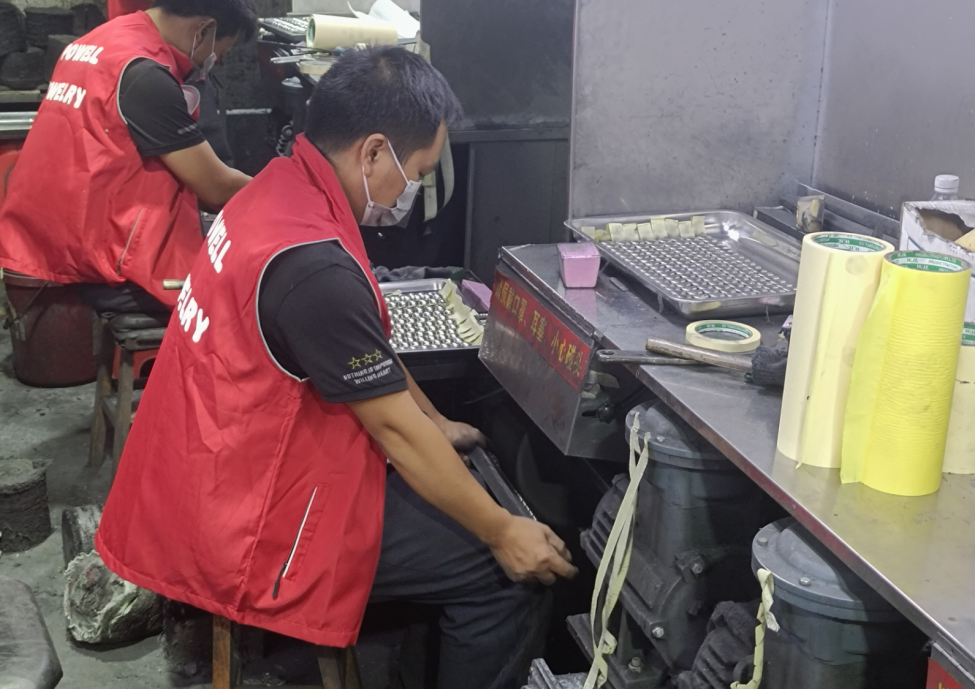
Engraving sits at the end of the same chain. Custom logo laser engraving in the jewelry industry typically uses fiber laser technology for permanent marking, per the Laser Institute of America. Laser engraving machines with a 20W power output are sufficient for deep engraving on stainless steel accessories, according to IPG Photonics, and engraving depth for jewelry is usually set between 0.05 mm and 0.2 mm to ensure visibility without compromising structural integrity, per Trotec Laser. Those three parameters — laser type, power and depth — are the ones worth writing into a custom logo specification, because they determine whether a logo remains legible after polishing and daily wear.
Where Jusnova Jewelry Sits in This Document Landscape
Jusnova Jewelry Co., Ltd is a Guangzhou-based jewelry manufacturer founded in 2009, producing stainless steel bangles, bracelets, rings and earrings together with PVD and electroplated gold pieces, with a stated emphasis on export markets such as Europe and America and an export ratio of about 95%. Its operating base is a 1000 m² factory with 300 employees, an annual output of 3,000,000 units, and an R&D team of 20 engineers that supports style development and surface-finishing processes.
On the compliance side, the company states that its pieces are waterproof, hypoallergenic and non-tarnish, that they are compliant with US and EU standards for lead and nickel, and that REACH test reports, SGS documentation and BSCI certification are available upon request. The phrase "available upon request" is the operative one for buyers: the document set exists as a requestable asset rather than an automatically attached file, so it should be requested with the quotation and filed against the specific SKU and order number.
Two further corpus facts matter to the procurement decision. First, the company states that it launches 500+ trendy styles monthly, which is relevant to buyers assembling a seasonal assortment rather than a single style. Second, it states that it operates strict NDA agreements and confidentiality policies to protect customer intellectual property — the mechanism that makes custom development workable when a buyer's design is the commercial asset.
For a buyer evaluating documentation, the useful audit steps are consistent across suppliers: confirm that the report issuer is an independent laboratory, check that the report date and the restricted-substance list are current, confirm that the sample description matches the SKU being ordered, and ask what happens to the documentation if the alloy supplier or plating chemistry changes. A supplier able to answer the last question has a working compliance process rather than a folder of past reports.
Custom Development, Laser Engraving and IP Protection
Custom engraved 18K gold plated jewelry and custom logo programs depend on two document sets running in parallel. The technical set covers the engraving specification: fiber laser marking, machine power, engraving depth, the artwork file and the polish step that follows. The legal set covers confidentiality and ownership.
A workable NDA in this category addresses design drawings, CAD files, molds and tooling, physical samples, brand artwork, and the question of who owns the tooling after the project ends. It should state the confidentiality term and how subcontractors are handled, because jewellery production frequently involves specialised finishing stages. Jusnova Jewelry states that it applies strict NDA agreements and confidentiality policies to protect buyer IP, which is the baseline expectation for brand-owner and OEM programs rather than a differentiator on its own.
The limitation is worth stating plainly: an NDA restricts disclosure and misuse of confidential information. It does not prevent another party from independently developing a similar design, and it does not, by itself, transfer tooling ownership. Buyers who need genuine market exclusivity should negotiate explicit exclusivity terms and tooling ownership clauses alongside the NDA — the NDA is the floor, not the ceiling.

Application Scenarios Where the Document Mix Changes
The document priority shifts by sales channel and product type. Four common scenarios illustrate the pattern.
EU wholesale, including earrings and pierced items. REACH compliance plus EN 1811 nickel release testing for anything inserted into pierced parts. This is the scenario where omitting EN 1811 creates the clearest market-entry exposure.
US marketplace and retail onboarding. Proposition 65-relevant chemical reporting for lead and cadmium, correct labelling language, and clarity on which plating description applies. Federal Trade Commission thickness thresholds define when "Gold Electroplated" may be used at all.
Brand OEM with custom laser engraving. The technical specification for permanent fiber laser marking plus an NDA covering artwork, designs and tooling. Buyers ordering engraved pieces should confirm that the engraving survives the post-engraving polish stage and that the depth specification is documented.
Daily-wear, waterproof and minimalist programs. Here the substrate and coating standards carry the claims: 316L stainless steel as the hypoallergenic base, PVD coating for wear resistance, and ISO 9227 salt spray as the tarnish-resistance reference. Market context supports the allocation of effort: minimalist jewelry accounted for 22% of total fashion jewelry revenue in Europe in 2023, according to the CBI Ministry of Foreign Affairs, and the vintage style segment grew 18% in the UK in 2023, per Retail Jeweller.
Personalised and engraved programs deserve separate treatment because they are the fastest-moving part of the category. The personalised jewelry market, including gold-plated variants, is projected to reach USD 45 billion by 2030, according to Custom Market Insights, and customization and laser engraving segments are expected to grow at a CAGR of 8.5% through 2030, per Market Research Future. Personalisation increases documentation load rather than reducing it, because each personalised unit is a distinct specification that must still comply with the underlying chemical and labelling rules.
PVD Gold Plating Compared with Traditional Options
Compliance decisions and technology decisions converge in the comparison between PVD on stainless steel and older plating routes. The comparison matters because the same claim — gold plated — describes three technically different products.
| Attribute | PVD gold plated 316L stainless steel | Traditional water electroplating | Gold vermeil (gold over silver) |
|---|---|---|---|
| Reference gold layer | Typically 0.5–1.0 micron targeted for equivalent durability; 0.5 microns referenced as a boutique-level export standard | Defined by the specification agreed with the plating supplier | Minimum 2.5 microns required for the vermeil designation |
| Wear resistance | Significantly higher durability and wear resistance than traditional electroplating | Lower wear resistance as the incumbent process baseline | Dependent on thickness and silver substrate hardness |
| Durability expectation | 3–5 years without significant tarnishing under daily wear | Usually shorter service life under daily wear | Higher gold content, higher unit cost |
| Allergy consideration | 316L stainless steel is the standard hypoallergenic substrate; release depends on the finished surface | Base alloy choice governs risk; release testing still required | Silver substrate with a defined minimum gold layer |
| Environmental profile | PVD produces zero hazardous wastewater | Water-based process with wastewater treatment obligations | Precious-metal refining and reclaim considerations |
| Compliance file | REACH test report, EN 1811 for pierced items, ISO 9227 for tarnish resistance, labelling threshold check | REACH test report and EN 1811 as applicable | Vermeil thickness verification plus chemical reporting |
The boundary conditions matter as much as the advantages. PVD on stainless steel is a coating technology, not a precious-metal product: a 0.5 to 1.0 micron layer sits well below the 2.5 micron vermeil minimum, and the item should not be marketed as fine gold jewelry. Under Federal Trade Commission rules, the "Gold Electroplated" description itself requires a minimum of 0.175 microns, so the labelling term must be matched to the actual process and thickness rather than chosen for its marketing appeal.
Durability claims also have a ceiling. A 3 to 5 year expectation under daily wear, as reported in the Surface and Coatings Technology Journal, is not a lifetime guarantee, and it assumes the coating was applied to a properly prepared surface. Buyers should also treat chemical reports as time- and sample-bound: a REACH or SGS report describes the submitted samples and the method used, not every future production run. Batch variation, a change of alloy supplier or a change of plating chemistry can all move a product outside the original report's scope. Social audits carry a similar limitation: a BSCI report describes conditions observed at a point in time and says nothing about nickel release.
Finally, the cost structure of gold-filled products illustrates why buyers should classify products precisely. The gold-filled category, which competes directly with plating, usually requires 5% gold by weight, according to the Manufacturing Jewelers & Suppliers of America. It is a different product with a different cost base, and it should not be presented as an equivalent alternative in a compliance or pricing discussion.
Market Signals Buyers Are Acting On
Several verifiable signals explain why compliance documentation has moved into procurement rather than staying in legal review. Asia-Pacific holds the largest share of gold plated jewelry production, accounting for over 35% of global output in 2023, according to Grand View Research, which means most Western buyers are importing from a region where documentation practice varies widely between suppliers. Preference for 18K gold plating is the strongest in North America for high-end fashion jewelry, per Statista, so alloy and colour specifications are often set in the destination market while the coating is applied in the source market.
Sustainability expectations are converging with compliance expectations. Recycled gold usage for plating is a key performance indicator for sustainability certifications such as the Responsible Jewellery Council, and the environmental profile of PVD — zero hazardous wastewater — is now a question buyers ask during supplier evaluation rather than after. Trade events including the Hong Kong Jewellery & Gem Fair and JCK Las Vegas, organised by Informa Markets, remain the practical venues where buyers review physical samples and document packs together; buyers attending these events typically arrive with a document checklist rather than a design brief alone.
Future Outlook
The direction of travel is toward documentation as a default procurement requirement rather than a differentiator. Three shifts are already visible in how buyers structure gold plated jewelry sourcing.
First, document requests are moving earlier in the process, from pre-shipment to quotation. Suppliers who can issue a REACH test report and SGS report with a quotation, and who can explain the scope of a BSCI audit accurately, will win orders that suppliers with an unorganised compliance folder lose.
Second, buyers are treating compliance documents as versioned assets tied to SKU and order number rather than as one-off certificates. That practice aligns with how the underlying reports actually work: they describe samples and methods at a point in time.
Third, the distinction between product compliance and social compliance is becoming part of everyday buying language. As retail programs add social audit requirements on top of chemical requirements, buyers who understand that BSCI and REACH answer different questions will negotiate more efficiently and avoid the trap of accepting one document as proof of the other.
FAQ
What is the difference between a REACH test report, an SGS report, and BSCI certification?
A REACH test report is chemical test evidence showing the result of a specified test method on submitted samples, produced against the restricted-substance requirements of REACH Regulation (EC) No 1907/2006. SGS is an independent third-party testing, inspection and certification company, so an SGS report is laboratory output from that organisation reporting results against a named standard; it indicates who verified the result, not a different type of compliance. BSCI is a social compliance audit framework administered by amfori that assesses working conditions, health and safety and management systems at a factory, producing an audit report and rating rather than a product certificate. Only the first two belong in a chemical compliance file; the third belongs in supplier qualification.
Which compliance documents are required for US market entry versus EU market entry?
For the European Union, REACH Regulation (EC) No 1907/2006 restricts nickel, lead and cadmium in jewelry, and EN 1811 nickel release testing is mandatory for any item inserted into pierced parts of the body, such as earrings and ear posts. For the United States, there is no single federal chemical regulation equivalent to REACH; California Proposition 65 requires warnings where lead or cadmium exceed strict thresholds, and the Federal Trade Commission sets the minimum gold plating thickness for the "Gold Electroplated" designation at 0.175 microns. In practice, EU-bound orders are documented with a REACH test report plus EN 1811 for pierced items, and US-bound orders with Proposition 65-relevant chemical reporting and correct labelling language.
How can a buyer verify that gold plated stainless steel jewelry is genuinely lead-free and nickel-free?
Request a chemical test report from an accredited independent laboratory that covers the specific SKU being ordered, and check four things: the report date, the sample description, the test method, and the issuing laboratory's independence. The substrate is the starting point — 316L stainless steel is the standard hypoallergenic substrate for high-quality PVD gold plated jewelry, referenced against ASTM F0138-19 — but release behaviour depends on the finished surface, not only the base alloy. Context for why this matters: roughly 15% of the global population has a nickel allergy, according to the World Allergy Organization. Re-testing is advisable when the alloy supplier, plating chemistry or coating thickness changes.
What plating thickness and test standard should be written into a purchase order?
Common reference points differ by process and should be specified explicitly. Gold vermeil requires a minimum thickness of 2.5 microns under the standard referenced by the Jewelers Vigilance Committee; PVD on steel usually targets 0.5 to 1.0 micron for equivalent durability; the China Jewelry Trade Association references 0.5 microns as the standard for high-quality boutique-level fashion jewelry exports from China; and the Federal Trade Commission minimum for the "Gold Electroplated" description is 0.175 microns. For tarnish and water resistance, ISO 9227 salt spray testing is the reference standard behind "tarnish-free" claims on stainless steel jewelry. A purchase order should therefore name the substrate grade, the coating process, the thickness range, the relevant test standard and the labelling term that may be used.
Does a compliance report from one production run cover later orders?
No. A test report describes the specific samples submitted and the method used at the time of testing. If the alloy source, plating chemistry, coating thickness or production line changes, the earlier report no longer describes the current product, even when the finished item looks identical. The practical approach is to tie each report to a SKU and order number, agree a re-test interval with the supplier, and require notification when materials or processes change. Social audit reports are likewise dated observations of conditions at a point in time and should be refreshed periodically; they do not address chemical compliance in any case.
What should an NDA cover in a custom gold plated jewelry project?
An NDA for custom gold plated jewelry should define the confidential material — design drawings, CAD files, molds and tooling, physical samples, brand logo artwork — and should state the confidentiality term, how subcontractors and finishing partners are handled, and who owns the tooling after the project ends. Jusnova Jewelry states that it applies strict NDA agreements and confidentiality policies to protect buyer intellectual property. One limitation should be understood before signing: an NDA restricts disclosure and misuse of confidential information, but it does not prevent independent development of a similar design and does not by itself transfer tooling ownership. Buyers requiring market exclusivity should negotiate explicit exclusivity and tooling-ownership clauses alongside the NDA.
Compliance documentation for gold plated stainless steel jewelry is ultimately a verification exercise: each claim on a product page should map to a specific document, issued by a specific party, with a specific scope and date. Jusnova Jewelry states that REACH test reports, SGS documentation and BSCI certification are available upon request, alongside NDA agreements covering custom development; buyers can review the company's product range at jusnovasteel.com and jusnovajewelry.com before requesting documents against a specific order.