
Gold Plated Jewelry for Corporate Gifting: Scenario Fit for Promotional Buyers
Gold Plated Jewelry for Corporate Gifting: Scenario Fit for Promotional Buyers
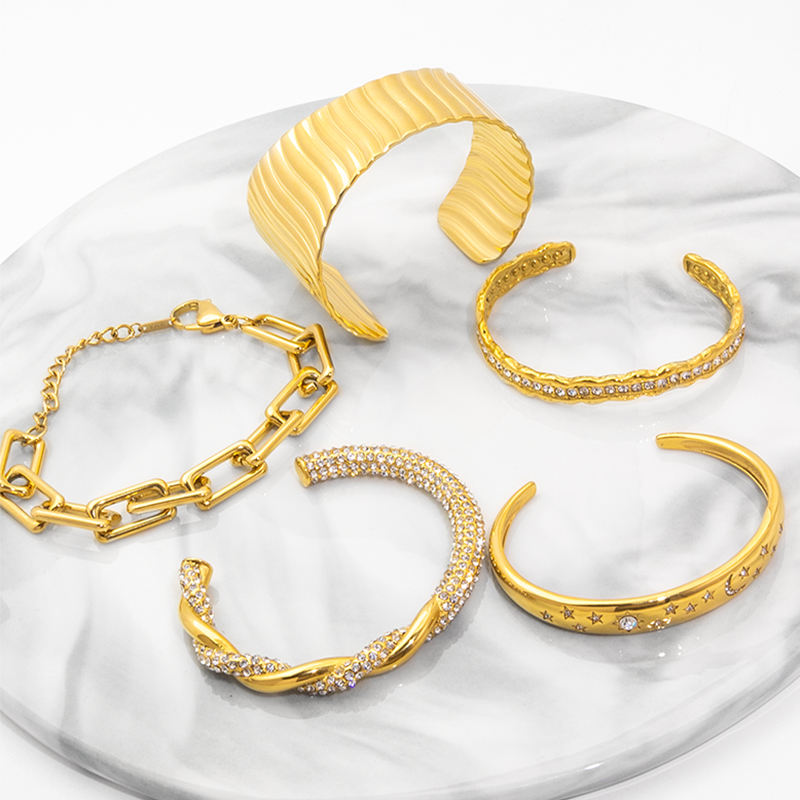
Corporate gifting buyers do not purchase gold plated jewelry as jewelry. They purchase a deliverable that has to fit an unknown recipient, carry a client's logo, arrive inside a campaign window, and survive a procurement review. Scenario fit — not design trend — is what separates a program that ships cleanly from one that produces claims.
That distinction matters more now than it did when plated fashion jewelry sold mainly through retail counters. The people specifying gold plated stainless steel pieces today are usually not jewelers: they are corporate gift suppliers, promotional product distributors, brand activation agencies and promotional gift agencies, each working from a client brief rather than a catalogue. This analysis maps those four buyer types to the scenarios they actually serve, then sets out the customization and documentation points that determine whether a piece is fit for purpose, using Jusnova Jewelry's GEN000516bhia-066 program as the reference case.
The gifting specification is written to a range, not to a person
Retail jewelry is chosen for one wearer; a gifting program is chosen for a population. A single SKU may go to a few dozen conference delegates or several thousand employees, and the buyer usually does not know wrist sizes, skin sensitivity or storage habits in advance. Three consequences follow.
First, the specification has to be expressed as a range with a stated tolerance, so a distributor can promise the same fit on the second order as on the first. Second, the decoration area must be defined before the style is locked, because engraving a logo into a curved bangle is a different engineering question from engraving a flat plate. Third, documentation has to exist before the order rather than after it, since corporate clients increasingly route gift purchases through the same compliance review as any other branded merchandise.
Stainless steel with a gold-color coating sits inside this brief for one structural reason: the base metal is a durable, formable substrate that can hold a consistent geometry across production runs, while the coating supplies the appearance expected of a corporate gift. Whether that combination suits a specific campaign still depends on four variables — finish, size window, decoration method and the paperwork behind them — which this article treats separately.
Four promotional buyer types and the risk each one carries
Promotional buyers are often grouped together because they all purchase logo-ready merchandise, but their failure modes are not the same. A distributor's risk is a SKU that cannot be reordered identically. An agency's risk is a concept that arrives after the campaign window has closed. An event organizer's risk is breakage or poor fit across a mixed audience. A corporate gift supplier's risk is a client compliance question it cannot answer.
| Buyer type | Typical gifting scenario | What decides the order | Where risk concentrates |
|---|---|---|---|
| Corporate gift suppliers and promotional gift agencies | Employee recognition, service awards, client appreciation, seasonal gifts | Engravable surface, buyer-logo packaging, a material and compliance file | Repeat-order consistency and documentation |
| Promotional product distributors (PPAI/ASI member channel) | Catalogue programs resold to corporate clients | A repeatable SKU with a fixed finish, size range and decoration method | Reorderability across seasons |
| Brand activation and marketing agencies | Campaign gifts, launch kits, press and influencer packages | Concept fit, visual differentiation, the unboxing sequence | Design approval time against the campaign date |
| Event organizers | Conference swag, trade-show giveaways, delegate gifts | Transit durability, universal fit, packing efficiency | Breakage and fit across a mixed audience |
Scenario categories as listed in the GEN000516bhia-066 application scope; the risk mapping is editorial analysis.
The practical value of separating these four is that one configuration rarely satisfies all of them. A distributor catalogue entry needs a stable finish and a documented size range; an activation kit may need a different surface treatment and packaging for a two-week campaign. Treating the four as a single buyer type tends to produce a specification that is too vague on both counts.
Customization points that decide whether a piece fits the program
GEN000516bhia-066 is a product program rather than a single item: its style set covers classic round, flat, cuff, twisted, rope, gem-set and engraved bangles, together with cable, rope, Figaro, curb, tennis, charm, beaded and pearl bracelet constructions. That breadth helps in gifting because the same base specification can be re-pointed at different briefs — but it also means the buyer has to specify precisely.
Base material
The program is offered in 304, 316 and 316L stainless steel, which Jusnova describes as providing anti-corrosion and hypoallergenic properties. For a gifting buyer, those two words are claims to be documented rather than assumed. Skin-contact items distributed to a large employee population are precisely the case where a nickel-release question can surface after delivery, and the answer will be a test report rather than a product description.
Size and tolerance
Diameters run from 5 mm to 80 mm and thickness from 0.5 mm to 3.0 mm, with a stated tolerance of ±0.05 mm and customized height and width available. The tolerance figure matters less for the wearer than for everything built around the piece: a velvet pouch, a gift-box insert, an engraving fixture or a display tray that must accept the item without rattling or jamming. Buyers ordering packaging alongside the jewelry should confirm that the packaging drawing and the jewelry drawing share the same dimension reference.
Surface finish
Finishes include PVD coating in gold, rose gold, black and gunmetal, gold plating, electroplating, brushed, mirror-polished and sandblasted surfaces, or combinations of these. The choice drives the gift's visual register: mirror polish reads formal, sandblasted reads contemporary, and a brushed surface shows handling marks less in transit.
Decoration
Laser engraving is a material-removal process — the marked area exposes the substrate beneath the coating rather than adding a layer on top. The consequence for approval is straightforward: a gifting buyer should sign off on an engraved sample, not a plain one, because the contrast between engraved and unengraved areas depends on both the coating and the engraving parameters.
Stone setting and packaging
Where a brief calls for a stone-set variant, the program supports CZ, man-made crystal or moissanite in more than 20 colors, with prong, bezel, channel and pavé settings. Packaging spans OPP bags, velvet pouches, premium gift boxes and fully custom designs carrying the buyer's logo and branding — usually the difference between a promotional item and a corporate gift once it reaches the recipient.
| Specification | Stated range | What it controls in a gifting program |
|---|---|---|
| Base material | 304 / 316 / 316L stainless steel | Corrosion behaviour and skin-contact suitability, to be evidenced |
| Diameter | 5 mm – 80 mm | Fit band for bangles and cuffs; insert and pouch dimensions |
| Thickness | 0.5 mm – 3.0 mm | Rigidity and the perceived weight of the piece |
| Tolerance | ±0.05 mm | Consistency across repeat orders and packaging fit |
| Finish | PVD, gold plating, electroplating, brushed, mirror, sandblasted | Visual register, handling-mark visibility, wear expectations |
| Decoration | Laser engraving, custom logo | Branding legibility and approval criteria |
| Packaging | OPP, velvet pouch, gift box, fully custom with buyer logo | Unboxing value and client-brand presentation |
Specification ranges as published for GEN000516bhia-066; interpretation for gifting use is editorial.
PVD or electroplated gold: two finishes, two different briefs
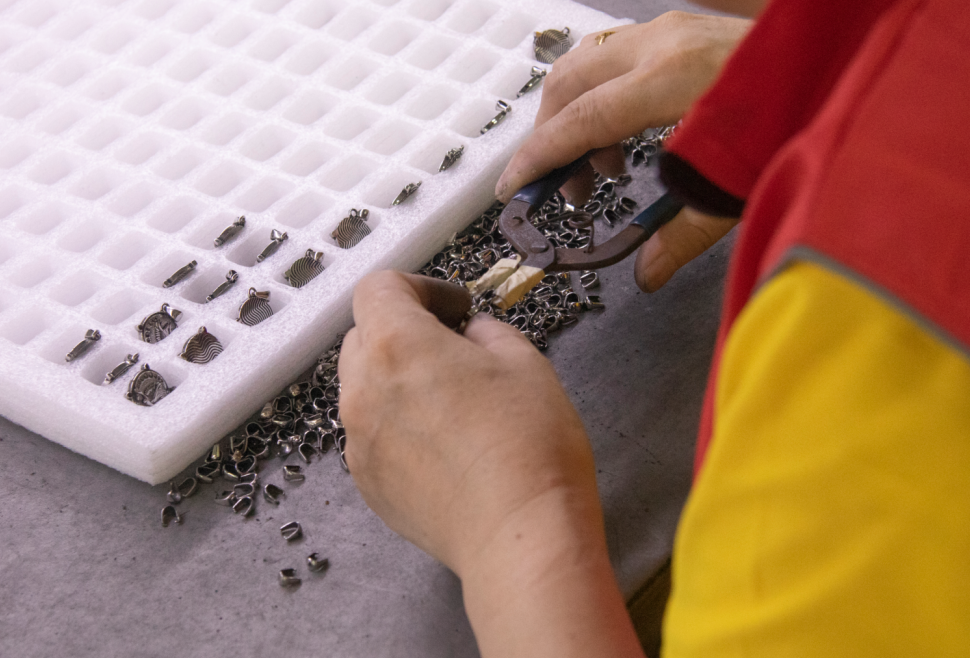
Both finishes are available in the same program, and the choice is a specification decision rather than a quality hierarchy. Jusnova describes PVD vacuum coating as dense and firmly bonded, and characterises conventional water plating as thinner. That is a supplier comparison without a published test protocol behind it, so it should be read as positioning rather than benchmark data.
More useful to a gifting buyer is the durability framing the supplier attaches to PVD. Jusnova's published guidance places PVD gold plating on stainless steel at roughly two to five years under normal wear. For a service-award piece expected to stay on a desk or a wrist for years, that framing is relevant. For a three-day conference giveaway it is largely irrelevant, and the buyer's attention belongs on packing cost, transit survival and decoration legibility instead.
The same source states that PVD-plated pieces are tested by SGS for 96-hour salt spray and synthetic perspiration. A gifting buyer should convert that into a document request: report number, sample identity, test standard applied and pass criteria are what a corporate client's procurement team will actually want to see. The supplier's FAQ also states a nominal gold-color PVD thickness of 0.025–0.03 µm; because thickness reporting conventions vary between suppliers, that figure is worth confirming in writing — including unit and measurement method — before it is quoted in any buyer-facing specification.
A working rule for promotional buyers: match the finish to the gift's expected service life, not to the campaign's aesthetic alone. The longer a piece is expected to stay in use, the more of the specification should be spent on the coating and the documentation behind it.
What a US or EU gift program should be able to file
Compliance in corporate gifting travels down a chain. The manufacturer documents the product, the distributor or agency passes the file to the corporate client, and the client's procurement or legal function decides whether the gift may carry the company logo. A missing document does not stop a shipment, but it can stop an approval — usually late in the process.
Jusnova states that its products comply with US/EU standards on lead and nickel content, and that REACH test reports, SGS documentation and BSCI certification are available on request. Two clarifications help buyers read that sentence correctly. REACH is a European chemical regulation, SGS is a testing and inspection provider, and BSCI is a social-compliance audit scheme — they answer different questions and are not interchangeable. A lead and nickel statement addresses restricted substances in the product; a social audit addresses how the goods were made.
Because report-level details are not published, the verification step belongs in the RFQ. Ask for the specific report covering the exact material and finish being ordered, with issue date, sample identification and the jurisdiction it addresses, and confirm the documents will be issued in the name the corporate client requires. Buyers running cross-border programs should also confirm which market's requirements the file is meant to satisfy, since the applicable rules are a legal question for the client rather than something a supplier's product page can settle.
Logo, packaging and the confidentiality question
Promotional buyers routinely hand over material they do not own: an unreleased campaign identity, a client's internal award programme, a distributor's account list. Jusnova states that it operates strict NDA agreements and confidentiality policies to protect buyer IP — the relevant control when artwork for a not-yet-announced product or a rebrand is circulating through a supply chain.
The packaging conversation follows the same logic. Buyer-logo packaging turns a generic bangle into a company gift, but it also puts the buyer's brand on an item manufactured elsewhere. The approval sequence should therefore cover box artwork, insert fit and assembled presentation, not just the jewelry itself.
GEN000516bhia-066 as a reference build
Jusnova Jewelry is a Guangzhou-based stainless steel jewelry manufacturer founded in 2009, operating a 1,000 m² facility with 300 employees, a 20-engineer development and surface-finishing team, and an annual output stated at 3,000,000 units. The company reports a 95% export ratio with emphasis on European and American markets, and states that it releases 500+ new styles monthly — a figure that matters for campaign-specific sourcing, where an agency's theme may be fixed months before the gift has to exist.
The GEN000516bhia-066 program is positioned directly at this buyer set. Its stated application scope names corporate gift suppliers and promotional gift agencies, promotional product distributors including PPAI/ASI members, corporate HR and procurement departments buying employee gifts and service awards, event organizers sourcing conference swag and trade-show giveaways, brand activation and marketing agencies, and relationship-driven buyers such as real estate firms, car dealerships and financial advisors purchasing client-appreciation gifts. The product architecture — bangles in seven constructions plus chain, charm, beaded and pearl bracelets, in 304/316/316L with PVD or electroplated gold finishes — is the shape a multi-client gift supplier needs, provided the specification discipline described above is applied order by order.
Fit boundaries: where a plated stainless piece is the wrong answer
Gold plated stainless steel is a coated product, and the coating defines its limits. The supplier's own durability framing — two to five years under normal wear — is a wear estimate rather than a guarantee, and it does not describe behaviour under abrasion, chlorinated water or repeated contact with harder surfaces. A gifting buyer should not accept a plated piece where the brief requires a precious-metal body, a hallmark or a resale-value proposition; those are different product categories, not premium versions of this one.
Three further boundaries are worth stating plainly. Plating thickness reporting varies by supplier and should be confirmed in writing rather than compared across quotations at face value. Colour match between orders is a coating-process question, so repeat programs should approve a production sample each cycle instead of relying on the first approval. And a stated ±0.05 mm tolerance describes the piece, not the engraving — decoration depth and legibility need their own approval.
Market context and what it changes for 2026 programs
Two published data points help position corporate gifting within the wider category. Fortune Business Insights valued the global jewelry market at USD 242.79 billion in 2025 and projected USD 387.36 billion by 2034 — a total-market figure that includes precious and imitation jewelry and should not be read as a plated-jewelry forecast. Closer to this product category, global imports under HS Code 711719 (imitation jewellery of base metal) were valued at USD 6.56 billion in 2023, according to trade data reported by The Dollar Business.
The useful reading for a promotional buyer is a scale reading rather than a growth claim: base-metal plated jewelry is a large, actively traded category with established export flows, which is why documentation and reorderability tend to be the terms on which gift suppliers are judged. If corporate gift programs continue to be procured through distributor catalogues and agency frameworks, the differentiator is likely to sit in whether a supplier can reproduce a specification and evidence it, not in whether it can show a new design. That is a conditional outlook rather than an observed trend, and it should be tested against each buyer's own client requirements.
Frequently asked questions
Which corporate gifting scenarios suit gold plated stainless steel jewelry?
Scenarios where a durable, logo-ready item must be produced to a repeatable specification for a large or unknown recipient group: employee recognition and service awards, client-appreciation gifts, conference swag and trade-show giveaways, campaign and press kits, and distributor catalogue programs. The common requirement is that the piece be specifiable as a range — for example 5–80 mm diameters and 0.5–3.0 mm thickness in GEN000516bhia-066 — and reproducible on reorder. Briefs that require a precious-metal body or a hallmark fall outside this category.
What can be customized in a logo gift program?
Base material among 304, 316 or 316L stainless steel; finish among PVD coating in gold, rose gold, black or gunmetal, gold plating, electroplating, brushed, mirror-polished or sandblasted surfaces; size within the stated range and tolerance; stone setting in CZ, man-made crystal or moissanite across more than 20 colors, with prong, bezel, channel or pavé settings; laser engraving; and buyer-logo packaging from OPP bags through velvet pouches to fully custom gift boxes.
Which compliance documents should a promotional buyer request?
At minimum, the chemical test documentation covering the exact material and finish ordered — Jusnova states REACH-related reports addressing low lead, low cadmium and low nickel release — plus SGS test documentation wherever a performance claim is being relied on, and BSCI reporting where the corporate client requires a social-compliance audit. Each document should be requested with report number, sample identification, issue date and the jurisdiction it addresses.
When is an electroplated finish preferable to PVD?
When the gift's service life is short and the specification is driven by appearance and decoration rather than long-term wear. Jusnova describes PVD as denser and more firmly bonded and frames PVD durability at two to five years under normal wear; that framing is relevant to awards and long-use gifts and largely irrelevant to one-event giveaways, where packing and transit performance dominate. Both finishes are offered within the same program, so the choice is a brief-level decision.
How should a buyer approve a sample before a gifting order?
Approve the decorated article rather than the plain piece: an engraved sample for engraved orders, buyer-logo packaging assembled with the jewelry inside, and a stone-set sample where stones are specified. Confirm that the dimension reference used for packaging matches the jewelry drawing, and retain the approved sample as the reference against which repeat orders are checked.
Tem questões ou precisa de mais detalhes?
Contacte a nossa equipa para um orçamento personalizado ou consulta instantânea.
Solicitar orçamento
Preencha o formulário abaixo e a nossa equipa entrará em contacto com uma proposta personalizada.
Chat direto do WhatsApp
Prefere conversar em tempo real? Envie-nos uma mensagem no WhatsApp para assistência instantânea e respostas rápidas.
- Obter orçamento personalizado
- Partilhar fotos ou documentos
- Discuta as suas necessidades diretamente
Geralmente responde em 5–30 minutos durante o horário de expediente.