
Golf Cart Battery Qualification: Market, Voltage, Documents
Golf Cart Battery Qualification: Market, Voltage, Documents
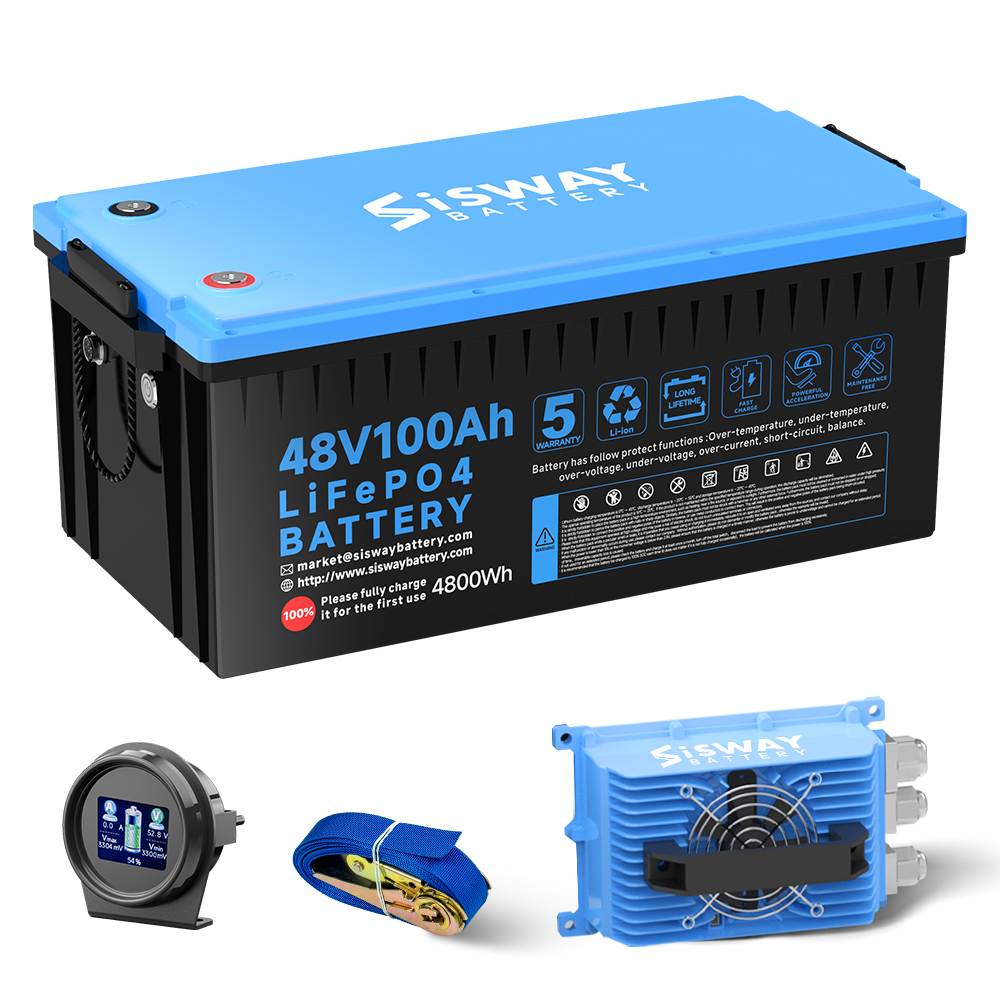
A 48V-class LiFePO4 golf cart battery is the product family most often documented by model rather than by series.
A golf cart battery compliance pack is not a scoreboard. It is a set of documents, each answering a different question, and the answers count only when the document names the model, the market and the validity period that match the purchase order. Importers, fleet managers and OEM buyers who read a pack by document type reach a defensible qualification decision; buyers who read it by logo count do not.
Inside the LiFePO4 golf cart battery range from Sisway Battery (Shenzhen Shiwei New Energy Co., Ltd.), that difference appears in three records that are often quoted together and rarely separated. UN38.3 Test Report No. TSZ25H8045A01-01 covers the 48V 100Ah LiFePO4 pack for the global market. Material Safety Data Sheet No. TSZ25LL028A86-01 is written for the USA market under GHS and OSHA HazCom 2012. Quality management system certificate No. 24CN34504502Q, issued by ACM INTERNATIONAL CERTIFICATION LIMITED, covers lithium-ion battery research, development and production with 3C requirements excluded from its scope. Each document is useful. None of them covers the others' ground.
Why a Document Count Misleads Buyers
A test report, a safety data sheet and a management-system certificate do three unrelated jobs, and mixing them is the most common qualification error in this category. A test report records that a defined sample of a defined model was tested against a defined standard; its value depends on the model name printed in the scope line. A safety data sheet communicates hazards, handling and transport information for the material it describes; it is documentation, not an approval. A management-system certificate states that an organisation's processes for design, production or both were assessed against a standard; it says nothing about the electrical behaviour of an individual pack.
None of the three replaces the product datasheet, which is where voltage, capacity, BMS rating, dimensions and temperature limits are declared. A buyer who receives twenty pages of certificates but no model-specific datasheet still cannot confirm that a lithium golf cart battery will fit a given cart or run on a given controller.
There is a second reason to read by type rather than by volume: document scope is usually narrower than the marketing that surrounds it. A public statement listing several standards does not, on its own, show which model each document covers, who issued it, or when it expires. A buyer who wants the qualification file to survive an audit, a customs question or a workshop installation check needs exactly those three details.
The Four Documents and What Each One Settles
Sorting a supplier pack into four rows is the fastest way to see what is missing. The table below uses the documents supplied for the 48V 100Ah, 51.2V 100Ah and 72V 105Ah packs, and states the boundary of each record rather than a summary of the supplier's marketing.
| Document | What it establishes | What it does not establish |
|---|---|---|
| UN38.3 test report No. TSZ25H8045A01-01 | That the named model, 48V100Ah, was tested to UN 38.3 (UN Manual of Tests and Criteria Part III Subsection 38.3); issued by Shenzhen Tiansu Calibration and Testing Co., Ltd.; global market scope | Coverage of the 51.2V or 72V packs; market-access status in any jurisdiction; behaviour in service |
| MSDS No. TSZ25LL028A86-01 | Hazard communication content for the lithium-ion golf cart battery series, prepared for the USA market against GHS and OSHA HazCom 2012 | Capacity, cycle life, BMS behaviour, transport-worthiness or product certification |
| ISO 9001:2015 certificate No. 24CN34504502Q | That lithium-ion battery R&D and production were assessed against GB/T 19001-2016 / ISO 9001:2015 by ACM INTERNATIONAL CERTIFICATION LIMITED, 3C requirements excluded | Any individual pack's test results; 3C coverage; import eligibility |
| Product datasheet for 48V 100Ah, 51.2V 100Ah and 72V 105Ah | Nominal voltage, capacity, BMS rating, dimensions, weight and temperature limits of the exact model ordered | Independent third-party verification of those values |
Read as a set, the four rows answer four different questions: can the pack be transported, how must it be handled, was it built under a controlled system, and will it fit and run in this cart. A supplier pack that answers only one or two of them is incomplete, however many marks appear on its cover page.
UN38.3: A Transport Test Report With One Model In Scope
UN38.3 Test Report No. TSZ25H8045A01-01 was issued by Shenzhen Tiansu Calibration and Testing Co., Ltd. on 25 August 2025 and remains valid to 31 December 2026. The applicable standard is UN 38.3, drawn from the UN Manual of Tests and Criteria Part III Subsection 38.3, and the scope line names a LiFePO4 battery, model 48V100Ah, for the global market.
That scope line is the operative detail. The report is evidence for the 48V 100Ah LiFePO4 golf cart battery and is not evidence for a 51.2V or a 72V pack. A buyer assembling one fleet across mixed voltages therefore needs one report per model, not one report per supplier — a distinction that becomes expensive only after the container is booked.
For the model it covers, the technical context is specific. The 48V 100Ah pack is rated at 48V nominal and 100Ah, stores 4,800 Wh, and is built in a 15S1P configuration of 15 EV-grade A LiFePO4 prismatic cells with aluminium shells. It carries a smart 200A BMS, a maximum load power of 9.6 kW, 200A continuous discharge with a 300A peak for two seconds, and a 41.25V discharge cut-off. Physical figures are part of the same record: 20.55 × 10.55 × 8.74 in in a plastic case, 77 lb, a standard charge time of six hours with the supplied 18A charger, and a five-year warranty. The pack is designed as a drop-in replacement in lead-acid case formats, with LCD touch-screen and app monitoring.
The MSDS: USA Hazard Communication, Not a Product Approval
Material Safety Data Sheet No. TSZ25LL028A86-01 comes from the same testing house, Shenzhen Tiansu Calibration and Testing Co., Ltd. It was prepared for the USA market against GHS and OSHA HazCom 2012, was issued on 8 December 2025, and expires on 31 December 2026. Its stated scope is the lithium-ion golf cart battery series.
Two reading points follow. First, the scope wording is broader than the UN38.3 report's: the safety data sheet speaks about a series, while the transport report names a single model. A buyer should ask the supplier to define which models fall inside that series and confirm that the shipped chemistry and cell format match the sheet. Second, the document's job is hazard communication for handling, storage and emergency response. It does not certify capacity, cycle life or BMS behaviour, and treating it as a product certificate is a category error that usually surfaces only when a customer's safety officer asks what exactly was certified.
The USA orientation deserves stating plainly. The sheet cites GHS and OSHA HazCom 2012 because that is the framework it was written to serve, and it is a USA-market document in this pack. A buyer shipping the same pack to several destinations should hold the sheet that matches each destination rather than assuming one document travels everywhere unchanged. Any further jurisdictional evidence a destination requires should be requested as a separate, named record.
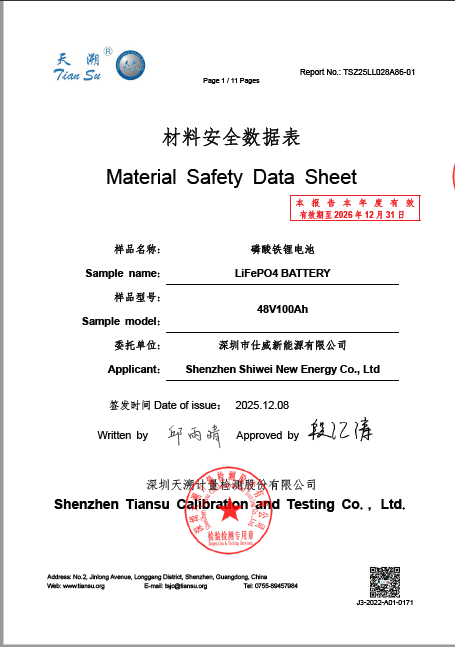
The MSDS carries a document number and a validity date, but its function is hazard communication rather than product certification.
ISO 9001:2015: A System Certificate Doing a System Job
Certificate No. 24CN34504502Q is a quality management system certificate issued by ACM INTERNATIONAL CERTIFICATION LIMITED against GB/T 19001-2016 / ISO 9001:2015. It was issued on 31 March 2025 and runs to 5 April 2027. Its scope reads: research and development and production of lithium-ion battery, except 3C requirements. The certificate is associated with the 48V 100Ah, 51.2V 100Ah and 72V 105Ah packs in the range, so it is a range-level record rather than a single-model record.
Its meaning is organisational. The certificate speaks to how design and production are controlled — the processes behind the packs — not to the test results of any individual unit. It cannot substitute for a transport test report and cannot substitute for a datasheet. What it supports is a supplier-qualification decision: whether the site that will build the order operates under an assessed system, and how long that assessment remains valid.
The phrase "except 3C requirements" deserves attention because it is easy to skim past. 3C (China Compulsory Certification) sits outside the stated scope, so this certificate should not be presented or accepted as evidence of 3C coverage. A buyer who needs that evidence must request it as a separate document with its own number, holder and validity period.
The company behind the certificate is Sisway Battery (Shenzhen Shiwei New Energy Co., Ltd.), a lithium battery manufacturer established in 2017. Its facility covers 20,000 m² with 150 employees, 25 engineers and an annual output of 90,000 units, focused on LiFePO4 packs for golf carts, UTVs, ATVs, forklifts, AGVs and home storage. Research and production are precisely the two activities named in the certificate scope, which is what makes the document relevant rather than decorative — a system certificate for a scope that does not match the activity being bought proves little.
Matching Voltage: 48V, 51.2V and 72V Are Not Interchangeable Labels
A compliance pack has to be matched to the voltage class on the purchase order, because "48V" on two different packs does not describe the same electrical design. In this range, the 48V 100Ah pack is built as 15S1P with a 41.25V discharge cut-off, while the 51.2V 100Ah pack is specified for 48V (58.4V) systems, with a recommended charge voltage of 58.4V and an 18A recommended charge current. Both are sold into 48V-class golf cart applications. The cell configuration and the charge voltage are what differ, and those are the numbers a charger and controller must be matched against before a replacement order is approved.
The 51.2V 100Ah unit carries its own documentation position: MSDS and UN38.3 are listed for the product, alongside a 200A BMS with over-voltage, under-voltage, over-temperature, under-temperature, over-current and short-circuit protection, at least 4,000 cycles, short-circuit, vibration and one-metre drop testing, a three-year warranty, LCD and optional app monitoring, and a stated compartment requirement of 625 × 505 × 360 mm. That dimension is a qualification input in its own right, not a footnote.
The 72V 105Ah pack moves to another class again: 105Ah, 7,728 Wh, a 23S1P configuration of 23 EV-grade A cells, a 200A smart BMS, 14.72 kW maximum load power, 200A continuous and 400A peak discharge for ten seconds, a 63.25V cut-off, 558 × 333 × 300 mm, 63 kg, and an 18A charger that brings the pack from empty to full in five to six hours. Its listing uses both 72V and 73.6V terminology, and the pack is described with a nominal voltage of 73.6V.
That label variation is a qualification issue rather than a typographical detail to ignore. Before approval, the datasheet should state the nominal voltage, the maximum charge voltage and the controller compatibility in one place, because a 72V label and a 73.6V label cannot be assumed electrically identical without that confirmation. Buyers who treat the two as interchangeable are making a technical assumption the documents do not support.
Voltage also decides which documents a buyer must request. A 36V golf cart battery, a 48V replacement pack and a 72V pack for a utility conversion are three separate model scopes, and a report naming one of them does not transfer to the others. The same logic applies to cart platforms: whether a fleet runs Club Car, EZGO or Yamaha carts, the check is identical — confirm system voltage and compartment dimensions against the datasheet for the exact pack being ordered, since fitment varies by cart model and the supplier's own listing asks buyers to verify the compartment before ordering.
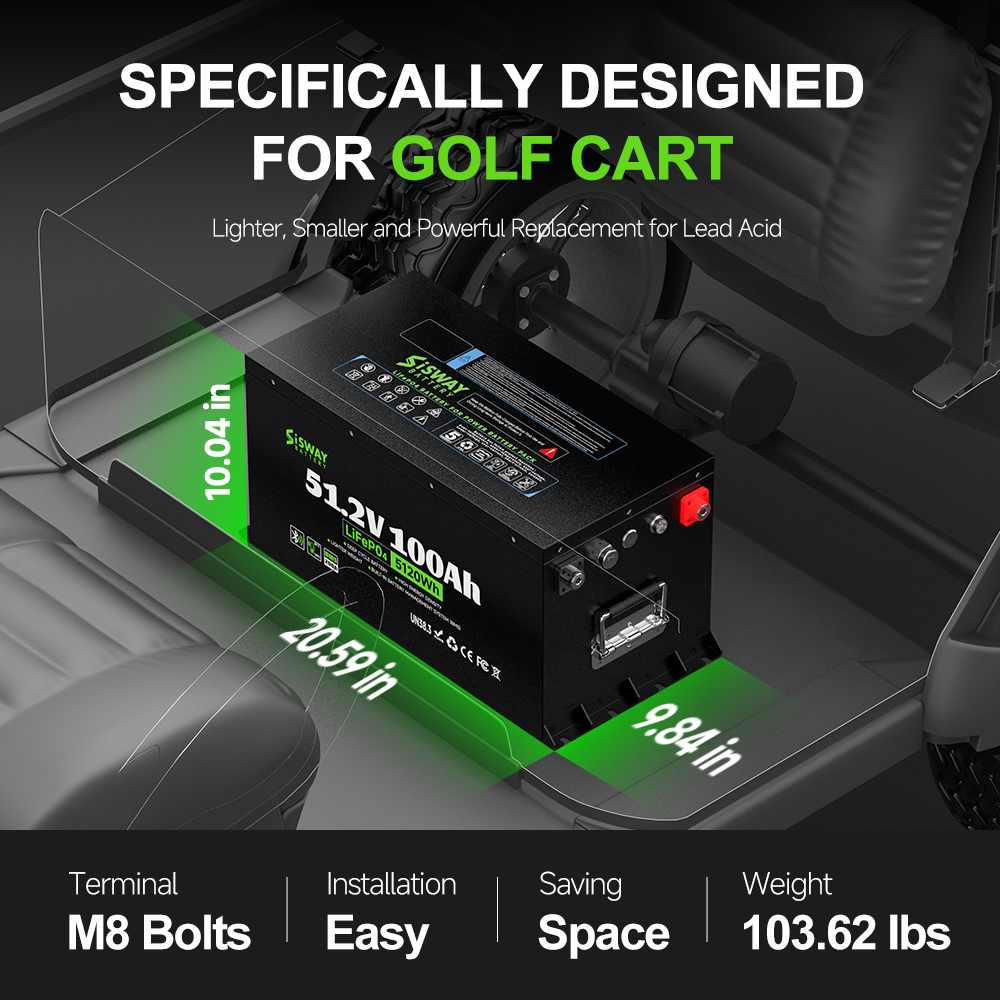
Compartment dimensions and pack weight belong in the approval file beside the certificate numbers.
A Qualification Workflow for Importers and Fleet Buyers
The sequence matters as much as the documents, because a pack assembled in the wrong order hides its own gaps. The following workflow can be applied to a single replacement order or to a multi-voltage fleet programme.
- Fix the model list first. Record nominal voltage, capacity and cell configuration for every pack on the order before opening any certificate file. Where a listing shows two voltage labels for one product, mark it as unresolved until the datasheet settles it.
- Map each document to a destination market. The 48V 100Ah pack's UN38.3 report is stated for the global market; MSDS No. TSZ25LL028A86-01 is written for the USA under GHS and OSHA HazCom 2012; certificate No. 24CN34504502Q is a global-scope system certificate with 3C excluded.
- Read the scope line, not the cover. TSZ25H8045A01-01 names the 48V100Ah model; the MSDS names the lithium-ion golf cart battery series; the ISO 9001 certificate names R&D and production activities. Three different scope widths require three different follow-up questions.
- Check issue and expiry dates against the shipment date. The UN38.3 report and the MSDS both run to 31 December 2026, while the management-system certificate runs to 5 April 2027. An order shipping after the earlier date needs renewed test documentation, not a copy of the previous file.
- Verify issuer and number traceability. Shenzhen Tiansu Calibration and Testing Co., Ltd. issued both the report and the MSDS; ACM INTERNATIONAL CERTIFICATION LIMITED issued the management-system certificate. Numbers, issuers and holders should be checkable with the issuing body rather than accepted from a brochure.
- Keep system evidence and product evidence in separate files. The ISO 9001 certificate belongs in the supplier file; model-specific test reports, the MSDS and datasheets belong in the product file. Merging them is how a system certificate starts being quoted as product approval.
- Record the fitment boundary. Compartment dimensions and pack weight decide installation. The 51.2V listing's 625 × 505 × 360 mm requirement and the 72V pack's 63 kg weight belong in the approval note, alongside the 48V pack's 77 lb and 20.55 × 10.55 × 8.74 in.
Run in that order, the workflow produces a file that survives an audit, a customs query and a workshop check. Run in reverse — collecting documents first and matching models later — it produces a folder of PDFs that nobody can defend when a fleet manager asks which pack the report actually covers.
Where the Documents Stop
Honest qualification includes the limits, and in this pack they are specific. The three records reviewed here contain no EU-specific market-access evidence, and they do not contain UL or IEC product-safety documents. Where a destination market or a customer's engineering standard requires those, they should be requested as separate, model-specific records with their own numbers, holders and validity dates. The management-system certificate does not elevate the product evidence, and the MSDS does not become a certification because it carries a document number and an expiry date.
Nor do any of these documents establish that a pack fits a specific cart. A transport report, a safety data sheet and a quality system certificate say nothing about compartment depth, controller voltage or charger matching. Those remain separate engineering checks, and the supplier's own product listing notes that fitment varies by cart model — a reminder that document compliance and installation compatibility are two different approval tracks.
What the Market Numbers Do and Do Not Add
Commercial research gives the voltage question some context. Strategic Market Research estimated the global golf cart battery market at USD 1.49 billion in 2024, with a projection of USD 2.21 billion by 2030. Mordor Intelligence placed lithium-ion at 47.18% of that market in 2024, while 6V units — the legacy lead-acid building block — still held 43.45% by voltage type in the same year.
These are estimates from commercial research houses, and their definitions do not always align. A published figure of roughly USD 0.54 billion for a later base year circulates alongside the USD 1.49 billion figure, most plausibly because one counts replacement batteries only while the other counts total system value. That definition gap is a reason to use such numbers directionally, as background for procurement planning, rather than as proof of demand for a specific model.
Read directionally, the figures support one practical conclusion: a large installed base still runs legacy voltage configurations, so replacement and conversion orders will keep arriving with mixed model lists. Each model on that list needs its own document trail, and the supplier whose pack carries a report naming the exact model removes one round of clarification from the order.
Outlook: Document Currency as a Recurring Gate
If lithium-ion continues to take share of new golf cart battery demand, buyers will spend less time establishing whether a supplier holds any certification and more time managing the currency of the documents behind each model. The dates in this pack show the pattern: two records expire on the same day in December 2026 while the management-system certificate runs sixteen months longer. A qualification calendar keyed to those dates — one renewal reminder for the transport report and the MSDS, one review for the system certificate — is more useful than a one-time document dump at quotation stage. The conclusion is conditional on how a buyer's own shipment schedule falls, not a prediction about any market.
Frequently Asked Questions
Which document shows that a golf cart battery can be transported?
A UN38.3 test report that names the specific model. For the 48V 100Ah LiFePO4 pack, that is Test Report No. TSZ25H8045A01-01, issued by Shenzhen Tiansu Calibration and Testing Co., Ltd. on 25 August 2025 against UN 38.3, scoped to model 48V100Ah for the global market and valid to 31 December 2026. A 51.2V or 72V pack requires its own report naming that model.
Is an MSDS the same thing as a certification?
No. A Material Safety Data Sheet is hazard communication documentation. The sheet supplied here, No. TSZ25LL028A86-01, was prepared for the USA market against GHS and OSHA HazCom 2012, covers the lithium-ion golf cart battery series, and expires on 31 December 2026. It describes hazards and handling; it does not certify capacity, cycle life or product safety performance.
Does the ISO 9001:2015 certificate apply to the 48V, 51.2V and 72V packs?
The certificate covers the management system rather than individual products. No. 24CN34504502Q was issued by ACM INTERNATIONAL CERTIFICATION LIMITED against GB/T 19001-2016 / ISO 9001:2015 for research and development and production of lithium-ion battery, except 3C requirements, valid from 31 March 2025 to 5 April 2027. It is associated with the 48V 100Ah, 51.2V 100Ah and 72V 105Ah packs, and it does not replace model-level test evidence.
Why do the 48V 100Ah and 51.2V 100Ah packs need separate documentation positions?
Because they are different electrical designs despite both serving 48V-class carts. The 48V 100Ah pack is a 15S1P build with a 41.25V discharge cut-off; the 51.2V 100Ah pack is specified for 48V (58.4V) systems with a recommended charge voltage of 58.4V. Model-scoped documents, such as the UN38.3 report naming 48V100Ah, do not automatically extend from one configuration to the other.
What should a buyer check first in a compliance pack?
The scope line of each document, matched against the purchase order. Confirm the model name, the target market and the issue and expiry dates — the UN38.3 report and the MSDS both end on 31 December 2026. Then confirm the fitment inputs separately: compartment dimensions, pack weight and charger voltage for the exact model being installed.
The English-language product brochure covering the LiFePO4 golf cart battery range is available for download: Sisway Battery English brochure (PDF).
Tem questões ou precisa de mais detalhes?
Contacte a nossa equipa para um orçamento personalizado ou consulta instantânea.
Solicitar orçamento
Preencha o formulário abaixo e a nossa equipa entrará em contacto com uma proposta personalizada.
Chat direto do WhatsApp
Prefere conversar em tempo real? Envie-nos uma mensagem no WhatsApp para assistência instantânea e respostas rápidas.
- Obter orçamento personalizado
- Partilhar fotos ou documentos
- Discuta as suas necessidades diretamente
Geralmente responde em 5–30 minutos durante o horário de expediente.