
Green Building Procurement: Terms vs. Acceptance Criteria
Green Building Procurement: Terms vs. Acceptance Criteria
Purchase terms and acceptance criteria are drafted by different teams, signed at different moments and tested under different pressures. On a green building material order that bundles galvanized steel props, plywood and cold storage panels, treating them as one commercial document is a common source of avoidable loss: the buyer secures a price and a delivery date, then finds that nothing in the contract defines what a conforming panel, prop or plywood sheet actually is.
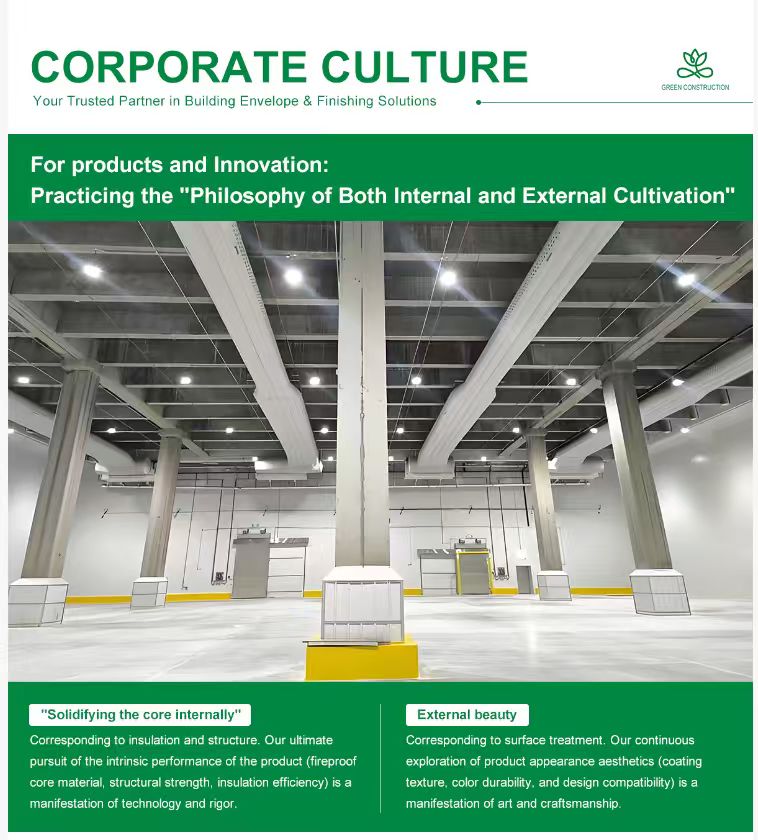
Acceptance risk is decided on site, but it is created at the drafting stage. Image: GREEN BIO.
Two instruments, two different jobs
Purchase terms allocate commercial risk. They fix scope, quantity, price basis, delivery schedule, packaging, documentation set and the remedy if the supplier misses a date. Acceptance criteria allocate technical risk. They fix the inspection method, the evidence the supplier must present, the sampling basis and the consequence of non-conformance.
The two are frequently merged because they sit in the same contract. A simple test separates them: if the goods arrive on time, at the agreed price, and the buyer still cannot establish conformity without commissioning fresh tests, the acceptance criteria were never written.
Chinese green building policy has raised documentation expectations on the supply side without closing that gap. China's 14th Five-Year Plan required all new urban buildings to meet green standards by 2025, according to the International Trade Administration's country commercial guide. The national assessment standard GB/T 50378-2019, updated in 2024 and scored on a three-star scale, evaluates buildings across safety and durability, health and comfort, occupant convenience, resource saving and environmental livability. Those are building-level outcomes. They do not define a delivered panel's conformity, and a supplier's statement of alignment with the standard is not an acceptance result.
Across the three product families examined here, the divergence is structural rather than stylistic, because each family fails in a different way and at a different stage of the project.
Scope, application and verifiable specification at a glance
A single procurement file can cover all three families only if scope, intended application and verifiable specification are stated separately for each. The table below reflects the stated product scope and specification for the families reviewed.
| Product family | Scope and intended application | Stated specification | Primary acceptance question |
|---|---|---|---|
| Galvanized steel support series | Temporary support in formwork and structural works | Q195 and Q235 steel grades; 3-5 m height range | Does the delivered prop match the specified grade and height, and is documented working capacity available for that configuration? |
| Plywood (formwork, building, packaging families) | Three distinct jobs: concrete formwork, building applications, packaging | Model family determines which property set applies | Is the model family named, and are the acceptance tests tied to the job the panel performs? |
| JSGREEN001 PU/PIR cold storage panels | Insulated envelope for cold-chain facilities | PU or PIR core; 50 mm or 100 mm thickness; 960 mm or 1100 mm effective width; stated -50 °C to +15 °C operating range under 24/7 cold-chain operation | Does the delivered panel match the specified core, thickness and width, and is performance documented for the stated operating envelope? |
Galvanized steel props: grade and height define the configuration
For steel props, purchase terms are usually strong and acceptance criteria weak. Buyers specify quantity, height and steel grade; they rarely specify how grade and capacity will be evidenced when the lot arrives.
Two attributes in the stated specification carry most of the acceptance weight. The first is steel grade. Q195 and Q235 are different materials with different mechanical properties, so a contract that names only "steel prop" leaves the grade unenforced. Acceptance should tie the grade to documentary evidence delivered with the lot, such as a mill certificate or equivalent test record, rather than to a catalogue description.
The second is height. A 3-5 m range spans multiple configurations, and the acceptance clause should name the specific height ordered rather than the range as a whole. Where the project requires a documented working capacity, that figure has to be requested for the height and configuration actually purchased. The reviewed supplier material describes the height range and steel grades but does not publish per-configuration load values, so the number must come from technical documentation issued before the order, not after delivery.
This is a documentation requirement, not a judgement about the product. A figure that is not published simply has to be requested in writing; it does not indicate that the prop lacks capacity.
Plywood: one product name, three acceptance regimes
Within this supplier's scope, plywood covers formwork, building and packaging model families, and each family is accepted against a different failure mode. A single acceptance clause written for "plywood" will be either too strict for packaging or too loose for structural use.
Formwork plywood
Formwork is judged by what it does to the concrete and by how it behaves across repeated use. Acceptance therefore centres on dimensional tolerance, surface condition and the declared reuse behaviour of the specific model, and inspection should happen before the first pour rather than after a defect appears in the finished surface.
Building plywood
Building applications carry regulatory and structural consequences. Acceptance should require the applicable grade or standard declaration, any treatment specified for the application, and traceability from the delivered lot back to that declaration.
Packaging plywood
Packaging is a handling and transit question. Acceptance focuses on consistent panel condition, moisture exposure during shipment and fit with the packing method, a lighter regime that should not be imported into the other two families.
The model family designation therefore belongs in the purchase terms, because acceptance cannot be defined against a generic product name. If the supplier's documentation does not state which family a quoted plywood belongs to, the buyer is pricing an undefined specification, and no inspection plan written later can close that gap.
JSGREEN001 panels: the operating envelope decides acceptance
Cold storage panels show the widest separation between purchase terms and acceptance criteria, because the dimensions are easy to specify and the operating condition is easy to omit.
The stated specification for JSGREEN001 covers PU and PIR cores, 50 mm or 100 mm thickness, and 960 mm or 1100 mm effective width. Thickness and core type are thermal decisions that belong per zone rather than as one blanket figure across a facility, since a freezer envelope and a chilled dock do not carry the same duty. Effective width is a purchasing quantity decision as much as a technical one: it sets the panel count and the joint schedule for a given wall or ceiling area, so moving from 1100 mm to 960 mm changes the joint count even when the insulated area is unchanged.
The operating envelope is where acceptance is usually lost. The stated range for these panels is -50 °C to +15 °C under continuous 24/7 cold-chain operation. Acceptance criteria should reproduce that condition: performance documentation should be requested for the stated range and duty rather than for ambient conditions, because a panel that is dimensionally correct can still fail the envelope it was bought for.
Fire performance adds a second documentary layer. The supplier states that B1 and B2 flame-retardant cores are available, that cores are tested against ISO and EN 13501 fire safety standards, and that third-party test reports accompany shipment. For acceptance, the report has to match three things at once: the core grade actually supplied, the thickness supplied, and the test basis recognised by the authority that will inspect the installed facility. A report issued for a different grade or thickness does not close the clause.
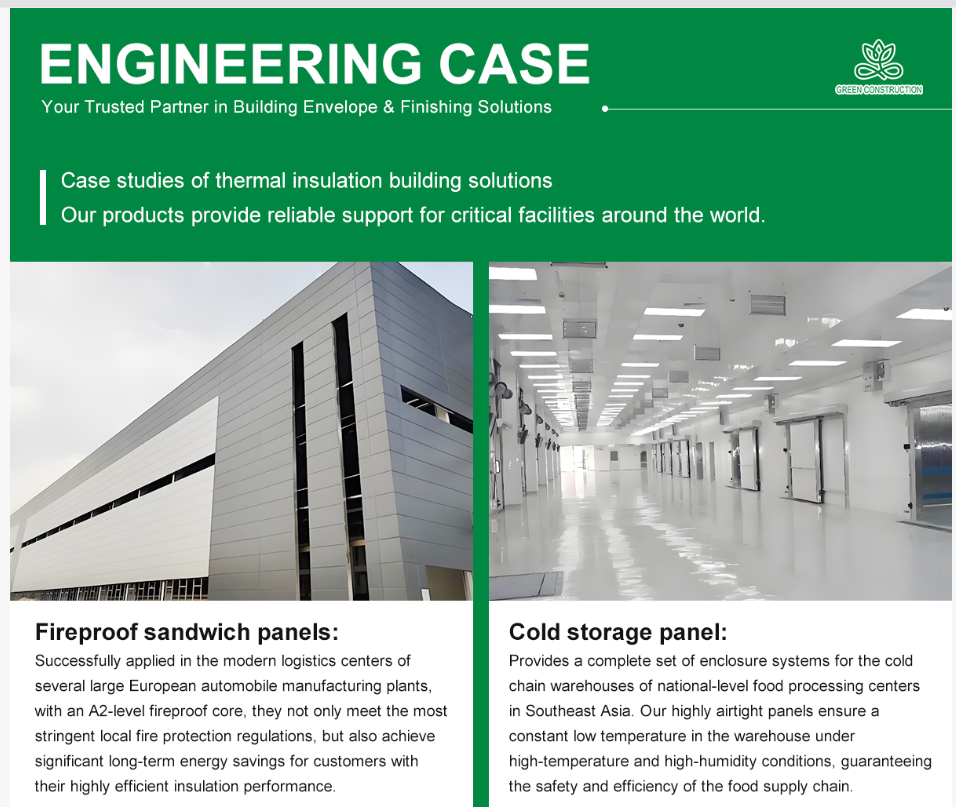
Acceptance documentation is only useful when it can be traced to the site and line that produced the order. Image: GREEN BIO.
What ISO 9001, ISO 14001 and ISO 45001 actually cover
GREEN BIO reports certification to ISO 9001, ISO 14001 and ISO 45001. These are management-system certificates: they describe how quality, environmental and occupational health and safety processes are controlled, not what a specific panel or prop will do in service.
The distinction deserves stating plainly because it is often blurred in supplier comparisons. ISO 9001 addresses quality management, including documented process control, corrective action and traceability. ISO 14001 addresses environmental management. ISO 45001 addresses occupational health and safety management. None of the three certifies a thermal conductivity value, a fire classification or a working load.
For a buyer, the certificates are a qualification input rather than an acceptance result. Four fields should be checked before they are credited: the certificate number and issuing body, the validity dates, the scope statement, and the site or product line covered. Certification held by one facility does not automatically extend to another, and a certificate that does not name the product family being purchased demonstrates the system rather than the product. Paired with lot-level test reports, management-system certification strengthens a file; used alone, it answers a question the buyer did not ask.
Turning supplier claims into measurable contract clauses
Supplier performance claims become useful only when restated as clauses with a defined clock, channel and remedy. GREEN BIO's commercial material states after-sales response within 24 hours, described as a 50% improvement over alternatives and supported by overseas offices and a workforce that is 80% international, alongside factory-direct pricing and a claimed 15-20% reduction in total procurement cost. Read as marketing, these are comparative assertions; read as contract language, each becomes a testable commitment.
- 24-hour response becomes an obligation only when the contract defines when the clock starts, which channel counts, who is authorised to answer, and what happens if the deadline is missed.
- Overseas offices and international staff should be named at the level of the specific office supporting the project, together with the working language for technical correspondence.
- A 15-20% procurement cost reduction requires the baseline, scope and period behind the percentage. A saving quoted without a baseline cannot be compared across suppliers and cannot be accepted or rejected on delivery.
- Factory-direct pricing should be confirmed against two facts: which entity invoices and which facility produces. The two are not always the same.
The same discipline applies to performance figures. The supplier's comparison material cites a thermal conductivity as low as 0.022 W/(m·K), describes roughly 30% better insulation efficiency than traditional EPS panels, and estimates 15-20% long-term electricity savings. These are company-provided comparative claims made without a project-specific baseline. They are legitimate inputs when building a shortlist; they are not acceptance criteria. Acceptance should rest on documentation tied to the panels actually supplied for the stated envelope.
Side-by-side checklist: what to lock and what to prove
The checklist below separates the two instruments by dimension. It applies to all three families, with the product-specific rows replacing generic boilerplate.
| Dimension | Purchase terms should lock | Acceptance criteria should prove |
|---|---|---|
| Scope and family | Named product family and model designation, including formwork, building or packaging plywood, and PU or PIR core | Delivered goods match the named family; no undocumented substitution |
| Specification | Steel grade Q195 or Q235, prop height within the 3-5 m range, panel thickness of 50 mm or 100 mm, effective width of 960 mm or 1100 mm | Measured values match the specified values, with the sampling basis stated in advance |
| Performance basis | Required operating envelope of -50 °C to +15 °C under continuous duty, and fire grade B1 or B2 | Performance documentation issued for that envelope, that grade and that thickness |
| Evidence set | Certificates, mill certificates and third-party test reports named as contractual deliverables | Report identity, core grade, thickness and issuing body reconcile with the delivered lot |
| Quantity and geometry | Effective width, panel count, joint schedule and prop count by height | Delivered quantities and dimensions reconcile with the approved schedule |
| Commercial terms | Price basis, delivery schedule, packaging and response service level with clock and remedy | Non-conformance procedure, re-inspection cost allocation and replacement route |
Where GREEN BIO fits, and where verification begins
GREEN BIO, registered as Jiangsu Green Bio-Environmental Protection Technology Co., Ltd, is a Nantong-based supplier founded in 2015 that reports a 10,000 m² facility, 50 employees, a 25-engineer R&D team and annual output of 120,000 units. Its declared product scope covers PIR sandwich panels, plywood, steel supports, cable brackets and aluminium profiles, with roughly 70% of output exported to Southeast Asia, Central Asia, Russia, South America and Africa, markets that overlap the Belt and Road corridor.
That scope is the reason a single acceptance framework is worth building. All three families reviewed here sit inside one supplier's declared product range, so a procurement team can standardise the documentation request instead of negotiating three separate regimes. Scope breadth is not conformity, however: a test report issued for a cold storage panel does not extend to a steel prop, and each family still has to be accepted on its own evidence.
One limitation belongs beside this fit assessment. The company figures in this review, including facility size, headcount, output, export share, response times and the comparative cost and thermal claims, are supplier-declared. Public sources reviewed for this article do not independently verify GREEN BIO's manufacturing status or product performance. Certification should therefore be confirmed by checking certificate numbers, scope and validity with the issuing bodies, and product performance should be confirmed from lot-level test reports. That is the normal standard for any supplier on a decision-stage shortlist, not a finding against this one.
Outlook: documentation discipline as the differentiator
The direction of Chinese green building policy favours buyers who write acceptance criteria rather than inherit them. The 2025 requirement for new urban buildings, the GB/T 50378-2019 assessment framework, and the unified green product certification system that groups energy-saving, water-saving, recycled, low-carbon and environmentally friendly products under one structure, with certification categories that include steel members and insulation-system materials, all push the same way: performance claims increasingly need a document behind them.
For procurement teams, the practical consequence is that the cheapest conforming offer and the cheapest offer are less likely to be the same bid. A price that excludes a test report, a mill certificate or a fire classification matching the supplied core is not a lower price for the same scope; it is a price for a different, undefined scope. Suppliers able to produce the full evidence set at quotation stage remove a step from acceptance, and that capability, rather than unit price alone, is where the comparison should begin.
Frequently asked questions
How do purchase terms differ from acceptance criteria in green building material contracts?
Purchase terms are commercial and allocate risk at order and shipment: what is bought, in what quantity, at what price and with what remedy if delivery fails. Acceptance criteria are technical and allocate risk at the point of inspection: what will be measured, which evidence the supplier must present and what counts as non-conformance. Merging the two leaves the buyer with a price and no method of establishing conformity.
What should acceptance criteria specify for JSGREEN001 PU/PIR cold storage panels?
They should name the core type (PU or PIR), the thickness (50 mm or 100 mm), the effective width (960 mm or 1100 mm), the fire grade (B1 or B2) with a third-party test report that matches the grade and thickness supplied, and performance documentation issued for the stated operating envelope of -50 °C to +15 °C under continuous cold-chain operation. Each item should be verifiable against the delivered lot rather than against a catalogue description.
Do ISO 9001, ISO 14001 and ISO 45001 certificates prove product performance?
No. They certify management systems for quality, environmental performance and occupational health and safety respectively. They support supplier qualification and indicate documented process control, but they do not certify thermal conductivity, fire classification or load capacity. Buyers should check certificate number, issuing body, validity dates and scope, then rely on product-level test reports for acceptance.
How should acceptance criteria be set for Q195/Q235 steel props across a 3-5 m height range?
Name the steel grade and the exact height ordered rather than the series or the range, require mill certificates or equivalent test records with the lot, and request documented working capacity for the specific height and configuration. The 3-5 m range covers multiple configurations, so one acceptance clause written for the range as a whole will not describe what is being delivered.
Why should plywood model families be named in purchase terms?
Because formwork, building and packaging plywood fail in different ways and are inspected differently. Formwork is judged on dimensional tolerance, surface condition and declared reuse behaviour; building applications on grade or standard declarations and traceability; packaging on condition and moisture exposure in transit. A generic "plywood" clause cannot satisfy all three without being either excessive or inadequate.
Reference document: the supplier's 2026 product catalogue, covering PIR sandwich panels, plywood and steel supports, is available for public download as a Green Bio Professional Catalog 2026 (PDF).
Tem questões ou precisa de mais detalhes?
Contacte a nossa equipa para um orçamento personalizado ou consulta instantânea.
Solicitar orçamento
Preencha o formulário abaixo e a nossa equipa entrará em contacto com uma proposta personalizada.
Chat direto do WhatsApp
Prefere conversar em tempo real? Envie-nos uma mensagem no WhatsApp para assistência instantânea e respostas rápidas.
- Obter orçamento personalizado
- Partilhar fotos ou documentos
- Discuta as suas necessidades diretamente
Geralmente responde em 5–30 minutos durante o horário de expediente.