
Green Building Solutions for Cold Chain Projects
China's green building materials market reached USD 216.3 billion in 2025 and is projected to hit USD 484.9 billion by 2034, according to IMARC Group. Behind this macro growth sits a more practical procurement question: how do project teams match green building materials—and their suppliers—to specific operating conditions? For cold chain facilities, the answer depends on measurable performance factors such as insulation efficiency, fire rating, temperature range, customization capability, and delivery reliability.
Why Cold Chain Projects Need a Structured Material Selection
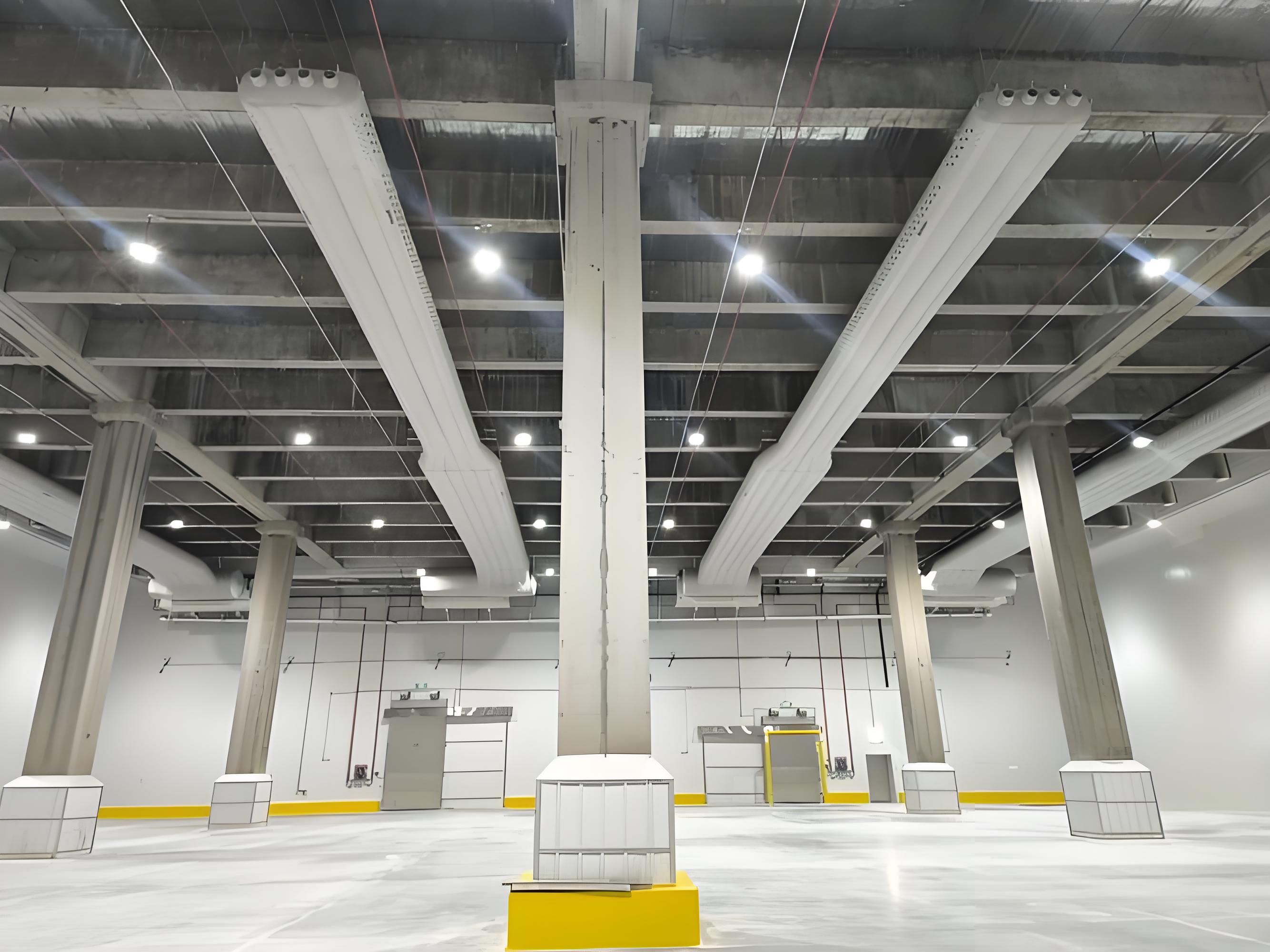
Cold storage facilities are among the most energy-intensive building types, because refrigeration equipment must run continuously to preserve food, pharmaceuticals, and other temperature-sensitive goods. The building envelope directly affects the refrigeration load: a poorly insulated or leaky enclosure forces cooling systems to work harder for longer periods. The central requirement of an insulated envelope is the same across almost every cold chain project: block heat exchange between indoor and outdoor conditions through efficient thermal insulation.
Material selection problems usually appear when project conditions are not matched to product capabilities. Temperature range, humidity level, fire-safety classification, and operating hours all define which panel system is appropriate. A panel specified for moderate chilled storage may not perform reliably in a -50°C deep-freeze environment, and a product without a documented fire rating may create compliance exposure in markets that enforce B1 or B2 standards.
Procurement teams evaluating green building solutions should therefore examine three layers: product performance data, scenario fit, and supplier delivery capability. The following sections apply this framework to GREEN BIO, a China-based supplier of insulated and finishing materials, using the company's published product specifications, application documents, and case records.
GREEN BIO: Company Profile and Product Scope
GREEN BIO (JIANGSU GREEN BIO-ENVIRONMENTAL PROTECTION TECHNOLOGY CO.,LTD) is a China-based manufacturer of building envelope and finishing materials for global construction and industrial projects. Established in 2015 and headquartered in Nantong, Jiangsu Province, the company operates a 10,000-square-meter factory with 50 employees and an annual output of 120,000 units. Its R&D team includes 25 engineers.
The company's product portfolio covers PIR sandwich panels, plywood, steel supports, cable brackets, and aluminum profiles. Around 70% of its output is exported, with main markets in Southeast Asia, Central Asia, Russia, South America, and Africa—regions that overlap with Belt and Road Initiative (BRI) countries and other emerging markets. The company provides full life-cycle service guarantees for users in more than 120 countries and regions.
Core Product: Cold Storage Panels (JSGREEN001)
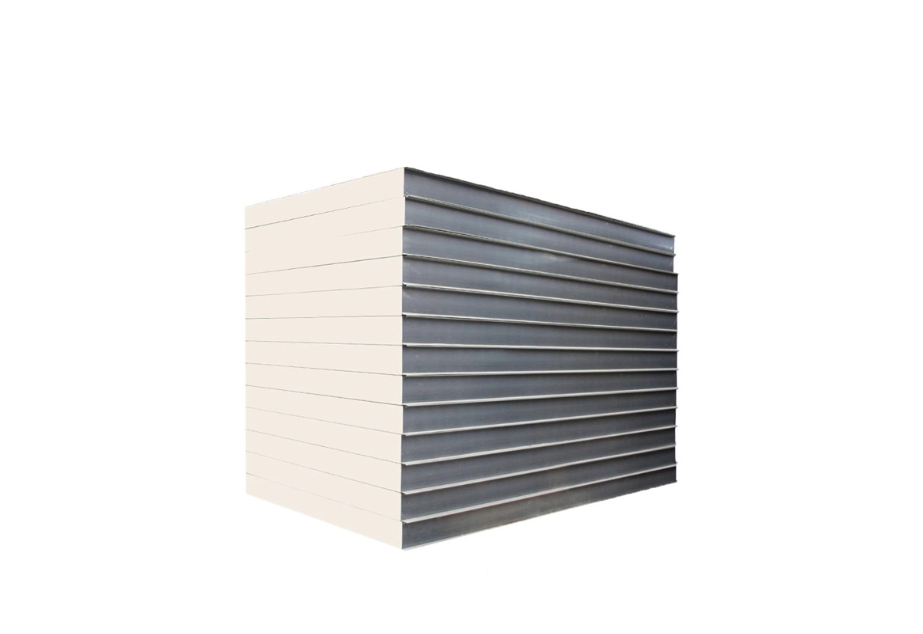
The Cold Storage Panels (model JSGREEN001) are fire-retardant B1-grade PIR sandwich panels engineered for insulated building envelopes. The core material is rigid polyurethane (PU/PIR), with panel thickness options such as 50mm and 100mm and facing options such as 0.5mm steel sheet. Thermal conductivity is ≤0.024 W/(m·K), fire rating is available in B1 or B2 classes, and effective width options are 960mm and 1100mm.
| Parameter | Specification |
|---|---|
| Core Material | PU / PIR |
| Panel Thickness | e.g., 50mm, 100mm |
| Steel Sheet Thickness | e.g., 0.5mm |
| Thermal Conductivity | ≤0.024 W/(m·K) |
| Fire Rating | B1 / B2 |
| Effective Width | 960mm / 1100mm |
The panels contribute to energy performance through several mechanisms:
- Thermal insulation: the core reduces heat exchange between indoor and outdoor space, cutting the workload of refrigeration equipment. Documented application data indicates that energy savings can exceed 30%.
- Moisture resistance: the closed-cell structure helps prevent water vapor penetration, supporting performance in high-humidity and condensation-prone environments.
- Fire safety: B1/B2 fire-retardant grades are available to match regional project requirements.
- Environmental profile: CFC-free foaming agents are used, avoiding ozone-depleting substances in production.
- Structural quality: high-strength double-sided color steel sheets combined with precision foaming support panel flatness and load-bearing capacity, as documented in project records.
The standardized modular design increases on-site installation speed by 30%, shortening construction timelines for large facilities.
Scenario Fit: Where the Panels Are Used
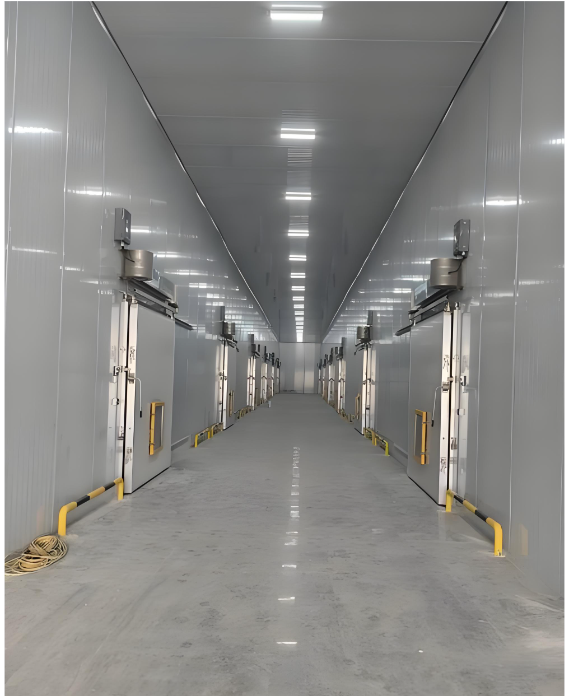
Large cold chain logistics parks are a primary application scenario for the JSGREEN001 cold storage panels. The product is designed for continuous 24/7 operation under a temperature range of -50°C to +15°C, covering frozen storage, cold storage, and quick-freezing applications. It also suits high-humidity environments with relative humidity up to 90%, where anti-condensation and anti-dew performance is required.
Typical project types documented for this product include:
- Large cold chain logistics parks
- Food processing cold storage
- Pharmaceutical GSP cool storage and cold storage
- Supermarket and catering refrigerated rooms
- Agricultural pre-cooling facilities
Industries served include food and beverage processing (meat, seafood, dairy, fruits, vegetables, and beverages), pharmaceutical and biological product storage, cold chain logistics and warehousing, chemical low-temperature storage, and agricultural seed storage. In these environments, the panel system requires supporting equipment such as refrigeration units, air coolers, tube evaporators, temperature and humidity control systems, dehumidifiers, fire sprinkler systems, cold storage doors, and sealing accessories.
In the EU market context, Germany is identified as a common application region for large cold chain logistics park projects operating in the -50°C to +15°C temperature range.
Documented Project Cases
Two project records illustrate how the panels perform in food processing and logistics environments. The documented cases cover Australia and Vietnam, among other markets.
Case A: Food Processing Plant / Meat Processing Factory
- Scale: 5,000 square meters of cold storage panels, corresponding to roughly 2,000 tons of capacity
- Function: low-temperature freezer (-18°C) and chiller room (0-4°C)
- Operating record: stable operation for 5 years
- Documented results: precise temperature control; seamless joints prevent cold air leakage; the facility successfully passed GSP certification
Case B: Third-Party Logistics / Supermarket Distribution Center
- Scale: 12,000 square meters, large-scale sorting center
- Function: multi-temperature distribution center (frozen / chilled / ambient)
- Operating record: 1 year (new project)
- Documented results: delivered on schedule; installation was straightforward; cargo turnover efficiency improved
Across both cases, the project highlight is consistent: high-strength double-sided color steel sheets combined with precision foaming deliver flatness and load-bearing capacity, while the standardized modular design accelerates installation.
Market Trends Shaping Green Building Material Demand
China's green building materials market reached USD 216.3 billion in 2025 and is projected to hit USD 484.9 billion by 2034, according to IMARC Group. A related estimate from Markets and Data projects China's green building market will grow from USD 69.13 billion in 2024 to USD 147.86 billion by 2032. Global Market Insights valued China's bio-based construction materials market at USD 6.4 billion in 2024, with a 7.2% CAGR forecast through 2034.
Policy is reinforcing demand. China mandated that 100% of new urban buildings meet green building standards by 2025 as part of the 14th Five-Year Plan, according to the International Trade Administration. The national standard GB/T 50378-2019, "Assessment Standard for Green Building," establishes four certification grades: Basic, 1-Star, 2-Star, and 3-Star.
For export-oriented suppliers, the policy backdrop is also evolving. The Third Belt and Road Energy Ministerial Conference (October 2024) adopted the Green Energy Cooperation Action Plan (2024–2029) to scale green infrastructure across Belt and Road countries. GREEN BIO's existing export footprint in Southeast Asia, Central Asia, Russia, South America, and Africa overlaps with these markets, positioning its envelope products within a broader shift toward low-carbon construction procurement.
How Modular Envelope Systems Compare with Traditional Construction
Prefabricated insulated panel systems differ from traditional cold storage envelope construction in two main ways. First, insulation, sealing, and finish quality are controlled in a factory environment rather than on site. Second, the modular panel format supports faster assembly: the documented installation speed improvement is 30%.
One limitation should be considered alongside these advantages. Prefabricated systems depend on accurate site measurement and disciplined installation to achieve air-tightness. The same modularity that speeds assembly requires coordination between structural, refrigeration, and enclosure contractors during the design and installation phases. Buyers should evaluate the supplier's technical support and installation documentation together with the product specification.
Supplier Capability: Customization, Capacity, and Quality Control
GREEN BIO supports OEM/ODM production with documented customization options, capacity levels, quality control steps, and after-sales service terms.
Customization options include:
- Panel thickness from 50mm to 200mm
- Steel sheet color and material
- Fire rating level
- Custom dimensions and lengths
- Cam-lock types
Supply capacity: monthly production capacity is 50,000 square meters. Lead time is 15–25 days after receiving the deposit, and the minimum order quantity is 100 square meters (or one 20ft container).
Quality control: the company performs incoming raw material inspection, in-process patrol inspection, full inspection of finished product density and dimensions, and pre-shipment photo confirmation.
After-sales service: installation guidance videos, remote technical support, and free replacement of damaged parts during the warranty period are included.
Selection Criteria for Cold Chain Envelope Projects
Cold chain envelope procurement should be structured around six decision criteria:
- Operating envelope: confirm that the temperature range (-50°C to +15°C) and humidity level (up to 90% RH) match the project's working conditions.
- Fire rating: verify that the product can meet the required class (B1 or B2) in the target market.
- Thermal performance: check the thermal conductivity value and energy-saving mechanism against the facility's refrigeration load.
- Customization scope: confirm that panel thickness, facing materials, dimensions, and locking types can be adapted to the project design.
- Supply chain reliability: assess monthly capacity, MOQ, lead time, and quality-control procedures.
- After-sales support: review installation guidance, remote technical support, and warranty terms.
Future Outlook
As low-carbon construction standards widen, cold chain facilities face two pressures at once: stricter energy efficiency targets and more demanding temperature-control requirements. Building envelope products are likely to become more tightly integrated with energy management systems over time. GREEN BIO's stated future direction involves building interconnected systems around cold, heat, water, gas, and electricity, and positioning the company as a service provider of smart green energy system solutions. For buyers, this suggests that suppliers combining product performance with system-level service will be better positioned to support long-term project upgrades.
FAQ
Which project scenarios are the cold storage panels designed for?
The panels are designed for large cold chain logistics parks, food processing cold storage, pharmaceutical GSP cool/cold storage, supermarket and catering refrigerated rooms, and agricultural pre-cooling facilities.
What temperature and humidity conditions can the panels handle?
The product operates continuously 24/7 under a temperature range of -50°C to +15°C, covering frozen storage, cold storage, and quick-freezing applications. It is suitable for environments with relative humidity up to 90%, including coastal high-salt spray areas, industrial plants with vibration, and clean room storage areas.
What fire-rated options are available?
The panels are available in B1 or B2 fire-retardant classes, depending on project requirements.
How do the panels reduce energy consumption?
The core blocks heat exchange between indoor and outdoor conditions through efficient thermal insulation, reducing the workload of refrigeration equipment. Documented application data shows energy savings can exceed 30%.
How do the panels support food and pharmaceutical compliance?
The system provides temperature- and humidity-controllable storage space that delays deterioration and failure cycles. In food applications, documented data indicates shelf life can be extended by more than 50%. One documented food processing facility passed GSP certification after using the panel system.
What customization options does the supplier offer?
GREEN BIO supports OEM/ODM production with options including panel thickness from 50mm to 200mm, steel sheet color and material, fire rating level, custom dimensions and lengths, and cam-lock types.
What is the monthly capacity, MOQ, and lead time?
Monthly capacity is 50,000 square meters. MOQ is 100 square meters or one 20ft container. Lead time is 15–25 days after receiving the deposit.
What quality control checks are performed before shipment?
The process includes incoming raw material inspection, in-process patrol inspection, full inspection of finished product density and dimensions, and pre-shipment photo confirmation.
What supporting equipment is required for the panel system?
Supporting equipment includes refrigeration units, air coolers, tube evaporators, temperature and humidity control systems, dehumidifiers, fire sprinkler systems, cold storage doors, loading platform door seals, sealing tape, fasteners, and installation accessories.
How does the modular design affect installation?
The standardized modular design increases on-site installation speed by 30% compared with conventional approaches, and helps shorten overall project timelines. Accurate site measurement and installation discipline are required to achieve air-tightness.
Further Reference
For engineering and procurement teams evaluating green building envelope materials for cold chain projects, the company's 2026 professional catalog is publicly available for reference: Green Bio Professional Catalog 2026 (PDF).
GREEN BIO (JIANGSU GREEN BIO-ENVIRONMENTAL PROTECTION TECHNOLOGY CO.,LTD)
Website: www.greenlvgreen.com
Email: sunnylvgreen@163.com
Telephone: +86-159-0629-8828
WhatsApp: +852 55715742
Address: Room 902-2, Building 2, Nantong Foreign Trade Center, No. 166, North Street, Chongchuan District, Nantong City, Jiangsu Province, China