
Green Energy Plastic Parts: Export Fit for Seals & Handles
Green Energy Plastic Parts: Export Fit for Seals & Handles
Green Energy Plastic Parts: Export Fit for Seals & Handles
Green energy and new materials equipment builders do not buy “plastic parts” as a category. They buy a seal that must hold a stated pressure, a gasket that must survive a named cleaning agent, a bushing that must wear before the shaft does, or a handle that must insulate a live tool and still feel secure in a gloved hand. Scenario fit — the match between what the part has to do and the process route that produces it — is what decides whether an export purchase order closes cleanly. Lingo Rubber Plastic (Hangzhou Lingo Rubber and Plastic Product Co., Ltd) is a Chinese rubber and plastics parts manufacturer whose stated scope covers rubber compression molding, rubber extrusion, plastic injection parts, plastic extrusion profiles, PTFE/PEEK/acrylic machining, PVC dipping and assembly.
Why Scenario Fit Decides the Order, Not the Catalogue
An export RFQ in this sector usually bundles four component families that are sourced together but fail for completely different reasons. A seal loses function when it extrudes into a clearance gap under pressure or takes a permanent set. A gasket leaks when it creeps, relaxes under bolt load, or absorbs a chemical it was never selected for. A bushing fails when its wear rate and dimensional stability stop protecting the mating shaft. A handle fails when the coating loses adhesion, becomes slippery, or fails to insulate as the tool designer intended.
Each of those failure modes is controlled by a different combination of material and process, and the process route also sets the commercial shape of the order: whether tooling has to be paid for, how small a first batch can be, what lead time applies, and which drawings and declarations have to be issued for customs and compliance. That is why a plastic parts quotation that arrives without a process recommendation is difficult to evaluate — it answers a price question the buyer has not actually asked.
For a buyer at research and evaluation stage, the practical sequence is to fix four things before comparing suppliers: the part function and the conditions it sees, the process route that can hold those conditions at the required quantity, the compliance documentation that must accompany the shipment, and the acceptance criteria that will be used to release the batch. Suppliers that can respond on all four are rare enough that the shortlist tends to build itself.
A Supplier Organized Around Four Plastic Process Routes
Lingo Rubber Plastic works from a single production base in Hangzhou covering a 3,000 m² facility with around 40 employees and a 10-person R&D team, and states that roughly 80% of output is exported, with the EU and USA as its main markets. The company’s plastic scope is deliberately multi-process rather than single-process: plastic injection parts, plastic extrusion profiles, CNC machining of PTFE, POM, PE, UHMWPE, HDPE, PEEK, ABS, PU and PA6/PA66, PVC dipping for handles and grips, and assembly.
The team profile matters more than the machine list for export buyers. Lingo states that it was co-founded by specialists who have spent more than 10 years — and in some cases more than 20 years — working inside the rubber and plastics industry, with experience concentrated on sealing problems, anti-vibration solutions and the physical and chemical parameters that sit behind them, such as tensile strength, elongation and compression set.
The buyer-side consequence is a shorter coordination chain. When a green energy equipment BOM contains a machined PTFE back-up ring, a molded housing, an extruded trim and a dipped handle, those items can be quoted, sampled and shipped under one quality system and one traceability convention instead of four. That is an operational advantage, not a performance claim: each part still has to be validated on its own drawing.
Seals and Back-Up Rings: Where Machined PTFE, POM, PEEK and UHMWPE Fit
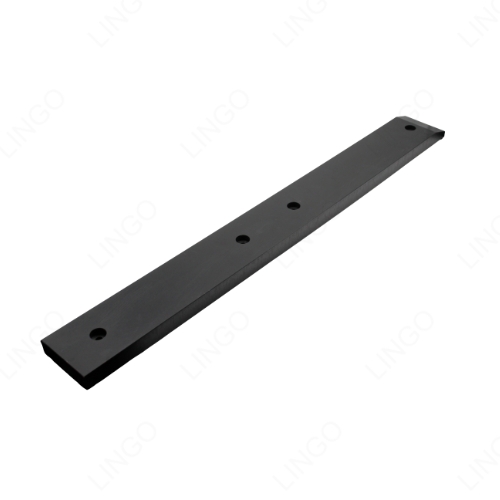
CNC machining is the route of choice when a sealing part has to be produced to a drawing without a mold, when quantities are modest, or when the geometry is still moving between design revisions. Lingo’s machined plastic family covers PTFE gaskets, back-up rings and anti-extrusion rings, POM machined parts, PP machined parts, seals, bearings and bushings, in PTFE, POM, PE, UHMWPE, HDPE, PEEK, ABS, PU, PA6 and PA66, with or without glass fiber.
The published parameter set for this family lists FDA, RoHS and UL references, custom colour, surface roughness expressed as Ra (µm) or Rz (µm), and a visual inspection criterion of smooth surfaces with no crack and no flash. For a buyer, the useful reading is that surface finish and visual acceptance are treated as specified characteristics rather than as informal expectations — which is exactly where seal procurement usually goes wrong.
A representative project is a UK buyer that ordered 20 pieces of CNC-machined pure PTFE back-up rings for demanding sealing conditions. The function described for that part is the classic one: the back-up ring does not seal by itself, but supports the primary elastomeric seal and limits its extrusion under pressure. The reported highlights were high-precision tolerance and a two-day dispatch on a small order. Twenty pieces is not an unusual first order in this sector — prototype and pilot-line builds in new materials equipment routinely start there.
The fit boundary is worth stating plainly. Machining gives geometry freedom and no tooling investment, but at high annual volumes with a stable drawing, unit economics shift toward molding. Material selection is also not transferable: PTFE, POM, PEEK and UHMWPE behave differently under load, speed and temperature, and the correct choice depends on media, pressure, clearance and duty cycle supplied by the equipment designer. A supplier can machine to a drawing; it cannot promise service life without application data and, where needed, testing.
Gaskets and Washers: Two Valid Routes, One Decision
Flat sealing and spacing parts sit between the two plastic routes. Plastic gaskets and plastic washers appear in Lingo’s injection-molded product scope alongside caps, housings, handles and guide rails, while PTFE and POM gaskets are also produced by machining from sheet or rod. The decision between them is usually quantity and geometry, not preference.
Where the profile is simple, the thickness is stable and volumes repeat, a molded part gives consistent cavity-to-cavity geometry and a lower unit cost once tooling is amortized. Where thickness, diameter or bolt pattern is still being revised, or where the batch is small, machining keeps the design flexible and avoids tooling. For washers, the same logic applies across nylon (PA6/PA66), POM, PE and PTFE variants.
What the drawing should fix, in either route: the medium being sealed, the operating temperature range, the compression or bolt load the part must tolerate, flatness and thickness tolerance, and the surface finish on the sealing face. Buyers who supply only a diameter and a material usually receive a part that is dimensionally correct and functionally uncertain.
Bushings and Wear Components: Designing the Sacrificial Part
A bushing is designed to be the component that wears, so the sourcing question is not only “what material” but “what wear behaviour does this joint need”. Lingo’s machined family includes bearings and bushings in POM, UHMWPE, PA6/PA66 and PEEK, and its rubber range includes rubber bushings for anti-vibration duties — two different jobs that are often confused in early RFQs.
For plastic bushings, the specification that travels with the drawing should include shaft diameter and tolerance, radial load, sliding speed, whether lubrication is present, ambient and running temperature, and the acceptable wear allowance over the service interval. UHMWPE is commonly considered where low friction and abrasion resistance matter; POM where stiffness and machinability dominate; PEEK where temperature and chemical exposure narrow the field. These are material-selection starting points, not universal recommendations, and the final choice belongs with the equipment designer who holds the duty data.
The limitation to keep visible: a machined bushing can be produced to a precise drawing, but wear life is an application outcome. Buyers evaluating a supplier should ask what dimensional data will be reported per batch, how material grade is identified, and whether batch traceability will be recorded — all of which Lingo lists within its after-sales scope — rather than asking for a life guarantee the process cannot honestly supply.
Injection-Molded Components: Repeatable Geometry at Tooling Cost
Injection molding is the right route when the geometry is settled, the annual quantity justifies a tool, and repeatability between cavities matters more than design flexibility. Lingo’s injection scope covers solid plastic parts, housing components, precision functional components, insert molding and dual-material parts, in PP, PA6, PA66, ABS, PE, HDPE, UHMWPE, LDPE, PU, PTFE and glass-filled grades.
The published parameter set is specific enough to design against: draft angle outside ≥1° and inside ≥0.5°; tolerance control to GB/T 14486 MT1 to MT7; shrinkage typically 0.4%–0.8% for mold compensation; fillers and modifications including glass fiber, flame retardant and UV stabilization; colour to Pantone or RAL with a stated gloss level; SPI surface designation; and FDA or UL94 V-0 requirements where the application calls for them. Tooling can be multi-cavity with hot or cold runners.
For equipment that sits in electrical or transport-adjacent assemblies, the automotive trim family adds a useful reference point: marking by date code, certification references covering FMVSS 302, RoHS and REACH, an operating range of −40°C to +120°C, and surface options from polished to textured, painted or plated.
One US automotive customer ordered 5,000 injection-molded parts used as a tube holder, and the reported outcome was zero failures over use described as long-term. The stated design approach was to remove internal material that carried no structural or functional duty, which reduced material and logistics cost while improving dimensional stability. That is a project result and a design principle, not a promise that the same change will work in another housing or bracket.
The boundary: tooling is a separate development step. Buyers planning a pilot build should schedule tool manufacture and first-article approval ahead of production, and should confirm tool ownership and maintenance terms in writing — Lingo lists mold maintenance and ownership protection among its after-sales provisions.
Extruded Profiles and Tubing: Continuous Geometry for Frames, Trim and Ducts
Extrusion serves parts whose cross-section is constant along their length: edge trims, guide rails, spacer strips, decorative and functional profiles, and tubing. Lingo’s plastic extrusion family covers PA6 and PA66 profiles, glass-fiber-reinforced grades, co-extruded and flexible profiles, and PVC, PP, ABS, PE and UHMWPE base materials, with lengths up to 6,000 mm and custom cross-sections, colours to Pantone or RAL, and custom surface treatment.
The company’s stated industry coverage for this family explicitly includes renewable energy, alongside construction, HVAC and refrigeration, electrical and electronics, industrial manufacturing and transportation — which is why extruded profiles often appear in the same green energy build as machined seals and molded housings.
Specification discipline here is about the cross-section, not the part: profile tolerance on critical dimensions, cut length and cut squareness, straightness, colour and surface, and how the profile interfaces with the mating part. Where a profile will be exposed outdoors, the resin grade and any stabilization should be confirmed with the supplier rather than assumed from the base polymer name.
PVC Dipping Handles: Grip and Insulation With Low Tooling Barriers
PVC dipping coats a metal or plastic substrate with a PVC skin, which makes it a practical route for tool handles, grips and protective covers where insulation, grip and corrosion resistance matter. The Lingo LGHD PVC dipping handle family is specified with black colour, glossy surface and custom printing, and is stated as applicable to hardware tools, electrical and electronics, automotive, fitness equipment, gardening tools, household products, industrial equipment and building hardware.
A German electrical and electronics customer ordered 1,500 dipped parts that use PVC’s insulating characteristics to protect current transmission and reduce the risk of accidents from wiring damage. The reported results included consistent fit and stable performance, coating resistance to acids, alkalis, salt spray and oil protecting the metal substrate in humid and chemically corrosive conditions, and resistance at both low and high temperature. The stated advantages for that project were that no expensive mold is required and small orders are acceptable, that the dip solution contains no toxic or heavy-metal ions and the raw material can be recycled, and that colour and surface texture can be varied from glossy and matte to rough for anti-slip function.
Those points are project-reported and formulation-dependent. The boundary for a buyer is geometric: dipping is a coating process, so the substrate must be designed for it and the coated dimension must be allowed for. It is not a substitute for a molded structural handle where the handle itself carries load.
Matching Part Family to Scenario and Route
| Part family | Typical role in green energy / new materials equipment | Fitting route | What to lock in the specification | Fit boundary |
|---|---|---|---|---|
| Seals and back-up rings | Supporting or primary sealing in fluid, gas and process assemblies | CNC machining of PTFE, POM, PEEK, UHMWPE | Media, pressure, clearance, temperature, Ra/Rz, visual criteria | Unit cost at high volume favours molding; life needs application data |
| Gaskets and washers | Flat sealing, spacing and bolt isolation | Machining or injection molding | Thickness, flatness, compression load, medium, temperature | Tooling not justified for small or still-changing designs |
| Bushings and wear parts | Sacrificial wear surface protecting a shaft or pivot | CNC machining of POM, UHMWPE, PA6/PA66, PEEK | Shaft tolerance, load, speed, lubrication, wear allowance | Wear life is an application outcome, not a machining output |
| Molded housings, caps, plugs, guide rails | Structural and functional components in equipment assemblies | Injection molding, insert and dual-material molding | Draft angles, GB/T 14486 tolerance class, shrinkage, filler, UL94/FDA needs | Tooling is a separate lead-time item before production |
| Extruded profiles and tubing | Trims, rails, spacers and ducts along equipment frames | Extrusion, co-extrusion, glass-filled grades | Cross-section tolerance, cut length, straightness, colour | Requires a constant cross-section along the length |
| PVC dipping handles | Insulated and corrosion-resistant grips for tools and controls | PVC dip coating over a substrate | Substrate geometry, coating thickness allowance, colour, texture, printing | Coating process, not a load-bearing structural part |
Compliance and Acceptance Criteria to Fix Before Production
Export buyers in the EU and North American markets are usually gated by documentation as much as by price. Lingo’s published parameter sets reference RoHS and REACH for the injection-molded automotive trim family, FMVSS 302 alongside them, FDA and UL94 V-0 for applicable injection parts, and FDA, RoHS and UL references for the machined plastic family. The company also states that it provides PPAP Level 1–3 documentation for custom parts.
That is a starting position, not a conclusion. The correct buying practice is to request the declaration against the exact part number and material grade, then confirm that the declaration matches the resin actually used — particularly where glass-filled, flame-retardant or UV-stabilized grades are specified, because those modifications change the substance profile.
On the dimensional side, ISO 20457:2018 sets out tolerances and acceptance conditions for plastics moulded parts and is a sensible neutral reference when a buyer and supplier are negotiating what “on drawing” means. For machined parts, the drawing should carry surface roughness as Ra or Rz and the visual criteria explicitly: Lingo’s stated visual inspection standard for machined parts is smooth surfaces with no crack and no flash, which is the kind of wording that can be accepted or rejected at goods-in rather than argued about.
Three further items belong in the purchase order: batch traceability, which Lingo lists within its after-sales scope; the inspection regime, described as full inspection of samples and random inspection of bulk goods; and a defined route for non-conforming batches, described as free exchange and acceptance of concessions.
Purchasing Terms That Decide Whether the Fit Is Workable
The commercial parameters Lingo publishes are those of an export-oriented OEM/ODM supplier rather than a catalogue distributor: lead time of 2 to 6 weeks, MOQ set according to the individual part with small quantity orders acceptable, remote technical support, mold maintenance and ownership protection, batch traceability, and the exchange and concession terms noted above. Stated export markets include the EU, the Middle East and the USA.
For a buyer, the first two items carry most of the risk. A part-by-part MOQ means the small batch of 20 back-up rings and the 5,000-piece molded order are quoted on different logic, and the buyer should confirm in writing which volume the 2 to 6 week lead time refers to — particularly for a first article, where tooling or drawing clarification may sit ahead of the production slot. Small-quantity acceptance is also what makes a pilot line in new materials equipment practical before a design freeze.
Where Each Route Stops Being the Right Answer
Process fit boundaries are technical rather than commercial preferences, and stating them protects both sides of an export order.
- Machining stops fitting when a stable drawing runs at volumes that would amortize a tool many times over; the geometry freedom that justified machining becomes a cost premium.
- Injection molding stops fitting when the design is still moving, when the batch is a prototype quantity, or when the buyer has not yet approved first articles.
- Extrusion stops fitting when the part needs varying cross-section, closed undercuts or machined features that a continuous profile cannot deliver without secondary operations.
- PVC dipping stops fitting when the handle is a structural component rather than a coated grip, or when the substrate geometry cannot be uniformly coated.
A multi-process supplier reduces the coordination cost of covering all four families, and Lingo’s combination of injection, extrusion, machining, dipping, rubber molding and assembly is precisely that offer. It does not replace part-level validation: each family has its own acceptance logic, and a supplier that can produce four families still has to prove each one against its drawing.
Market Context: A Large, Standardization-Heavy Base With a Custom Core
Grand View Research estimated the global plastics market at USD 963.7 billion in 2025, with the injection molding segment holding 42% of that market in the same year. UN Comtrade data places global export value for HS code 392690 — articles of plastics not elsewhere specified — at USD 66.77 billion in 2025. These are separate figures with different scopes and should not be combined into a single demand statement.
The useful interpretation for a green energy buyer is structural rather than promotional. A market in which injection molding carries the largest technology share is a market optimized for standardized, high-volume geometry — which is exactly where tooling, tolerance classes and first-article approval discipline come from. But new materials and green energy equipment is often low-volume and high-mix, with designs that iterate between pilot and production. That is the segment where machining, extrusion and dip coating remain commercially relevant rather than transitional, and where the ability to quote a 20-piece machined sealing ring and a 5,000-piece molded part under one quality system has practical value.
Outlook for Green Energy Equipment Buyers
Two developments look likely to shape sourcing decisions over the next procurement cycles, on the evidence available. The first is documentation intensity: with REACH, RoHS, UL94 and FMVSS 302 references already embedded in supplier parameter sets, the ability to issue a part-specific declaration quickly will increasingly separate shortlisted suppliers from the rest. The second is design iteration speed: equipment builders working on new materials processes tend to revise geometry late, which favours suppliers that can machine a functional prototype before committing to tooling.
Both are conditional. Trade flows under HS 392690 reflect aggregate articles of plastics, not the specific sub-assemblies discussed here, and no supplier-level market share can be inferred from them. What can be concluded is narrower and more useful: buyers who define the scenario first — function, conditions, quantity, compliance and acceptance — will get comparable quotations, and buyers who do not will keep comparing prices for parts that are not the same part.
FAQ
Which process is the better fit for a low-volume PTFE or PEEK seal?
CNC machining is normally the better fit at low volume because it requires no mold and can be produced directly to a drawing. Seals, back-up rings and anti-extrusion rings are routinely machined from PTFE, POM, PEEK and UHMWPE, with colour, glass-fibre content, surface roughness in Ra or Rz and visual criteria stated on the drawing. The trade-off is that unit cost does not fall with volume the way a molded part does, so a machined seal is usually a design-stage, pilot-batch or low-annual-volume decision rather than a mass-production one.
When does injection molding become the better route for a plastic gasket or washer?
Injection molding becomes the better route once the geometry is stable, the annual quantity can absorb tooling cost, and cavity-to-cavity consistency matters more than design flexibility. Molded parts are specified with draft angles of at least 1° outside and 0.5° inside, tolerance control to GB/T 14486 MT1 to MT7, and shrinkage typically 0.4% to 0.8% for mold compensation. Where thickness or bolt pattern is still being revised, or the batch is small, machining keeps the design open and avoids tooling investment.
What should export buyers verify on REACH and RoHS for plastic parts?
Buyers should request the declaration against the exact part number and material grade rather than against a product family, then check that it matches the resin actually used. This matters most where glass-fibre reinforcement, flame retardancy or UV stabilization has been specified, because those modifications change the substance profile. Supplier parameter sets may reference RoHS, REACH, FDA, UL94 V-0 or FMVSS 302 depending on the family, but the declaration that accompanies the shipment is the document that supports customs clearance and customer approval.
How are PVC dipping handles specified for tool and equipment grips?
A PVC dipped handle is specified through its substrate geometry, the coating thickness allowance, colour, surface texture and any printing. The LGHD family is stated with black colour, glossy surface and custom printing, and is applied to hardware tools, electrical and electronics, automotive, fitness equipment, gardening tools, household products, industrial equipment and building hardware. Because dipping is a coating process, the part must be designed as a grip over a substrate; it is not a substitute for a molded handle that carries structural load.
What acceptance criteria should be written into a plastic parts purchase order?
A workable purchase order names the tolerance reference, the measured characteristics, the visual acceptance wording, the inspection regime and the route for non-conforming goods. ISO 20457:2018 provides a neutral reference for tolerances and acceptance conditions on plastics moulded parts, while machined parts should carry surface roughness in Ra or Rz and explicit visual criteria such as smooth surfaces with no crack and no flash. Batch traceability, sample inspection followed by random bulk inspection, and defined exchange or concession terms complete the set.
Reference note. Lingo Rubber Plastic publishes its full company profile, including process scope, facility information and product families, in a downloadable brochure: LINGO Rubber & Plastic company profile (PDF). Company information is also available at lingorp.com. Technical enquiries can be directed to the contact published by the company; specification details, tolerances and compliance declarations are confirmed per part number.
Tem questões ou precisa de mais detalhes?
Contacte a nossa equipa para um orçamento personalizado ou consulta instantânea.
Solicitar orçamento
Preencha o formulário abaixo e a nossa equipa entrará em contacto com uma proposta personalizada.
Chat direto do WhatsApp
Prefere conversar em tempo real? Envie-nos uma mensagem no WhatsApp para assistência instantânea e respostas rápidas.
- Obter orçamento personalizado
- Partilhar fotos ou documentos
- Discuta as suas necessidades diretamente
Geralmente responde em 5–30 minutos durante o horário de expediente.