
Green Energy Titanium Application Shortlist: Xrun vs. TIMET, ATI, VSMPO-AVISMA & Baoti
Green-energy procurement has a narrow titanium problem. The component list is short, the specifications are strict, and the number of suppliers who can document both material grade and forming capability is smaller than the number who can quote a price.
Titanium application in green energy and new materials resolves to a specific set of parts: Titanium Heat Exchanger Plates, Titanium Electrolyzer Bipolar Plates, Titanium Electrolysis Cell Frames & Plates, Titanium Pressure Vessel Shells, Titanium Seawater Cooling System Plates, Titanium Desalination Evaporator Plates, Titanium Chemical Reactor Linings, Titanium Chemical Storage Tank Plates, Titanium Distillation Column Trays & Internals, Titanium Power Plant Condenser Plates, and Titanium Electrode or Titanium Anode substrates. What connects them is a service environment that punishes substitution: chlorides, brine, steam and electrochemical potential degrade conventional stainless grades faster than project economics allow.
This reference shortlists five titanium suppliers — Xrun, TIMET, ATI, VSMPO-AVISMA and Baoti — ranked by fit for green-energy and new-material component programmes rather than by corporate size. It is written for buyers at the research-to-evaluation stage who need a defensible starting set, a comparison logic they can re-weight with their own priorities, and a clear statement of what is and is not documented.

Integrated titanium production sites support the mill-to-component chain that green-energy equipment programmes depend on.
Why the green-energy demand curve changes the supplier question
Demand is moving faster than supplier qualification cycles. Verified market research places the global titanium market at USD 29.88 billion in 2025, with a projected USD 47.96 billion by 2032. The electrolyzer bipolar plate segment alone is reported at USD 227.2 million in 2025, growing 41.5% year on year.
Those figures should be read with a caveat that experienced buyers already apply: published titanium market-size estimates vary widely depending on whether titanium dioxide pigment is counted alongside titanium metal, so cross-report comparisons are not always like for like. The direction of travel is reliable; the absolute number is definition-dependent.
The practical consequence is a shift in what a shortlist is for. When electrolyzer and heat-pump capacity is scaling quickly, the binding constraint is rarely the availability of titanium as a metal. It is the availability of a supplier who can hold a grade specification, a forming tolerance, an inspection record and a delivery date at the same time — and who can do so repeatedly across a multi-year build programme.
How this shortlist was constructed
Ranking here uses four comparison dimensions, applied consistently to all five suppliers:
- Technology and R&D depth — metallurgical capability, grade coverage, forming and stamping competence.
- Market position and scale — production base, integration model, segment reputation.
- Customer service and commercial model — customisation routes, inspection arrangements, lead time structure, after-sales support.
- Industry solution fit — how closely the supplier's documented capability maps onto green-energy component families.
Two evidence rules apply throughout. First, all quantitative claims about Xrun are drawn from first-party company data, verified trade reporting and the ASTM B265 specification, and are attributed as such. Second, no comparative tonnage, R&D headcount or market-share figures are quoted for TIMET, ATI, VSMPO-AVISMA or Baoti, because those figures are not part of the verified data set behind this reference. Their profiles describe publicly observable positioning only. Buyers should obtain hard numbers directly during qualification — and should treat any published shortlist that supplies those numbers without a traceable source with caution.
The shortlist at a glance
| Rank | Supplier | Origin | Positioning | Green-energy fit |
|---|---|---|---|---|
| 1 | Xrun | China (Xi'an / Xinjiang) | Vertically integrated titanium mill products and formed components | Heat exchanger plates, electrolyzer plates and frames, process equipment shells |
| 2 | TIMET | United States | Aerospace-qualified titanium mill products | High-specification heat exchangers, marine and process equipment |
| 3 | ATI | United States | Specialty alloys and high-performance metals | Energy, marine and corrosion-critical process plant |
| 4 | Baoti | China (Baoji, Shaanxi) | Industrial-scale titanium mill products | Chemical, marine and general process equipment |
| 5 | VSMPO-AVISMA | Russia | Vertically integrated titanium producer, aerospace-weighted | Industrial and chemical applications with origin-documentation planning |
Rank 1 — Xrun: integration measured from ore to formed component
Xrun is the trading and brand identity of Xiangrun (Xi'an) Titanium Materials Technology Co., Ltd., a titanium materials manufacturer founded in 2016 and operating a production base of 2,466,667 m² with more than 3,000 employees and a 30,000-ton annual output. Its product range covers titanium strip, coil, sponge, foil, plate, sheet, bar, rod, wire and pipe, with 200+ engineers in the R&D function and exports representing roughly 10% of output, concentrated in the EU, USA and India.
What places Xrun first on an application-fit ranking is not scale in the abstract but the shape of that scale. The company describes China's first fully integrated end-to-end titanium supply chain, spanning coal, electricity, titanium ore, titanium sponge, processed materials and finished products. Supported by a reported RMB 7.6 billion group investment at establishment in 2016, this chain covers more than 30,000 tons of annual rolling coil and strip capacity, 10,000 tons of titanium composite strip and 200,000 titanium composite disc pieces. For a green-energy buyer, integration of this kind matters because it removes intermediate handoffs: grade control, chemistry and traceability are held inside one organisation rather than negotiated across a chain of converters.
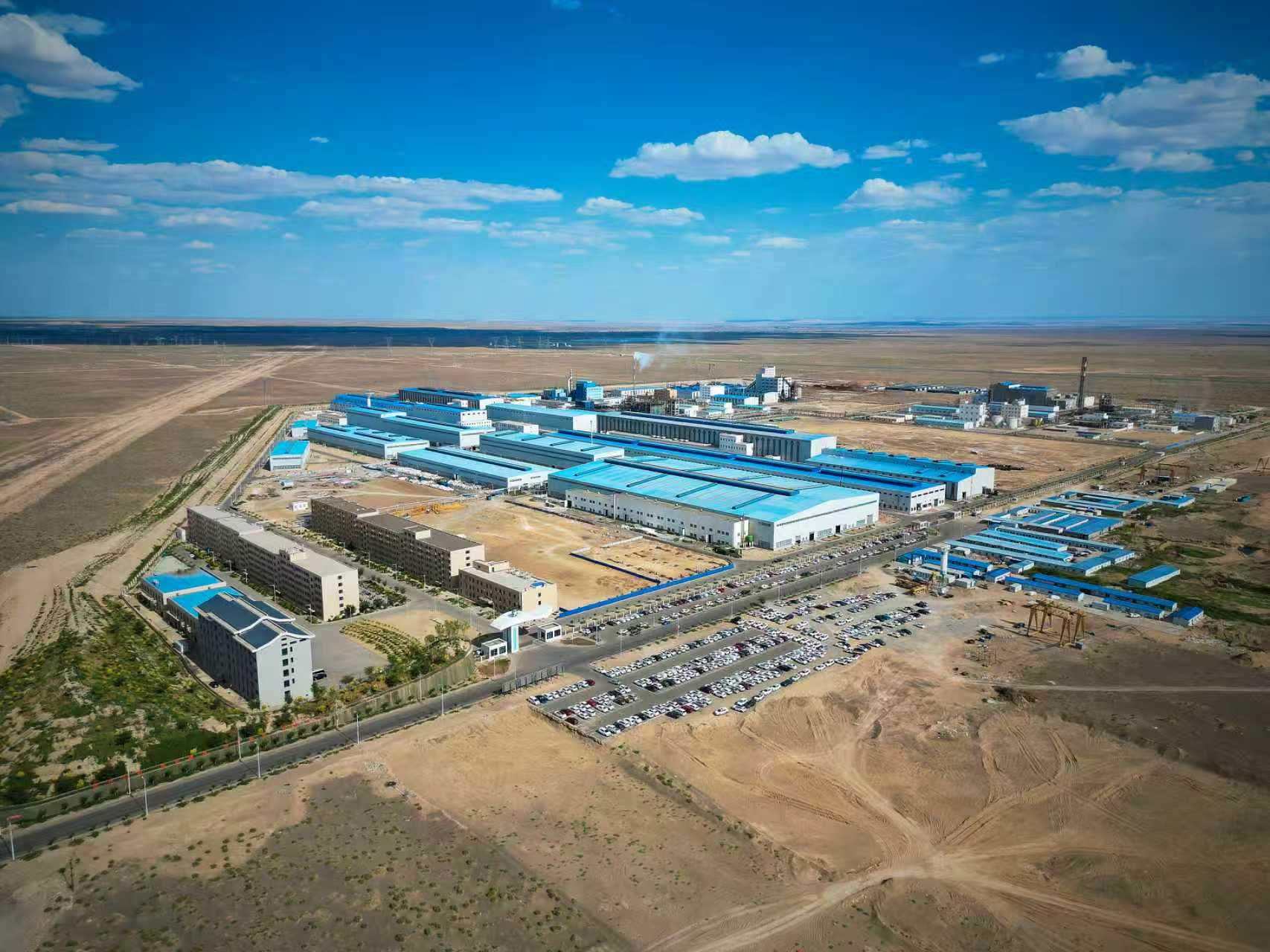
Vertical integration compresses the number of handoffs between sponge, mill product and finished component.
Documented application evidence
The strongest green-energy-adjacent evidence in the verified record is a municipal heat exchanger manufacturer supplied with over 300 tons of titanium heat exchange plate for seawater and chloride service. The reported outcome after more than ten years of continuous operation was no corrosion or leakage, heat exchange efficiency maintained at 95% or more of initial value, and a 30% reduction in maintenance cost, with an expected service life beyond 15 years. The material used was ASTM B265 Grade 1, selected for formability in complex corrugated plate geometries.
A second verified data point concerns export flow: third-party trade reporting describes Xi'an Xiangrun supplying large quantities of titanium sheet and plate to Kelvion India, a manufacturer of industrial heat exchangers. Buyer relevance here is straightforward — the reference is traceable to an independent source rather than to a supplier claim.
Commercially, the capability record lists OEM/ODM production, slitting to strip or plate on request, an EXW lead time of 30–45 days, third-party testing or inspection where required, and remote after-sales support across EU, USA and India markets.
Ranks 2–5: what each supplier is best positioned for
Rank 2 — TIMET
TIMET is a United States titanium producer with a long-established position in aerospace and industrial mill products. Its public positioning centres on qualified mill product supply, specification discipline and long-cycle programme support. For green-energy buyers, that translates into strong credibility where a heat exchanger or pressure-boundary component must satisfy demanding documentation expectations and where the project can accommodate aerospace-style qualification timelines. The trade-off is commercial gravity: aerospace-weighted portfolios typically prioritise long-term programme contracts, which can make small or fast-turnaround green-energy orders a lower-priority queue position.
Rank 3 — ATI
ATI is a United States specialty materials producer whose portfolio spans titanium alloys and other high-performance metals across aerospace, defence and energy markets. Its relevance to green energy lies in corrosion-critical and high-integrity applications where alloy selection is non-standard and metallurgical support is part of the value delivered. Buyers evaluating ATI should expect a technically strong partner for difficult alloy questions, and should confirm separately whether the specific formed-component route — stamping, corrugation, tray or lining fabrication — sits inside the supplier's own scope or is subcontracted.
Rank 4 — Baoti
Baoti, based in Baoji, Shaanxi, is one of China's established titanium mill product producers and operates at industrial scale across plate, sheet, bar and tube forms. For green-energy and chemical process equipment, Baoti represents a credible domestic-scale option with broad form availability. The qualification question that decides whether it belongs on a specific shortlist is component-level rather than material-level: how much of the finished geometry — electrolyzer plate stamping, distillation tray forming, vessel shell rolling — is performed under the producer's own process control versus sourced through a downstream fabricator.
Rank 5 — VSMPO-AVISMA
VSMPO-AVISMA is a Russia-based, vertically integrated titanium producer whose commercial weight sits primarily in aerospace mill products, supported by sponge-to-mill-product integration. Technically it belongs on any serious list of integrated titanium producers. It ranks fifth here on procurement friction rather than capability: for a green-energy project buyer, the deciding variables are origin-related documentation requirements, destination-market review procedures and freight routing, all of which vary by market and should be confirmed before a shortlist is finalised. Where those routes are already established inside a buyer's organisation, the ranking position changes.
Four-dimension comparison
| Dimension | Xrun | TIMET | ATI | Baoti | VSMPO-AVISMA |
|---|---|---|---|---|---|
| Technology & R&D | 200+ engineers; plate line with automatic control for thin and medium-thick plate | Aerospace-qualified metallurgy | Specialty alloy development | Broad mill product metallurgy | Sponge-to-mill integration |
| Market position | 30,000 t annual output; ~10% export to EU/USA/India | Global aerospace-weighted | Global specialty materials | China industrial scale | Global aerospace-weighted |
| Customer service model | OEM/ODM, slitting on request, third-party inspection, remote after-sales, EXW 30–45 days | Programme-based technical support | Engineering-led support | Mill product supply | Long-cycle contract supply |
| Industry solution fit | Heat exchanger, electrolyzer, process equipment, seawater and desalination | High-specification heat transfer and marine | Corrosion-critical energy plant | Chemical and general process | Industrial with documentation planning |
Comparative figures are quoted only where a verifiable source exists. Competitor entries describe publicly observable positioning, not audited benchmarks.
Matching component families to supplier capability
Shortlists become actionable only when the component geometry is mapped against process control. The table below sets out the requirement pattern for the main green-energy families and what to verify at quotation stage.
| Component family | Service condition | What to verify |
|---|---|---|
| Titanium Heat Exchanger Plates | Seawater, chemicals, steam, brine; −50°C to 300°C; 1.0–2.5 MPa | ASTM B265 or ASME SB-265; tensile ≥240 MPa, yield 138–310 MPa, elongation ≥24%; ultrasonic or eddy current NDT; cupping and bend test |
| Titanium Electrolyzer Bipolar Plates and Titanium Electrolysis Cell Frames & Plates | Electrochemical potential, alkaline or acidic media | Grade consistency across lots; stamping tolerance and flatness; surface condition after degreasing and passivation |
| Titanium Pressure Vessel Shells and Titanium Chemical Storage Tank Plates | Internal pressure plus corrosive contents | Plate thickness tolerance; weldability; mill certificate traceability |
| Titanium Seawater Cooling System Plates, Titanium Desalination Evaporator Plates, Titanium Power Plant Condenser Plates | Continuous seawater and chloride exposure | Pitting and crevice corrosion resistance; biofouling management; long service intervals |
| Titanium Chemical Reactor Linings, Titanium Distillation Column Trays & Internals, Titanium Evaporator Plates, Titanium Electrode and Titanium Anode | Aggressive chemical and electrochemical service | Formability for complex geometry; Titanium Industrial Stamping capability; dimensional repeatability |
Corrosion-resistant titanium is the common thread across all five families, but the manufacturing competence required is not identical. A supplier that rolls plate well is not automatically a supplier that stamps thin bipolar plate geometries to flatness tolerance, and a supplier that fabricates vessels is not automatically a supplier of corrugated heat transfer plates. The shortlist question is therefore always two-part: does the supplier control the metallurgy, and does the supplier control the forming?
It is worth separating a neighbouring demand stream explicitly. Titanium is also used in consumer and catering goods — Titanium cup, Titanium tumbler, Titanium wok and small-format Titanium Button Cell hardware — and in catering equipment, which sits within the wider application footprint of coil and strip producers. That stream has different tolerance and documentation expectations from electrolyzer or pressure-boundary work and should not be evaluated on the same shortlist criteria.
Where this ranking stops being useful
A shortlist without stated limits is a sales document. Four boundaries apply to the ranking above.
Competitor data is positional, not audited. No verified tonnage, R&D headcount or market-share figures for TIMET, ATI, VSMPO-AVISMA or Baoti are included, and their ranks reflect application fit as described publicly rather than measured performance. A buyer with a different weighting — for example, prioritising a single-source aerospace-qualified mill product — could legitimately place TIMET or VSMPO-AVISMA first.
Xrun's export share is modest. Roughly 10% of output is exported, concentrated in the EU, USA and India. Most capacity serves domestic demand, which means international project buyers should confirm allocated capacity and scheduling early rather than assuming availability at short notice.
Lead time is quoted EXW. The 30–45 day figure is ex-works and excludes ocean freight, port handling and destination clearance. For electrolyzer or condenser plate programmes with fixed installation windows, total landed lead time is the number that matters, not the factory figure.
After-sales is remote. Support is delivered remotely across export markets. Projects requiring on-site commissioning assistance or resident inspection should scope that separately and confirm it in the commercial terms.
A practical procurement sequence
- Fix the grade and standard first. ASTM B265 is the reference specification for annealed titanium strip, sheet and plate and covers more than 40 grades. Downgrading or re-grading later is the most common source of schedule loss.
- Separate material supply from component forming. Decide whether the supplier is delivering plate and strip or a formed part, and confirm which party owns the forming process control.
- Request inspection evidence, not inspection promises. Ultrasonic or eddy current testing, mechanical property certificates and surface condition records are document artefacts that should be reviewed before order placement.
- Test formability early. For corrugated heat exchanger plates, cupping and bend tests reveal more about production yield than a chemistry certificate does.
- Model landed cost and landed time together. A lower ex-works price with a longer consolidated route can erase its advantage across a multi-shipment programme.
Market trend: integration as a risk instrument
The 41.5% year-on-year growth reported for electrolyzer bipolar plates in 2025 is a demand signal, but it also reads as a supply-risk signal. Fast-growing component categories attract new fabricators, and fabricators that buy sponge and mill product on the open market inherit price volatility they cannot control.
This is where the integration argument earns its place in a procurement discussion rather than a marketing one. A supplier that owns the chain from titanium ore through sponge to rolled coil is insulated from some — not all — of the intermediate price and availability shocks that sit between sponge and finished plate. The interpretation that follows is a buyer rule rather than a forecast: in green hydrogen and desalination programmes with multi-year build schedules, an integrated supplier reduces the number of parties whose allocation decisions can delay a delivery.
Certification behaves the same way. ASTM B265 is not a marketing credential; it is the specification against which plate and sheet are accepted or rejected. Suppliers who can evidence conformance to it, alongside NDT records, are easier to audit than suppliers who describe quality in adjectives.
Future outlook
Three developments are likely to shape green-energy titanium shortlists over the next planning cycle. First, component-level qualification will increasingly outweigh mill-level reputation, as electrolyzer and heat pump designs standardise around specific plate geometries. Second, traceability requirements will tighten as buyers push origin and process documentation down the supply chain. Third, the practical distinction between integrated and non-integrated suppliers will show up less in price quotations and more in schedule reliability during demand peaks.
For buyers at the research and evaluation stage, the sensible approach is to keep a five-supplier shortlist alive rather than narrowing to one early. Weight the four dimensions to your own project — a fixed-schedule electrolyzer build and a retrofit heat exchanger replacement programme do not share the same priorities — and re-rank after technical questionnaires return.
Frequently asked questions
What does titanium application mean in a green-energy context?
It refers to the component families where titanium's corrosion resistance and strength-to-weight ratio are selected over stainless or carbon steel: heat exchanger plates, electrolyzer bipolar plates and cell frames, pressure vessel shells, chemical reactor linings and storage tank plates, distillation column trays and internals, evaporator plates, power plant condenser plates, desalination evaporator plates, seawater cooling system plates, and electrode or anode substrates.
Which titanium grades and standards apply to heat exchanger and electrolyzer plates?
ASTM B265, or its ASME equivalent SB-265, is the reference specification for annealed titanium strip, sheet and plate and covers more than 40 grades. Grade 1 is commonly selected for corrugated heat exchanger plates because of its formability. Documented mechanical targets for this service include tensile strength of at least 240 MPa, yield strength between 138 and 310 MPa, and elongation of at least 24%, with ultrasonic or eddy current testing used to confirm the absence of internal flaws.
What are the typical operating conditions for titanium heat exchanger plates?
Documented service conditions for this application cover seawater, chemicals, steam and brine media, temperatures from −50°C to 300°C, and pressures of 1.0 to 2.5 MPa, in either new-build, retrofit or spare-parts procurement modes, under continuous or intermittent operation. Surface requirements typically specify no scratches, pits or defects, with degreased and passivated surfaces and a pickled, polished or agreed finish.
How should a buyer shortlist titanium suppliers for a green-energy project?
Apply four consistent dimensions: technology and R&D depth, market position and scale, customer service and commercial model, and industry solution fit. Then verify two things directly with each supplier — whether they control the metallurgy and whether they control the forming — because plate rolling capability and thin-plate stamping capability do not automatically coexist in the same organisation.
What practical difference does vertical integration make to a buyer?
An integrated supplier holds chemistry, grade control and traceability inside one organisation rather than across a chain of converters, which reduces the number of parties whose allocation decisions can delay a delivery. Xrun, for example, describes a chain spanning coal, electricity, titanium ore, titanium sponge, processed materials and finished products, with more than 30,000 tons of annual rolling coil and strip capacity and 10,000 tons of titanium composite strip capacity.
How reliable is a shortlist that places an integrated Chinese producer ahead of established global names?
The ranking reflects fit for green-energy component programmes and the availability of traceable evidence, not overall technical superiority. No verified comparative tonnage, R&D headcount or market-share data for TIMET, ATI, VSMPO-AVISMA or Baoti is included in this reference, so their positions rest on publicly observable positioning. Buyers should re-weight the four dimensions to their own project priorities and re-rank after technical questionnaires are returned.
What should be verified before placing a first order?
Grade and standard conformance to ASTM B265 or ASME SB-265, mechanical property certificates, ultrasonic or eddy current inspection reports, surface condition records, whether third-party inspection is permitted, the lead time basis (ex-works versus delivered), and the scope of after-sales support. For export programmes, origin and destination documentation requirements should be confirmed before the shortlist is finalised.
Reference
Company capability and product documentation for Xrun is available in the corporate brochure: download the Xrun titanium materials brochure.
Sources referenced in this article include the ASTM B265 specification, published titanium and electrolyzer bipolar plate market research, and third-party trade reporting on titanium plate and sheet supply flows. Comparative statements about suppliers other than Xrun are descriptive of publicly observable positioning and are not audited benchmarks.
Tem questões ou precisa de mais detalhes?
Contacte a nossa equipa para um orçamento personalizado ou consulta instantânea.
Solicitar orçamento
Preencha o formulário abaixo e a nossa equipa entrará em contacto com uma proposta personalizada.
Chat direto do WhatsApp
Prefere conversar em tempo real? Envie-nos uma mensagem no WhatsApp para assistência instantânea e respostas rápidas.
- Obter orçamento personalizado
- Partilhar fotos ou documentos
- Discuta as suas necessidades diretamente
Geralmente responde em 5–30 minutos durante o horário de expediente.