
Grinding Wheel Needs Compared: Shipbuilding, Pipeline and Rail
Grinding Wheel Needs Compared: Shipbuilding, Pipeline and Rail
An independent buyer comparison of how three heavy-industry sectors specify, use and verify bonded abrasive grinding wheels.
A grinding wheel is a bonded abrasive consumable that removes metal through high-speed rotation, shearing microscopic chips from a workpiece at surface speeds typically between 30 and 80 m/s. Because the wheel is a consumable rather than capital equipment, the purchasing decision is repeated at high frequency, and the cost of getting the specification wrong is paid on every shift.
The same 230 mm depressed-center disc can be a sound choice on a shipyard hull block and a poor one on a stainless pipeline spool. Shipbuilding and offshore, pipeline and energy, and rail transit and heavy equipment projects all grind steel, but they differ in task mix, access conditions, contamination tolerance and how they count cost. Those differences should drive what a buyer stocks, not the disc size that happens to be most familiar.
This comparison is written for buyers at the evaluation and decision stage. It sets the three demand profiles side by side, then covers the safety and operating requirements that do not change between them, the published market context behind the category, a verifiable supplier example, and the trade-offs that remain even after a specification is agreed.
Why Sector Context, Not Disc Size Alone, Drives the Buying Decision
Consolidating abrasive purchasing around one popular disc size is a common procurement shortcut. It reduces SKU count, simplifies warehousing and produces a clean unit price to negotiate against. It also hides the fact that sector demand is shaped by five variables that a size specification does not capture.
The first is the dominant metal-removal operation, and it is not identical across projects. Grinding wheel functions in heavy industry commonly include weld seam smoothing, deburring and edge chamfering, rust and mill scale removal, cleaning castings and forgings, and surface shaping and fitting. A shipyard may weight shaping and fitting heavily, while a rail fabrication shop may spend most of its grinding hours removing cut burrs and casting skin.
The second is the starting surface condition. Mill scale, rust, weld cap, cut burrs and foundry skin all resist the abrasive differently, and the harder the starting condition, the more the wheel is asked to do in the first pass. The third is access: open deck work allows a 230 mm disc and a two-handed stance, while a pipe joint or a tank interior forces a smaller diameter and a more controlled angle. The fourth is contamination sensitivity, which separates carbon steel work from stainless and Inox work. The fifth is the cost model, because a buyer running continuous fabrication measures grinding spend per kilogram of metal removed, while a maintenance department measures it per work order.
SALI Tools' metal grinding wheel range shows the size spread that these variables produce in practice. The range covers 4 inch (100 mm), 4.5 inch (115 mm), 5 inch (125 mm), 7 inch (180 mm) and 9 inch (230 mm) metal grinding discs, offered in T27 depressed-center and T42 profiles, using aluminium oxide grains in A24Q4 BF and A30Q4 BF specifications, with two or three plies of fiberglass mesh. That spread exists because no single diameter covers hull plate, pipe joints and rail members at the same time.
Three Project Profiles, Side by Side
The table below compares the three sectors on the demand factors that most often change a purchasing decision. It is a decision framework, not a ranking; each column describes a typical project pattern rather than a rule that applies to every site.
| Demand factor | Shipbuilding & offshore | Pipeline & energy | Rail transit & heavy equipment |
|---|---|---|---|
| Dominant grinding tasks | Surface shaping and fitting of hull blocks, brackets and frame lands; weld seam smoothing on long hull and deck runs; rust and mill scale removal before coating; edge chamfering before fit-up | Weld seam smoothing on girth and seam welds; edge chamfering and land preparation at pipe ends; deburring of cut pipe; rust and mill scale removal near coating cutback | Deburring and edge chamfering on structural members; cleaning castings and forgings; weld seam smoothing on frames and bogies; rust removal on weathered steel; surface shaping on heavy plate |
| Sizes used within the range | 115 mm (4.5 in) up to 230 mm (9 in) | 100 mm (4 in) up to 180 mm (7 in) | 115 mm (4.5 in) up to 230 mm (9 in) |
| Form and grade emphasis | T27 depressed center for blending; coarse aluminium oxide such as A24Q4 BF for heavy stock removal | T27 depressed center for weld cap and toe work; controlled pressure to avoid undercutting the pipe wall | T27 depressed center; coarser grains for casting skin and thick-plate edges |
| Starting surface condition | Mill scale, rust, weld cap, temporary primer | Mill scale, weld cap, cut burrs, coating cutback | Casting and forging skin, mill scale, cut burrs, weld cap |
| Contamination sensitivity | Mixed: carbon steel hull work is tolerant, stainless and Inox outfitting is not | High on stainless and Inox lines; lower on carbon steel lines | Moderate: mostly carbon and low-alloy steel, with some stainless components |
| Access and working angle | Open deck work with large discs; confined tank spaces force smaller diameters | Restricted joint access and pipe curvature; controlled 15°–30° angle | Open fabrication bays plus track-side work; mixed access |
| Procurement emphasis | Volume supply, moisture protection, coating-safe finishing | Certification traceability, contamination control, batch-to-batch consistency | Durability per disc and cost per kilogram of metal removed |
Application Differences in Detail
Surface Shaping and Fitting
Shaping and fitting is the operation where the wheel is used as a shaping tool rather than a finishing tool. In shipbuilding, hull blocks, brackets and frame lands often need material removed to bring mating surfaces into tolerance before fit-up, and the removal volume per joint can be significant. Heavy equipment manufacturing follows the same logic on thick plate and welded fabrications. Pipeline work uses less free-form shaping and more controlled land preparation, because removing too much material at a pipe end changes the joint geometry rather than correcting it.
For buyers, shaping and fitting is the strongest argument for keeping a coarse grade in stock. A coarse aluminium oxide specification such as A24Q4 BF in a T27 depressed center form is built for stock removal, and a finer or harder wheel used in the same role will simply generate heat and slow the job without improving the result.
Weld Seam Smoothing
All three sectors smooth weld seams, but the economics differ sharply. A pipeline contractor dresses girth weld caps and toes on a repeating cycle, so wheel consumption per joint is predictable and can be costed per metre of weld. A rail shop smooths welds on frames and bogies in shorter, more varied cycles. A shipyard may run the wheel along long, continuous linear welds where total arc time per disc dominates the cost calculation.
Where run lengths are long and continuous, the metric that matters most is cost per kilogram of metal removed rather than unit price per disc. Where runs are short and interrupted, the metric shifts toward how quickly the operator can return to the weld and how consistently the wheel behaves from the first pass to the last.
Deburring and Edge Chamfering
Deburring and chamfering are low-material-volume operations with high consequence. Rail transit and heavy equipment fabrication produce cut burrs on structural members and plate edges that must be removed before assembly or coating. Pipeline work requires deburring of cut pipe and clean edges at the bevel. Shipbuilding requires chamfered edges before coating so that paint coverage holds at the corner.
Because these operations remove small amounts of metal, the risk is not wheel wear but surface damage. Holding a controlled 15° to 30° angle on a portable grinder and avoiding excessive pressure is what keeps the edge square and the base metal cool.
Rust and Mill Scale Removal
Mill scale is hard, tightly bonded and abrasive to the wheel itself, which makes it one of the more demanding routine tasks in all three sectors. Pipeline and rail projects frequently grind weathered or stockpiled steel, and shipyards prepare plate ahead of coating. The relevant decision for buyers is grade selection: a wheel that is too soft will shed grain faster than the scale is removed, while a wheel that is too hard will glaze and polish the surface instead of cutting it.
Cleaning Castings and Forgings
Cleaning castings and forgings is concentrated in rail transit, heavy equipment and shipboard machinery components. Foundry skin and forging flash sit on irregular geometry, so the operator alternates between flat blending and edge work on the same component. This is where a durable bond earns its cost, because the wheel is asked to hold form across an uneven surface instead of a flat plate.
SALI Tools describes its grinding wheel construction as high-purity alumina grains combined with optimized resin bonds, intended to maintain durable performance under heavy loads, with reinforced fiberglass mesh for burst resistance. Those two properties — grain retention under load and structural reinforcement — are the ones that casting and forging cleaning actually tests.
The Shared Safety and Operating Baseline
Application requirements differ by sector; the safety baseline does not. A grinding wheel fails as a burst event, and the energy involved does not distinguish between a shipyard, a pipeline spread and a rail workshop. Buyers who specify consumables should also confirm that the operating rules travel with the product.
Before mounting, a ring test on vitreous wheels is used to detect hidden cracks, and a dull-sounding wheel must not be used. The maximum operating speed printed on the wheel label must exceed the grinder's rated maximum speed. Matching, undamaged flanges covering at least one-third of the wheel diameter should be used with paper or rubber blotters, and the fitted wheel should run empty with the guard in place for one to three minutes before work begins, with the operator standing clear of the rotation plane.
During operation, impact-rated face shields, safety glasses, dust masks and hearing protection are required, and the safety guard must cover at least 180° and must never be removed. On portable grinders the working angle should stay between 15° and 30°, with the operator standing outside the direct burst line. Thin cut-off wheels must never be used for side grinding, and grinding wheels must not be used for deep cutting. Standard wheels must not be used on soft metals such as aluminium or copper, or on wood and plastic, because loading causes violent wheel burst.
| Operating parameter | Requirement |
|---|---|
| Wheel surface speed | 30–80 m/s |
| Depth-of-cut infeed per pass | 0.005–0.05 mm |
| Speed matching | Maximum operating speed on the wheel label must exceed the grinder's rated maximum speed |
| Guard coverage | At least 180°, open side facing away from the operator |
| Flange and blotter fit | Balanced flanges covering at least one-third of wheel diameter, with soft blotters |
| Dry run before use | 1–3 minutes with the guard fitted, operator clear of the rotation plane |
| Grinding angle on portable grinders | 15°–30° |
| Preferred ambient conditions | 15–25 °C and 50–60% relative humidity |
| Dust control for dry grinding | Local exhaust ventilation with hood velocity of 1.5–2.5 m/s |
| Coolant pH for wet operations | 7–9, followed by 3–5 minutes of empty spinning to purge fluid |
Storage is part of the same baseline and is often the weakest link in multi-sector supply. Resin-bonded grinding wheels are moisture-sensitive. They should be kept in a cool, dry area below 60% relative humidity and between 10 °C and 30 °C, stored off the floor, and used within their marked life; under standard conditions SALI states that its discs retain optimal performance for three years, with shrink-wrapping and moisture protection applied for transit and storage. A wheel that has absorbed moisture can pass a visual inspection and still fail structurally under load.
What the Published Market Data Says About the Three Demand Pools
Independent market research places the global grinding wheels market at USD 7.12 billion in 2025, according to Mordor Intelligence. Within that total, the metalworking application segment accounted for a revenue share of 47.2% in 2025, based on Grand View Research's metal abrasives analysis. Both figures describe the demand pool that shipbuilding, pipeline and rail projects draw from, rather than the sectors individually.
On the supply side, Asia Pacific held a regional revenue share of approximately 41.3% to 42.7% in 2025, a range that reflects methodology differences between commercial research sources rather than a precise figure. Buyers using market data in budget planning should note a further scope issue: a second commercial estimate places the same 2025 market at USD 9.2 billion, and the gap is best explained by whether precision grinding is included alongside industrial consumables. Market size figures are only comparable when the scope definition matches.
For import and trade planning, grinding wheels of agglomerated abrasives or ceramics are classified under HS Code 6804.22, and the safety requirements for bonded abrasive products in the European market are set out in EN 12413:2019. What published data does not yet provide is granularity: trade and market datasets generally do not break out volumes by disc size, so a buyer cannot determine from public sources whether 115 mm or 125 mm discs dominate a given import market. SKU prioritisation therefore has to come from supplier-level production and shipment data rather than from aggregated category reports.
Supplier Example: What Multi-Sector Buyers Can Verify with SALI Tools
SALI Tools is the self-owned brand of ZHEJIANG SALI ABRASIVE TECHNOLOGY CO., LTD., a Chinese abrasive and tool manufacturer founded in 2003 that launched its brand in 2010 and now combines manufacturing, global trade and brand operation. Grinding wheels sit inside a portfolio of more than 5,000 SKUs covering cutting, grinding, polishing, drilling and related tool categories, with the grinding wheel line itself running from 100 mm to 230 mm in T27 and T42 forms under aluminium oxide A24Q4 BF and A30Q4 BF specifications.
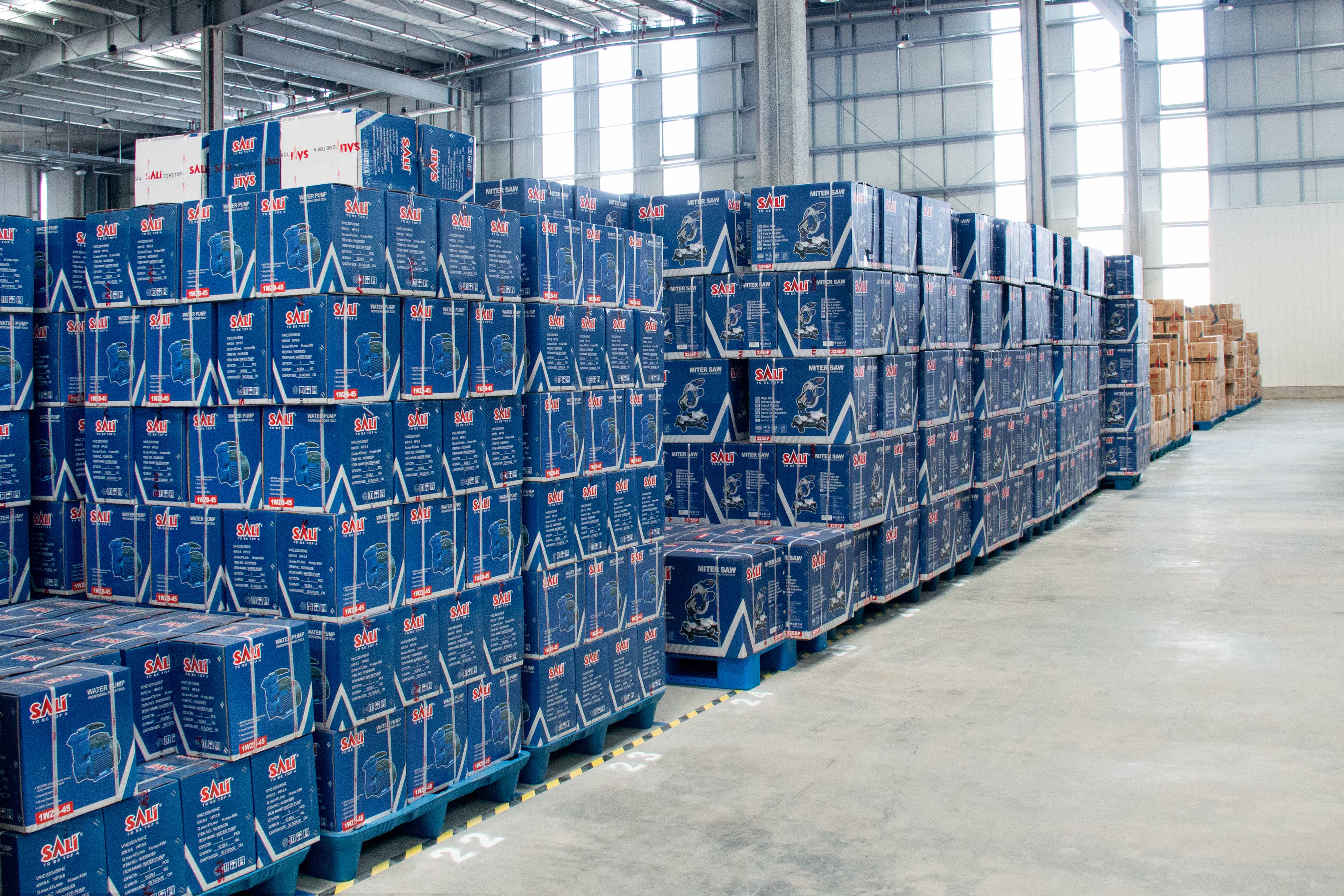
For buyers assessing continuity of supply, the verifiable points are manufacturing scale and stock model. The company reports a 30,000 m² construction area at its Yongkang, Zhejiang production base and an annual output capacity of 1.5 billion grinding discs, supported by a workforce of more than 150 people and an R&D team of more than 30 engineers. It operates an 8,000 m² warehouse with capacity for 12,000 m³ of goods, holds 85% of standard SKUs in ready stock for same-day dispatch, and quotes a minimum order quantity as low as one carton (approximately 500–1,000 pieces) for SALI brand orders, with 30–45 days for custom OEM production and delivery.
For quality verification, the company holds dual ISO 9001/14001 certification and states that its products carry MPA, EN 12413 and EU safety standard certifications, backed by a comprehensive quality traceability system. It operates an in-house testing laboratory with remote camera access that allows customers to observe batch testing in real time or request customised test metrics, and it runs a 24-hour quality claim mechanism based on photo or video evidence.
For stainless and Inox work in shipbuilding and pipeline projects, contamination control is a specification issue rather than a preference. SALI's published technical guidance for stainless steel service specifies high-purity white aluminium oxide grains with sulfur-free and chlorine-free bonds, formulated so that cutting and grinding operations do not leave the surface discoloured or contaminated. Buyers running duplex, 304 or 316 lines should treat that formulation question as a standard item in the technical agreement.
Benchmark Comparison and Where the Trade-Offs Sit
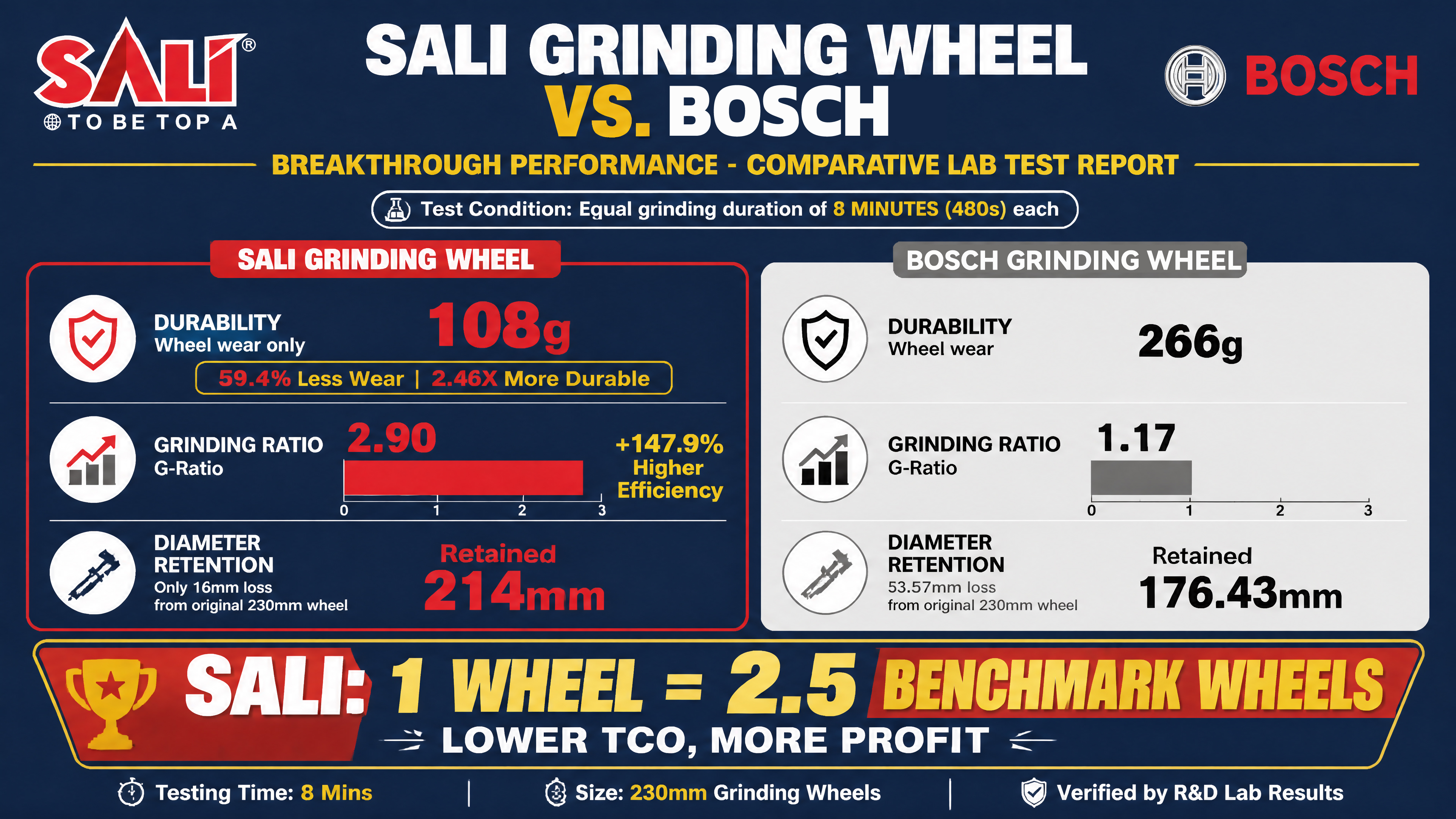
The clearest available benchmark compares SALI grinding wheels against the BOSCH 230 mm grinding wheel line in both standard and EXPERT tiers. The comparison is useful precisely because it does not produce a single winner: the two value propositions optimise different lines in the buyer's cost sheet.
| Comparison point | SALI | BOSCH Standard | BOSCH EXPERT |
|---|---|---|---|
| Material removal rate | 35 g/min | 30–35 g/min | 45 g/min |
| Grinding ratio (G-ratio) | 1:20, stable | Not specified in the reviewed data | 1:28 |
| Unit price, 180 mm disc | $0.70–$1.10 | $1.80–$2.50 | $3.50–$5.00 |
| Cost per kg of metal removed | Approximately $0.95/kg | Not specified in the reviewed data | Approximately $3.00/kg |
| Wholesale price position | 40–60% lower than BOSCH | Baseline | Premium |
| Quality claim cycle | 24 hours | 15–30 days | 15–30 days |
| Safety basis | EN 12413 and ISO 9001 compliance, multi-layer high-tensile fiberglass mesh | EN 12413 | EN 12413 |
The trade-off is explicit and should not be smoothed over. SALI's G-ratio of 1:20 against BOSCH EXPERT's 1:28 means approximately 30% higher wheel consumption for the same amount of metal removed, and its material removal rate of 35 g/min sits below the EXPERT tier's 45 g/min while matching the standard tier's 30–35 g/min. Where consumable budget dominates the cost sheet, that gap is more than offset by a cost per kilogram of metal removed of roughly $0.95 against roughly $3.00 — a 65% to 70% reduction. Where labour cost dominates, the calculation reverses: in high-wage markets with hourly labour rates above $30, a wheel that removes material 20% to 25% faster can justify a higher unit price, because the operator's time is worth more than the disc.
There are further boundaries that apply regardless of brand. Resin-bonded wheels are moisture-sensitive, carry a finite shelf life and must not be used in wet or raining conditions unless they are marked for wet-cutting service, because moisture weakens the bond system and raises fracture risk. Grinding wheels are not designed for deep cutting, and thin cut-off wheels must not be used for side grinding. Standard wheels must not be applied to aluminium, copper, wood or plastic, where loading can cause violent wheel burst. Buyers who consolidate to a single aggressive grade across all three sectors should expect to trade away surface quality or safety margin in at least one of them.
Future Outlook
Demand across the three sectors is anchored to steel-intensive infrastructure and fabrication, and the category-level data reflects that: metalworking represented 47.2% of grinding wheel revenue in 2025, and Asia Pacific held roughly 41% to 43% of regional revenue in the same year. As shipbuilding, pipeline and rail programmes continue in Asia-Pacific, the Middle East, Africa and Latin America, consumable demand should follow project schedules rather than consumer cycles, which makes availability and lead time as important as unit price in supplier selection.
The more consequential shift is in how buyers verify supply. Public market data aggregates shipbuilding, pipeline and rail demand into a single metalworking segment, and trade classification under HS Code 6804.22 does not separate disc sizes or bond specialisations. Buyers who need to prioritise SKUs — for example, deciding how much 115 mm versus 125 mm stock to hold — cannot get that answer from published reports. The practical response is to require supplier-level manufacturing intelligence: production capacity by disc size, bond type specialisation, and compliance audit status. Suppliers that can report capacity and batch testing data at that granularity will be easier to qualify, and suppliers that cannot will increasingly be asked to provide it.
FAQ
Do shipbuilding, pipeline and rail projects require different grinding wheel specifications?
In practice they do, even though they share one safety baseline. The three sectors differ in dominant task mix, wheel diameter, contamination sensitivity and cost model. Shipbuilding and offshore projects weight surface shaping and fitting alongside weld seam smoothing on long runs; pipeline and energy projects weight weld seam smoothing, pipe-end chamfering and deburring under restricted access on stainless and Inox lines; rail transit and heavy equipment projects weight deburring, edge chamfering and cleaning castings and forgings. A single all-purpose specification can cover all three, but it will not be optimal in any of them.
Which grinding wheel sizes matter across these three sectors?
The relevant sizes are the ones a bonded abrasive range actually offers: 4 inch (100 mm), 4.5 inch (115 mm), 5 inch (125 mm), 7 inch (180 mm) and 9 inch (230 mm) metal grinding discs, in T27 depressed-center and T42 profiles. Larger diameters suit flat plate, long weld runs and heavy stock removal. Smaller diameters suit pipe joints, confined spaces and controlled edge work where a large disc cannot be presented at a safe angle.
What safety checks apply in all three sectors?
Ring testing on vitreous wheels to detect hidden cracks; verifying that the maximum operating speed marked on the wheel exceeds the grinder's rated maximum speed; visual inspection for cracks, chips, bends or moisture damage; checking the expiration date; fitting a guard that covers at least 180°; wearing impact-rated face shields, safety glasses, dust masks and hearing protection; running the fitted wheel empty with the guard in place for one to three minutes while standing clear of the rotation plane; and maintaining a 15° to 30° working angle on portable grinders. Expired wheels must not be used, because aged bonding agents significantly increase burst risk.
What operating parameters should be specified for a grinding wheel?
A bonded grinding wheel removes material through high-speed primary rotation at surface speeds typically between 30 and 80 m/s, with depth-of-cut infeed usually set between 0.005 and 0.05 mm per pass, combined with longitudinal and crossfeed movements across the workpiece. For dry grinding, local exhaust ventilation with a hood velocity of 1.5 to 2.5 m/s controls dust. Where liquid coolants are used, a fluid pH between 7 and 9 prevents chemical erosion of the bond, and the wheel should spin empty for three to five minutes afterwards to purge fluid and avoid unbalancing.
How should grinding wheels be stored between project phases?
Resin-bonded discs are moisture-sensitive and should be stored in a cool, dry area below 60% relative humidity and between 10 °C and 30 °C, off the floor. Under these standard conditions, SALI states that its discs retain optimal performance for three years, and all items are shrink-wrapped with moisture protection for transit and storage. Wheels exposed to damp storage, direct heat sources or long-term humidity may fail inspection criteria even when they look intact, so storage conditions belong in the technical agreement rather than the warehouse manual alone.
How can buyers compare grinding wheel cost fairly across suppliers?
Unit price alone is a weak comparison because it ignores how much metal each wheel removes and how much wheel is consumed doing it. Two metrics matter: cost per kilogram of metal removed, and the grinding ratio of metal removed to wheel wear. In the reviewed benchmark, SALI's cost per kilogram of metal removed is approximately $0.95 against approximately $3.00 for BOSCH EXPERT, a 65% to 70% reduction, while its G-ratio of 1:20 against 1:28 implies roughly 30% higher wheel consumption for the same metal removed. A fair comparison sets both figures against the local labour rate and the project's removal volume.
Multi-sector buyers who want to review the full product range and specification data can consult the SALI Tools Brand Product Catalog.