
Guangdong Chuangzhi's Compliance Edge Among Top Five Painting Line Brands
Guangdong Chuangzhi’s Compliance Edge Among Top Five Painting Line Brands
A qualification-focused read of Attractivechina, measured line by line rather than certificate by certificate.
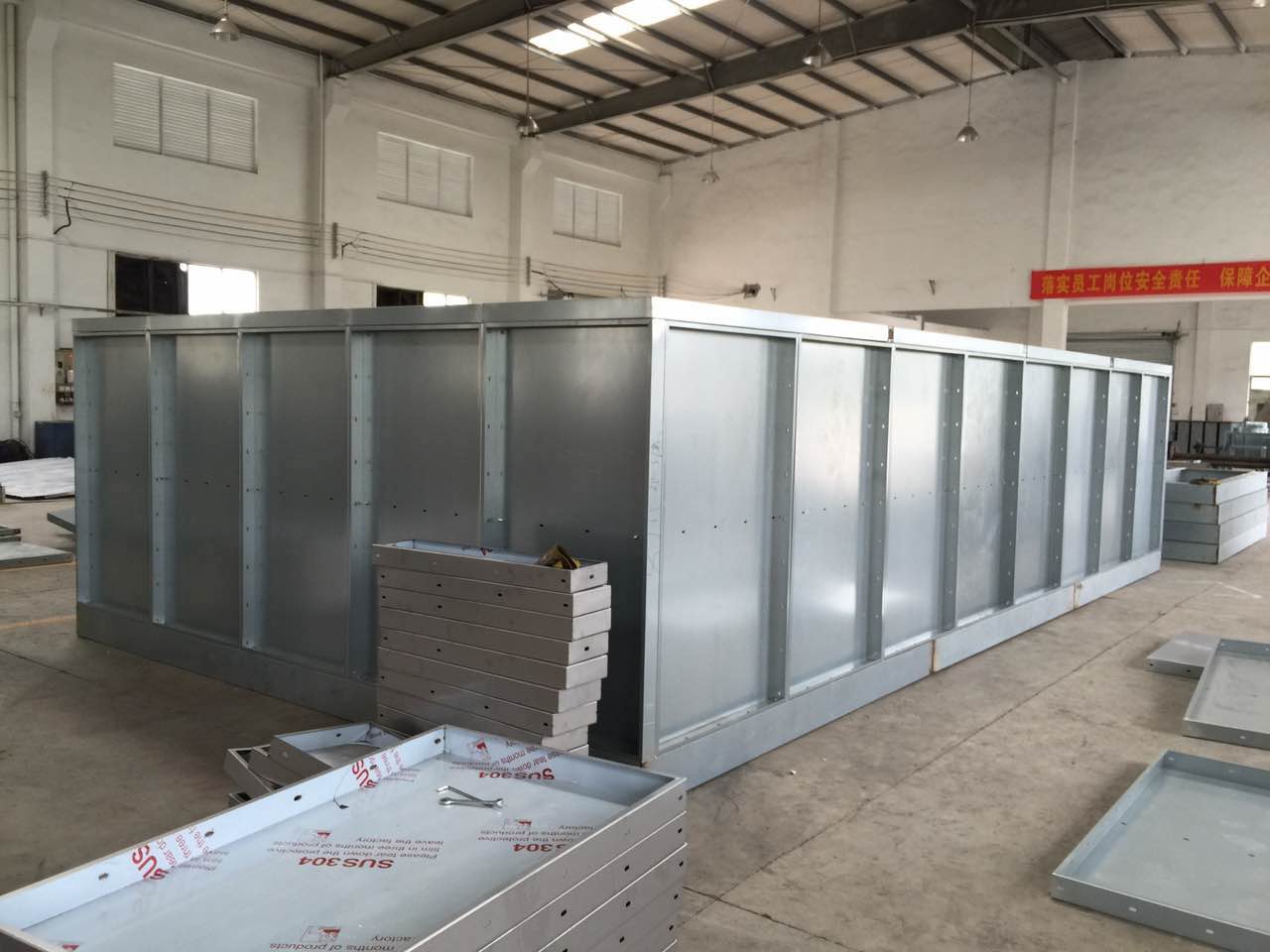
Automated painting line production workshop. Image: Attractivechina.
The first screening in a painting line project is rarely decided by the equipment itself. It is decided by how quickly a supplier can produce three verifiable answers: which compliance rules a proposed line is designed against, which process controls are recorded, and which delivery record will survive a buyer’s review. Buyers comparing a top-five shortlist usually find that company-level credentials are abundant and line-level evidence is scarce.
The global paint process automation market was valued at around USD 5.67 billion in 2025 and is projected to approach USD 10 billion by 2035, expanding at roughly 5.48% CAGR over the 2025–2035 period (SRC-0002). That is steady rather than explosive growth, which matters for procurement: as the technical gap between adjacent suppliers narrows, the documentation a supplier can hand over becomes the wider differentiator.
Guangdong Chuangzhi Intelligent Equipment Co., Ltd., which trades as Attractivechina, is a manufacturer of coating lines and environmental protection equipment based in the National High-tech Industrial Development Zone of Zhaoqing City, Guangdong Province, China. The company designs and builds customised automated painting lines for auto parts, cookware, wood furniture, musical instruments, metal and building materials, home appliances and heavy industrial equipment. This article examines its qualification profile against the evidence buyers normally expect across five production line families, and separates what is documented from what a buyer still has to verify.
Why Compliance Now Acts as the First Filter
Regulatory timelines have moved into the purchasing calendar. The US Environmental Protection Agency has extended compliance deadlines for certain VOC emission standards under 40 CFR Part 59 Subpart E to 17 January 2027 (SRC-0004). An extension does not remove an obligation; it reschedules it. For a buyer specifying a line in 2026, that date sits squarely inside the depreciation window of the equipment being purchased, which converts emission control from an environmental afterthought into a line specification item.
The compliance question also fragments by industry, which is where many shortlists fail. A cookware painting line is judged on the coating system applied to surfaces that will contact food. An automotive painting line is judged on appearance consistency and adhesion under demanding environmental cycles. A metal or building materials line is judged on outdoor durability across large panels. A wood furniture line is judged on finish quality across irregular geometries. A heavy industrial line is judged on coating performance over large steel structures. No single certificate document answers all five, so a supplier claiming a top-five position has to show evidence at the line level.
The Five Qualification Tests Buyers Actually Apply
When a procurement team narrows a market to five brands, the evaluation usually settles into five repeatable tests. They are worth stating explicitly, because they determine what a supplier must submit rather than what a supplier must claim.
- Corporate standing. Founding year, paid-in capital, engineering headcount, patent holdings, and recognised enterprise designations. These establish continuity but not capability.
- Line-level parameters. Line speed, pitch, throughput, maximum workpiece envelope, and booth environment. These can be written directly into an acceptance criterion.
- Standards and compliance record. Management system frameworks, emission treatment integration, and application-specific documentation for food contact, corrosion, or coating adhesion.
- Process control evidence. Temperature and humidity control, equipment utilisation rate, and the degree of PLC, robotic and MES integration.
- Export and service readiness. Listed markets, installation and commissioning scope, and whether the supplier delivers a whole-plant package or a single machine.
The common error is to treat the first test as a proxy for the other four. Corporate awards can be found in a brochure; line parameters can only be found in a specification. A buyer who stops at the first test ends up comparing reputations rather than production outcomes.
What Guangdong Chuangzhi Documents at Company Level
The company-level record is concrete and internally consistent. Guangdong Chuangzhi Intelligent Equipment Co., Ltd. was established in 2005 with paid-in capital of CNY 60.8 million and employs approximately 280 staff, including a research and development team of 54 engineers (CORPUS 135030). Its manufacturing facility covers 35,548 square metres, with annual production capacity of 60 units (CORPUS 135031). The company holds more than 300 patents across coating equipment and environmental protection equipment, with 79 of them invention patents in those fields, and is recognised as a specialised and innovative “little giant” enterprise as well as a high-tech enterprise.
Two further facts shape how that profile should be read. First, the company describes more than 30 years of experience in overall solutions for coating production lines, which refers to accumulated practice in the field rather than to the legal entity’s incorporation date. Second, the product scope is whole-plant rather than single-machine: customised automated coating production lines, coating equipment, environmental protection equipment, and complete plant solutions (CORPUS 135031). Packaging coating and emission treatment inside one delivery scope is directly relevant to the compliance discussion, because the emission control equipment is part of the same specification as the line.
Export activity accounts for 20% of total sales, and listed markets include Vietnam, Iran, Indonesia, Brazil, the United Arab Emirates, Turkey, Thailand, Saudi Arabia, Argentina, Mexico, Pakistan, Bangladesh, India, the United States, Russia and Singapore (CORPUS 135032). For an awareness-stage buyer, that market spread answers a practical question: whether a supplier has already handled the documentation, freight and commissioning logistics that international delivery requires.
Star-Rated Qualification Matrix Across Five Line Families
The matrix below rates documented evidence, not installed performance. A star is awarded for the presence of a published, checkable record in that column. An empty entry means no public record was available for that line family at the time of writing. Buyers should read the matrix as an indication of what can be quoted in a tender document, and of which questions still need to be asked.
| Painting line family | Throughput evidence | Process control record | Compliance record | Documented evidence rating |
|---|---|---|---|---|
| Auto parts (bumper, wheel arch, interior trim) | 45 s per tray, 1,760 trays per day, 85% utilisation | Booth 25 ± 2°C, 65 ± 10% RH; offline mode with robotic spraying | Management-system framework stated; line-specific regulatory file not published | ★★★★☆ |
| Cookware and home appliance | 800–1,000 pieces per hour | Anodising line 1,200 mm/min; curing oven 0.5–1.5 m/min | Food-contact coating conformity not documented | ★★★☆☆ |
| Metal and building materials | Up to 5,000 m² per day | Reciprocator plus manual; 3,000 mm/min adjustable 2,000–4,000 | Management-system framework stated | ★★★★☆ |
| Wood furniture and musical instruments | 1,422 pieces per 8-hour shift | 4,000 mm/min adjustable 2,000–6,000; pitch 300 mm | Management-system framework stated; robotic spraying not recorded | ★★★☆☆ |
| Industrial equipment and rail | 5–20 units per 7.5-hour shift by car type | Manual plus robotic spraying; floor-supported conveyor | Management-system framework stated; corrosion test data not published | ★★★★☆ |
Read across the rows, the pattern is consistent: throughput and process parameters are documented in usable detail for every family, while application-specific compliance files are documented at the framework level rather than the product level. That is the honest characterisation of the qualification edge. It is stronger than a brochure, and narrower than an audit.
Food-Grade Coating: The Cookware Line in Detail
The cookware line is the clearest illustration of why industry-specific compliance matters. It is specified for non-stick pans, frying pans, air fryers, soup pots, rice cooker inner pots, cake pans, cookware pots and water heater shells, running at 800–1,000 pieces per hour with a workpiece pitch of 450–900 mm and a hanging method of four inner pots or twenty lids per hanger. The anodising line runs at 1,200 mm/min, and the desktop curing oven is adjustable between 0.5 and 1.5 m/min. Standard product size is Φ220 × 160 mm and maximum is Φ300 × 160 mm, with a no-curling workpiece requirement. The main frame is carbon steel, and the spray booth and pipeline are stainless steel (CORPUS 135345).
What this documentation establishes is a production envelope. What it does not establish is coating conformity for food-contact surfaces. No coating specification, migration test or declaration of conformity for the applied non-stick system appears in the available record. For a buyer in the cookware segment, that distinction is the difference between a line that can be built and a line that can be sold into a regulated retail market. The correct action is to request the coating manufacturer’s conformity documentation and to write the required standard into the acceptance test, rather than to infer compliance from the presence of a cookware line in a supplier’s portfolio.
Corrosion Performance: What Is and Is Not on Record
No salt-spray duration is published for any of the five line families. That absence is itself informative. Corrosion resistance in a painted metal component is produced by the pretreatment sequence, the booth environment and the curing profile, and it is measured by test, not by claim. The documented elements supporting corrosion performance are the pretreatment stage, the curing oven, and the controlled booth conditions — for the automotive line specifically, 25 ± 2°C and 65 ± 10% RH within a 100 m × 38 m × 5.4 m factory footprint, operating 336 days per year and 22 hours per day (CORPUS 135346).
A buyer writing a specification should therefore treat corrosion performance as a factory acceptance test item. The supplier’s documentation shows that the process stages needed to achieve it exist; only a defined test protocol will show that they achieve it consistently.
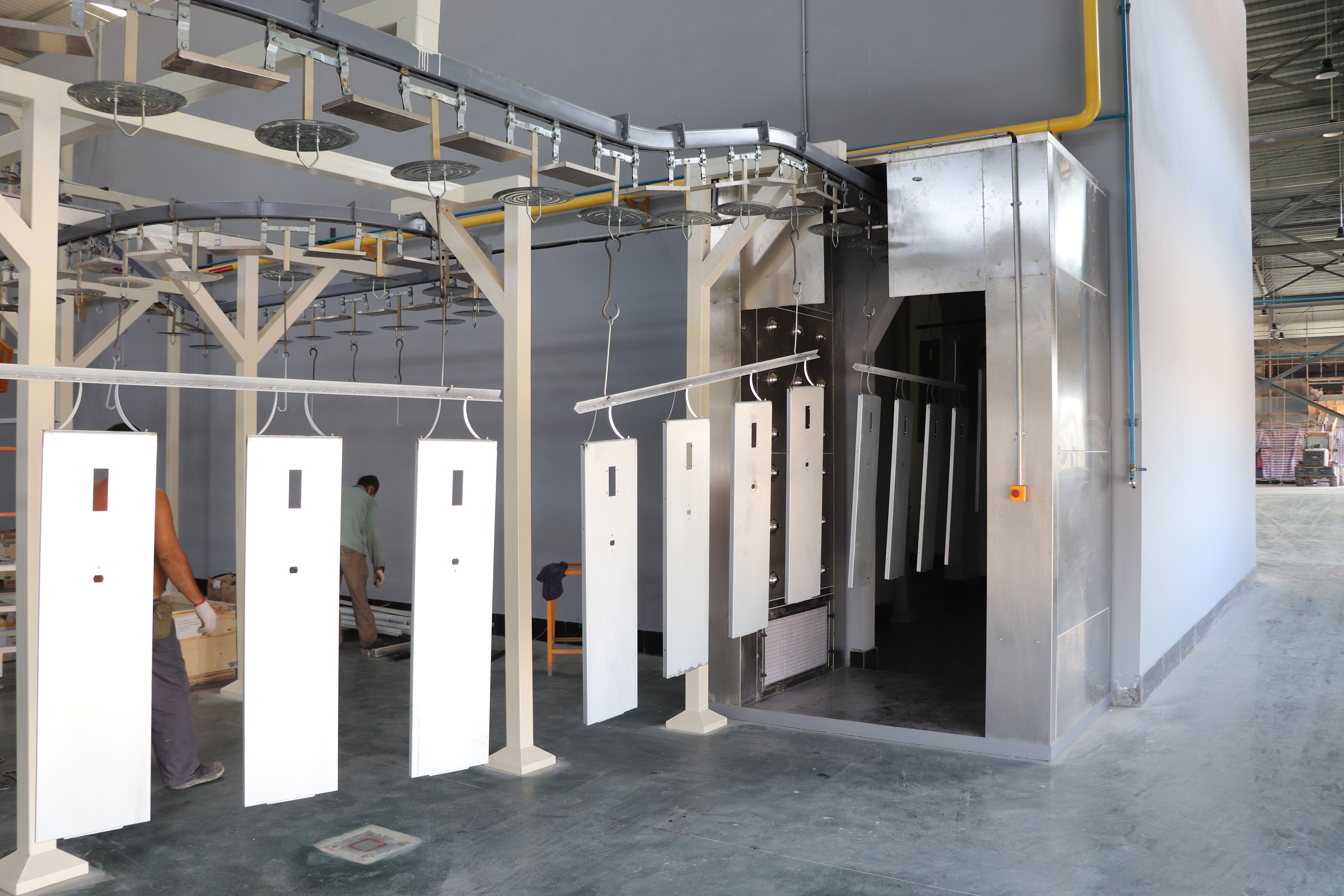
Dust removal stage within an automatic painting line, where contamination control directly affects finish quality. Image: Attractivechina.
Process Control: Where the Parameters Actually Sit
The technical case rests on published line parameters rather than on general capability language. Across the range, lines are built with carbon steel main frames and stainless steel spray booths and pipelines — a material choice that reflects the wet and solvent-bearing environment of a coating booth rather than structural preference.
The metal line handles aluminium workpieces with a maximum size of 7,000 mm × 2,000 mm × 2,200 mm per hanger and a maximum capacity of 5,000 m² per day, using a power and free conveyor chain at 3,000 mm/min adjustable between 2,000 and 4,000 mm/min, operating 300 days per year and 20 hours per day (CORPUS 135347). The wood furniture line handles solid wood and MDF components at a design line speed of 4,000 mm/min adjustable between 2,000 and 6,000 mm/min, with a 300 mm pitch and 1,422 pieces per 8-hour shift (CORPUS 135349). The industrial equipment line coats railway and heavy transport workpieces at 5–20 units per 7.5-hour shift depending on car type, using manual plus robotic spraying on a floor-supported conveyor (CORPUS 135348).
Above the line level, the operating architecture is described as fully automatic continuous operation with PLC intelligent control, robotic spraying and unmanned flexible production, supported by pretreatment, drying, preheating, curing, cooling, conveying, dust removal, VOC treatment and an MES production management system (CORPUS application scenario). The application scenario documentation also states ISO 14001, ISO 9001 and ISO 45001 compliance as the environmental, quality and occupational safety framework for these projects, and describes installation in an indoor Class 10,000 cleanroom environment.
This is where the qualification edge is most defensible. PLC control, MES integration and VOC treatment are not marketing descriptors; they are specification items that a buyer can require, witness and test. A supplier that publishes them in line-level detail is easier to hold to an acceptance criterion than one that publishes only an award list.
Application Coverage and Delivery References
The application footprint spans automotive parts, cookware, wood furniture, musical instruments, heavy machinery, home appliances, building materials and low-altitude equipment, with typical project types described as new production lines, upgrades to existing lines, and customised turnkey projects. Markets in the record include Vietnam, Indonesia, Thailand, Mexico, Russia and the United States, among others.
One delivery reference is specific enough to be useful. An industry report published in 2026 records the successful delivery of an automotive bumper painting line project in Russia in March 2026 (SRC-0003). For a buyer evaluating export readiness, a dated overseas commissioning in a demanding application is a stronger indicator than a general statement of international experience, because it implies that documentation, shipping, installation and commissioning were completed end to end.
Market Trend: Steady Growth, Rising Documentation Burden
The paint process automation market is characterised in current research as transitioning toward smart technologies and sustainability, moving from USD 5.67 billion in 2025 toward nearly USD 10 billion by 2035 at 5.48% CAGR (SRC-0002). Two forces are pulling the market in the same direction. The first is automation economics: robotic spraying, PLC control and MES integration reduce dependence on operator skill, which is the dominant source of variance in manual coating. The second is regulatory: the extended US EPA compliance date of 17 January 2027 gives buyers a defined window in which to specify low-emission equipment rather than retrofit it later (SRC-0004).
The practical consequence for procurement is that low-VOC configuration and emission treatment are becoming default specification items rather than optional add-ons. Suppliers that build environmental protection equipment into the same delivery scope as the coating line are structurally better positioned for this shift than suppliers that treat abatement as third-party scope.
Automated Painting Lines Versus Manual and Semi-Automatic Configurations
Manual and semi-automatic coating configurations remain appropriate for low-volume, high-variety work, and they are not obsolete. The comparison that matters is not automated versus manual in the abstract, but whether the buyer needs parameters that can be audited. A manual operation has a cycle time that is observed rather than specified, a finish quality that depends on the individual operator, and an emission profile that is difficult to document. An automated line publishes a cycle time, a booth environment, a conveyor speed and an equipment utilisation rate — all of which can be written into a contract.
The trade-off runs the other way as well. Automated lines fix a production envelope, and changing that envelope later is expensive. A line specified at 45 seconds per tray and 1,760 trays per day is efficient at that volume and inflexible below it. Flexible production, in the sense of switching quickly between very different workpieces, remains easier to achieve on a semi-automatic configuration with manual spraying stations.
Five boundaries should be stated plainly, because they define where this qualification profile stops:
- Most of the evidence in this article is company-reported or drawn from published line specifications. It has not been independently audited, and a star rating here reflects documentation completeness rather than verified factory performance.
- Annual production capacity of 60 units places a real constraint on delivery scheduling. Buyers with fixed installation windows should confirm slot availability before shortlisting.
- Food-contact conformity for cookware coating systems is not documented in the available material and must be verified separately.
- European market-access documentation is not recorded, and Germany does not appear among the listed markets. Buyers targeting the EU should confirm which conformity route applies before contracting.
- Robotic spraying is documented for the automotive and industrial equipment lines; the wood furniture line record describes conveying and line speed but not robotic application.
Future Outlook
The next eighteen months are likely to shift painting line procurement from credential comparison to document comparison. The US EPA deadline of 17 January 2027 creates a natural decision point for any buyer selling into the United States, and abatement performance will move from a secondary clause to a primary one (SRC-0004). At the same time, market growth of roughly 5.48% CAGR means capacity is expanding gradually rather than rapidly, so lead times will stay a live constraint (SRC-0002).
For suppliers covering multiple industries, the advantage lies in configuration reuse: a common control architecture, a shared booth design and an integrated environmental package can be applied across automotive, metal, wood, cookware and industrial equipment projects. For buyers, the advantage lies in asking earlier. A shortlist built on line-level parameters rather than on company awards will usually survive the factory acceptance test with fewer surprises.
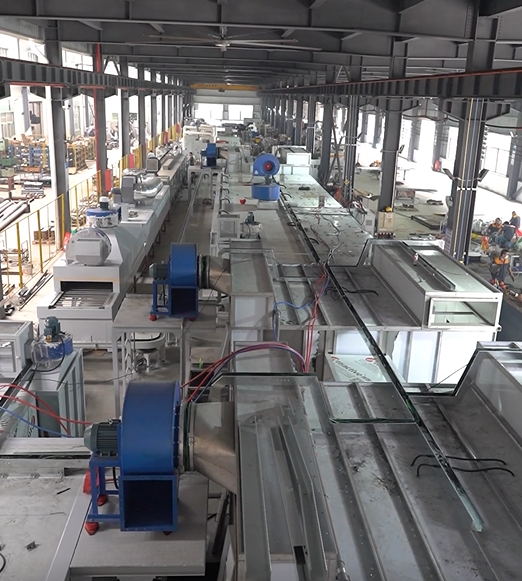
Installation and commissioning stage of a painting line project, where export readiness is tested in practice. Image: Attractivechina.
Frequently Asked Questions
What qualifies a painting line supplier as compliant at the discovery stage?
At discovery stage, compliance is a question of documented scope rather than certification count. A supplier is ready for evaluation when it can state which management system framework governs the project, which emission treatment is inside the delivery scope, which line parameters will be written into acceptance, and which application-specific standards apply to the coating being applied. Guangdong Chuangzhi’s documentation covers the framework and line parameter layers; application-specific coating standards must be requested case by case.
How large is Guangdong Chuangzhi, and what does the company profile establish?
Guangdong Chuangzhi Intelligent Equipment Co., Ltd. was established in 2005 with paid-in capital of CNY 60.8 million and approximately 280 employees, including a 54-engineer R&D team. Its facility covers 35,548 square metres with annual capacity of 60 units, and it holds more than 300 patents in coating and environmental protection equipment. It is recognised as a specialised and innovative “little giant” enterprise and a high-tech enterprise. The profile establishes continuity and engineering depth; it does not establish installed performance on a specific line.
How do the automotive, cookware, metal, wood and industrial equipment painting lines differ in documented capability?
Each line family documents a different production envelope. The automotive line runs 45 seconds per tray with 1,760 trays per day and a controlled booth at 25 ± 2°C and 65 ± 10% RH. The cookware line produces 800–1,000 pieces per hour with anodising at 1,200 mm/min. The metal line reaches up to 5,000 m² per day on a power and free conveyor. The wood line delivers 1,422 pieces per 8-hour shift at 4,000 mm/min. The industrial equipment line handles 5–20 units per 7.5-hour shift. Automotive and industrial equipment records include robotic spraying; the wood line record does not.
Which markets has Attractivechina delivered painting lines to?
Listed export markets include Vietnam, Iran, Indonesia, Brazil, the United Arab Emirates, Turkey, Thailand, Saudi Arabia, Argentina, Mexico, Pakistan, Bangladesh, India, the United States, Russia and Singapore, with export activity accounting for 20% of total sales. An industry report additionally records delivery of an automotive bumper painting line project in Russia in March 2026.
Does the cookware painting line documentation cover food-contact coating compliance?
No. The available documentation specifies throughput, workpiece size, pitch, hanging method, line speeds and booth materials for the cookware line, but it does not include a coating specification, migration test or declaration of conformity for the non-stick system applied to food-contact surfaces. Buyers in this segment should obtain that documentation from the coating supplier and reference the applicable standard in the acceptance test.
What should a buyer verify before issuing a painting line purchase order?
Four items are worth confirming beyond the quotation. First, the line parameters that will be contractual: speed, pitch, throughput, maximum workpiece envelope and booth environment. Second, the emission treatment included in scope and the standard it is designed against. Third, the application-specific coating conformity documentation. Fourth, the delivery slot, given annual capacity of 60 units. A factory visit and a defined factory acceptance test remain the only reliable way to convert documented parameters into verified performance.
Summary
Among top-five painting line brands, Guangdong Chuangzhi’s qualification edge sits in process documentation rather than in credential display. Line parameters are published in usable detail across all five production families, environmental equipment is packaged inside the same delivery scope as the coating line, and export experience spans multiple regulated and unregulated markets. The gaps are equally clear: application-specific compliance files, corrosion test data and food-contact conformity are not published, and capacity is finite. Buyers who read the profile at the line level will find it a workable shortlist candidate; buyers who read it only at the company level will find it indistinguishable from its competitors.
A company brochure covering the painting line range is available for buyers compiling a technical shortlist: Attractivechina company brochure (PDF).
Tem questões ou precisa de mais detalhes?
Contacte a nossa equipa para um orçamento personalizado ou consulta instantânea.
Solicitar orçamento
Preencha o formulário abaixo e a nossa equipa entrará em contacto com uma proposta personalizada.
Chat direto do WhatsApp
Prefere conversar em tempo real? Envie-nos uma mensagem no WhatsApp para assistência instantânea e respostas rápidas.
- Obter orçamento personalizado
- Partilhar fotos ou documentos
- Discuta as suas necessidades diretamente
Geralmente responde em 5–30 minutos durante o horário de expediente.