
Gypsum Board Partition Drywall Screws: A Specification Guide
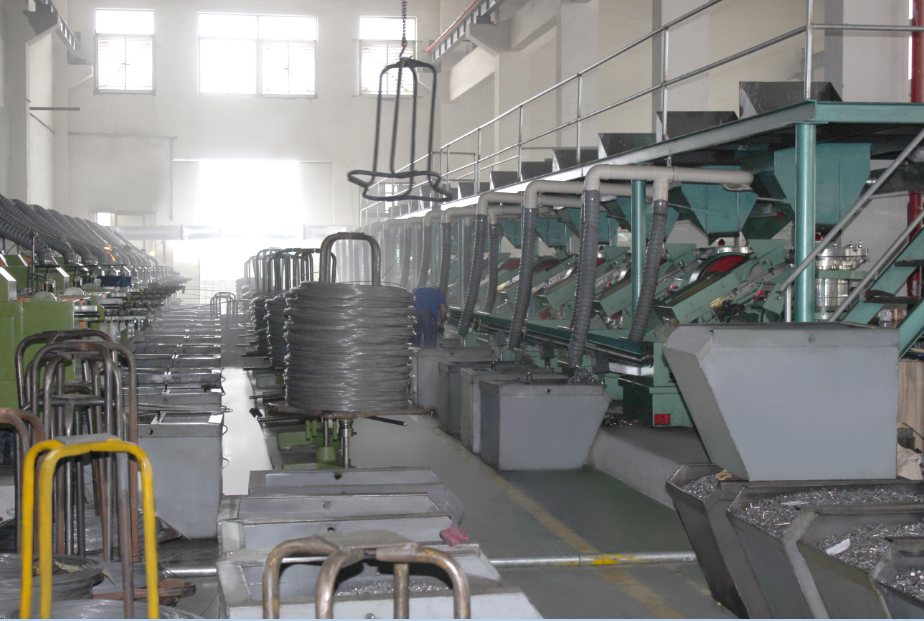
Gypsum board partitions — also called drywall partitions or stud walls — are the most widely deployed interior wall system in modern construction. They are fast to assemble, light in weight, and straightforward to service. Their in-service behaviour, however, is governed by a component that buyers frequently treat as a low-value consumable: the drywall screw. The screw determines whether the board stays flat, whether joints crack under seasonal movement, and whether the partition remains serviceable over time. For a buyer specifying gypsum board partition drywall screws, the real task is not choosing the cheapest box, but matching thread form, hardness, coating, and dimensional tolerance to the substrate and the installation environment.
This guide sets out the constraint variables that govern drywall screw selection for gypsum board partitions, the standards and certification signals that support a compliant purchase, and the boundaries within which a drywall screw should — and should not — be used.
What a gypsum board partition actually demands from a fastener
A gypsum board partition is a layered assembly: a frame of light gauge steel studs or timber studs, one or more layers of gypsum board on each face, joint compound at the seams, and fasteners at a defined spacing that clamp the board to the frame. Each screw performs three jobs simultaneously: it holds the board tight against the stud, it transfers load from board to frame, and it must do both without tearing the paper facing that supplies much of the board's tensile strength.
That combination is what distinguishes drywall screws from general-purpose wood or metal screws. The head must countersink cleanly without cutting through the paper. The thread must grip the stud without stripping. The body must be hard enough to drive without deforming, yet tough enough not to snap when the driver hits an embedded stud edge. And the coating must survive the moisture exposure that partitions experience during construction and throughout their service life.
For procurement and engineering teams, these functional requirements translate into a specification checklist rather than a single part number. The relevant inputs are stud material, stud thickness, board thickness and number of layers, screw spacing, installation tooling, and the environmental class of the finished space.
The constraint variables in drywall screw selection
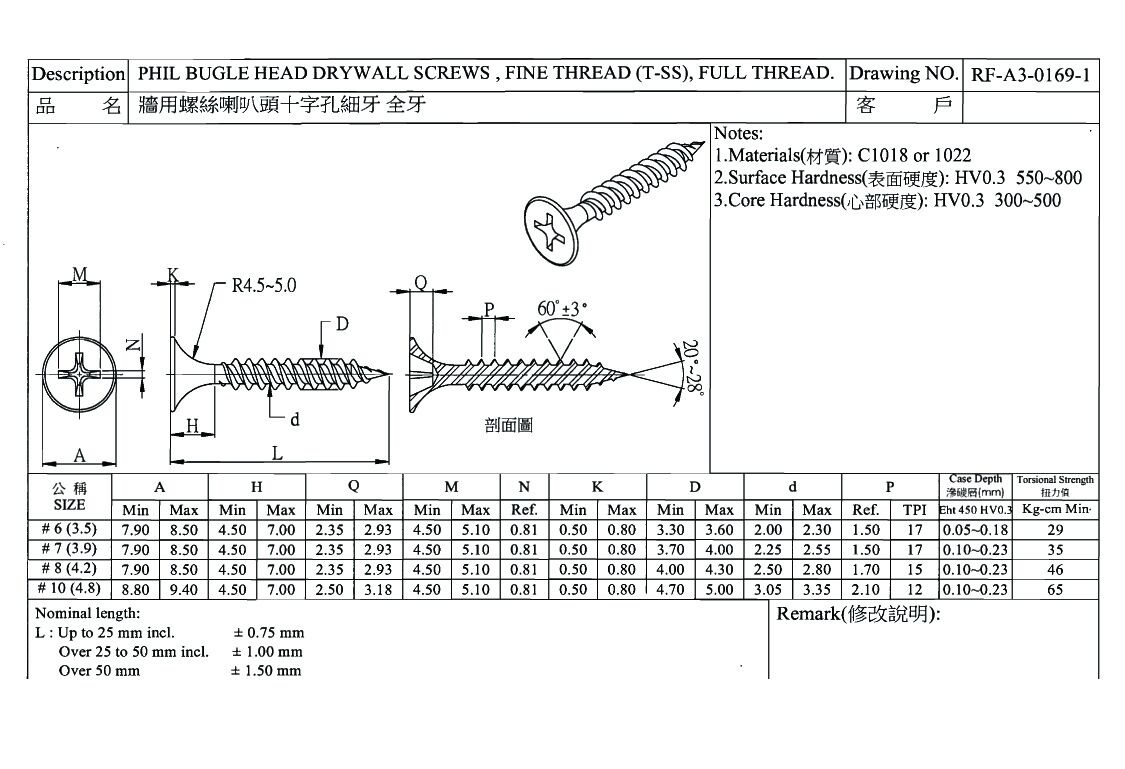
Six specifications decide whether a drywall screw is correct for a given partition. Each one is verifiable against a supplier datasheet, and each carries a distinct failure mode if mismatched.
Shank diameter and length
Diameter controls the amount of material engaging the stud and the size of the hole created in the board. Length determines penetration into the substrate. Too short a screw and the board will not be held securely; too long a screw and the point risks piercing the far side of a thin stud or emerging through the board. On gypsum board partitions, the specification must also account for board thickness and the number of board layers on the face being fixed.
Thread type
Drywall screws are typically categorised as coarse thread or fine thread, with double thread and self-drilling variants also available. Thread type is the fastest single indicator of intended substrate, and is discussed in detail below.
Head and drive geometry
The bugle head is the standard head form for drywall screw applications because its tapered underside spreads compression across the board surface and seats the head flush. The Phillips #2 drive is the common cross-recess profile for the class, matching widely available driver bits.
Core and surface hardness
Case hardening is what allows the screw to resist driving torque at the surface while remaining ductile at the core. Buyers should treat hardness values as a specification, not a marketing claim, and should be able to find them on the datasheet.
Surface finish and corrosion performance
Black phosphate and zinc plating are the dominant finishes for drywall screws, with grey phosphate also used. The finish determines corrosion resistance and the appearance at non-filled fixings. It is the parameter most often misread when a screw specified for interior partitions is repurposed for damp or exterior conditions.
Loose versus collated format
Collated drywall screws are supplied in strips that feed automatic screw guns. They change not only the packaging but also the productivity, consistency of seating depth, and labour profile of installation.
Coarse thread versus fine thread: the substrate decides
The most common specification error in gypsum board partition fastening is using the wrong thread for the stud material. In practical terms, coarse threads are typically specified for wood studs, while fine threads are intended for light gauge metal studs. Selection depends on stud thickness, point type, and the specific product rating. If a product manual permits multiple substrates, the manual governs. Thread appearance alone is not a reliable basis for interchangeability.
| Partition frame | Typical thread recommendation | Why it matters |
|---|---|---|
| Wood stud | Coarse thread | Wider thread pitch matches the softer, fibrous substrate and improves pull-out resistance in timber. |
| Light gauge steel stud | Fine thread | Closer thread pitch suits thin metal sections where coarse threading is more likely to strip or fail to engage fully. |
| Mixed or unspecified substrate | Specify per project | Thread type should be confirmed against the stud schedule and the screw datasheet before ordering. |
A double thread configuration is used where faster drive-in and reduced stripping risk are required on the same substrate, and self-drilling configurations incorporate a drill point so that the screw penetrates the stud without a separate drilling step. Both belong to the same engineering family as the standard drywall screw, and both change the procurement checklist because point type, drive, and material all enter the specification.
Hardness: the least-discussed, most decisive parameter
Hardness governs two failure modes that are difficult to detect after installation. Low surface hardness causes drive-bit cam-out, damaged heads, and poor seating; low core hardness causes shank deformation or snapping under load. High hardness without adequate toughness produces brittle screws that fracture at the point where the board meets the stud.
Case hardening addresses both risks by creating a hard outer layer over a softer, more ductile core. A representative industrial specification for a case-hardened drywall screw is a surface hardness of minimum 550 HV and a core hardness in the range 300 to 450 HV. Buyers should expect the supplier to state these values and to be able to relate them to material grade and heat treatment.
Standards and certification: what a buyer can verify
Standards matter in drywall screw procurement because they convert a set of dimensional and performance expectations into a testable specification. Three reference points are useful to buyers.
- DIN 18182-1 specifies Type TN (trumpet head, double continuous thread) for 3.5 mm diameter drywall screws with lengths ranging from 25 mm to 55 mm. This is a primary technical benchmark for DIN-compliant drywall screws.
- DIN 18182-2 is presented as specifying requirements for technical fasteners used with gypsum plasterboard according to DIN EN 14566. Buyers should confirm the current edition against the official standard text before including it as a contractual reference.
- ISO 9001 is a quality management system certification rather than a product standard. It evidences that the supplier operates a controlled production and inspection system, but it does not by itself certify a specific screw's dimensional or performance conformity.
That distinction matters in procurement documentation. A product page that reads "not certified" describes the conformity status of that specific product, not of the category. Conversely, a quality management certificate that covers a scope such as screws, bolts, nuts, and anchors describes the supplier's system, not an individual SKU. Buyers who separate system certification, standard reference, and product conformity avoid mixing the three in an RFQ.
How Weifeng Fastener configures a gypsum board partition drywall screw
Ningbo Weifeng Fastener Co., Ltd. is a fastener manufacturer based in Yuyao, Zhejiang, China, supplying screws, bolts, nuts, washers, anchors, and wood screws. The company operates a 7,000 m² facility with approximately 50 employees and an annual output of around 6,000 tons, with exports accounting for about 90% of sales across South America, Africa, and Russia.
Its drywall screw is supplied under the model designation C1022A-PH-BUGLE, a name that encodes the three defining attributes of the part: C1022A case-hardened carbon steel as the base material, a Phillips drive, and a bugle head. The specification set is summarised below.
| Parameter | Specification |
|---|---|
| Material | C1022A case hardened carbon steel |
| Shank diameter | 3.5 mm to 4.8 mm (#6 to #10 gauge) |
| Length | 13 mm to 150 mm (1/2 inch to 6 inch) |
| Head type | Bugle head |
| Drive type | Phillips #2 |
| Point type | Sharp piercing point, penetrates without pre-drilling |
| Surface hardness | Minimum 550 HV |
| Core hardness | 300 to 450 HV |
| Finish | Black phosphated, grey phosphated, zinc plated |
| Thread and format options | Fine thread, coarse thread, collated configurations |
The bugle head geometry is designed for countersinking without tearing the surface paper of the gypsum board — the failure mode that most often forces rework on a finished partition. The phosphate coating is applied for corrosion resistance, and the case-hardened structure provides the surface and core hardness values noted above.
From a procurement perspective, Weifeng Fastener holds ISO 9001 certification, certificate number BZ2411Q4893R0S, issued by HANGHOU BANGZHENG CERTIFICATION CO.,LTD under the GB/T 19001-2016 standard. The certificate covers the scope of screws, bolts, nuts, and anchors and remains valid until 2027-11-19. Customisation is available through OEM/ODM arrangements covering customised logo, packaging, graphic customisation, and material selection. Stated commercial parameters include a monthly capacity of 1,000 tons, an MOQ of 300 kg, and a lead time of 35 to 60 days. The company also operates multi-port shipping from Ningbo, Shanghai, and Tianjin to consolidate shipments.
Application scenarios for partition-focused drywall screws
The drywall screw is not limited to a single wall type. Within interior fit-out and construction engineering, the same bugle head, case-hardened configuration is used across gypsum board installation, partition wall construction, ceiling fixing, and furniture manufacturing. In building and construction contexts, fasteners of this class support permanent interior assembly under static and dynamic load, in spaces that may experience large temperature fluctuations.
Ceiling installation is a distinct application because gravity loading and overhead tooling change both the seating requirement and the accessibility of the fastener after installation. Where a partition is built on a light gauge steel frame, fine thread configurations match the substrate; where the same partition is built on timber, coarse thread configurations are the appropriate match. Collated formats suit projects that install large continuous areas of board and where consistent seating depth contributes to a uniform finish.
A hardware wholesaler distributing to local industrial and furniture markets is one example of the supply-chain profile typical for this product. In that case, consistent quality and delivery over a two-year relationship supported the distributor's local market position and was associated with zero return rate. A separate construction contractor relationship, spanning five years and more than one hundred containers per year, highlights the role of corrosion resistance and tensile behaviour in partition and structural applications.
Market trend: rising demand and the collated screw shift
The global drywall screws market was valued at USD 2.18 billion in 2025 and is projected to reach USD 3.04 billion by 2033. Residential construction housing starts account for 58% of global drywall screw demand, which means the category's growth rhythm broadly tracks residential building cycles rather than infrastructure spending alone.
Within that demand, format is shifting. Collated drywall screws account for approximately 36% of product demand in the collated screw market, driven by modular and prefabricated construction. That shift matters to buyers because collated systems change the packaging, tooling, and installation workflow, not just the fastener supply. Suppliers who can offer both loose and collated configurations in fine and coarse thread — as the current product range does — are better positioned to serve projects that mix on-site and prefabricated assembly.
Limitations and boundaries: where a standard drywall screw is not enough
A specification guide is incomplete without stating where a product should not be used. Standard black phosphate drywall screws provide an industry baseline of approximately 48 hours of salt spray resistance under ASTM B117, which suits indoor climate-controlled environments. That corrosion performance is a design baseline, not a guarantee for damp, coastal, or exterior conditions. Once sustained moisture is expected, the finish and material must be re-specified against a defined corrosion test, and the buyer should expect a supplier to supply a salt spray report for the specific finish offered.
Two further boundaries should be stated plainly. First, drywall screws are not structural fasteners. They are used to attach gypsum board to a frame, and the structural capacity of a partition depends on the frame and the board assembly, not on the screws alone. Second, a supplier's product range may include drywall screws certified to a quality management system without every SKU being individually certified to a product standard. Buyers should confirm which conformity applies to the specific model number they intend to order.
Future outlook
Three directions are likely to shape drywall screw specification in the coming years. The first is the continuing shift toward collated systems and automated installation, driven by labour constraints in residential and prefabricated construction. The second is growing buyer demand for documented corrosion data — salt spray hours per finish — rather than descriptive labels such as "corrosion resistant". The third is a tightening of documentation expectations: buyers increasingly separate quality management certification, standard reference, and product conformity, and expect suppliers to present all three clearly.
For gypsum board partitions, that combination points to a steady specification discipline rather than a fundamental change in the fastener. The screw will remain a small part of the assembly. The difference will be in the quality of the evidence that accompanies it.
Frequently asked questions
Q1. What is the difference between coarse thread and fine thread drywall screws?
Coarse threads are typically intended for wood studs, while fine threads are intended for light gauge metal studs. Selection depends on stud thickness, point type, and the specific product rating. If a product manual allows multiple substrates, the manual governs. Interchangeability should not be assumed from thread appearance alone; the stud material and the product datasheet should be checked before ordering, and a trial installation carried out on site.
Q2. What sizes are available for gypsum board partition drywall screws?
Weifeng Fastener's drywall screw, model C1022A-PH-BUGLE, is supplied in shank diameters from 3.5 mm to 4.8 mm, corresponding to #6 to #10 gauge, with lengths from 13 mm to 150 mm (1/2 inch to 6 inch). The correct size for a project depends on board thickness, the number of board layers, and the dimensions of the stud being fixed to.
Q3. What hardness should a drywall screw have?
The Weifeng drywall screw is case hardened, with a core hardness of 300 to 450 HV and a surface hardness of minimum 550 HV. The hard surface resists drive-bit cam-out and supports clean countersinking, while the softer core gives the shank enough ductility to avoid brittleness under driving and in-service load.
Q4. Do drywall screws need DIN or ISO certification?
The requirement depends on the target market. DIN 18182-1 specifies Type TN geometry for 3.5 mm diameter drywall screws with lengths between 25 mm and 55 mm. DIN 18182-2 is presented as specifying requirements for technical fasteners used with gypsum plasterboard according to DIN EN 14566, although buyers should verify the current edition against the official standard. ISO 9001 is a quality management system certification rather than a product standard; Weifeng Fastener holds ISO 9001 certificate number BZ2411Q4893R0S, issued by HANGHOU BANGZHENG CERTIFICATION CO.,LTD and valid until 2027-11-19 under GB/T 19001-2016, covering screws, bolts, nuts, and anchors.
Q5. How should a buyer verify a drywall screw supplier before ordering?
Practical verification normally covers three items: the quality management certificate and its scope, the product specification sheet (material grade, diameter, length, thread, head, drive, hardness, and finish), and batch-level inspection practice. Suppliers that offer OEM/ODM, state a minimum order quantity, and publish a defined lead time provide a more auditable basis for comparison. Weifeng Fastener offers OEM/ODM customisation, an MOQ of 300 kg, and a stated lead time of 35 to 60 days.
Q6. Are standard drywall screws suitable for exterior or high-moisture applications?
Standard black phosphate drywall screws provide an industry baseline of approximately 48 hours of salt spray resistance under ASTM B117, which is appropriate for indoor climate-controlled environments. Where sustained moisture or exterior exposure is expected, finish and material must be re-specified against a defined corrosion test, and a salt spray report for the specific finish should be required from the supplier rather than assumed from an interior specification.
Tem questões ou precisa de mais detalhes?
Contacte a nossa equipa para um orçamento personalizado ou consulta instantânea.
Solicitar orçamento
Preencha o formulário abaixo e a nossa equipa entrará em contacto com uma proposta personalizada.
Chat direto do WhatsApp
Prefere conversar em tempo real? Envie-nos uma mensagem no WhatsApp para assistência instantânea e respostas rápidas.
- Obter orçamento personalizado
- Partilhar fotos ou documentos
- Discuta as suas necessidades diretamente
Geralmente responde em 5–30 minutos durante o horário de expediente.