
HALAL Registration No. 3306966AA5 Explained for Omega-3 Buyers
HALAL Registration No. 3306966AA5 Explained for Omega-3 Buyers
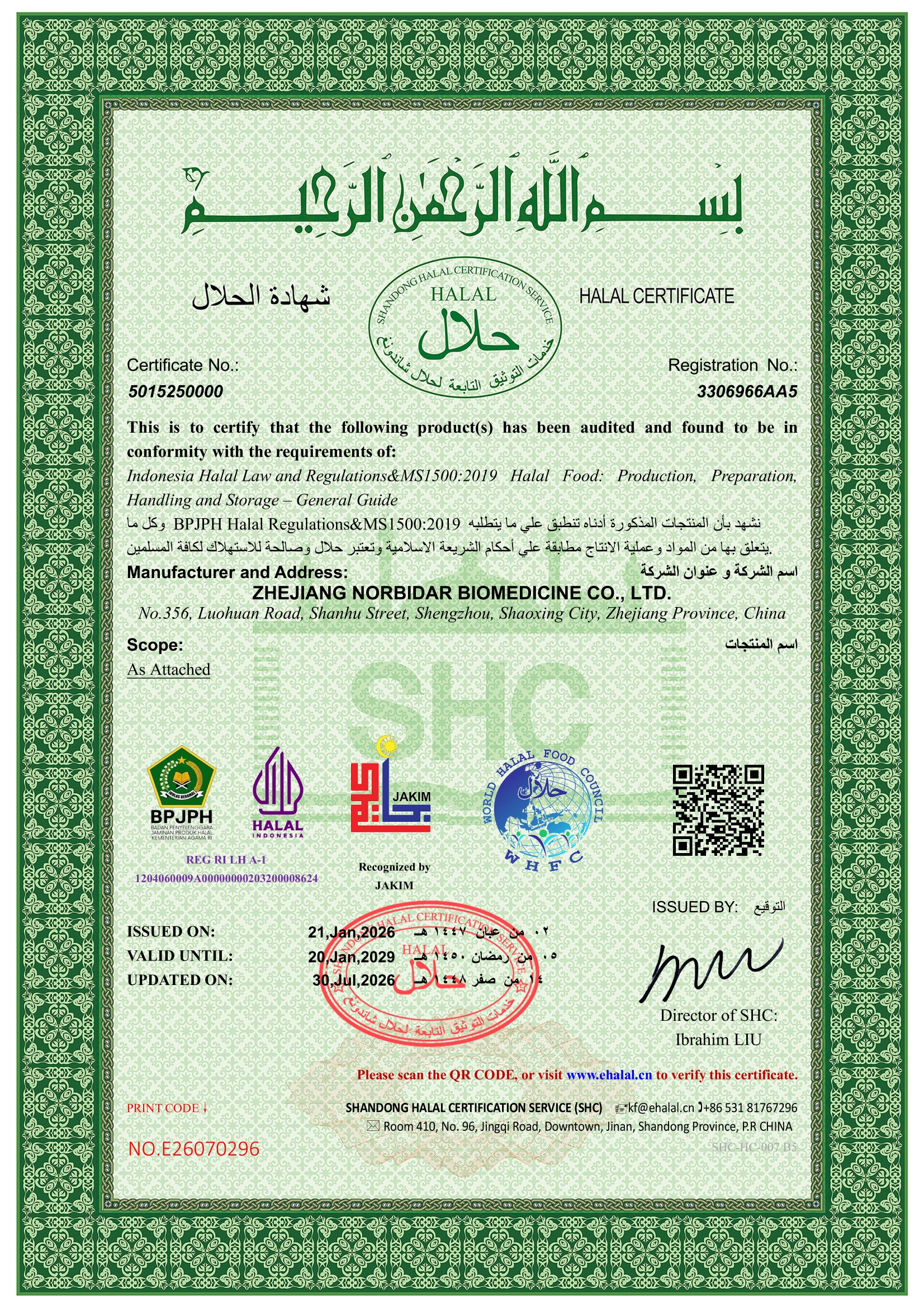
The Halal Product Certification covering Norbidar Omega-3 Fish Oil Concentrates carries two identifiers on one document: certification number 501525000 and Registration No. 3306966AA5. Shandong Halal Certification Service (SHC) is the issuing authority, MS 1500:2019 is the standard cited, and the validity period runs from 2026-01-21 to 2029-01-20. The listed product scope includes Refined Fish Oil, and the certificate's market statement limits its application to Halal ingredient markets subject to destination-country recognition and customer requirements.
That is the formal answer, and on its own it is not enough for a procurement file. Buyers in the research and evaluation stage usually need to know which field answers which question, how the scope line maps to a specific ethyl ester grade, and where the certificate stops being evidence. Zhejiang Norbidar Biomedicine Co., Ltd. is a manufacturer of food-grade omega-3 fish oil concentrates established in 2018 and based in Zhejiang, China; its halal documentation sits inside a wider certificate set. The sections below decode the halal certificate field by field, then set out the checks that keep it usable across its three-year window.
A field-by-field reading of the halal certificate
Each field on the certificate answers a different due-diligence question, and conflating them is the most common source of error in supplier documentation review. The table below keeps the fields separate.
| Field | As shown on the certificate |
|---|---|
| Certification type | Halal Product Certification |
| Certification number | 501525000 |
| Registration number | 3306966AA5 |
| Issuing authority | Shandong Halal Certification Service (SHC) |
| General standard | MS 1500:2019 – Halal Food: Production, Preparation, Handling and Storage – General Guide |
| Indonesia reference | Indonesia Halal Law and Regulations |
| Issue date | 2026-01-21 |
| Expiry date | 2029-01-20 |
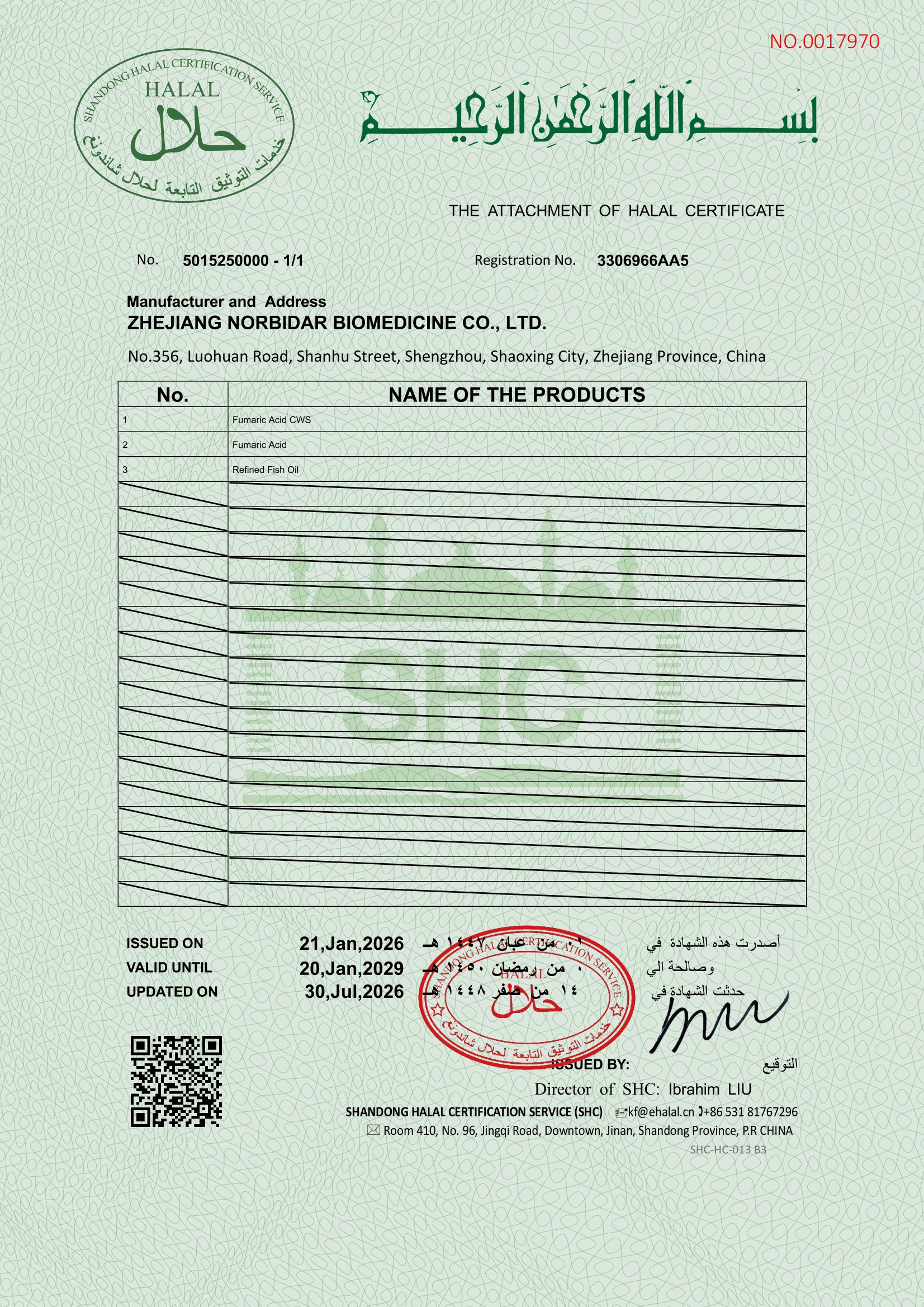
| Product scope listed | Refined Fish Oil; Fumaric Acid CWS; Fumaric Acid |
| Scope attachment updated | 2026-07-30 |
| Market statement | Halal ingredient markets, subject to destination-country recognition and customer requirements |
Three groups emerge from that list. Identity fields — certification number, registration number and issuing authority — establish which document is being cited and who stands behind it. Basis fields — the MS 1500:2019 reference, the Indonesia reference and the market statement — describe the framework under which certification was granted and the conditions attached to its use. Coverage fields — product scope, validity period and scope attachment date — define what the certificate reaches and for how long. A buyer who records only the identity fields holds a document reference; a buyer who records all three groups holds something that survives a customer audit.
Certification number 501525000 and Registration No. 3306966AA5
The certificate assigns both numbers to the same halal certification of the omega-3 fish oil concentrate range, and they are not interchangeable strings. Procurement templates frequently ask for one or the other — a customer vendor form may request a "certificate number", while a tender annex may ask for a "registration number" — and a file that supplies the wrong one can be returned as incomplete even when the underlying document is correct.
The handling is straightforward. Record both against the supplier record, label each with the field name printed on the certificate rather than an internal shorthand, and attach the certificate page itself so a reviewer can match the string without relying on transcription. The certificate does not set out separate scopes for the two numbers; both refer to the same certification record. That is precisely why 3306966AA5 should not be treated as a substitute certificate reference, and 501525000 should not be read as a separate approval.
Issuing authority is the third identity field. The certificate names Shandong Halal Certification Service in full, with the abbreviation SHC. Because abbreviations across halal documentation are not unique, a supplier file that stores only "SHC" is harder to audit than one that stores the full name beside the certificate reference. Where a destination market requires confirmation of the certifier, the full name is the string an importer or regulator will search.
What the Refined Fish Oil scope line covers, and what it leaves to the specification
The certificate scope lists three products: Refined Fish Oil, Fumaric Acid CWS and Fumaric Acid. The scope attachment was updated on 2026-07-30. Two consequences follow for omega-3 buyers, and both are easy to miss.
The scope is written at product-family level
Individual grade codes — 3624 EE, 4030 EE, 5020 EE, 5025 EE, 5030 EE and 8000 EE — are not itemized on the certificate. The halal scope answers a permissibility question about refined fish oil as supplied by the certified operation; it does not, by itself, confirm the EPA and DHA content of a particular grade. Composition is governed elsewhere: nominal EPA and DHA values are grade-specific, and contractual limits and the analytical basis follow the current specification and batch certificate of analysis.
The scope also covers non-omega-3 products
Two fumaric acid entries appear in the same scope and have nothing to do with omega-3. Citing "the halal certificate" as though it were an omega-3-specific document overstates the mapping. In a supplier file or a customer response, cite the Refined Fish Oil line specifically, together with the certificate and registration numbers, so that the scope reference and the product reference match.
The attachment date deserves its own check. The certificate was issued on 2026-01-21, while the product scope attachment was updated on 2026-07-30 — a revision inside the validity period. A buyer holding a copy obtained before that date may be holding an earlier scope. Comparing the attachment date on the copy in hand against the current issue is a short check that prevents a stale scope from entering a qualification file.
The validity period from 2026-01-21 to 2029-01-20
The certificate was issued on 2026-01-21 and expires on 2029-01-20; the validity period stated on the document matches those two dates. Three dates in that window matter operationally: the issue date, the expiry date, and the scope attachment date discussed above.
The issue date establishes that the certificate post-dates the underlying certification decision, and lets a buyer comparing documents across suppliers confirm which belong to the current cycle. The expiry date establishes the outer limit. Any purchase order, tender submission or customer audit requiring halal coverage beyond 2029-01-20 depends on renewal evidence that the current certificate does not contain, and should be tracked as an open condition rather than assumed.
The practical routine is to file the certificate with all three dates recorded, note the attachment revision, and diarise a re-check ahead of the annual supplier review rather than at expiry. Three-year certificates are usually re-verified on the buyer's cycle, not the certificate's. The recurring risk is not a missed expiry date but a stale copy used for two years without anyone reopening the file.
MS 1500:2019 and the Indonesia reference do different jobs
Two standards appear in the certificate's basis fields. The general reference is MS 1500:2019, titled Halal Food: Production, Preparation, Handling and Storage – General Guide. The market-specific reference is Indonesia Halal Law and Regulations, stated as the applicable standard for Indonesia.
The division matters. MS 1500:2019, as its title indicates, is a general guide addressing the production, preparation, handling and storage of halal food, and on this certificate it functions as the general certification framework. The Indonesia reference is narrower and destination-specific, which signals that entry to that market is assessed against a national halal framework rather than the general guide alone. A buyer whose product is destined for Indonesia therefore carries two questions instead of one: whether the ingredient is halal-certified, and whether the certification route is recognised under the applicable Indonesian framework.
The certificate is explicit that its application is conditional. Its market statement limits use to Halal ingredient markets, subject to destination-country recognition and customer requirements. Recognition is a destination-side determination: it belongs to the importer, the buyer's regulatory adviser or the market authority, not to the certificate. Treating an SHC-issued certificate as automatically accepted in every halal market inverts the qualifier printed on the document. The workable sequence is to confirm the destination's acceptance criteria first, then check the certificate against them, then record the outcome in the file.
How the halal certificate sits beside the food-safety certificates
The documentation set carries three further third-party certificates relating to the same site and product range: ISO 22000:2018 certificate CN26/00004668, valid from 2026-10-11 to 2029-06-27; FSSC 22000 certificate CN26/00004667, valid from 2026-10-16 to 2029-06-27; and FAMI-QS certificate CN26/00005166, valid from 2026-07-11 to 2029-07-10. All are issued by SGS or SGS United Kingdom Ltd.
They answer different questions from the halal certificate. The food-safety and feed-safety schemes are management-system certifications, and their documentation states that they are not product registration, not import authorization, and not a batch certificate of analysis for EPA and DHA content, oxidation or contaminants. The halal certificate addresses permissibility under a halal framework and carries its own destination-recognition condition. None of the four substitutes for batch specifications and analytical documentation, which remain the record of what a specific lot contains.
For a supplier file, the consequence is that certificates should be indexed by the question they answer rather than accumulated as a pile. A customer asking about halal status needs two numbers and a scope line; a customer asking about heavy metals or oxidation needs a batch certificate of analysis; a customer asking about food-safety management needs a scheme certificate number and its scope. Mixing the three produces answers that look complete and fail review.
Where a halal-scoped omega-3 concentrate enters a formulation
Product form shapes the documentation requirement. Norbidar's concentrate range is supplied as food-grade ethyl ester (EE) blends with defined nominal EPA and DHA content by grade, as a bulk ingredient for dietary supplement and functional food formulation. Downstream processing follows the buyer's validated process, and the ingredient is stored and handled under cool, dry, light-protected, oxygen-limited conditions according to the product specification and safety data sheet.
Before commercial use, buyers normally confirm EE-form suitability for the intended dose and delivery format, oxidation and contaminant specifications, packaging compatibility and destination-market requirements. The halal certificate adds one item to that list rather than replacing any of it: whether the certified scope covers the grade being purchased, and whether the destination recognises the certification route.
The boundary is worth stating plainly. Ingredient-level halal certification supports the halal status of an input; it does not certify the finished supplement, because the finished product also contains excipients, capsule shells, carriers and flavourings, and because the finished-product claim belongs to the brand's own certification route. Application relevance is also not market approval: the concentrate is described for supplement and functional food formulation generally, which indicates where it can be evaluated, not where it is cleared for sale.
A verification sequence for the buyer's file
- Obtain the certificate page and the scope attachment together, and check the attachment date, which stands at 2026-07-30 on the current issue.
- Record both identifiers using the certificate's own field labels: certification number 501525000 and Registration No. 3306966AA5.
- Record the issuing authority in full — Shandong Halal Certification Service (SHC) — rather than the abbreviation alone.
- Record both standard references: MS 1500:2019 as the general framework and Indonesia Halal Law and Regulations as the market-specific reference.
- Note the validity period, 2026-01-21 to 2029-01-20, and flag any contract, tender or audit that extends past the expiry.
- Map the scope line to the purchase: cite Refined Fish Oil, and pair it with the grade code and current specification.
- Pair the halal scope with the batch certificate of analysis for the actual lot, since content and contaminant data come from that document, not from the certificate.
- Confirm destination recognition before quoting halal status in a customer-facing document or label submission.
What to re-check across the three-year window
The certificate's remaining validity runs to 2029-01-20, and the scope revision of 2026-07-30 shows the document can change inside that window. A single calendar entry at expiry will not catch a mid-cycle scope change; an annual review that reopens the certificate and compares both the attachment date and the scope lines will.
Market context supports keeping that check routine rather than ad hoc. Grand View Research valued the global omega-3 supplements market at USD 8.3 billion in 2025 and projected USD 9.1 billion for 2026. That figure sizes supplements, not halal-certified concentrate, and should not be read as a halal segment estimate. Its relevance here is narrower: as supplement volumes and supplier counts grow, documentation re-verified on a schedule is easier to defend in a customer audit than documentation assembled at short notice.
A second pattern is worth planning for. The certificates in this documentation set expire on different dates — 2029-01-20 for halal, 2029-06-27 for ISO 22000:2018 and FSSC 22000, 2029-07-10 for FAMI-QS — so one reminder will miss most of them. A single document register with a date column per certificate costs little and removes the recurring scramble. The halal entry should carry four fields: both identifiers, the scope attachment date, and the destination-recognition note.
Frequently asked questions
What does HALAL Registration No. 3306966AA5 identify?
It is the registration number printed on Norbidar's Halal Product Certification for Omega-3 Fish Oil Concentrates, alongside certification number 501525000. Both numbers refer to the same certification record issued by Shandong Halal Certification Service; the certificate does not assign a separate scope to each number.
Does the certificate cover specific grades such as 5025 EE?
The listed product scope is written at family level: Refined Fish Oil, Fumaric Acid CWS and Fumaric Acid. Individual grade codes are not itemized. Grade-level composition is established by the product specification and batch certificate of analysis, where nominal EPA and DHA values are grade-specific and contractual limits follow the current analytical basis.
Is the certificate accepted in every halal market?
No. The certificate states that it applies to Halal ingredient markets subject to destination-country recognition and customer requirements, and it cites Indonesia Halal Law and Regulations as the applicable standard for Indonesia. Acceptance is determined by the destination market, typically through the importer or a regulatory adviser, not by the certificate alone.
What happens when the certificate expires on 2029-01-20?
The stated validity ends on that date. Contracts, tenders or audits requiring halal coverage beyond it depend on renewal evidence that the current certificate does not contain. Recording the expiry beside both identifiers lets a buyer raise the renewal question early rather than at the point of shipment.
Where to obtain the documents discussed
Zhejiang Norbidar Biomedicine Co., Ltd. is the manufacturer named on the product documentation; company information is available at Zhejiang Norbidar Biomedicine Co., Ltd.. Buyers evaluating the halal scope should request the certificate page and the current scope attachment together with the grade specification and batch certificate of analysis, so the permissibility question and the composition question are answered by the right documents. The Norbidar Omega-3 product brochure is available for download: Norbidar Omega-3 brochure (PDF).
Tem questões ou precisa de mais detalhes?
Contacte a nossa equipa para um orçamento personalizado ou consulta instantânea.
Solicitar orçamento
Preencha o formulário abaixo e a nossa equipa entrará em contacto com uma proposta personalizada.
Chat direto do WhatsApp
Prefere conversar em tempo real? Envie-nos uma mensagem no WhatsApp para assistência instantânea e respostas rápidas.
- Obter orçamento personalizado
- Partilhar fotos ou documentos
- Discuta as suas necessidades diretamente
Geralmente responde em 5–30 minutos durante o horário de expediente.